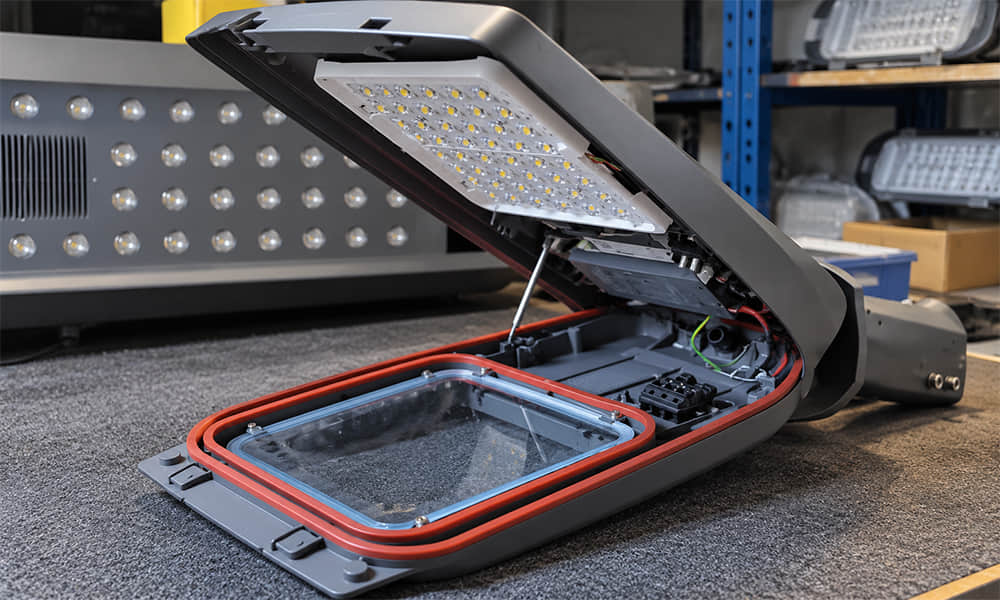
Outdoor recessed downlights are often specified for entrances, canopies, covered walkways, hotel facades, terraces, and landscape-adjacent architectural areas. They appear simple because the fixture is largely hidden in a ceiling, soffit, or structural recess. In practice, achieving a comfortable and useful result requires careful control of the complete optical system.
For luminaire manufacturers, the challenge is not only to make an outdoor recessed downlight withstand its environment. The fixture must also create the intended beam pattern, avoid uncomfortable glare, provide sufficient light on the target area, and maintain a consistent visual effect from one fixture to the next. This is where the COB LED, secondary optic, reflector structure, recessed depth, cover glass, and housing design must work together.
This guide focuses on selecting a COB lens for exterior recessed luminaires. The same principles apply to outdoor LED downlights, exterior LED downlights, and projects sometimes described as external recessed downlights.
What Are Outdoor Recessed Downlights?
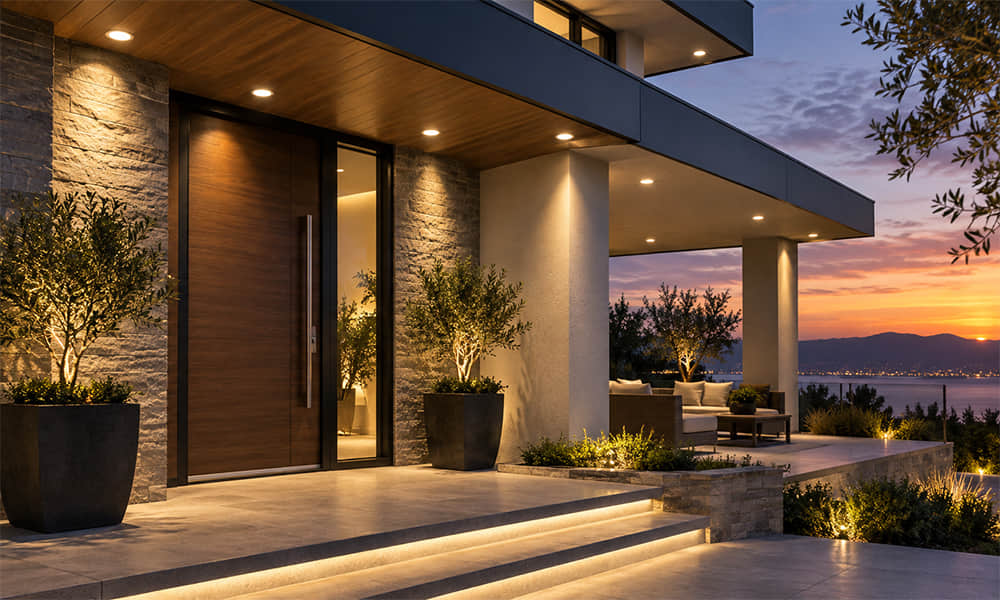
Outdoor recessed downlights are luminaires installed into a soffit, canopy, ceiling, eave, wall, or other architectural recess. Unlike surface-mounted fixtures, they keep much of the housing out of view and can create a clean architectural appearance around building entrances, circulation areas, covered terraces, and exterior public spaces.
Although a recessed downlight is commonly aimed downward, its actual target can vary. It may illuminate a doorway threshold, a pedestrian path, a reception canopy, a column, signage, or the area immediately outside an entrance. Each target requires a different relationship between mounting height, fixture spacing, light distribution, and glare control.
A high-quality luminaire therefore needs more than a powerful LED. It needs a controlled optical component that directs the available light into the useful area. Asahi develops LED lenses for lighting manufacturers that need to manage this distribution at fixture level.
Why COB Optics Matter in Outdoor Recessed Downlights
A COB LED can provide a compact, concentrated light-emitting surface for a downlight. However, a bare COB source does not automatically produce the beam width, center intensity, visual comfort, or edge transition required by the project.
The COB LED downlight lens controls how the source light leaves the fixture. Depending on its optical geometry, it can create a narrow beam for a high canopy, a medium beam for an entrance zone, or a wider distribution for lower mounting positions and closer fixture spacing. It also affects how much light reaches the intended plane instead of becoming spill light outside the target area.
The final result does not come from the lens alone. A recessed luminaire may include a holder, reflector cup, trim ring, anti-glare baffle, protective glass, gasket, and bezel. These parts can block, reflect, or redirect part of the beam. For this reason, a lens should be evaluated in the intended fixture assembly rather than only as an isolated sample.
Common Problems with Exterior LED Downlights
Harsh Hotspots Directly Below the Fixture
One common issue is a bright, concentrated circle directly below every fixture, with noticeably darker zones between fixtures. This may happen when the beam is too narrow for the mounting height and spacing, or when a high-output COB is paired with an optic designed for a more distant target.
Increasing wattage is rarely the correct first response. More power can make the center hotspot brighter while leaving the distribution pattern unchanged. A more suitable beam angle, different spacing, or revised mounting height may improve useful coverage more effectively.
Glare at Entrances, Canopies, and Pedestrian Areas
A downlight may reach the required illuminance while still being uncomfortable to look at. This is especially common where pedestrians approach the fixture from below or at a shallow viewing angle, such as under hotel canopies, covered walkways, and low exterior ceilings.
Glare is influenced by the apparent brightness of the emitting area, the depth of the LED and lens inside the fixture, the trim geometry, the viewing direction, and the amount of uncontrolled light outside the main beam. A COB lens can help direct light toward the task area, but the fixture also needs adequate recess depth and an appropriate anti-glare structure.
It is not accurate to claim that one lens alone guarantees a specific UGR value or “zero glare.” Visual comfort must be checked using the actual optical, mechanical, and installation conditions.
Insufficient Light on Doors, Walls, or Signage
A conventional symmetrical downlight distribution is effective when the target is directly below the fixture. It may be less effective when the design goal is to illuminate a doorway, wall, sign, or vertical architectural feature offset from the mounting position.
Before selecting a standard circular beam, confirm where the useful light is needed. In some cases, adjusting the fixture location or aiming angle is more effective than selecting a higher-power LED. In other cases, an oval, asymmetric, or architectural wall-wash optic may be more suitable than a typical recessed downlight lens.
Uneven Pools of Light Between Fixtures
Even fixtures using the same nominal beam angle can create different overlap patterns. The usable light field depends on the complete luminous-intensity distribution, not only the angle printed on a datasheet. Center beam intensity, field angle, edge transition, and the orientation of the optical system all affect the appearance of the illuminated surface.
For example, two lenses labelled 30° can produce different visible pools of light because their low-intensity perimeter and center-beam candlepower differ. See Beam Angle vs Field Angle: Why 30° Lenses Look Different before approving a lens solely by its nominal beam angle.
Outdoor Exposure and Moisture Concerns
For exterior recessed luminaires, the waterproof design should be reviewed together with the optical assembly. Protective glass, lens clearance, gasket compression, cable entry, drainage, ventilation strategy, and thermal behavior can all affect long-term reliability.
An IP rating is important, but it does not independently prove that a particular fixture will remain free from internal fogging or liquid-water ingress in every installation. Repeated mist, droplets, or water accumulation should be investigated as an assembly and environmental issue. Our guide to LED light condensation and water ingress explains the difference between temporary fogging and a potential sealing or ventilation problem.
How to Select a COB Lens for an Outdoor Recessed Downlight
Start with the Target Area, Not the Beam-Angle Label
Begin with the actual lighting task. Record the mounting height, fixture spacing, target-plane dimensions, required direction of light, and expected pedestrian viewing angles. A lens should be chosen for the target geometry rather than simply because it is described as narrow, medium, or wide.
For a practical initial evaluation, determine:
- The height between the recessed fixture and the target plane
- The area that each fixture must cover
- The spacing between adjacent luminaires
- Whether the target is horizontal, vertical, or both
- Whether people can see directly into the light aperture
- Whether the fixture must limit spill outside a property boundary or circulation area
This information helps identify whether the project needs concentrated center intensity, broader overlap, controlled beam edges, or a different luminaire position.
Match the Lens to the COB Light-Emitting Surface
A COB lens for downlight must be compatible with the actual COB model rather than only its nominal wattage. COB sources can differ in light-emitting-surface size, dome shape, phosphor appearance, optical center, height, and mechanical dimensions. A lens tested with one source may create a different beam when used with another COB.
When reviewing an existing lens, confirm the exact LED part number and the dimensions of its emitting surface. Also confirm the PCB position, COB-to-lens distance, holder geometry, and whether the lens can be centered repeatedly during assembly. A small positional error may shift the hotspot, alter the beam edge, or create left-to-right asymmetry.
Select Beam Control by Installation Condition
Narrow-beam COB lenses are generally considered when the fixture is mounted high above a defined target, such as an architectural column, entry feature, sign, or distant ground zone. Their concentrated distribution can provide useful intensity at distance, but they require careful glare control and spacing analysis.
Medium-beam COB lenses are often suitable for outdoor entryways, porticos, exterior corridors, and covered pedestrian spaces. They can balance visible coverage with a controlled fixture spacing, provided the light field overlaps appropriately.
Wide-beam COB lenses may be appropriate for lower mounting heights or larger nearby areas. However, a wider distribution should be evaluated for spill light and visual comfort, particularly where the fixture opening is visible from normal walking directions.
For a wall, doorway, or elongated architectural target, do not assume that a symmetrical round beam is the best answer. The target geometry may call for a different optical layout or a revised fixture position.
Allow Space for the Complete Anti-Glare Structure
The usable optical space inside a recessed downlight is often limited. The lens height, LED-to-lens distance, reflector cup, trim depth, retaining ring, protective cover, and gasket all require clearance. A lens with a suitable beam angle may still be unsuitable if it conflicts with the bezel or is too close to the cover glass.
Review the optical and mechanical stack together. The goal is to keep the light source appropriately recessed, avoid unwanted reflections from internal surfaces, maintain alignment during assembly, and preserve the intended beam pattern after the fixture is sealed.
Recommended COB Lens Options for Recessed Downlight Manufacturers
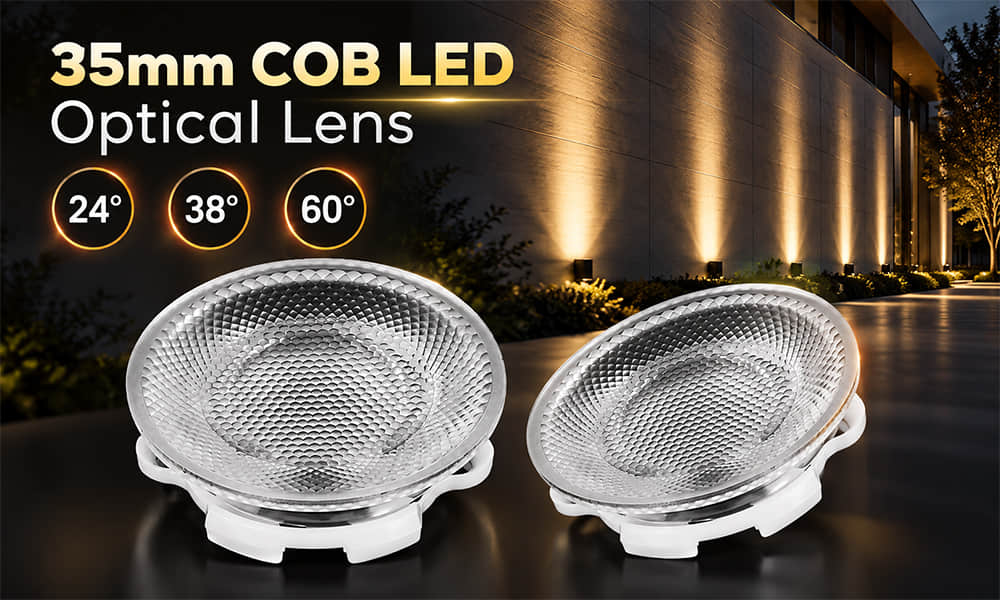
Asahi’s COB Lens collection provides optical options for track lights, downlights, and other COB-based luminaires. These products should be screened according to the COB light-emitting surface, fixture aperture, available height, desired beam distribution, and required holder or reflector arrangement.
COB Lenses for Narrow-Beam Exterior Accent Lighting
For outdoor recessed fixtures used to emphasize a building entrance, column, logo, artwork, or architectural detail, a narrow-beam solution can concentrate light on a defined target. The key checks are not only the nominal angle, but also center beam candlepower, beam smoothness, edge spill, and the degree to which the fixture recess hides the bright optical opening.
A narrow beam can be useful for a long throw, but it should not be used to compensate for poor fixture location. If the fixture is too close to a target or installed at a low height, a narrow optic can create excessive brightness and visually harsh contrast.
COB Lenses for Medium-Beam Outdoor Downlights
Medium-beam options are commonly practical for entry canopies, soffits, exterior corridors, and covered walkways. Their purpose is to create useful illumination over a defined area while supporting reasonable fixture spacing.
For these projects, compare the complete distribution across the target plane. The lens should support smooth overlap between adjacent fixtures without leaving dark gaps or creating bright repetitive pools of light. The right result depends on actual mounting height and spacing, not a universal beam-angle recommendation.
When a Reflector or Lens-Reflector System May Be More Suitable
Some downlight housings are designed around a reflector cup, deep optical chamber, or a lens-reflector combination. In these cases, the existing mechanical structure may influence the final beam shape and cutoff more strongly than a standalone lens. The decision should be based on the required optical performance, available fixture depth, visual appearance, and manufacturing approach.
This article focuses on COB lens selection. If the project is at the concept stage and the appropriate secondary-optic architecture is not yet decided, evaluate the reflector, lens, holder, and housing as one controlled optical system.
Verify the Complete Recessed Downlight Assembly Before Production
Do not approve an outdoor recessed downlight lens based only on appearance or a wall projection photograph. Camera exposure, test distance, wall color, ambient light, and assembly position can make an unsuitable beam look acceptable in an informal comparison.
For a meaningful evaluation, test the intended COB, PCB, lens, holder or reflector, housing, trim, and protective cover under defined electrical and thermal conditions. Review the luminous-intensity distribution, beam and field angles, center intensity, beam smoothness, light outside the target area, and any visible color separation or artifacts.
Asahi’s LED lens optical performance testing guide outlines how to control LED position, current, temperature, assembly fit, and photometric checks before sample approval or mass production.
Request an Existing COB Lens Recommendation
To evaluate an existing COB lens for an outdoor recessed downlight project, provide the complete COB part number, emitting-surface dimensions, PCB or heat-sink drawing, fixture opening, available optical height, mounting height, fixture spacing, target area, and desired light distribution.
With this information, Asahi can first assess whether an available COB lens is mechanically and optically suitable. If an existing option cannot meet the target distribution or fixture constraints, a custom LED lens evaluation can be considered after the project requirements are defined.