Parking lot lighting is used to improve visibility, safety and security in outdoor car parks, commercial parking areas, shopping centers, logistics yards, campuses, parking garages and building entrances. For drivers and pedestrians, good lighting helps identify vehicles, obstacles, signs, curbs, walking paths and possible safety risks.
In the U.S. market, many projects use LED parking lot lights, LED shoebox lights, pole-mounted area lights and parking lot flood lights to replace older HID fixtures. But better parking lot lighting is not only about higher wattage or brighter LEDs. The real performance depends on how the light is distributed across parking spaces, drive lanes, entrances and pedestrian areas.
For lighting manufacturers, the optical lens is one of the key components that determines the final beam pattern. A suitable parking lot lighting lens can help improve uniformity, reduce glare, control spill light and make LED area lights more efficient in real outdoor projects.
What Is Parking Lot Lighting?
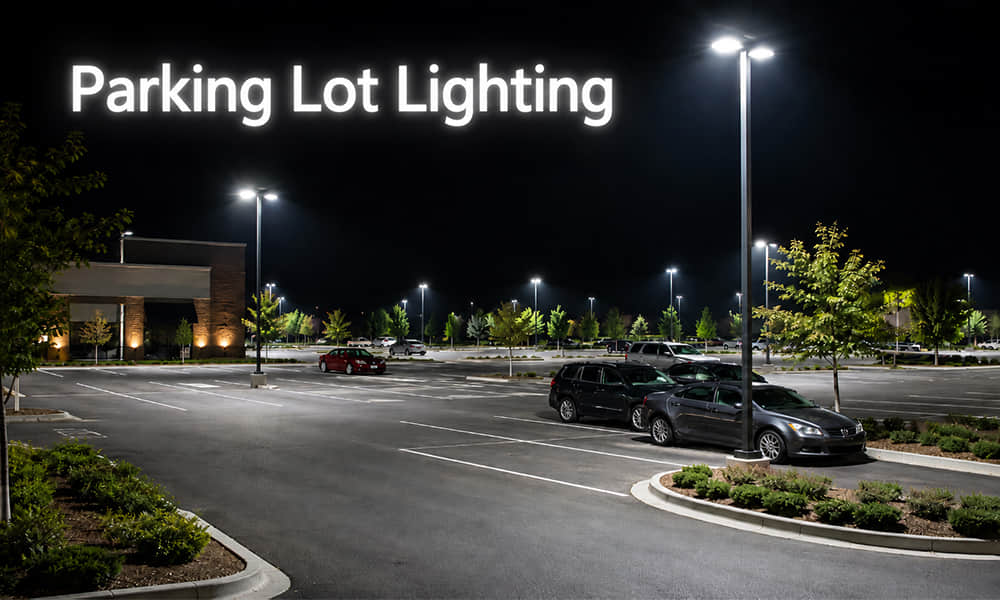
Parking lot lighting refers to outdoor lighting systems designed for vehicle parking areas and related movement zones. These areas may include parking spaces, drive lanes, pedestrian walkways, loading zones, entrances, exits and security camera coverage areas.
Unlike decorative outdoor lighting, parking lot lighting has a strong functional purpose. It needs to help people see clearly at night while keeping the environment comfortable and safe. A commercial parking lot may need wide and uniform coverage, while a narrow drive lane or entrance may need more directional optical control.
This is why LED optics matter. Without suitable beam control, a fixture may create bright hot spots near the pole, dark zones between poles, glare toward drivers or wasted light outside the parking area.
Common Types of Parking Lot Lighting Fixtures
LED Shoebox Lights
LED shoebox light fixtures are one of the most common choices for outdoor parking lots in North America. They are usually mounted on poles and used for commercial parking lots, retail centers, office parks and large outdoor areas.
For this fixture type, lens selection should match the pole height, pole spacing and mounting position. Type III, Type IV and Type V light distributions are commonly considered depending on the parking lot layout.
Parking Lot Flood Lights
Parking lot flood lights may be used for entrances, loading areas, building perimeters, smaller parking spaces or security lighting. Compared with general area lights, flood lights may need a more targeted beam.
If the beam is too wide, light may spill outside the target area. If the beam is too narrow, the parking area may show uneven brightness. The lens should help balance coverage and useful intensity.
Pole-Mounted LED Area Lights
Pole-mounted LED area lights are used in many commercial parking lot lights projects. They can be installed in the center of a parking area, along the perimeter or near entrances and drive lanes.
For these fixtures, optical distribution is often more important than fixture power. A well-selected lens can reduce the number of dark zones and improve the usable light delivered to the ground.
Parking Garage Light Fixtures
Parking garage lights have different requirements from open outdoor lots. Ceiling height is lower, glare can be more noticeable and the lighting must support both vehicle movement and pedestrian safety.
Wide, even distribution and comfortable glare control are often more important than long-distance throw in parking garages.
Solar Parking Lot Lights
Solar parking lot lights and solar LED parking lot fixtures are also common in some projects. Since solar systems are limited by battery capacity and panel performance, optical efficiency becomes especially important.
A suitable lens can help direct more of the available LED output toward the useful parking area instead of wasting light outside the target zone.
Key Lighting Problems in Parking Lots
Dark Zones Between Poles
Dark zones are one of the most common problems in parking lot lighting. They usually appear between poles, near the edges of the lot or around areas blocked by vehicles, trees or structures.
A good optical layout should reduce strong brightness differences between pole locations and the spaces between them. This requires matching the lens distribution to pole spacing and mounting height.
Glare for Drivers and Pedestrians
Parking lots are viewed from many angles. Drivers look toward lights while entering, turning or parking. Pedestrians may walk close to the fixtures. If the luminaire creates strong glare, visibility and comfort can both decrease.
A low glare parking lot lens helps control high-angle light and reduce uncomfortable brightness toward users. This is especially important for shopping centers, office parking areas, schools, hospitals and residential-adjacent lots.
Uneven Light Around Parking Spaces
Good parking lot lighting should provide useful visibility across both drive lanes and parking spaces. If the beam pattern is not suitable, one area may be over-lit while another area remains too dark.
Lens selection helps control the spread of light across the pavement, improving the balance between brightness, coverage and uniformity.
Light Spill Outside the Parking Area
Parking lots are often close to roads, shops, homes or landscaped areas. If the fixture sends too much light outside the target zone, it can cause light trespass, wasted energy and visual disturbance.
For edge-mounted fixtures, asymmetric distribution can help push light forward into the parking area while reducing unnecessary backlight.
Poor Visibility for Cameras and Security
Security cameras need enough light and balanced contrast to capture useful images. A parking lot with bright hot spots and dark shadows may not provide good camera visibility, even if the average brightness appears acceptable.
Better optical distribution can improve the visual environment for both human users and security systems.
Why LED Lens Selection Matters for Parking Lot Lighting
LEDs emit light from small, high-brightness sources. Without optical control, the light may spread in directions that do not match the parking lot layout. This can lead to glare, dark areas, poor uniformity and wasted light.
A suitable LED lens for parking lot lighting shapes the beam before it leaves the fixture. It helps define how far the light reaches, how wide it spreads, how much light goes forward, and how well adjacent fixtures overlap.
For lighting manufacturers developing street and area lighting lens solutions, the optical target should be considered early together with LED package, PCB layout, fixture housing and installation geometry.
Common Light Distributions Used in Parking Lot Lighting
Parking lot lighting often uses Type III, Type IV or Type V distribution, depending on pole position and the target coverage area. This page only uses these distribution types as a practical lens selection reference. For a full explanation of IES distribution types, you can read Asahi’s guide to Type I, Type II, Type III, Type IV and Type V light distribution.
Type III distribution is often considered for parking rows, drive lanes and layouts that need both forward reach and side coverage. For 5050 LED area lights requiring wide asymmetric output, the 5050LED TypeIII-M Street Light Lens Wide Asymmetric Beam can be reviewed as an existing option.
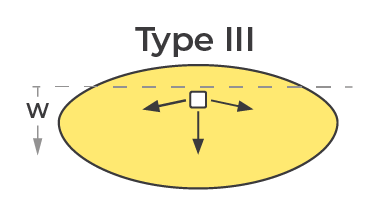
Type IV distribution is useful when fixtures are installed near the edge of a parking lot and need to push light forward into the target area. For edge-mounted parking area fixtures, the 2x2 Lens TypeIV 5050LED High Power Parking Area Lens is a relevant option.

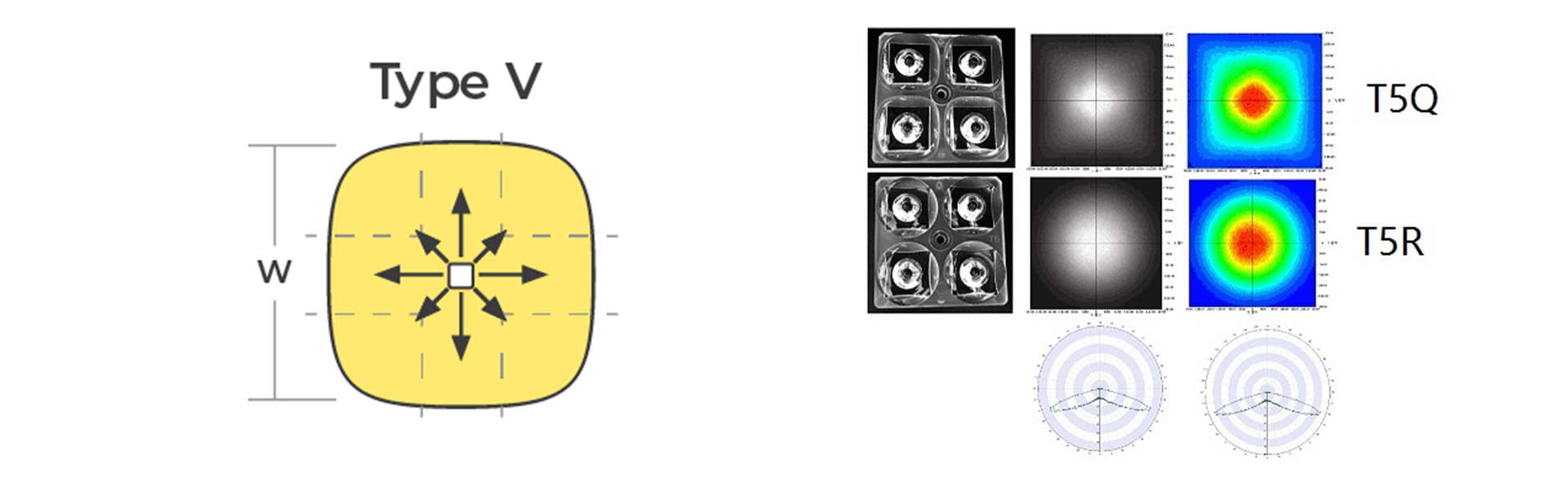
Type V distribution can be considered for open areas or center-mounted pole positions where wide and balanced coverage is needed. For this type of car parking zone, the 2x2 TypeV Round Beam Lens For Car Parking Zone may be suitable for evaluation.
Lens Selection Guide by Parking Lot Layout
For Shopping Mall and Retail Parking Lots
Shopping centers and retail parking lots need comfortable visibility for drivers, pedestrians and security cameras. The lighting should help people move safely from vehicles to store entrances while avoiding harsh glare.
Type IV lenses may be useful for edge-mounted poles, while Type V lenses can support broader coverage from central pole locations. The final choice should depend on pole layout and target illumination area.
For Commercial and Office Parking Areas
Commercial office parking areas often need a balance between safety, energy efficiency and visual comfort. These spaces may have fixed pole locations, pedestrian routes and building entrances that require controlled light distribution.
A suitable parking lot light optics solution should reduce dark zones between poles and avoid excessive brightness near office windows or adjacent properties.
For Logistics Yards and Industrial Parking Lots
Logistics yards, truck parking areas and industrial outdoor spaces usually need stronger visibility for vehicle movement, loading operations and night work. Pole heights and coverage areas may be larger than standard commercial parking lots.
In these projects, Type III or Type IV distribution may help project light farther across drive lanes and working areas. Optical efficiency and outdoor durability are also important because maintenance can be costly.
For Parking Garage Entrances and Drive Lanes
Parking garage entrances, ramps and drive lanes need clear visibility with controlled glare. Drivers move between outdoor and indoor lighting conditions, so harsh brightness changes can be uncomfortable.
Wide and even optics may be useful for entrance zones, while more directional distribution may be required for ramps or specific drive lanes.
For Solar or Low-Power Parking Lot Fixtures
Solar and low-power parking lot fixtures must use available light efficiently. Since energy storage is limited, the optical system should direct light toward the useful ground area as much as possible.
Lens selection can help reduce wasted light and support better performance from a lower-power LED system.
Important Parameters Before Choosing a Parking Lot Lighting Lens
Pole Height and Pole Spacing
Pole height and pole spacing strongly affect lens selection. A fixture mounted at a lower height may require a different distribution than a high-mounted LED shoebox light.
If pole spacing is large, the lens must help project light far enough to overlap with neighboring fixtures. If poles are closer together, a wider or softer distribution may be more suitable.
Mounting Position: Center, Edge or Corner
The mounting position determines whether the fixture should distribute light symmetrically or asymmetrically. A center pole may use Type V distribution, while an edge or corner pole may require Type III or Type IV forward throw.
Target Coverage Area
Before choosing a lens, the target parking spaces, drive lanes, pedestrian paths and boundary areas should be defined. This helps decide whether the project needs wide area coverage, long forward throw or stronger glare control.
LED Package and PCB Layout
The LED package and PCB layout affect optical performance. A lens designed for 5050 LEDs may not perform the same way with another LED package or different spacing.
For lens evaluation, it is helpful to provide the LED model, PCB drawing, lens position and fixture structure.
IES File or Simulation Target
Parking lot projects often require lighting simulation before production. If you already have an IES target, DIALux layout or project photometric requirement, it can help narrow the lens selection more quickly.
Outdoor Protection and Material Requirement
Parking lot fixtures work outdoors for long periods. Optical lenses may need to support outdoor durability, stable transmission and mechanical reliability. IP66, IK10, PC and PMMA are often considered in outdoor fixture design, but the final choice should match the product structure and application environment.
Recommended Asahi Optics Lens Solutions for Parking Lot Lighting
Asahi Optics provides different optical options for parking lot lighting, street lighting and area lighting fixtures. For LED shoebox lights and outdoor parking lot fixtures, the Street and Area Lighting Lens category is a practical starting point for existing lens evaluation.
Type III Lens for Balanced Forward and Side Distribution
For long parking rows, drive lanes and areas requiring balanced forward and lateral coverage, a Type III lens can be considered. This distribution is useful when the lighting layout needs more reach than a symmetric beam while still maintaining side coverage.
The 5050LED TypeIII-M option can be evaluated for LED area lights where wide asymmetric coverage is required.
Type IV Lens for Perimeter and Edge-Mounted Fixtures
For parking lots where fixtures are placed near the edge of the area, Type IV distribution is often a strong choice. It helps push light forward into the parking area and reduces wasted light behind the pole.
The 2x2 TypeIV 5050LED parking area lens is suitable for manufacturers developing high-power parking area fixtures, commercial LED parking lot lights or edge-mounted shoebox-style luminaires.
Type V Lens for Open Parking Areas and Garage Zones
For open parking areas or parking garage zones where the fixture is placed closer to the center of the target area, Type V distribution can provide broad and balanced coverage.
A Type V round beam option can be useful when the project needs wide, even illumination around the luminaire rather than a strong forward-throw pattern.
What Information Helps Us Recommend a Parking Lot Lens?
To recommend a suitable parking lot lighting lens, Asahi needs to understand both the fixture design and the project layout. The more complete the information is, the more accurate the lens recommendation can be.
Useful information includes:
- parking lot layout or site drawing
- pole height
- pole spacing
- fixture mounting position
- LED brand and LED model
- PCB drawing
- target distribution type, such as Type III, Type IV or Type V
- target lux level and uniformity
- IES file or DIALux simulation target
- IP, IK, material or outdoor durability requirement
With these details, Asahi can help determine whether an existing lens is suitable or whether the project needs additional optical evaluation. You can contact Asahi Optics with your fixture and site information to request an existing lens recommendation.
When Existing Lenses Are Not Enough
In many parking lot lighting projects, an existing Type III, Type IV or Type V lens can meet the early evaluation or production requirement. However, some projects have special pole spacing, PCB layout, beam direction or glare-control targets that require further review.
When standard lenses cannot match the required distribution or mechanical structure, Asahi can provide LED optical design support for project-level optical evaluation. This should be considered when the luminaire needs a special distribution, a strict uniformity target or a profile that cannot use an existing lens directly.
Conclusion: Better Parking Lot Lighting Starts with Better Light Distribution
Parking lot lighting is not only about choosing higher wattage, taller poles or brighter LED fixtures. The optical distribution determines whether the light reaches parking spaces, drive lanes, pedestrian paths and security zones effectively.
For LED parking lot lights, commercial area lights, shoebox fixtures and parking garage lights, the right lens can improve uniformity, reduce glare, control spill light and support better energy efficiency.
By selecting the proper Type III, Type IV or Type V lens according to pole height, mounting position and site layout, lighting manufacturers can build parking lot fixtures that perform better in real outdoor applications.