High mast lighting is used to illuminate large outdoor areas from tall poles or towers. It is commonly applied in airports, seaports, highways, interchanges, parking lots, logistics yards, industrial areas, sports fields, and other open spaces where wide-area visibility and safety are required.
Compared with ordinary outdoor lighting, a high mast lighting system usually works from a much higher mounting position and needs to cover a much larger area. This means the optical system must control long-distance projection, uniformity, glare, spill light, and beam direction more carefully.
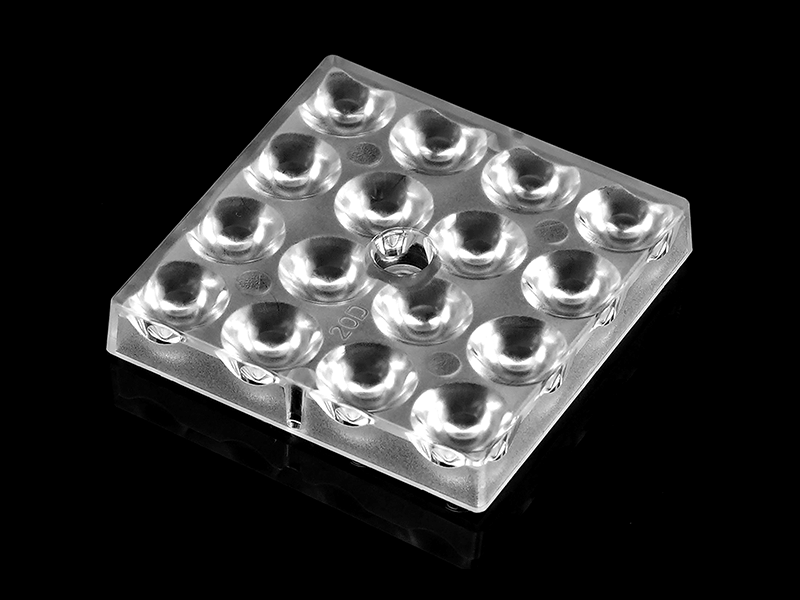
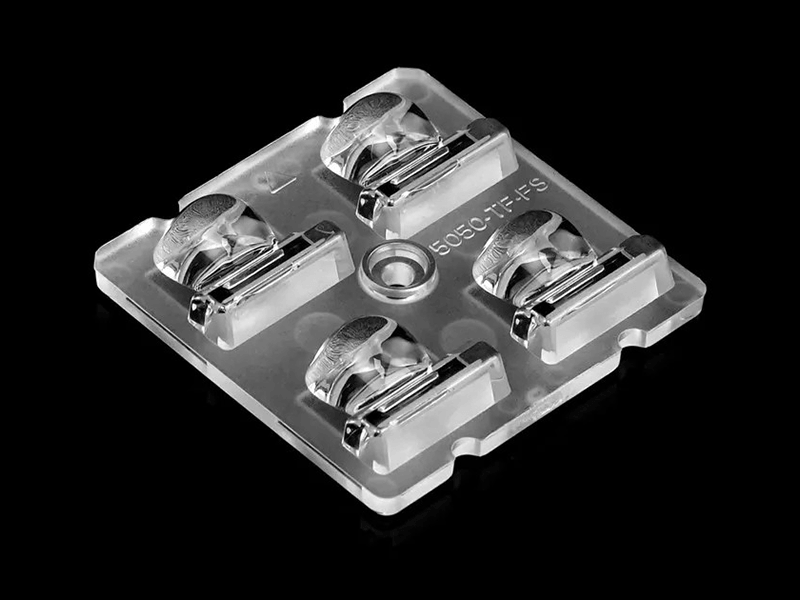
For LED high mast fixtures, the lens is one of the key components that determines the final light distribution. A suitable LED lens for high mast lighting can help improve beam control, optical efficiency, illumination coverage, and visual comfort in large-area applications.
What Is High Mast Lighting?
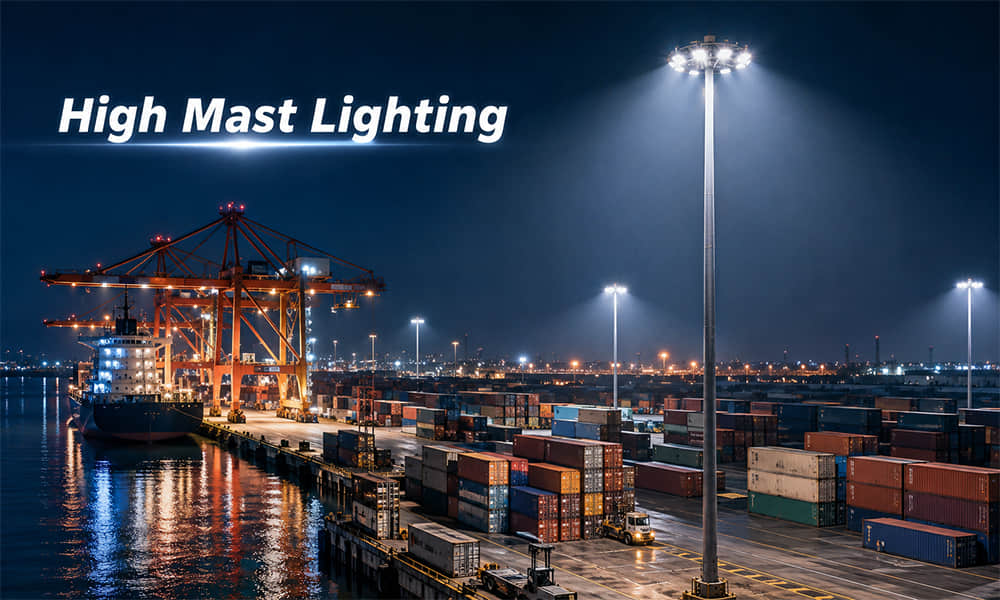
High mast lighting refers to a lighting system installed on tall poles, towers, or masts to illuminate large outdoor spaces. A single high mast pole may carry multiple LED flood lights or high-power luminaires arranged in a circular, rectangular, or directional configuration.
The purpose of high mast lighting is not only to provide high brightness. It must deliver usable light to the correct target area while reducing dark zones, glare, and wasted spill light. This is why optical design and lens selection are important for high mast LED lighting.
In many projects, users may focus first on wattage, pole height, or high mast light price. However, for lighting performance, the lens and light distribution are just as important. A high-power LED fixture without suitable optics may still produce poor uniformity or excessive glare.
Where Is High Mast Lighting Used?
Airport High Mast Lighting
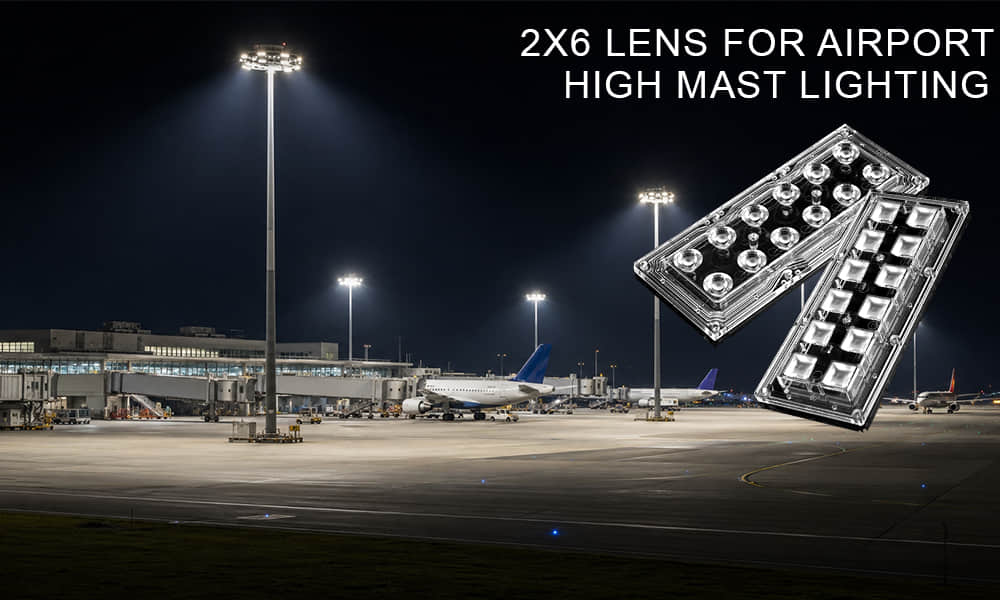
Airport high mast lighting is used for aprons, cargo areas, aircraft parking zones, service roads, and other large aviation spaces. These areas require reliable visibility for ground staff, vehicles, aircraft movement, and security monitoring.
For airport applications, the lighting must provide wide coverage while controlling glare and avoiding unnecessary spill light. The lens should help distribute light efficiently across the target area without creating strong hot spots or dark zones.
Ports, Terminals and Container Yards
Ports and container terminals require strong large-area lighting for loading, unloading, container handling, vehicle movement, and night operations. High mast fixtures are often installed around open yards and heavy-duty working areas.
In these projects, high mast flood light performance depends heavily on beam angle and optical direction. A suitable lens can help project light over a long distance and improve visibility across wide ground surfaces.
Freeway and Highway High Mast Lighting
Freeway high mast lighting and highway interchange lighting are used to illuminate complex road areas, ramps, junctions, toll stations, and wide traffic zones. These projects need good visibility for drivers while keeping glare under control.
The lens should help guide light toward the road area rather than wasting it outside the target zone. For highway and interchange applications, asymmetric or forward-throw optical distribution may be useful depending on pole position and road geometry.
Large Parking Lots and Logistics Areas
High mast parking lot lights are used in commercial parking areas, truck yards, logistics centers, distribution hubs, and industrial open spaces. These locations require broad and uniform illumination for vehicles, pedestrians, loading areas, and surveillance cameras.
For these applications, lighting uniformity and glare control are especially important. The right lens helps avoid very bright areas near the pole and very dark areas farther away.
Sports Fields and Outdoor Activity Areas
High mast lighting can also be used around sports fields, training grounds, stadium-related areas, and large outdoor activity spaces. These projects often need long-throw light, high brightness, and good uniformity across a wide field.
For sports and large-area lighting, narrow beam or medium beam optical lenses may be selected according to pole height, field size, and target lighting level.
Key Lighting Challenges in High Mast Applications
Long Throw Distance from High Mounting Heights
High mast fixtures are installed at much greater heights than normal street lights or area lights. Because the light must travel a longer distance, the optical beam must be carefully controlled.
If the beam is too wide, much of the light may be lost before reaching the target area. If the beam is too narrow, the ground may show strong hot spots and poor uniformity. This makes narrow beam LED lens selection important for some high mast projects.
Large Coverage Area and Dark Zone Control
A high mast lighting system often needs to cover a large area with fewer poles. This can reduce installation complexity, but it also creates a challenge: the light must be distributed over a wide space without leaving dark zones.
Lens selection affects how far the light can reach, how evenly it spreads, and whether the coverage area meets the project requirement.
Glare Control for Drivers, Workers and Athletes
High mast fixtures are powerful, and uncontrolled glare can affect drivers, workers, athletes, and nearby residents. In transport, airport, port, and sports applications, glare control is not optional. It directly affects safety and comfort.
A well-designed high mast lighting lens can help reduce unwanted light above or outside the target area and improve visual comfort.
Uniformity Across Wide Outdoor Spaces
Large-area lighting must avoid strong contrast between bright and dark zones. Poor uniformity can reduce safety and make the lighting system look unprofessional.
The lens should help balance center intensity, edge coverage, and overlapping beams between fixtures. This is especially important in airports, ports, parking lots, logistics yards, and sports lighting areas.
Efficiency and Reliability in Outdoor Environments
High mast fixtures are installed outdoors and are often difficult to maintain. Optical efficiency matters because more usable light can reduce wasted power and improve fixture performance.
The lens material and structure should also be suitable for outdoor lighting conditions, including temperature changes, dust, humidity, and long operating hours.
How LED Lenses Improve High Mast Lighting Performance
Beam Angle Control
The beam angle determines how light spreads from the fixture. In high mast LED lighting, beam angle must match pole height, target area size, and fixture arrangement.
A narrow beam can support long-throw illumination, while a wider beam can help cover nearby areas. Some projects may require different beam angles in the same lighting system to achieve better uniformity.
Narrow Beam and Forward Throw Distribution
High mast projects often need strong forward throw, especially when luminaires are mounted on one side of a large area or aimed toward a distant target. A narrow beam LED lens can help concentrate light and improve long-distance illumination.
This type of optical control is useful for sports fields, airport apron lighting, port yards, and large open spaces where the fixture must project light far from the mast.
Asymmetric Light Distribution
In many high mast applications, the pole is not located in the center of the lighting area. For example, poles may be installed around the edge of a parking lot, road interchange, port yard, or sports field.
An asymmetric LED lens can help push light toward the required direction and reduce wasted light behind the pole. This improves usable illumination and supports better project efficiency.
Optical Efficiency for High-Power LED Fixtures
High mast luminaires often use high-power LEDs or multiple LED arrays. The lens must transmit light efficiently and maintain stable optical performance.
High-quality high power LED optics help convert LED output into usable light on the ground. This can support better fixture performance without relying only on higher wattage.
Glare and Spill Light Reduction
Glare and spill light can become serious problems when high mast fixtures are installed near roads, airports, residential areas, or working zones. A suitable optical lens can help shape the beam and reduce unnecessary light outside the target area.
This is why lens selection should be considered early in the fixture design, not only after the luminaire housing and LED power have been confirmed.
Lens Selection Guide for High Mast Lighting Projects
For Airport Aprons and Cargo Areas
Airport high mast lighting requires wide coverage, good visibility, and controlled glare. The lens should help distribute light evenly across apron and cargo areas while reducing strong brightness toward pilots, drivers, and ground workers.
Depending on the pole layout, the fixture may need medium beam, narrow beam, or asymmetric optical distribution.
For Ports and Container Terminals
Ports and container terminals need reliable illumination for heavy equipment, containers, trucks, and workers. High mast lights must cover large ground areas and maintain visibility during night operations.
For this type of project, lens selection should focus on long throw, wide-area uniformity, and durable optical performance in outdoor environments.
For Freeways and Interchanges
Freeway and interchange high mast lighting should improve driver visibility while reducing glare. The optical distribution must match road width, pole position, mounting height, and traffic direction.
Forward-throw or asymmetric distribution can help direct light to the road surface and reduce wasted light outside the useful area.
For Parking Lots and Large Open Areas
Large parking lots and logistics yards need balanced illumination for vehicles, pedestrians, cameras, and security. A good high mast lighting system should avoid strong hot spots near the pole and weak illumination at the edges.
Lens selection should be based on coverage area, pole spacing, mounting height, and target uniformity.
For Sports and Stadium-Related High Mast Lighting
Sports and stadium-related high mast lighting may require stronger beam control and longer throw. The lens should help deliver light to the field or activity area with good uniformity.
For these projects, narrow beam or high-efficiency optical lenses may be useful when the fixture is mounted far from the target area.
Important Parameters for High Mast Lighting Lens Selection
Mounting Height
Mounting height is one of the first parameters to confirm. A 12 meter high mast project and a 30 meter high mast project may require very different beam angles and optical intensity.
Higher mounting positions usually need stronger beam control and more careful optical planning.
Pole Spacing and Coverage Area
The distance between poles affects overlap and uniformity. If the spacing is large, the lens must help project light farther and maintain enough intensity at the edge of the coverage area.
For better recommendations, the target high mast lighting coverage area should be clearly defined.
Target Beam Angle
Some projects need narrow beam light for long throw, while others need wider beam distribution for nearby area coverage. The target beam angle should be selected according to real project geometry.
Beam angle should not be chosen only by fixture wattage. It should match mounting height, aiming direction, and application type.
LED Package and PCB Layout
The LED package and PCB layout affect how the lens performs. A lens designed for one LED package may not deliver the same beam pattern when used with another LED or different PCB spacing.
For high mast lighting lens evaluation, it is helpful to provide LED model, PCB drawing, lens position, and fixture structure.
Optical Material and Outdoor Durability
High mast lights are used outdoors for long periods. Lens material, optical stability, temperature resistance, and mechanical fit should be considered when selecting the optical component.
For large-area LED fixtures, optical reliability is important because maintenance at high mounting positions can be costly.
Recommended Asahi Optics Lens Solutions for High Mast Lighting
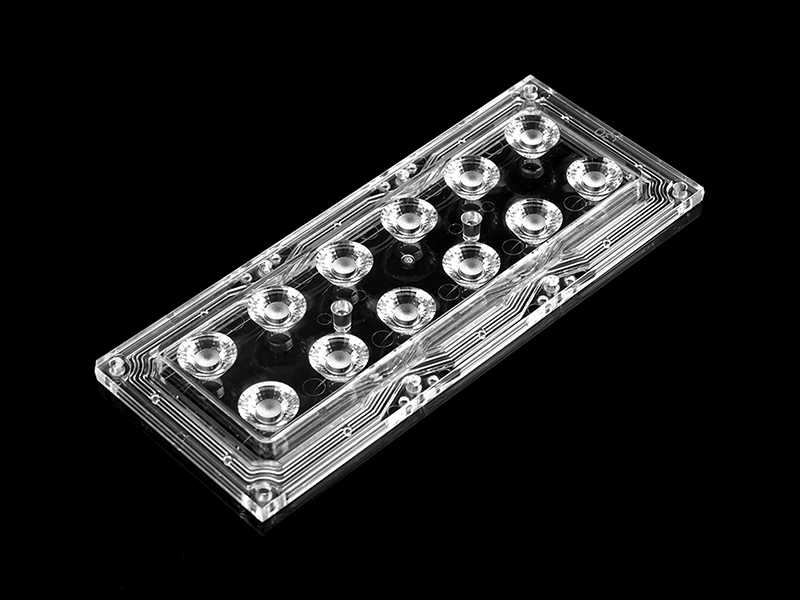
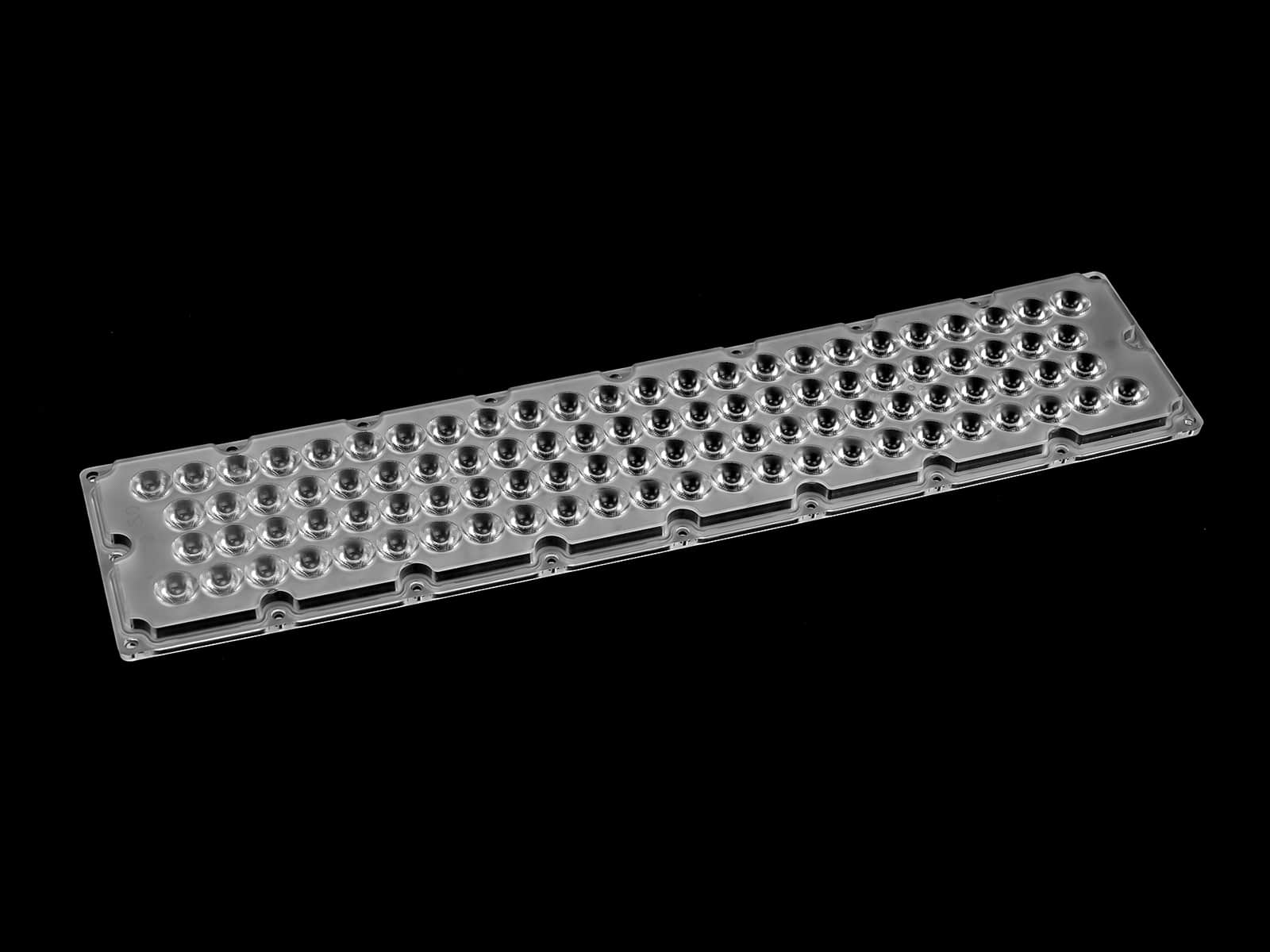
For high mast and large-area lighting projects, Asahi Optics recommends reviewing our LP66 2x6 Lens 173mm product category. This type of lens is suitable for high-power LED fixtures that require multiple LED arrays, outdoor protection, and controlled light distribution.
LP66 2x6 Lens 173mm for High Mast and Area Lighting
The LP66 2x6 Lens 173mm category can be used as a starting point for high mast lighting, large-area lighting, street and area lighting, and flood lighting projects.
For high mast applications, this lens format is useful when the fixture needs an integrated multi-LED optical solution with controlled distribution. It can support high-power outdoor LED luminaires where beam direction, protection, and consistency are important.
2x6 Arrays 8 Degree 3535 LED Stadium Spotlight Lens
For long-throw or narrow-beam applications, the 2x6 Arrays 8 Degree 3535 LED Stadium Spotlight Lens can be considered as an existing lens option.
This lens is especially relevant for projects that need concentrated beam output, such as sports lighting, stadium-related high mast fixtures, large outdoor activity areas, and long-distance flood lighting. The 8 degree beam helps concentrate light for applications where stronger directionality is required.
For airport, port, parking lot, or highway projects, final suitability should still be verified according to mounting height, target area, LED package, PCB layout, and simulation requirements.
Why Start with an Existing Lens?
Using an existing lens can help lighting manufacturers evaluate optical feasibility before changing the fixture structure or starting a new mold. It allows the engineering team to test beam angle, intensity, mechanical fit, and project suitability more quickly.
If the existing lens meets the required high mast lighting performance, it may shorten development time and reduce early project cost. If the project needs a different beam or LED arrangement, the test results can still provide useful reference data for further optical evaluation.
What Information Helps Us Recommend a High Mast Lighting Lens?
To recommend a suitable LED lens for high mast lighting, Asahi Optics needs to understand the project geometry and fixture design. The more complete the information is, the more accurate the recommendation can be.
Useful information includes:
- application area, such as airport, port, parking lot, highway, or sports field
- pole height or mounting height
- pole spacing
- target illumination area
- LED brand and LED model
- PCB drawing
- target beam angle
- fixture size and lens installation space
- IES file or simulation target
- outdoor protection requirement
With this information, Asahi can help review whether an existing lens such as the IP66 2x6 Lens 173mm or the 2x6 Arrays 8 Degree 3535 LED Stadium Spotlight Lens is suitable for the project.
When Existing Lenses Are Not Enough
In many high mast lighting projects, an existing lens can be used for evaluation or production. However, some projects may require a special optical distribution because of pole height, road geometry, field size, LED layout, or glare limitation.
When an existing lens cannot meet the target beam angle, uniformity, PCB layout, or installation structure, Asahi can provide LED optical design support for project-level optical evaluation.
This page focuses on high mast lighting applications and existing lens recommendation. For projects with special optical requirements, optical simulation and engineering review can help define the next development direction.
Conclusion: Choose the Right Lens for High Mast LED Lighting
High mast lighting is not only about using higher wattage or taller poles. The optical lens plays a direct role in light distribution, long-distance projection, coverage area, uniformity, glare control, and overall fixture performance.
For airports, ports, highways, parking lots, sports fields, and large outdoor areas, selecting the right high mast lighting lens early can help improve lighting quality and reduce unnecessary testing during fixture development.
If you are developing a high mast LED fixture or large-area outdoor luminaire, review Asahi’s IP66 2x6 Lens 173mm category, check the 2x6 Arrays 8 Degree 3535 LED Stadium Spotlight Lens, or request an existing lens recommendation from Asahi Optics.