Stage lighting is one of the most demanding application areas for LED optics. Unlike general illumination, stage fixtures must do more than provide brightness. They need to shape atmosphere, control beam direction, mix colors smoothly, support fast visual changes, and keep the performer, object, or scene visible without unwanted glare or color separation.
For manufacturers of LED stage lighting, the optical lens is a small component with a large impact. A suitable LED stage lighting lens can improve color mixing, increase usable light output, refine the beam angle, reduce optical loss, and help different fixtures maintain consistent performance in production.
Asahi Optics provides LED optical lens solutions for different lighting applications, including stage and theater fixtures. For stage lighting projects using RGBW LEDs, our RGBW Stage Light Single Lens category is designed to help lighting manufacturers evaluate suitable existing lens options for PAR cans, wash lights, moving head fixtures, and other color-mixing stage luminaires.
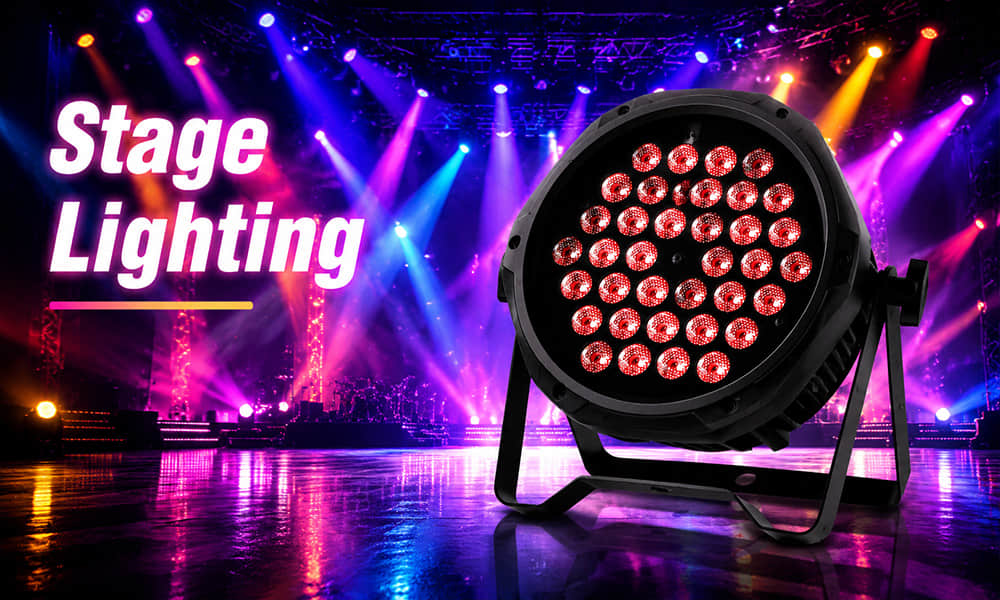
What Is Stage Lighting?
Stage lighting refers to the use of controlled light to illuminate performers, objects, scenery, and performance spaces. It is widely used in theaters, concerts, TV studios, churches, event venues, clubs, exhibition halls, and live entertainment spaces.
In simple terms, stage lighting helps the audience see what matters. In professional lighting design, however, it also controls mood, color, focus, movement, depth, and visual rhythm. A single stage may require wide wash lighting for atmosphere, focused beams for performers, dynamic moving effects for concerts, and softer theatrical lighting for dramatic scenes.
This is why theater lighting and theatrical lighting often require a more precise optical system than ordinary commercial lighting. The fixture must not only be bright; it must place light exactly where the designer expects it, with the right beam shape, color quality, and visual comfort.
Common Types of LED Stage Lighting Fixtures
The stage lighting market includes many types of fixtures. Each fixture type has different optical requirements, and the lens design should match the intended beam effect, LED package, mechanical structure, and working distance.
LED PAR Can Stage Lights
LED PAR can fixtures are widely used for stage wash lighting, background lighting, event lighting, and architectural accent effects. Modern PAR can stage lights often use RGBW or multi-color LEDs to create rich color output from a compact fixture body.
For this type of luminaire, the lens usually needs to support wide or medium beam angles, smooth color mixing, and efficient light transmission. A poor lens may create visible red, green, blue, or white color shadows on the stage surface, especially at short projection distances. A suitable RGBW LED lens helps blend the light before it reaches the target area, making the output more uniform and visually comfortable.
Moving Head Lights
Moving head lights are used in concerts, live shows, TV studios, clubs, and large entertainment venues. They can rotate, tilt, zoom, change color, and create dynamic beam or wash effects. In this application, the optical system must support movement, compact structure, and reliable beam consistency.
For an LED moving head light, the lens must work within limited mechanical space while maintaining optical efficiency. If the fixture uses RGBW LEDs, the lens also needs to support strong color mixing and stable beam projection during movement. This makes the choice of optical lens for stage lights especially important for moving head wash fixtures.
Stage Spotlights
A stage spotlight is used to highlight performers, speakers, musicians, or objects on the stage. Compared with wide wash lighting, spotlight applications usually require stronger beam direction, better edge control, and higher center intensity.
For spotlight stage lighting, the optical design should reduce wasted spill light and help the fixture produce a controlled beam. Depending on the fixture design, manufacturers may use a lens system, reflector system, or combined optical structure. When LEDs are used as the light source, a well-matched stage light lens helps control the beam angle and improve the usable light delivered to the target area.
Theater and Performance Lighting
Theater lighting places special emphasis on visual comfort, scene control, and consistent color appearance. The lighting must support actors, scenery, costumes, and stage depth without distracting the audience. In this environment, glare, uneven color, harsh beam edges, or visible optical artifacts can affect the viewing experience.
For LED theater fixtures, lens selection should consider beam smoothness, color blending, fixture distance, and the type of performance space. The goal is not always maximum brightness. In many cases, the goal is controlled, comfortable, and repeatable light.
Fresnel and Wash Stage Lights
A Fresnel stage light is often used when a softer beam edge is needed. Wash lights are used to cover larger stage areas with even illumination. LED versions of these fixtures may use COB LEDs, RGBW LEDs, or multi-LED arrays, depending on the target brightness and color effect.
For wash applications, the lens should help distribute light evenly across the stage. For Fresnel-style effects, the optical system may need to create a softer transition between the center beam and the outer edge. The right lens choice helps avoid hot spots, patchy color, and visible unevenness on the performance area.
Key Lighting Problems in Stage and Theater Applications
Stage lighting fixtures work in complex visual environments. A fixture may be used close to performers, mounted high above the stage, aimed across long distances, or used together with many other lights. Because of this, small optical problems can become highly visible during real use.
Uneven Color Mixing
Many RGBW stage lights use separate red, green, blue, and white LED chips. If the lens does not mix the light properly, the beam may show colored shadows, rings, or separation on the stage. This problem is especially noticeable on white surfaces, backdrops, and close-range wash lighting.
A well-designed RGBW LED lens helps blend the output from different LED colors and produces a more uniform beam. For PAR lights, wash lights, and moving head fixtures, this can improve the overall visual quality of the fixture.
Uncontrolled Beam Spread
Beam angle is one of the most important optical parameters in LED stage lighting. A narrow beam can highlight a performer or create a dramatic effect, while a wide beam can cover scenery or background surfaces. If the lens angle is not suitable, the fixture may produce too much spill light or fail to cover the intended area.
For manufacturers, selecting the right lens angle helps match the fixture to real application scenarios. A PAR can for stage wash lighting may need a wider beam, while a stage spotlight may require tighter control. The optical lens determines how effectively the LED light is shaped and delivered.
Visible Color Shadows on the Stage
Color shadow is a common issue in compact RGBW stage fixtures. When different color chips are physically separated on the PCB, the light may not overlap perfectly after passing through the lens. This can create multi-colored shadows around performers, props, or stage edges.
Lens geometry, LED spacing, optical distance, and surface design all affect color mixing. For this reason, manufacturers should evaluate the lens together with the LED layout and fixture structure, not as an isolated component.
Low Optical Efficiency
Stage fixtures often need high brightness from a compact body. If the lens material or optical design causes excessive loss, the fixture may require more power to achieve the same visual output. This can increase heat, reduce efficiency, and affect product reliability.
A high-transmission LED optical lens helps convert LED output into usable light. For stage lighting manufacturers, this can support better fixture performance without relying only on higher LED power.
Inconsistent Beam Quality Between Fixtures
Professional lighting projects often use many fixtures together. If the beam angle, brightness, or color mixing differs from one unit to another, the whole lighting design may look uneven. Consistency is especially important for theaters, studios, touring equipment, and rental lighting systems.
Lens precision and production stability both matter. A reliable LED optics manufacturer should be able to provide stable optical performance across samples and mass production, helping fixture manufacturers maintain consistent output from batch to batch.
How LED Lenses Affect Stage Lighting Performance
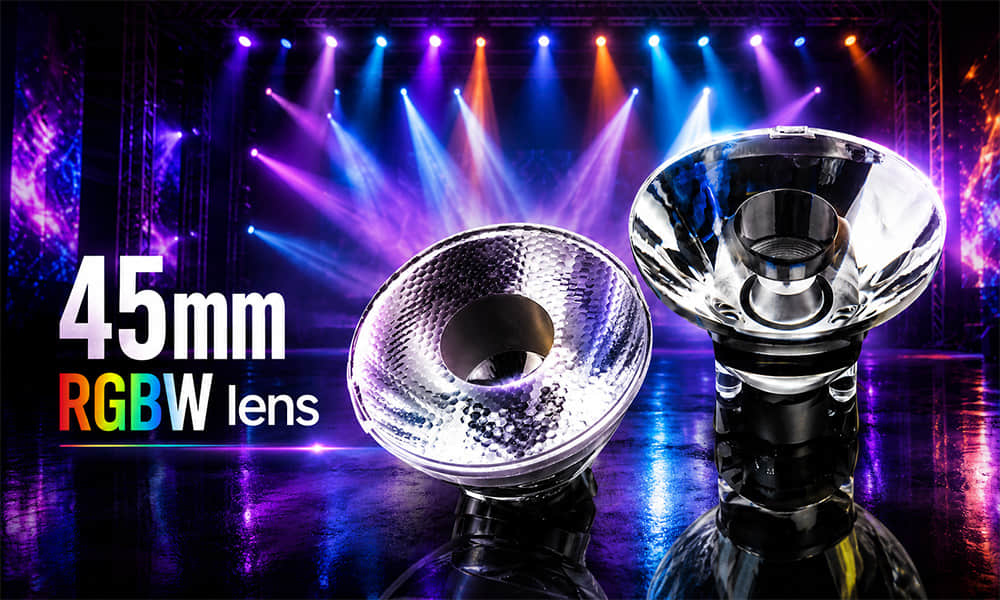
The lens is not only a cover over the LED. In stage lighting, it is part of the optical engine. It controls how light leaves the fixture, how colors blend, how much light reaches the target, and how the beam feels to the human eye.
Beam Angle Control
The LED stage lighting lens helps define whether the fixture produces a narrow, medium, or wide beam. Beam angle affects throw distance, coverage area, brightness perception, and visual effect.
For example, a narrow lens may be suitable for accent lighting or stronger visual focus, while a wider lens may work better for stage wash, background lighting, or short-distance event lighting. In RGBW PAR applications, multiple beam angle options may be needed for different fixture series or market requirements.
RGBW Color Mixing
Color mixing is one of the main reasons stage lighting manufacturers pay close attention to lens selection. In an RGBW fixture, the lens must handle light from different LED chips and blend them into a smooth output.
A suitable optical lens for RGBW stage lights can reduce color separation and improve beam uniformity. This is important for PAR can stage lights, moving head wash lights, compact theater fixtures, and any luminaire that needs clean mixed colors at different dimming levels.
Light Transmission and Optical Efficiency
Optical efficiency affects how much LED light is actually delivered to the stage. Lens material, surface quality, optical geometry, and manufacturing accuracy all influence transmission.
High-quality PC or PMMA optical lenses can help improve light utilization while keeping the fixture compact. For stage lighting manufacturers, better efficiency may support higher brightness, lower thermal pressure, or more stable performance during long operating hours.
Glare and Beam Edge Control
Stage lighting is viewed directly or indirectly by performers, audiences, cameras, and lighting designers. A harsh beam, uncontrolled glare, or messy beam edge can reduce visual comfort and make the fixture look less professional.
The right stage light lens can help refine the beam edge and reduce unwanted spill. In theater and performance lighting, this contributes to a cleaner visual environment and better control over the illuminated area.
Fixture Size and Optical Layout
Modern stage lighting fixtures are becoming more compact, especially portable event lights, mini moving heads, and slim RGBW PAR cans. Lens size, installation height, LED spacing, and PCB layout all need to work together.
When selecting an existing lens, manufacturers should compare the LED package, PCB design, mechanical holder, beam angle, and target application. A lens that performs well in one fixture may not automatically work in another if the optical distance or LED arrangement changes.
Lens Selection Guide for Different Stage Lighting Fixtures
Because stage lighting includes many fixture types, lens selection should start from the application instead of only from lens dimensions. The same RGBW LED can produce very different results depending on the lens angle, optical structure, and fixture layout.
For RGBW PAR Can Lights
For LED PAR can fixtures, the main optical goals are usually color mixing, beam coverage, and efficiency. These lights are often used for stage wash, event lighting, DJ lighting, background color, and small venue illumination.
A suitable lens for RGBW PAR cans should provide smooth mixed color, stable beam shape, and good transmission. Depending on the fixture design, manufacturers may choose medium or wide beam lenses to match indoor stage distances and coverage needs.
For this type of project, Asahi’s RGBW Stage Light Single Lens category is a practical starting point for existing lens evaluation.
For Moving Head Wash Lights
Moving head wash lights need compact optics, good color mixing, and reliable beam performance during movement. Since the fixture head must rotate and tilt, the optical system usually needs to fit within a limited space.
For moving head lights using RGBW LEDs, the lens should support efficient color blending and consistent beam output. If the lens creates uneven color or unwanted artifacts, those problems may become more visible when the beam moves across the stage or background.
For Stage Spotlights
For stage spotlight applications, the optical goal is usually stronger beam control. The fixture may need to highlight a performer, speaker, instrument, or object without flooding the surrounding area.
In this case, lens selection should focus on beam angle, center intensity, edge quality, and optical efficiency. Depending on the fixture structure, a tighter lens or additional optical components may be required to achieve the desired spotlight effect.
For Theater Lighting Fixtures
Theater lighting requires a balance between control and comfort. The light should support the performance without producing harsh glare or distracting color unevenness. Beam consistency is also important because multiple fixtures are often used together in a lighting rig.
For LED theater fixtures, the lens should be evaluated under real working distance and dimming conditions. This helps confirm whether the beam remains smooth and whether the mixed color is acceptable for stage scenes, costumes, and skin tones.
For Fresnel and Wash Lighting
For Fresnel stage light and wash lighting applications, the beam is often expected to be soft, broad, and even. Lens selection should avoid strong hot spots and visible color separation.
For RGBW wash lights, optical mixing is especially important. A good lens can help create a smoother color field, making the fixture more useful for background lighting, stage atmosphere, and event spaces.
Recommended RGBW Stage Light Lens Products from Asahi Optics
For stage lighting manufacturers developing RGBW fixtures, Asahi recommends starting with our RGBW Stage Light Single Lens product category. These lenses are designed for LED stage lighting applications where color mixing, beam shaping, and compact optical structure are important.
RGBW Stage Light Single Lens for PAR and Wash Fixtures
The RGBW Stage Light Single Lens category is suitable for manufacturers working on RGBW PAR cans, compact wash lights, and color-changing stage fixtures. These applications usually require a lens that can help mix multi-color LED output while maintaining useful brightness and controlled beam distribution.
For PAR can stage lights, the lens can help create a cleaner wash effect and reduce visible color separation. For moving head wash fixtures, the compact single-lens design can support a more efficient optical layout inside the fixture head. For theater or event lighting, smooth beam quality helps improve the visual result seen by the audience and camera.
This category is especially relevant when your project uses RGBW LED packages and needs an existing lens option for early evaluation, sample testing, or production planning.
Why Use an Existing RGBW Lens First?
For many stage lighting projects, an existing lens is the fastest way to evaluate optical feasibility. Before opening a new mold or changing the fixture structure, manufacturers can test whether an available lens meets the target beam angle, color mixing, mechanical size, and visual effect.
Using an existing lens can help shorten development time, reduce early-stage cost, and allow the engineering team to compare several beam options more quickly. If the existing lens fits the LED layout and performance target, it may be suitable for production. If the project has special requirements, the test result can also provide useful reference data for later optical adjustment.
What Information Helps Select a Stage Lighting Lens?
To recommend a suitable LED stage lighting lens, the lens supplier needs more than a general fixture name. Stage lighting performance depends on the interaction between LED, lens, PCB, fixture structure, and target beam effect.
For a faster recommendation, it is helpful to provide the LED brand and model, LED package size, RGBW chip layout, PCB drawing, lens installation space, target beam angle, fixture type, and intended application. For example, an RGBW PAR can used for short-distance wash lighting may need a different beam from a moving head fixture used in a concert venue.
If you already have a target beam angle or sample fixture, that information can make the selection process more accurate. If you do not have complete data yet, Asahi can still help review the basic LED and fixture requirements and suggest possible existing lens options.
When Should You Consider Optical Design Support?
In many projects, an existing lens is enough for evaluation or production. However, some stage lighting fixtures require a special optical structure because of LED spacing, compact mechanical limits, unusual beam targets, or strict color mixing requirements.
In these cases, Asahi can provide LED optical design support to help evaluate the optical path and lens feasibility. This is especially useful when the existing lens cannot meet the required beam angle, color uniformity, installation size, or visual effect.
This page focuses on stage lighting applications and existing RGBW lens selection. For projects that need a dedicated lens geometry, optical simulation, or tooling evaluation, you can also review Asahi’s custom LED lens capability as a separate development path.
Conclusion: Build Better Stage Lighting with the Right LED Lens
Stage lighting depends on precise optical control. Whether the fixture is an RGBW PAR can, moving head wash light, theater light, stage spotlight, or Fresnel-style luminaire, the lens has a direct impact on beam angle, color mixing, brightness, glare, and visual consistency.
For manufacturers developing LED stage lighting products, selecting the right lens early can reduce testing time and improve fixture performance. Asahi Optics offers RGBW stage light lens options for different stage lighting applications, helping engineering teams evaluate existing lens solutions before moving into production.
If you are developing an RGBW PAR, moving head, wash, or theater lighting fixture, visit our RGBW Stage Light Single Lens category or request an existing lens recommendation from Asahi Optics.