
Wall wash lighting is used to create a smooth, continuous layer of light across a vertical surface. It can make an architectural facade appear brighter after dark, improve the visual depth of an interior wall, support gallery displays, or create a more welcoming atmosphere in hotels, retail spaces, entrances, and public areas.
A successful wall wash effect is not achieved by brightness alone. The light must reach the wall at the correct angle, overlap evenly with neighboring fixtures, avoid excessive brightness near the luminaire, and limit unwanted light outside the target surface. This is where wall wash lighting optics become important.
Asahi Optics develops precision LED lenses for architectural luminaires, including compact single-lens systems for wall washers, landscape fixtures, in-ground lights, and linear architectural lighting. The final lighting result depends on the complete fixture design, including the LED, lens, PCB layout, housing, mounting position, aiming angle, and wall geometry.
What Is Wall Wash Lighting?
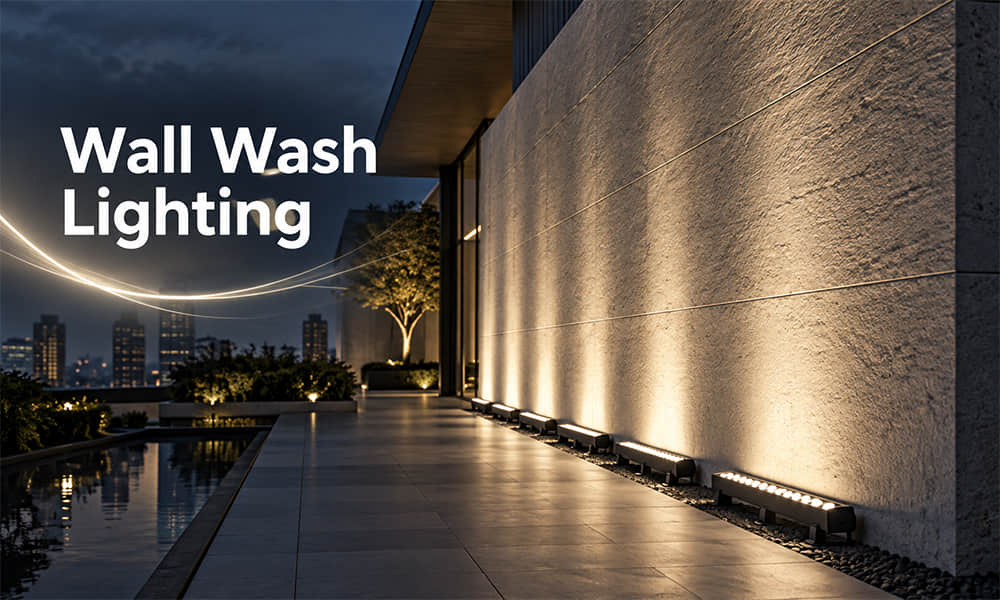
Wall wash lighting is an architectural lighting technique that distributes light across a wall as evenly as possible. The intention is usually to make the full surface visible and visually connected, rather than creating isolated bright spots or sharply focused accents.
Wall washing can be used for interior walls, building facades, hotel entrances, museum displays, retail walls, corridors, landscape features, stone surfaces, and architectural columns. The desired effect changes according to the wall material, fixture location, viewing distance, and the visual purpose of the project.
Wall Washing vs. Wall Grazing
Wall washing and wall grazing are related techniques, but they have different optical goals. Wall washing aims to provide broad and relatively even illumination across a vertical plane. It is suitable when the wall itself should appear smooth, bright, and continuous.
Wall grazing places the fixture closer to the wall and directs the beam at a shallow angle. This makes textures such as stone, brick, wood, concrete, or decorative panels more visible because small surface variations create highlights and shadows.
A wall washer can also be used for accent lighting, but accent lighting normally focuses on a smaller object or architectural detail. A complete wall wash design must instead consider the full wall height, width, fixture spacing, and overlap between multiple beams.
Common Wall Washer Lighting Configurations
Exterior Wall Wash Lighting
Exterior wall wash lighting is commonly used for building facades, hotel entrances, columns, monuments, cultural buildings, landscape walls, and architectural features. Outdoor fixtures may be ground-mounted, recessed, surface-mounted, or installed on brackets facing the wall.
The optical design must account for the fixture-to-wall distance, target wall height, mounting height, fixture spacing, wall texture, and expected viewing positions. A lens that provides a suitable beam for a short stone wall may not work for a tall facade because the required throw distance and vertical coverage are completely different.
Outdoor wall washer projects should also consider lens material, fixture sealing, gasket structure, water drainage, thermal conditions, and the risk of visible glare for pedestrians or nearby residents.
Indoor Wall Wash Lighting
Indoor wall wash lighting is used in galleries, museums, hotels, retail spaces, offices, restaurants, corridors, reception areas, and high-end residential interiors. In these applications, visual comfort and wall brightness continuity are often more important than creating a dramatic narrow beam.
Ceiling-mounted wall washers can make a room feel larger by increasing vertical brightness. However, a poorly selected distribution may create bright scallops near the ceiling or dark sections further down the wall. The optical lens and luminaire position should therefore be selected according to the wall height and ceiling offset.
Linear LED Wall Washers
A linear LED wall washer uses multiple LEDs along a long housing to illuminate a continuous architectural surface. This format is common for facades, retail walls, long corridors, landscape edges, and decorative building lines.
In a linear fixture, the final wall pattern is created by repeated LED-and-lens units. LED pitch, lens orientation, fixture length, spacing between luminaires, and the distance to the wall all affect whether the illuminated surface appears continuous or shows repeated bright and dark bands.
For broader architectural single-lens options, see the Architectural Lighting Single Lens collection . The lens should be chosen according to the actual fixture geometry rather than by beam angle alone.
Recessed and In-Ground Wall Wash Fixtures
Recessed and in-ground fixtures are often used to wash facades, columns, landscape walls, and architectural entrances from below. Because the fixture is close to the ground and may be visible to pedestrians, glare control and aiming direction are especially important.
A narrow beam may be required to reach the top of a tall wall, while an oval distribution can help spread light along the width of a facade. The fixture must also avoid creating an overly bright band directly above the ground while leaving the upper wall insufficiently illuminated.
Wall Wash Lighting Problems That Optical Lenses Help Solve
Bright Scallops and Dark Gaps
Bright scallops are repeated curves or bright pools visible on a wall below individual fixtures. They usually occur when beam angle, fixture spacing, installation distance, or aiming direction does not provide sufficient overlap between neighboring light distributions.
Optical lenses can help shape the beam more precisely, but they cannot solve every scalloping issue independently. The fixture layout must also be correct. A suitable lens distribution should be tested with the intended mounting height, fixture spacing, and wall distance.
Over-Bright Areas Near the Fixture
When a wall washer is installed too close to the wall or uses a distribution that is too concentrated, the lower section of the wall can appear much brighter than the upper section. This can make the wall look uneven and may create discomfort for people standing near the fixture.
A wider beam, an oval distribution, a different aiming angle, or a revised fixture position may improve the result. The correct choice depends on the wall height and the distance from the light source to the target surface.
Insufficient Light at the Top of a Tall Wall
Tall facades, columns, and architectural features may require a more concentrated distribution to deliver useful light to the upper area. However, narrowing the beam too much can create a visible hotspot near the bottom or reduce coverage across the wall width.
The lighting designer should balance vertical throw, wall width, fixture position, and overlap from adjacent luminaires. In some projects, an oval beam can provide better practical coverage than a standard round beam.
Light Spill Beyond the Wall Surface
Uncontrolled light can spill onto windows, ceilings, nearby surfaces, roads, vegetation, or the night sky. This reduces the efficiency of the installation and may create visual disturbance outside the intended architectural feature.
A LED wall washer should use the lens, fixture shielding, mounting location, and aiming angle together to direct light toward the wall. The optical system should be evaluated as part of the complete fixture rather than as a separate plastic component.
Glare from Visible LED Sources
High-brightness LEDs can be uncomfortable when the source is visible from normal viewing positions. The lens can help control the direction of light, while the housing, baffle, louver, installation position, and viewing angle also affect the final glare result.
A lens can support better beam control, but it should not be claimed to guarantee a specific UGR level. Final glare performance depends on the complete luminaire and installation environment.
How Optical Lenses Shape a Wall Wash Beam
Beam Angle and Throw Distance
Beam angle is only one part of wall washer selection. A 10° lens can project light much higher than a 60° lens at the same mounting point, but the resulting coverage width will be smaller. The same lens also creates a different wall pattern when the fixture-to-wall distance changes.
For this reason, a wall wash project should start with the wall dimensions, fixture position, and target coverage area. The beam angle can then be selected as part of the full optical layout.
Round Beams for Columns and Focused Sections
Round beams are useful for narrow facades, entrance columns, wall sections, architectural details, and focal areas. Narrow round distributions can be used when the fixture must project light over a longer distance or emphasize a tall vertical element.
Wider round distributions can suit shorter walls or closer mounting positions where a smoother, broader illumination field is required.
Oval Beams for Wider Wall Coverage
Oval beam lenses spread light more in one direction than the other. This is useful for long walls, linear fixtures, rectangular architectural elements, and facade sections where the target surface is wider than it is tall.
A 10 × 45°, 10 × 60°, 30 × 60°, or 30 × 65° distribution can help a fixture cover more wall width while maintaining useful vertical control. The longer axis of the lens must be oriented correctly in the luminaire, otherwise the final wall pattern may not match the intended design.
Multiple Lenses in a Linear Fixture
A linear wall washer normally uses many LEDs and lenses in one housing. Each lens contributes to the final pattern, and neighboring beams should overlap without creating repeated hot spots or dark gaps.
LED pitch, lens spacing, module orientation, fixture mounting height, and wall distance must be reviewed together. A suitable optical design can improve continuity, but a poor mechanical layout can still create visible brightness variation on the wall.
LED-to-Lens Alignment
The LED must remain correctly centered under the lens. A small offset can change the beam direction, reduce symmetry, and make repeated wall-washer modules appear inconsistent. PCB hole positions, lens locating features, holder design, and assembly tolerance therefore matter in both prototype and mass production stages.
Key Parameters for Selecting Wall Wash Lighting Optics
The following information helps identify a suitable LED lens for wall washer projects:
| Project Input | Why It Matters |
|---|---|
| LED manufacturer, model, and package | Confirms compatibility between the LED emitting area and the lens optical design. |
| LED quantity and center-to-center pitch | Determines how individual beams overlap in a linear or multi-LED fixture. |
| Fixture-to-wall distance | Changes the projected beam height, width, and brightness distribution. |
| Wall height and width | Defines the required vertical throw and horizontal coverage. |
| Fixture mounting height and spacing | Influences scalloping, dark gaps, and continuity between luminaires. |
| Wall material and texture | Helps determine whether the project requires smooth wall washing or grazing effects. |
| Required beam shape | Supports selection of round, oval, narrow, wide, or directional distributions. |
| Fixture housing dimensions | Limits lens diameter, lens height, holder structure, and front-cover clearance. |
| Outdoor or indoor installation conditions | Influences material selection, sealing design, and environmental requirements. |
| Target beam image or lighting reference | Provides a practical visual target for evaluating the proposed optical distribution. |
Selecting Optics by Wall Washer Fixture Type
Compact Single-LED Wall Washers
Compact single-LED wall washers are often used for columns, narrow facade sections, small landscape fixtures, recessed uplights, and focused architectural features. The lens can be selected from narrow, medium, wide, or oval beam options depending on the wall height and fixture distance.
Narrow beams may suit taller columns or longer throw distances. Wider beams can be used where the fixture is closer to the wall. Oval distributions are useful when the required wall coverage is wider in one direction.
Multi-LED Linear Wall Washers
Multi-LED linear fixtures are designed for long walls and continuous facades. Their optical performance depends on repeated lens modules, LED spacing, and fixture layout. The goal is to produce a connected wall wash rather than a sequence of separate light pools.
A wall-washer lens series with multiple beam options gives the fixture designer more flexibility to match the same mechanical platform to different wall heights and installation distances.
In-Ground and Upward-Facing Wall Washers
In-ground fixtures project light upward from the base of a wall, facade, or column. These applications need careful beam control because the source can be visible to pedestrians and the lower wall can become excessively bright if the fixture is too close or the beam is not properly selected.
The required optic should be chosen according to facade height, wall setback, fixture aiming angle, and desired coverage. Outdoor sealing and drainage must be addressed by the complete luminaire structure.
Indoor Ceiling-Mounted Wall Washers
Ceiling-mounted wall washers are commonly used in offices, galleries, retail interiors, museums, and hospitality environments. They help increase vertical brightness and make rooms feel more open.
The lens must support consistent wall illumination without producing harsh bright bands near the ceiling. Installation position, ceiling offset, wall height, and viewing direction should be reviewed together.
Recommended 22mm Wall Wash Lighting Lenses from Asahi
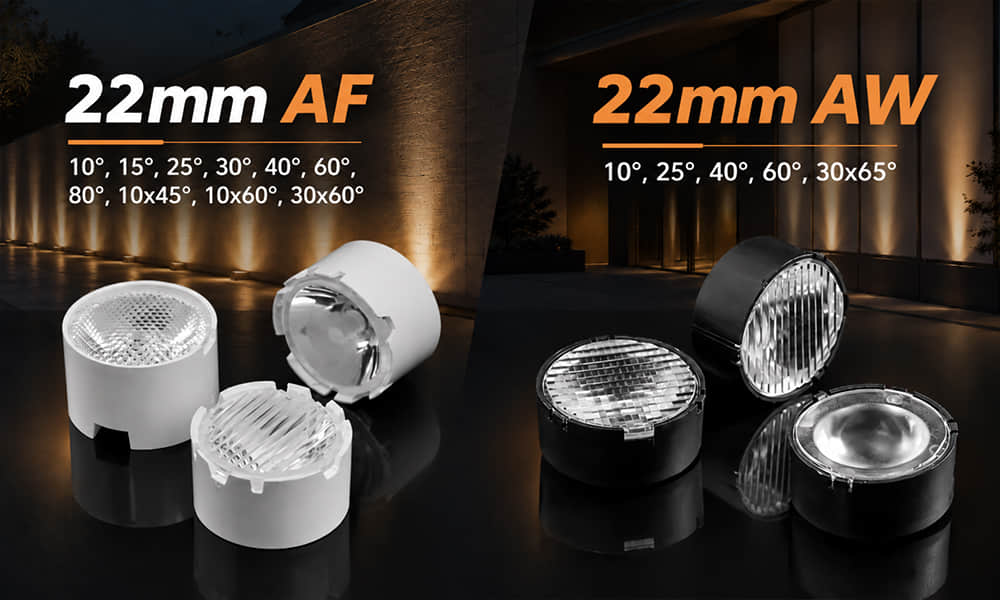
AF Series 22mm Single Lens
The AF Series 22mm Single Lens provides a broad selection of round and oval distributions for architectural and wall-washer fixture designs. Its range of available beam patterns makes it suitable for projects that need to compare focused, medium, wide, and elongated coverage from one compact optical platform.
- Model series: AF21D12H
- Diameter: Ø21.3 mm
- Beam options: 10°, 15°, 25°, 30°, 40°, 60°, 80°, 10 × 45°, 10 × 60°, and 30 × 60°
- Compatible LED types: 3030 / 3535 / 5050 LED
- Lens material: PMMA
- Holder material: PC
The round beam options can be considered for columns, focused wall sections, and compact architectural fixtures. The oval options are useful when the project needs wider coverage along one direction, such as in linear wall washing or rectangular facade sections.
AX Series 22mm Architectural Lens
The AX Series is another compact option for architectural and landscape wall-washer fixtures. It is designed for 3535 LEDs and includes several beam angles, including an oval 30 × 65° distribution that can be useful for long or wide wall surfaces.
- Model series: AX22D9H
- Diameter: Ø22.4 mm
- Beam options: 10°, 25°, 40°, 60°, and 30 × 65°
- Compatible LED type: 3535 LED
The 10° option can be considered for longer throw distances and tall vertical features. The 25°, 40°, and 60° options offer different coverage widths for architectural fixtures, while the 30 × 65° beam can support wider wall washing in a selected direction. The AX Series is available through the Architectural Lighting Single Lens category .
When an Existing Wall Washer Lens Is Not Enough
An existing lens may not match every wall-wash project. Further evaluation may be needed when the fixture-to-wall distance is unusual, the target wall has a special height-to-width ratio, the LED pitch does not fit an available lens platform, or a prototype shows visible bright spots, dark gaps, or uneven edge coverage.
Other cases include limited fixture height, special mounting angles, strict spill-light control, and a need for a non-standard oval or asymmetric distribution. In these situations, the LED datasheet, PCB drawing, luminaire dimensions, wall geometry, fixture layout, and target beam pattern should be reviewed together.
If an existing optic cannot meet the optical and mechanical requirements, Asahi can evaluate the project through its custom LED lens development service . The first step is to identify whether an existing lens can meet the required wall pattern before a new optical design is considered.
Request an Existing Wall Wash Lens Recommendation
To request an existing lens recommendation for a wall washer light, please provide:
- LED manufacturer, model, package, and datasheet
- PCB layout, LED quantity, and LED pitch
- Fixture drawing and available internal dimensions
- Distance between the fixture and the wall
- Wall height, width, material, and surface texture
- Fixture mounting height, aiming direction, and spacing
- Required beam angle or target wall-coverage image
- Indoor or outdoor installation requirements
- IP, material, sealing, and environmental requirements
- Existing IES file, light-distribution curve, or prototype image if available
With these inputs, Asahi can compare suitable AF Series, AX Series, and other architectural optics to recommend a practical starting point for fixture development and optical validation.