Dental treatment requires a clear view of a small and highly detailed working area. A well-designed dental lighting optics system helps dentists see teeth, gums, restorative materials, and instruments with consistent illumination throughout the procedure. The objective is not simply to increase brightness. The optical system must control the beam direction, light spot size, edge transition, glare, and uniformity at the actual working distance.
Asahi Optics develops precision optical components for dental lighting, including dental examination lights, dental operatory lights, and compact medical luminaires. Our lenses are designed to work with the selected LED, PCB layout, lamp-head geometry, and required treatment-field pattern.
What Is Dental Lighting?

Dental lighting refers to the illumination used directly during dental examination and treatment. Unlike general room lighting, a dental light must deliver controlled illumination to the oral cavity while limiting unwanted light outside the treatment area.
This page focuses on the optical requirements of:
- Dental operatory lights used above a treatment chair
- Dental examination lights for routine diagnosis and inspection
- Dental overhead lights mounted on a ceiling or articulated arm
- Chair-mounted and dental-unit lights
- Wall-mounted, mobile, and portable dental lights
These products should be distinguished from dental curing lights, teeth-whitening lights, and dental headlights. Curing and whitening systems have different optical objectives, while a headlight is worn by the clinician and normally uses a different mechanical and beam configuration. The recommendations on this page are intended for dental treatment and examination luminaires.
Common Types of Dental Examination and Operatory Lights
Ceiling-Mounted Dental Lights
A ceiling mounted dental light or articulated dental ceiling light can be positioned around the patient and treatment chair. Because the lamp head may be moved repeatedly, its optical system must maintain a predictable beam when the angle or working distance changes.
The lens needs to control the useful treatment field without creating excessive spill light on the ceiling, walls, equipment, or the patient's eyes. Compact single-lens modules can also help designers arrange several LEDs in a relatively small lamp head.
Chair- or Unit-Mounted Dental Operatory Lights
A chair-mounted dental operatory light is usually installed close to the treatment area. Its lamp head may have limited space for the LED board, holder, heat sink, and optical components. The lens therefore has to produce the required illumination pattern within a short optical package.
For these systems, the LED package, emitting surface, lens height, and mounting tolerance should be reviewed together. A lens with a nominal beam angle that appears suitable on paper may produce a different spot when the LED-to-lens distance or lamp-head position changes.
Wall-Mounted Dental Lights
Wall-mounted dental lights are fixed to a bracket or articulated arm. Their optical design must direct light toward the chair and avoid unnecessary illumination of nearby surfaces. A controlled beam can improve visual comfort and reduce distractions in a compact treatment room.
When selecting a dental examination light lens for a wall-mounted design, the optical team should consider the distance from the wall to the patient's mouth, the adjustment range of the arm, and the required spot shape.
Mobile and Portable Dental Lights
A mobile dental light or portable operatory unit may be repositioned between rooms or treatment areas. Repeated movement makes beam stability and mechanical alignment especially important. The lens should remain securely located over the LED and should continue to produce a consistent spot after lamp-head adjustment.
Small-diameter optics are often useful when the portable lamp head must remain light and compact. Thermal conditions, cleaning procedures, and the available mounting structure should also be considered before selecting the material and lens geometry.
Lighting Problems a Dental Light Must Solve
Clear Illumination Inside a Small Oral Cavity
The treatment area inside the mouth contains small contours, reflective surfaces, and areas that can be partially hidden by instruments. An uncontrolled LED beam may create bright regions in one area while leaving another area difficult to inspect.
Proper dental examination light optics collect and direct the available LED output toward the oral cavity. The lens should support a useful working field without wasting a large proportion of the light outside the area that the clinician needs to see.
Uniform Light Across the Treatment Field
A treatment field with a very bright center and a dark edge can make visual inspection less comfortable. It may also require the operator to reposition the lamp repeatedly. For this reason, dental light designers evaluate the complete light spot rather than looking only at peak illuminance.
In a multi-LED design, individual beams should overlap correctly at the specified working distance. The optical arrangement, LED spacing, and lens angle all affect the resulting dental light uniformity.
Shadow Control from Hands and Instruments
Hands, dental instruments, and the clinician's head can block a direct beam. Using several LEDs with individual optics allows light to reach the treatment field from different directions. When the beams are designed to overlap, the system can reduce strong, distracting shadows.
Shadow performance depends on the entire luminaire, including LED arrangement, reflector geometry, lamp-head size, and the position of the optical modules. A single lens cannot compensate for an unsuitable LED layout, so the lens and PCB should be evaluated as one system.
Glare and Visual Comfort
A dental lamp is often positioned relatively close to the patient's face. Uncontrolled high-angle light can cause discomfort even when the treatment field itself is properly illuminated. Beam cut-off, edge softness, and lamp-head shielding all contribute to glare control for dental lights.
The optical lens should keep the useful light within the intended treatment area and reduce unnecessary spill toward the patient's eyes. The final evaluation should be performed with the actual lamp head, LED current, diffuser or cover, and mounting angle.
Stable Color Appearance for Clinical Observation
Color appearance is relevant when dentists inspect teeth, gums, and restorative materials. However, correlated color temperature and color rendering are primarily determined by the LED source and the complete lighting system. A transparent optical lens mainly controls collection, direction, beam shape, and distribution.
Therefore, dental lighting optics should be selected together with the required LED spectral specification. The optical lens should not be described as the sole component that sets CCT or CRI.
Maintaining the Beam During Lamp-Head Repositioning
Dental lights are commonly adjusted during treatment. If the lens is not accurately aligned with the LED, moving the lamp head can produce an unexpected shift in the light spot or an uneven edge. Lens positioning features, PCB tolerances, and the mechanical holder are important parts of the design.
How the Optical Lens Affects Dental Light Performance
Light Collection from Each LED
The first function of a dental light lens is to collect a useful portion of the LED output and direct it toward the treatment area. Diameter, height, focal geometry, and the LED's emitting surface must be matched.
A mismatch between the LED package and the lens can lead to excessive spill, a distorted beam, or a loss of useful intensity. This is why a dental light optical lens should be selected from verified LED compatibility data instead of beam angle alone.
Beam Shape and Working Distance
Beam angle is not the same as the final light spot size. The distance between the lens and the LED, as well as the distance from the lamp head to the patient's mouth, changes the size and shape of the illuminated field.
For an oval or rectangular treatment field, the design team may need an asymmetric or free-form optical surface. The target should be specified at a defined working distance, such as the distance used in the lamp's photometric test.
Overlapping Multiple LED Beams
In a multi-LED dental lamp, every LED and lens pair contributes to the final pattern. The beams should overlap smoothly at the treatment plane. Incorrect spacing can create multiple bright spots, dark gaps, or a central hot spot.
Optical simulation and prototype testing are useful for checking the interaction between lens angle, LED spacing, drive current, and lamp-head geometry. IES or other photometric data can then be generated from the complete luminaire rather than from an isolated lens.
Edge Control and Unwanted Spill
The outer portion of the beam should transition in a controlled way. A well-designed edge can help maintain visibility across the treatment field while reducing light outside the patient's mouth.
Edge performance is influenced by the lens surface, LED position, cover glass, and the alignment of neighboring modules. It should be checked at the intended distance and at the lamp-head angles used in normal operation.
LED-to-Lens Alignment and Assembly Tolerance
Even a precise optical design can perform poorly if the LED is not centered under the lens. During product development, the following details should be reviewed:
- LED center position and emitting-area dimensions
- PCB hole pattern and component height
- Lens holder and locating features
- Lens-to-LED distance
- Allowed lateral and angular assembly tolerance
- Clearance for the cover, reflector, and heat sink
Key Parameters for Selecting Dental Light Optics
The following information helps an optical manufacturer recommend a suitable dental operatory light lens:
| Design parameter | Why it matters |
|---|---|
| LED manufacturer and model | Defines the emitting area, output level, and optical compatibility. |
| LED package | Determines whether a 3535, 5050, XML, or another lens platform is appropriate. |
| Number and arrangement of LEDs | Influences total output, beam overlap, shadow control, and lamp-head dimensions. |
| Working distance | Determines the actual spot size and distribution at the treatment area. |
| Target spot size and shape | Guides the choice between circular, oval, rectangular, symmetric, and asymmetric optics. |
| Uniformity requirement | Helps control the difference between the center and edge of the treatment field. |
| Lamp-head dimensions | Limits the lens diameter, height, spacing, and possible LED count. |
| Lens-to-LED distance | Affects focus, beam concentration, and the final optical efficiency. |
| PCB drawing | Allows the lens and holder position to be checked against the actual assembly. |
| Cleaning and operating environment | Supports appropriate material and surface decisions for repeated maintenance. |
Asahi's existing dental-light reference shows a light spot of 16 cm × 8 cm at 70 cm from the lighting device. This is a reference result for a specific product and test configuration, not a universal value for every dental lamp. Actual performance depends on the LED, PCB, drive current, lens spacing, working distance, and complete luminaire structure.
Selecting Optics by Dental Light Configuration
Multi-LED Overhead Operatory Lights
Multi-LED overhead lights can use individual lenses to create overlapping beams from several positions. This approach supports uniform illumination and helps compensate when part of the direct beam is blocked by the operator or an instrument.
The recommended lens angle should be evaluated with the exact LED pitch and working distance. Increasing the number of LEDs does not automatically guarantee a uniform treatment field; the beam intersections must be checked through optical simulation and prototype testing.
Compact Examination Lights
Compact examination lights require a balance between optical performance and mechanical size. A short lens height or small diameter may be important when the lamp head has limited room for the PCB, holder, and heat sink.
In this configuration, the lens should be selected according to the required spot size at the actual examination distance. A narrow beam may be suitable for a concentrated field, while a wider or asymmetric option may be preferable when a larger oval area is required.
Mobile and Wall-Mounted Dental Lights
Mobile and wall-mounted systems benefit from optics that maintain a stable pattern while the lamp is repositioned. Secure locating features and controlled tolerance are just as important as the nominal beam angle.
Dental Lights Requiring an Oval or Rectangular Treatment Field
The oral treatment area is often better served by an oval or rectangular field than by a perfect circular spot. This can be achieved through asymmetric optical surfaces, free-form lens geometry, multiple lens orientations, or a carefully arranged LED board.
The target aspect ratio should be defined before selecting the lens. The design team should also specify how sharply the light should transition at the edge and how much light outside the treatment field is acceptable.
Recommended Asahi Dental Light Optics
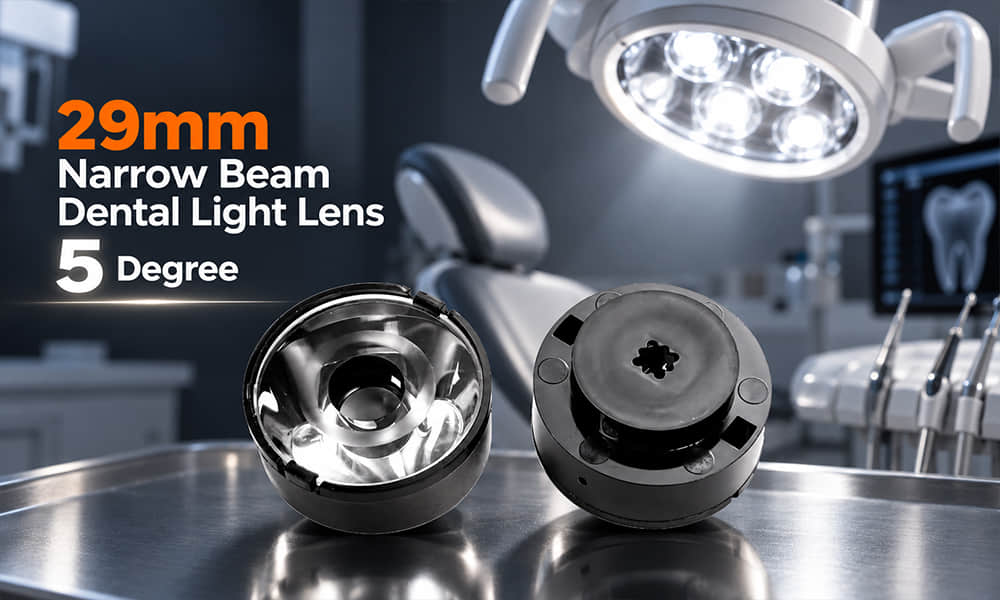
29mm Narrow Beam Dental Light Lens, 5 Degree
The 29mm Narrow Beam Dental Light Lens 5 Degree is designed for compact directional lighting systems and can be considered for dental examination and operatory light projects that require a concentrated beam.
- Model: AYS29DH17-5G
- Diameter: Ø29 mm
- Height: 16.85 mm
- Beam angle: 5°
- Material: PMMA
- Light transmission: more than 90%
- Compatible LED types: 3535 and 5050 LED
Its compact format can help designers build a small lamp head with controlled illumination. The final spot size must still be verified using the selected LED, lens height, working distance, and complete lamp assembly.
35mm Narrow-Beam Medical and Task-Light Lens Series
For projects that use XPE-2, XPG-2, XPG-3, or XML LEDs, the 35mm Narrow Beam Angle Surgical Task Light Lens Series offers several beam options that may be evaluated for dental examination or compact medical task-light applications.
- Diameter: Ø35 mm
- Beam options: 3.8°, 4°, 6°, and 15°
- Compatible LED types: XPE-2, XPG-2, XPG-3, and XML
- Available technical files: lens drawings, PCB drawings, and photometric files for selected models
Customers developing a larger multi-LED medical lamp can also review the Surgical Lighting Single Lens collection for additional diameters and beam angles. The appropriate model should be selected according to the dental lamp's working distance and required treatment-field geometry, rather than by application name alone.
When an Existing Dental Light Lens Is Not Enough
A standard lens may not provide the required result when the PCB layout is fixed, the lamp head has limited internal height, or the project needs a special rectangular proportion. Other common reasons include an unusual LED package, a specific edge cut-off, or a working distance that does not match an existing beam pattern.
In these cases, Asahi can review the LED data, PCB drawing, mechanical envelope, and target photometric result to identify a suitable existing lens or discuss an LED optical design solution. Custom development is considered only when an existing product cannot meet the required optical and mechanical conditions.
Request a Dental Light Lens Recommendation
To request an existing lens recommendation for a dental lamp, please provide the following project information:
- LED manufacturer, model, and datasheet
- Number of LEDs and their arrangement
- PCB layout or mounting drawing
- Lens-to-LED distance
- Working distance from the lamp to the patient's mouth
- Required spot size and shape
- Target illuminance and uniformity requirements
- Lamp-head dimensions and available installation space
- Existing beam photos, polar curves, or IES files if available
With these inputs, our optical team can compare suitable dental light lenses, check mechanical compatibility, and recommend a practical starting point for prototype testing.