
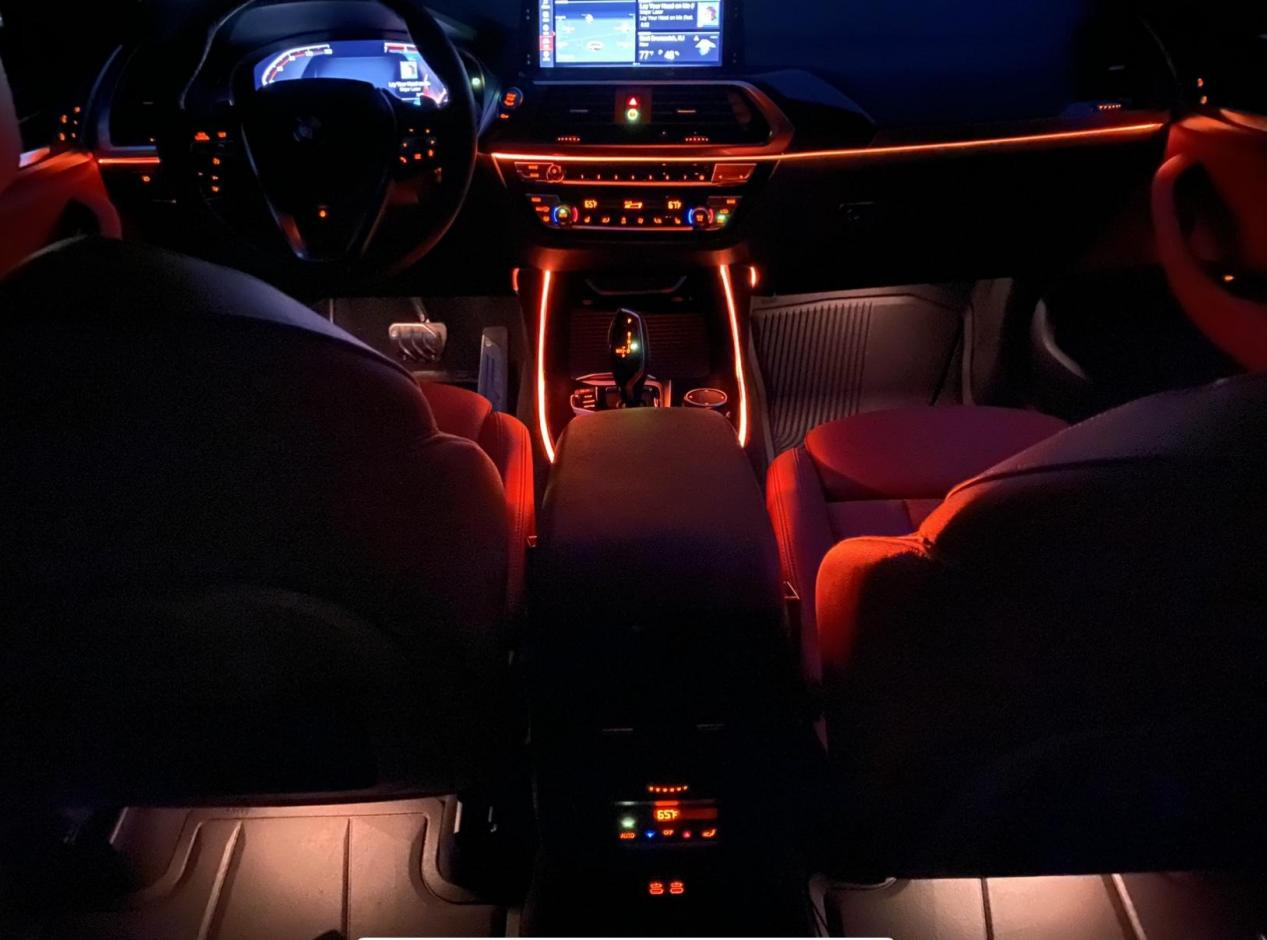
Automotive ambient lighting optics control how LED light is collected, transferred and distributed throughout a vehicle interior. They help transform small point-source LEDs into soft illuminated lines, discreet accent lighting or evenly lit decorative surfaces. Typical locations include the dashboard, door trim, center console, footwell, storage compartments and roofline.
A successful car ambient lighting system depends on more than LED color and electronic controls. The coupling lens, light guide, diffuser, surrounding mechanical structure and interior materials all influence the final appearance. If these elements are not matched correctly, the system may show visible LED dots, brightness variations, color separation or distracting reflections.
This page explains the main automotive ambient-lighting configurations, the optical problems they need to solve and the information required to evaluate a suitable optical solution. For other exterior and interior vehicle-lighting functions, visit the automotive lighting applications section.
What Is Automotive Ambient Lighting?

Automotive interior ambient lighting is low-level illumination integrated into a vehicle cabin to improve its visual atmosphere, highlight interior features and support selected functional cues. Unlike reading lamps or dome lights, ambient lighting is generally not intended to provide high illuminance for a specific task. Its purpose is to create controlled visual accents without distracting the driver or producing uncomfortable brightness.
Depending on the vehicle design, ambient lighting may appear as a continuous line along a door panel, a softly illuminated dashboard surface, a glow around the center console or localized light inside a storage area. The system may use a single static color, tunable white LEDs, RGB LEDs or dynamically controlled multicolor sources.
Modern vehicle ambient lighting can support several design and user-experience functions:
- Highlighting dashboard, console and door-trim contours
- Helping passengers identify controls, storage spaces and cabin boundaries
- Creating welcome, departure and driving-mode lighting effects
- Strengthening a recognizable interior lighting signature
- Providing subtle visual feedback for selected vehicle functions
- Improving the perceived depth and material quality of the cabin
The visual result must remain consistent across multiple components and viewing positions. This makes optical control especially important when designers want a continuous, grain-free light line or an even illuminated surface.
Where Ambient Lighting Is Used Inside a Vehicle
The optical arrangement should be selected according to the installation position, available depth, target surface and required appearance. One solution will not produce the same result in every part of the cabin.
Dashboard and Instrument Panel Lighting
Dashboard ambient lighting is often installed in a narrow channel between trim components. The LEDs may be hidden behind the panel while a light guide or diffuser creates a visible line along the surface.
This location usually offers limited space for the LED, PCB, coupling optic and light guide. The light also needs to remain visually comfortable when observed from the driver’s normal position. Poorly controlled light can reflect in glossy trim, the windshield or instrument surfaces. The optical system therefore needs to direct useful light toward the intended decorative area while limiting unwanted leakage.
Door Trim and Center Console Lighting
Door panels and center consoles commonly use long illuminated lines, curved light guides or indirect light reflected from nearby surfaces. These installations may need to follow complex three-dimensional interior geometry.
One of the main challenges is maintaining consistent brightness from the beginning to the end of the illuminated feature. Differences in guide curvature, extraction structures, trim gaps and surface materials can make one section look brighter than another. A suitable coupling optic and carefully controlled extraction pattern help improve uniformity across the visible line.
Footwell, Storage and Indirect Cabin Lighting
Footwell lighting, cup-holder lighting and storage-compartment illumination generally require soft coverage rather than a sharply defined beam. The LED is frequently hidden so that passengers see the illuminated area instead of the light source itself.
In these applications, a small lens can spread or redirect the LED output toward the target surface. The required distribution depends on the mounting height, angle, available opening and size of the area being illuminated. A beam that is too narrow may create a concentrated bright patch, while an excessively wide distribution can waste light inside the surrounding structure.
Roofline and Decorative Interior Features
Roofline illumination, overhead accent lighting and illuminated decorative elements may use direct lenses, side-emitting light guides or diffused surfaces. These systems often need to remain attractive from several passenger positions rather than from one fixed viewing direction.
The optical design should consider both the illuminated appearance and the unlit appearance. Visible optical structures, joints or LED positions can affect the perceived quality of the interior even when the system is switched off.
Common Optical Problems in Car Ambient Lighting
Many car interior ambient lighting defects cannot be corrected simply by increasing LED power or changing the electronic control settings. They result from the relationship between the light source, optical component, mechanical structure and visible trim surface.
Visible LED Hotspots and Bright-Dark Segments
An LED emits from a relatively small area. When it is placed too close to a diffuser or visible surface, its position may remain noticeable as a bright dot. Multiple LEDs can also produce a repeated bright-dark pattern along a lighting strip.
Increasing diffusion can hide the LED image, but excessive diffusion may reduce optical efficiency and blur an intended lighting feature. Other possible approaches include changing the LED spacing, increasing the mixing distance, improving light-guide extraction or using an optical lens to redistribute light before it reaches the diffuser.
Brightness Loss Along a Long Light Guide
A light guide does not automatically produce equal brightness across its full length. Light is gradually extracted or lost as it travels through the guide. Without compensation, the entrance may appear too bright while the far end becomes weak.
The result depends on factors such as:
- Light-guide material and optical clarity
- Cross-sectional shape and guide length
- Distance and alignment between the LED and guide entrance
- Coupling efficiency at the input surface
- Curves, joints and changes in guide geometry
- Density and orientation of extraction structures
- Single-ended or double-ended illumination
The coupling optic should place as much useful LED output as possible within the accepted propagation angles of the guide. The extraction pattern can then be adjusted along the guide to compensate for the remaining light level.
Uneven RGB Color Mixing
RGB and RGBW packages contain emitters in different positions. If their light is not mixed before entering the visible section, the illuminated line may show colored edges, patches or changes in hue when viewed from different directions.
A successful RGB ambient lighting car system must account for the physical arrangement of the LED dies, the distance available for mixing and the optical behavior of the coupling lens, guide and diffuser. A lens developed for a single-color LED may not provide the same result with a multichannel LED package.
Light Leakage and Unwanted Reflections
Light escaping through panel gaps or reflecting from glossy surfaces can weaken the intended design. Leakage is often associated with incomplete shielding, misalignment between the LED and optic, excessive beam width or variation in the assembled position.
Optical control and mechanical control need to work together. The lens should direct light into the useful path, while holders, barriers and trim structures prevent uncontrolled light from reaching visible surfaces.
Glare in the Driver’s Field of View
Interior ambient lighting is normally viewed against a relatively dark background. Even a small exposed bright area can therefore become uncomfortable at night. Potential problems include a directly visible LED, a bright lens surface or a reflection appearing in the windshield.
Reducing electrical power alone may make the entire feature too dim without eliminating the concentrated bright point. Hiding the source, adjusting the emission direction and spreading luminance over a larger area are often more effective optical approaches.
Variation Caused by Mechanical Tolerances
Small changes in the gap between the LED, lens and light guide can affect coupling efficiency and distribution. Lens tilt, PCB movement, guide deformation and inconsistent assembly pressure may also alter the appearance from one unit to another.
The optical concept should therefore be evaluated together with the mechanical stack-up. Reliable location features and repeatable assembly are necessary if the illuminated effect needs to remain consistent during production.
How Optical Components Affect Automotive Ambient Lighting
LED Coupling Optics
A coupling optic is positioned between the LED and a light guide or target surface. Its purpose is to collect useful light from the source and redirect it into the angular range required by the next optical element.
Efficient coupling can reduce the excessive brightness commonly seen near the guide entrance and deliver more usable light farther into the system. The correct geometry depends on the LED package, emitting-area dimensions, distance to the guide and shape of the entrance surface.
Light Guides and Micro-Optical Structures
Light guides transport light through internal reflection and release it at selected positions. Printed dots, laser patterns, molded microstructures or textured areas can be used to extract light from the guide.
These extraction features are rarely identical along the entire component. Their density or geometry may change to compensate for decreasing light levels. Curved guides may require additional adjustments because bends can alter propagation and increase local losses.
Searches such as fiber optic ambient lighting car and fibre optic car ambient lighting are often used broadly to describe thin, continuous interior light lines. In an engineering project, however, the component may be a rigid PMMA light guide, a flexible light guide or another illuminated structure. The actual material and cross-section must be identified before an appropriate coupling solution can be selected.
Diffusers and Optical Surface Textures
Diffusers soften the LED image and help blend neighboring light regions. They can be separate components or integrated textures on a lens, light guide or decorative cover.
Greater diffusion is not always better. Strong scattering can reduce transmission, enlarge the glowing area or make a narrow illuminated line lose definition. The correct balance depends on LED spacing, mixing distance, desired surface brightness and the appearance of the surrounding trim.
Lenses for Direct and Indirect Illumination
An automotive ambient light lens may spread, focus, redirect or asymmetrically distribute LED light. In a direct system, it helps form the visible illuminated region. In an indirect system, it directs light toward a reflective surface or into a hidden cavity that produces a softer glow.
Lens performance cannot be separated from the complete assembly. LED placement, PCB orientation, housing walls, diffuser position and surface materials can all change the final result. Readers who need a deeper explanation of uniformity and illuminated brand signatures can review our article about the optical system design of automotive ambient lights.
Selecting Optics for Different Ambient Lighting Systems
Point and Local Accent Lighting
Point or local accent lighting is suitable for cup holders, storage areas, door handles, switches and small decorative features. These applications often use one LED and a compact lens.
Before selecting the lens, determine:
- The distance from the LED to the target surface
- The required illuminated diameter or shape
- The mounting direction and available optical height
- Whether the LED or lens is visible to the passenger
- Whether the surface is matte, textured, metallic or glossy
- The acceptable brightness variation across the target area
A narrow distribution can be appropriate for a small, distant target, while a wider or asymmetric distribution may suit a nearby surface positioned to one side of the LED. The required beam cannot be selected accurately from angle alone because installation distance and target geometry also affect the visible result.
Linear Light-Guide Systems
Linear guides are commonly used to create continuous illuminated contours along dashboards, door panels and center consoles. These systems may use one LED at one end, LEDs at both ends or multiple injection points.
Single-ended illumination simplifies wiring and reduces component count, but maintaining brightness over a long guide becomes more difficult. Double-ended illumination can improve far-end brightness, although the two light regions must meet without creating an obvious bright or dark transition.
When evaluating a coupling lens for a linear guide, the LED emission must be matched to the guide entrance. A large alignment error or unsuitable angular distribution can cause substantial input loss. The guide’s extraction structures should then be developed around the actual coupled-light distribution rather than an assumed LED output.
Diffused Light Strips and Hidden Lighting
A diffused strip may use several LEDs behind an optical cover or inside a shallow channel. The main design variables include LED pitch, distance to the diffuser, diffuser transmission and the width of the visible aperture.
If the installation depth is limited, the diffuser may not have enough distance to blend adjacent LEDs. A pre-distribution lens or suitable internal structure can improve overlap before light reaches the visible surface. If more depth is available, the designer may be able to achieve uniformity with a simpler optical arrangement.
RGB and Dynamic Color Lighting
Dynamic LED car ambient lighting can change according to driving mode, user preference or welcome sequences. The optical system must produce consistent mixed color throughout these transitions.
Important considerations include:
- The location of each color die within the LED package
- The mixing distance before the light becomes visible
- Coupling balance between red, green, blue and white channels
- Color-dependent transmission through optical materials
- Color separation at the edges of the illuminated feature
- Consistency between straight and curved sections
Optical samples should be checked at different colors and dimming levels. A system that appears uniform in white may reveal separation when only two color channels are active.
Practical Optical Selection Criteria
Choosing an optic from diameter or beam angle alone is rarely sufficient for an automotive interior project. The following factors should be reviewed together.
LED Compatibility
The LED package name does not always define the exact emitting geometry. Two LEDs with similar outer dimensions may have different die sizes, dome structures or multichannel layouts. Optical evaluation should use the intended manufacturer and LED model whenever possible.
Available Installation Space
Compact interior structures limit the height and width available for the optic. The distance between the LED and visible surface determines how much room the light has to mix. Mechanical clips, ribs, screw bosses and wiring may also block part of the distribution.
Target Appearance
The customer should define whether the required result is a narrow line, broad glow, illuminated icon, local pool of light or reflected accent. Reference images are useful, but measurable information such as visible width, target position and acceptable uniformity makes technical evaluation more reliable.
Interior Materials and Surface Finish
Leather, fabric, coated plastic, metallic trim and wood-like surfaces reflect and absorb light differently. A distribution that appears smooth on a matte surface may create bright reflections on glossy trim. Representative interior materials should therefore be included in prototype evaluation when possible.
Environmental and Production Conditions
Material selection and mechanical design should consider the project’s temperature, vibration, aging and chemical-exposure requirements. These requirements vary by vehicle platform and installation position. They should be provided by the customer instead of assumed from the application name.
The production design must also maintain stable LED-to-optic alignment. An attractive laboratory sample is not enough if normal assembly variation causes visible differences between finished units.
Information Required for an Automotive Ambient Lighting Evaluation
Providing complete project information helps determine whether an existing optic can be tested or whether a dedicated solution is required. Useful inputs include:
- LED information: manufacturer, model, package dimensions, emitting-area data and color configuration
- Electrical layout: LED quantity, PCB arrangement and operating mode
- Mechanical space: available width, height, mounting features and LED-to-target distance
- Optical structure: direct lens, reflector, diffuser, rigid guide or flexible guide
- Light-guide information: material, length, cross-section, curvature and entrance geometry
- Target appearance: illuminated width, shape, color and desired visual uniformity
- Viewing positions: driver, front passenger and rear-passenger observation directions
- Interior materials: trim color, texture, reflectivity and representative samples
- Mechanical files: 2D drawings and 3D models of the relevant assembly
- Reference information: photographs, prototypes or an existing illuminated sample
- Project stage: concept evaluation, prototype development or preparation for production
When available, actual LED samples, guide samples and representative trim components allow the optical result to be assessed under conditions closer to the final assembly.
Recommended Asahi Automotive Ambient Lighting Optics
Asahi offers optical components for several vehicle-lighting functions through its automotive lighting optics product section. For cabin ambient-lighting projects, product selection should start with the intended LED, installation structure and target illuminated effect.
Automotive Ambient Light Lens
The Automotive Ambient Light Lens is the most directly relevant existing product for this application. It is designed to provide controlled, soft and uniform light diffusion for automotive interior lighting. The current product information lists light transmittance of 93%.
This lens can be considered when evaluating localized ambient illumination or an optical element within a wider interior-lighting assembly. Final suitability still depends on LED compatibility, mechanical alignment, target geometry and the other optical components used in the system.
For an initial recommendation, customers can provide the LED model, available dimensions, installation drawing and photographs or renderings of the desired illuminated effect. Asahi can then review whether this existing lens is appropriate for sample evaluation.
When an Existing Ambient Light Lens Is Not Enough
Automotive interiors frequently use platform-specific curves, narrow installation channels and distinctive illuminated patterns. An existing lens may not match the light-guide entrance, mechanical envelope or target appearance of every project.
If no standard product provides the required result, Asahi can evaluate the project through its automotive LED lens design service. This path can cover optical simulation, mechanical coordination, prototype evaluation, mold development and production according to the confirmed project requirements.
The custom-design capability is presented here only as an alternative when an existing optic cannot meet the application. The first step should still be to define the lighting problem and determine whether an available automotive lens can be tested.
Build a More Uniform Automotive Ambient Lighting System
High-quality automotive interior accent lighting comes from coordination between the LED, coupling optic, light guide, diffuser, housing and visible trim. Selecting these elements independently can lead to hotspots, uneven brightness, color separation, leakage or excessive glare.
A reliable evaluation begins with the actual LED and mechanical layout. It then considers where the light needs to enter, how it travels through the system and how passengers will see the final illuminated surface. Prototype testing should reproduce the intended guide, diffuser, trim material and assembly position as closely as possible.
Send Asahi your LED model, installation dimensions, target lighting effect and available drawings to request an existing lens recommendation for your automotive ambient-lighting project.