Choosing LED parking lot lighting fixtures starts with the lighting the site needs—not with a wattage-equivalence chart. A suitable fixture must deliver useful illumination across parking spaces, driving lanes and pedestrian routes while fitting the available poles, electrical supply and operating conditions.
For facility teams, lighting specifiers and luminaire manufacturers, the most reliable comparison combines complete-luminaire photometric data with a site layout. This is especially important in a retrofit: a fixture that fits an existing pole does not automatically reproduce the old installation’s light distribution.
Start with the Site and Existing Equipment
Before requesting replacement fixtures, document what is already installed and which problems the project needs to solve.
- Site layout: Parking spaces, vehicle lanes, pedestrian routes, entrances, neighboring properties and significant obstructions.
- Existing poles: Locations, mounting heights, number of fixtures per pole and mounting interfaces.
- Existing equipment: Fixture and lamp types, supply voltage, controls and complete-system input power where available.
- Current problems: Dark areas, excessive glare, light spilling beyond the property, failed equipment or difficult maintenance access.
- Operating schedule: Hours of use, expected activity after closing and any required dimmed operating periods.
For a new installation, the same site information helps determine where poles and fixtures should be placed. For a retrofit, it establishes which parts of the existing infrastructure can be considered for reuse.
Compare Delivered Illumination, Not Just Watts and Lumens
Watts describe electrical input; lumens describe total light output. Neither tells the buyer how much light reaches the far end of a parking row or the pedestrian route between vehicles.
Two fixtures with similar lumen ratings can produce different results because they distribute light differently. One may create a bright patch near the pole while leaving a darker area between poles. Another may direct more of its output toward that area.
Request a point-by-point photometric calculation for the proposed fixture and layout. Review at least:
- Average illuminance: An overall indicator for the defined calculation area.
- Minimum illuminance: The lowest calculated value within that area.
- Uniformity: The relationship between values across the area, using the ratio and calculation method specified for the project.
- Critical locations: Entrances, pedestrian crossings, areas between poles and other locations identified in the site plan.
- Property boundary: Light reaching neighboring land or other locations subject to project limits.
Compare plans only when they use the same site geometry, calculation area, grid, maintenance assumptions and operating mode. A higher average does not necessarily mean that the darkest part of the parking lot is better lit.
For U.S. projects, the IES recommended practice for roadway and parking facilities is one resource for the lighting design team. The applicable criteria should be determined for the project and its jurisdiction; there is no single illuminance target that applies to every parking lot.
Confirm That the IES File Matches the Quoted Fixture
A photometric plan is only as useful as the fixture data used to create it. Ask the supplier to identify the exact luminaire configuration represented by the IES or LDT file.
Check that the file corresponds to the quoted optical distribution, light-output package and installation orientation. If the fixture is offered with selectable output or different optical options, confirm which settings were used in the calculation.
For a project with dimmed operating periods, request the information needed to evaluate that mode as well. Do not assume that a full-output plan proves the site will meet its requirements after dimming.
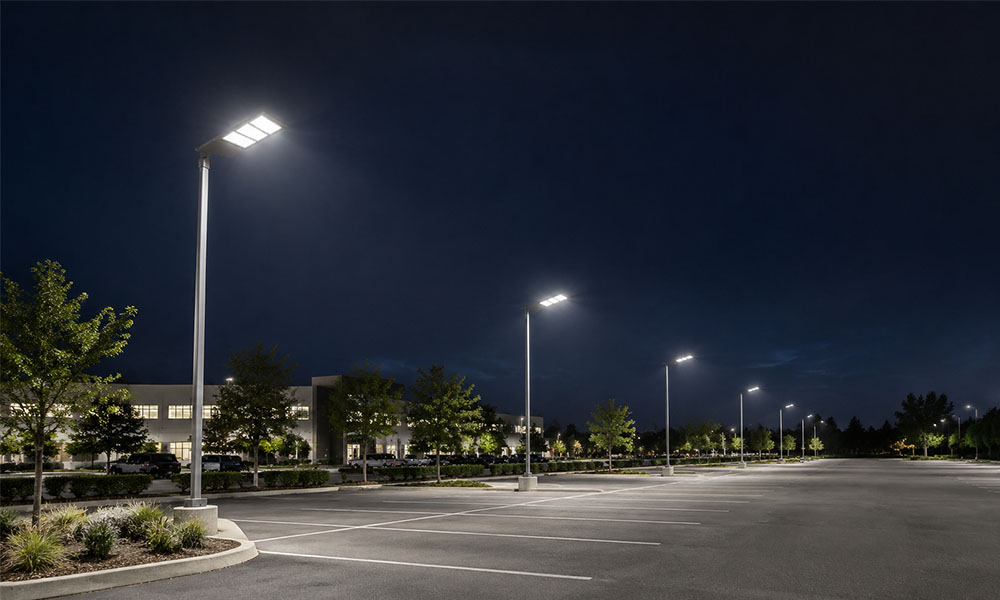
Our parking lot lighting application guide explains how site geometry and optical distribution affect where light is delivered. The fixture’s finished photometric data should be used for the project layout.
Can Existing Parking Lot Poles Be Reused?
Existing poles can sometimes be retained, but physical attachment is only one part of the decision. A qualified project team should assess the complete pole and mounting arrangement for the proposed fixture.
Review the condition of the pole, base and anchor points; mounting height and interface; the number and arrangement of fixtures; and the fixture’s weight and wind loading under applicable local requirements. Also confirm the available supply voltage, wiring condition and compatibility with the intended controls.
Keep the photometric result in the comparison. If the existing pole positions create unacceptable dark areas or boundary spill with the proposed fixtures, a one-for-one replacement may need a different optic, revised layout or additional work.
Check Glare, Boundary Spill and Fixture Aiming
A fixture should light the intended area without creating avoidable brightness in the direction of drivers, pedestrians or neighboring properties.
Review the site plan from the relevant viewing positions and check where light falls beyond the property boundary. Shields or alternative distributions may be worth evaluating, but their effect should be included in the photometric data used for the layout.
Avoid treating upward tilt as a simple way to extend coverage. Tilting changes the installed distribution and may increase glare or uplight. A DOE-hosted discussion of tilted outdoor lighting explains why a luminaire’s reported backlight, uplight and glare characteristics depend on its installation orientation.
If the fixture needs to be tilted, assess the proposed aiming angle in the design rather than assuming that ratings reported for the original orientation remain unchanged.
Review Controls and Nighttime Operating Modes
Photocells, schedules and occupancy controls can reduce unnecessary operation, provided the resulting lighting still meets the site’s requirements.
Before selecting controls, establish the expected activity pattern and determine which areas must remain illuminated. Check sensor coverage, response time, compatibility with the driver and the lighting level in each programmed mode.
For example, independently dimming individual poles may leave the area around a pedestrian bright while adjacent spaces remain dark. Depending on the site, coordinated zones may provide a more suitable transition. The selected control strategy should be evaluated together with the site’s lighting and security requirements.
Check Outdoor Suitability and Maintenance
Compare the complete luminaire’s documentation with the installation environment and applicable market requirements. Useful items include:
- Outdoor and wet-location suitability where required.
- Ingress protection appropriate to the expected exposure.
- Ambient-temperature range and relevant material or corrosion information.
- Surge-protection specifications appropriate to the electrical design.
- Applicable safety certifications and the exact product configuration they cover.
- Driver serviceability, spare parts and warranty terms.
These items address different aspects of the product. An IP rating, a component certification or a surge-protection claim does not automatically establish complete-luminaire suitability.
When comparing energy use, use the input power of the complete existing and proposed systems, together with the actual fixture quantities and operating schedules. The U.S. Department of Energy’s exterior lighting guidance discusses luminaire efficacy and controls; the purchase requirements on that page apply to the specified federal procurement categories, not automatically to every project.
Optical Selection for Parking Lot Luminaire Manufacturers

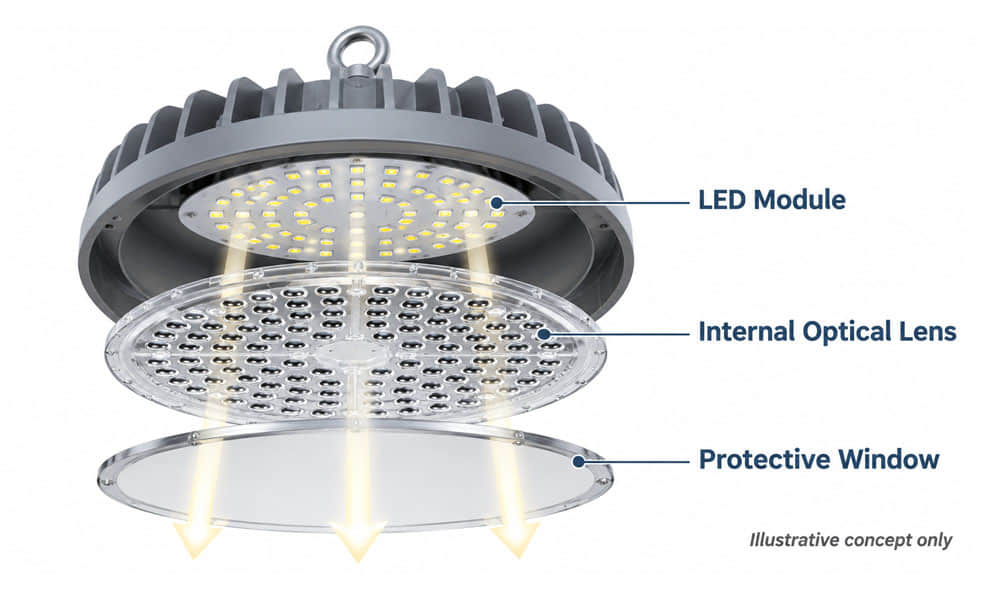
For an OEM developing an LED parking lot fixture, the secondary optic is one part of the complete design. It must work with the selected LED, PCB, housing, mounting orientation and target distribution.
Asahi’s street and area lighting lens range provides existing optical components for evaluation. A component’s stated distribution or compatibility does not establish the performance, ingress rating or certification of the finished luminaire.
Contact Asahi Optics with the LED model, PCB arrangement, available optical space, intended mounting height and target distribution. If available, include the site geometry or an existing photometric file. We can help identify existing optics worth evaluating, apparent source or mounting constraints, and the information needed for the next optical review.