The main advantages of using LEDs for industrial lighting are potentially lower energy use, fewer high-level maintenance interventions, more flexible light distribution and better control of when and where lighting operates. LED systems also offer a range of options for color rendering and visual comfort.
For luminaire manufacturers, lighting engineers and facility teams, these benefits depend on the complete installation—not simply on choosing an LED light source. The driver, optics, controls, mounting arrangement and operating environment all influence the result. Compare the proposed system with the equipment actually in use, whether that is HID, fluorescent or another lighting technology.
Lower Energy Use in Long-Hour Industrial Facilities
LED lighting can reduce the electricity needed for an industrial task when the complete LED installation delivers the required illumination with lower system input power.
The comparison should start with the work area, not a lamp’s wattage-equivalence claim. A lower-power fixture is not an equivalent replacement if it leaves rack faces, workstations or circulation areas inadequately lit.
For an installation operating at a constant input power, a basic estimate is:
Annual energy use (kWh) = Number of luminaires × System input power (W) × Annual operating hours ÷ 1,000
Use the input power of the complete system, including the existing ballast or new driver where applicable. If the new layout uses a different number of luminaires, calculate each installation separately. Where lighting operates at different power levels, calculate each operating period separately and add the results. Include relevant control-system standby consumption where it affects the comparison.
Keep two sources of savings distinct: a more efficient system may use less power while operating, while controls may reduce operating hours or output when full lighting is unnecessary. Neither benefit can be assigned one fixed percentage for every facility.
Fewer High-Level Maintenance Interventions
In a high-bay installation, the cost of maintenance includes more than the replacement component. Access may require a lift, a temporary aisle closure, production coordination or work outside normal shifts.
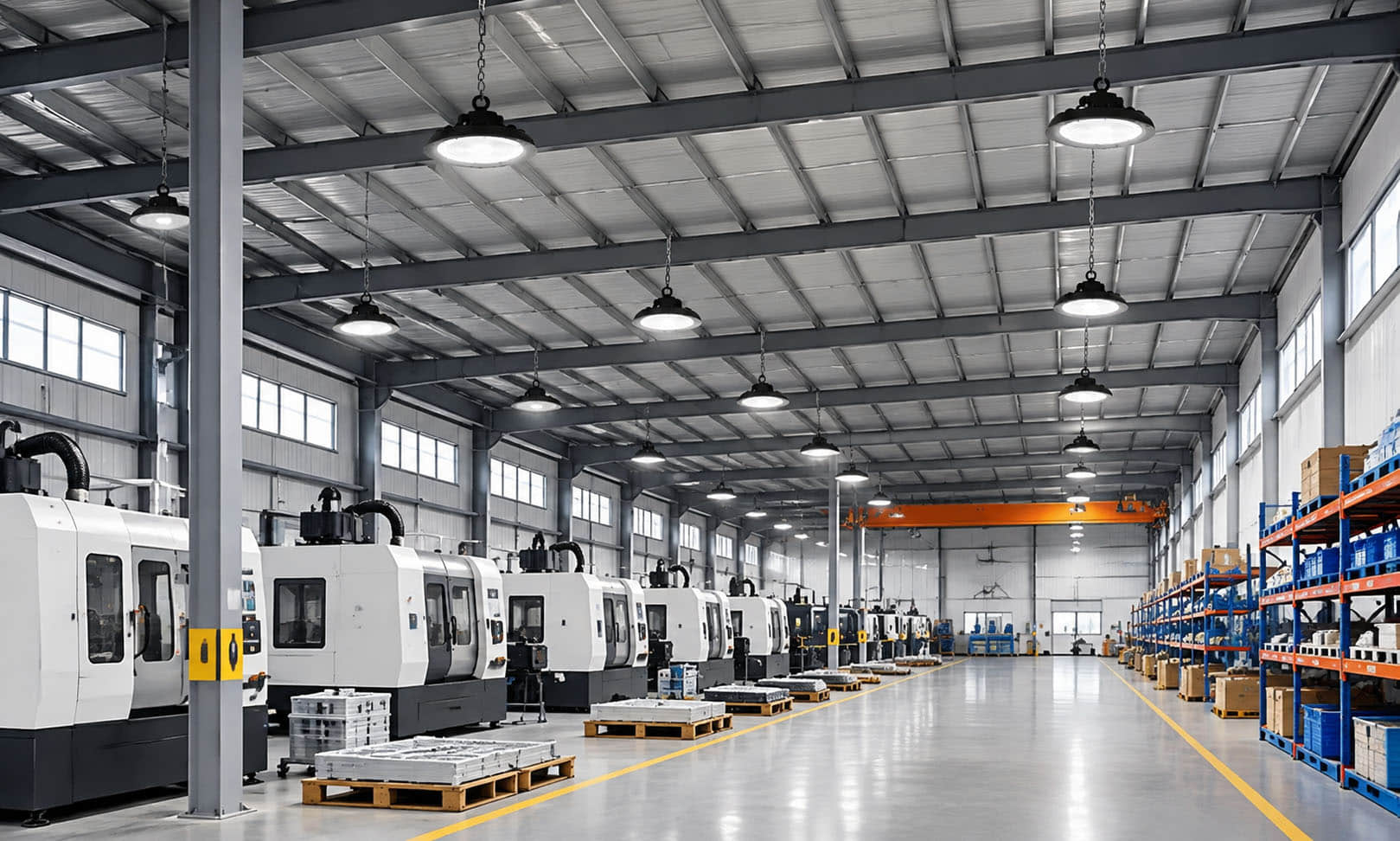
Industrial LED high bay lighting can reduce these interventions when the complete luminaire is designed and operated for the site conditions. This can be especially valuable above machinery, storage racks or production lines where access is difficult.
Before accepting a maintenance claim, ask:
- Does the reliability information apply to the LED component, the driver or the complete luminaire?
- Is the fixture suitable for the expected ambient temperature and operating hours?
- Can the driver or light engine be replaced, and are suitable spare parts available?
- How will the facility monitor light levels and plan maintenance?
An LED component’s lumen-maintenance rating does not, by itself, establish the life of the complete fixture. For a closer look at operating hours and interpreting maintenance data, see how much LED lights dim after three years.
More Useful Light on Floors, Workstations and Rack Faces
One practical benefit of LED industrial lighting is the ability to design a luminaire around where the work takes place. Total lumens alone do not show how much light reaches a specific surface.
Different industrial areas can have different priorities:
- Open production floors: Light must reach the working plane with suitable continuity between fixtures and around equipment.
- Warehouse aisles: Floor illumination matters, but workers may also need adequate light on vertical rack faces, labels and stored goods.
- Inspection stations: Light direction, shadows and reflections can affect whether a surface detail is easy to see.
For example, increasing the total output of a high-bay fixture does not necessarily solve a dark rack label if much of the added light reaches the aisle floor instead. The distribution and installation geometry must be assessed together.
Secondary optics can help direct LED output toward the required area, but a nominal beam angle alone cannot establish the illuminance or uniformity of a finished layout. Our industrial lighting optics guide explains how application geometry influences optical selection.
Instant Light and More Flexible Zone Control
Many LED systems provide rapid light output after switching and can be paired with compatible dimming and control equipment. This is useful when comparing them with HID installations that require warm-up or restrike time.
The control strategy should follow how each area is used:
- Continuously occupied production areas: Maintain the lighting needed for normal operation rather than assuming frequent switching will save energy.
- Intermittently used aisles: Occupancy-based control may reduce output when the area is unoccupied, subject to the site’s visibility and safety requirements.
- Areas with daylight: Compatible daylight controls may reduce electric lighting when sufficient natural light is available.
The U.S. Department of Energy’s commercial and industrial LED luminaire purchasing guidance identifies occupancy sensing, task tuning and dimming as control strategies that can support energy savings where applicable.
Actual savings depend on occupancy patterns, sensor coverage, commissioning and the permitted light levels. Controls must also be coordinated with the facility’s safety and emergency-lighting requirements.
Lighting Quality Matched to the Industrial Task
An LED system can be specified for more than illuminance. The relevant visual requirements depend on what people need to identify and how they view it.
Color Recognition
When workers distinguish wires, labels, coatings or material defects by color, evaluate the source’s color-rendering characteristics against those materials. Color temperature describes the appearance of the light; it does not, on its own, establish whether colors will be rendered adequately.
Visual Comfort and Reflections
A bright source visible above a workstation or a strong reflection on polished metal can make a task uncomfortable even when the measured illuminance is adequate. Review luminaire position, shielding and viewing direction together with the properties of the work surface.
Flicker and Moving Equipment
Do not assume that every LED fixture is flicker-free. Light output can vary over time depending on the driver, load, dimming level and control combination.
The U.S. Department of Energy’s flicker research explains that no single metric describes every application or response. Near rotating machinery, ask for suitable temporal-light data under the intended operating and dimming conditions. The absence of obvious flicker to the eye does not, by itself, establish that stroboscopic effects are absent.
What to Check Before Specifying Industrial LED Lighting
Use the expected benefit to decide what evidence to request from the luminaire supplier or project team.
| Expected Benefit | Evidence to Review |
|---|---|
| Lower energy use | Complete-system input power, fixture quantity and operating schedule for both installations. |
| Useful illumination | Photometric calculations or measurements for the actual layout and relevant working surfaces. |
| Reduced maintenance | Complete-product reliability information, serviceable components and spare-part availability. |
| Effective controls | Compatibility, sensor coverage, operating settings and commissioning plan. |
| Environmental suitability | Applicable temperature, ingress-protection, material-resistance and other project-specific documentation. |
Heat resistance, dust protection, corrosion resistance and suitability for hazardous locations are not automatic properties of an LED source. Check the complete product and any required certifications against the conditions and rules applicable to the project.
Discuss the Optical Requirements of Your Industrial Luminaire
For an industrial luminaire project, send Asahi Optics the LED part number, mounting height, target area or approximate layout, required lighting effect and available optical space. Existing drawings or photometric files are useful when available.
Contact Asahi Optics for an optical assessment. We can help identify existing lenses worth evaluating, obvious source or mounting constraints, and the additional information needed for the next selection step. The optical review supports the luminaire design; it does not replace complete-system electrical, thermal or site validation.