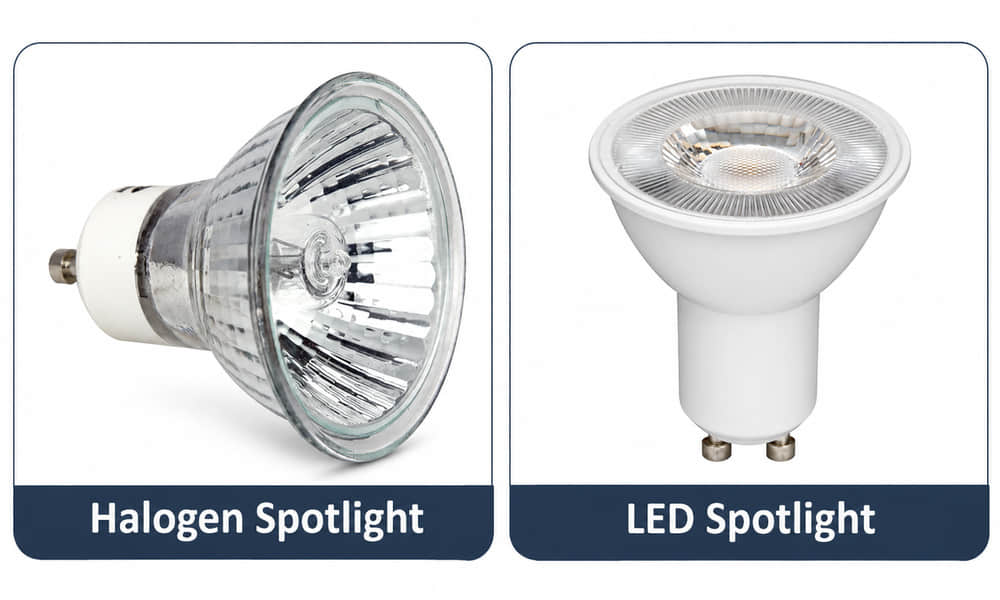
The right LED alternative to halogen is often a compatible finished replacement lamp—not a newly designed optical system. If that lamp meets the lighting requirement and works with the existing fixture, supply and controls, redevelopment may add unnecessary complexity. When no suitable replacement meets those conditions, compare an OEM redesign with replacing the complete luminaire.
For lighting manufacturers and project teams, the key decision is what can reasonably be retained. Our halogen vs LED comparison covers the broader technology differences. This guide focuses on choosing an implementation route and identifying the constraints that can change that choice.
Choose Between a Replacement Lamp, OEM Redesign and New Luminaire
Start with the least extensive change that meets the complete requirement. Keeping an existing housing is useful only if it does not create disproportionate electrical, thermal, optical or maintenance problems.
| Route | When It Makes Sense | What Must Be Confirmed |
|---|---|---|
| Finished LED replacement lamp | A manufacturer-supported replacement can deliver the required lighting effect without modifying the luminaire. | Lamp base, supply rating, control compatibility, physical fit and permitted operating environment. |
| OEM optical and light-engine redevelopment | There is a clear reason to retain parts of the existing structure, but finished replacement lamps cannot meet the requirement. | LED source, driver, heat transfer, optical space, mounting interfaces and complete-product validation. |
| Complete luminaire replacement | The old construction restricts performance, service access or integration enough to make redevelopment unattractive. | Installation compatibility, delivered lighting, controls, maintenance access and total project cost. |
A bare LED module with a separate lens belongs to the redevelopment route. It is not interchangeable with a finished replacement lamp simply because it fits inside the same opening.
When Is an LED Replacement Lamp Enough?
A finished LED lamp is a reasonable halogen replacement when its documented operating requirements match the installation and its lighting performance satisfies the project. A matching base or “halogen equivalent” label is only an initial filter.
Before selecting a replacement, record:
- The existing lamp reference: Include its base, electrical rating and dimensions. “MR16” alone is not a complete electrical or mechanical specification.
- The supply equipment: Identify any transformer or external control gear by manufacturer and model.
- The controls: Record the dimmer model, lamp quantity and required operating scenes.
- The installation conditions: Check the available clearance, retaining arrangement, enclosure and relevant environmental restrictions.
Check the Lamp, Transformer and Dimmer Together
For low-voltage installations, do not assume that a transformer which operates halogen lamps will also operate the proposed LED lamps correctly. Electrical loading and control behavior differ.
Lutron’s guidance on dimming low-voltage LED MR16 lamps explains why compatibility depends on the lamp, transformer and dimmer combination. Use manufacturer-supported combinations for the actual equipment and lamp quantity rather than applying a general loading rule.
Flicker, buzzing, unstable startup or an unusable dimming range calls for an electrical compatibility review—not a different lens. Any changes to wiring or supply equipment should be assessed by a suitably qualified professional.
Check Installation Suitability, Not Just Wattage
Lower electrical input does not automatically establish that a replacement lamp is suitable for an enclosed or recessed fitting. Follow the lamp manufacturer’s installation restrictions and temperature requirements.
Also distinguish between tolerating heat and removing heat. A housing that survived a hot halogen lamp does not necessarily provide an effective thermal path for an LED module. This becomes especially important when moving from a finished replacement lamp to an OEM light-engine redesign.
Can the Original Halogen Reflector Be Reused?
Possibly—but source position alone cannot establish compatibility. A halogen reflector was designed around a filament with a particular size, shape and emission pattern. An LED presents a different emitting surface and angular distribution.
First identify which reflector is being discussed. A finished directional LED replacement lamp is evaluated with its supplied optical assembly. Retaining a separate reflector inside the luminaire is mainly a redevelopment question; it should not involve dismantling a finished replacement lamp.
For an OEM design, assess three relationships:
- Source geometry: Can the reflector collect useful light from the selected LED’s emitting area and orientation?
- Source location: Can the emitting surface occupy the required position while leaving room for the PCB and thermal structure?
- Exit path: Do the aperture, cover and shielding transmit the intended distribution without unacceptable obstruction or stray light?
A reflector may remain usable, require adjustment or need replacement. Decide from the resulting distribution and mechanical feasibility—not from whether the LED appears to sit near the original filament position.
When OEM Redesign Is the More Practical Route
Redevelopment is worth evaluating when the project has a firm reason to retain an existing structure, but available replacement lamps cannot satisfy its optical or integration requirements. That reason might be a fixed architectural opening, a specific external appearance or an established product platform.
Resolve the available space before selecting an optic. The LED, PCB, heat-transfer structure, driver, lens and retaining parts must fit together; each cannot be allocated the same remaining volume.
For optical selection, establish:
- The exact LED part number and emitting-area information.
- The target dimensions, working distance and aiming arrangement.
- The usable optical diameter and height.
- The LED-to-optic mounting references and retention method.
- Any cover, bezel or shielding that will remain in the light path.
Then screen existing optics before commissioning new tooling. For compact directional designs, Asahi’s architectural lighting single lenses provide existing component families to evaluate against the selected source and available envelope. They are optical components, not finished halogen replacement bulbs.
If a candidate optic works only by moving the LED into a position that prevents adequate cooling or reliable assembly, it is not a practical match. Optical selection must respect the structure, rather than forcing the structure around a nominal beam angle.
When Replacing the Complete Luminaire Makes More Sense
Consider a new luminaire when preserving the old equipment means replacing most internal components while retaining the same limitations.
Warning signs include insufficient space for cooling and optics, deteriorated mounting parts, inaccessible control gear or a required distribution that the existing aperture cannot accommodate. These conditions do not automatically rule out redevelopment, but they weaken the reason for retaining the housing.
Compare the complete options: engineering effort, components, installation work, validation, maintenance access and replacement support. For a small installation, redevelopment costs may be difficult to justify. For a repeat OEM product, the same work may support a continuing product platform.
The manufacturer or responsible project team should also establish the applicable safety and compliance requirements for the resulting product. Retaining an original enclosure does not, by itself, establish that a modified assembly remains covered by its original assessment.
Approve the Route Before Committing to Quantity

Evaluate a representative finished installation or prototype before purchasing a full batch. Approval should answer whether the selected route works—not merely whether the lamp switches on.
- Mechanical: The assembly fits, remains securely retained and can be serviced.
- Electrical and control: Startup and required operating scenes are stable with the intended equipment.
- Thermal: Relevant component temperatures remain within their specified limits under the intended installation conditions.
- Lighting: The target illumination, beam transition, color appearance and unwanted spill meet the agreed requirement.
For the optical acceptance method, use our guide to matching LED spotlight beam quality to halogen. It explains how to compare the illuminated object and its surroundings without relying solely on matching wattage or beam-angle labels.
Request an Optical Assessment for an OEM Conversion
Asahi Optics supports the secondary-optics part of an LED redevelopment project. Start with the proposed LED part number, target area, mounting geometry and available optical space. Include the original lamp reference and useful drawings or photographs if available.
Request an existing-optic assessment to identify candidate lenses, evident source or mounting constraints, and the additional information needed for evaluation. If existing options cannot meet the optical requirement, the next step is to assess whether custom development is justified. Driver compatibility, thermal design and complete-product approval remain separate responsibilities within the overall project.