The automotive lighting landscape has undergone a fundamental transformation. As noted by industry pioneers like HELLA, LEDs have aggressively replaced classic halogen and xenon bulbs. The reasons are undeniable: phenomenal luminous efficiency, extremely compact dimensions, high color saturation, and inertialess switching.
However, an LED chip on its own is merely a raw, intensely bright electronic component. It cannot illuminate a highway safely, nor can it prevent blinding oncoming traffic. The true magic that transforms this raw semiconductor energy into a safe, compliant, and aesthetically stunning beam pattern is the LED headlight lens.
In this article, we dive deep into the optical mechanics behind modern LED headlights, exploring how advanced refraction, reflection, and ultra-precise lens manufacturing unlock the full potential of automotive LED technology.
The Lambertian Radiator: Capturing the 120° Beam Angle
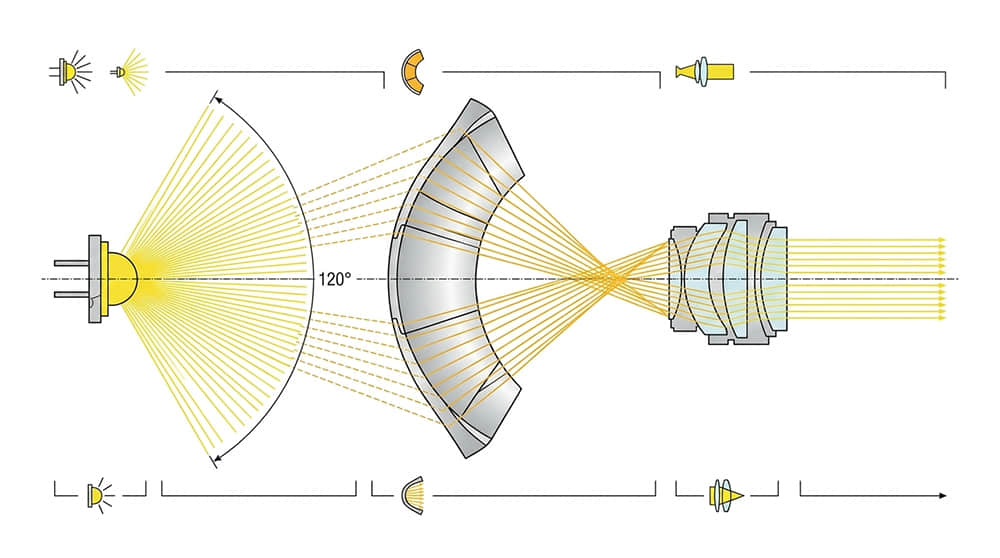
To understand headlight lenses, we must first understand the light source. Unlike a traditional halogen bulb that scatters light 360 degrees in all directions, an LED is a Lambertian radiator. It emits directional light, typically constrained within a 120-degree beam angle.
While this directional nature makes LEDs highly efficient, it completely changes the rules of automotive optical design. The headlight lens system must be perfectly engineered to capture this concentrated 120-degree emission and distribute it without optical loss. To achieve this, modern LED headlamps rely on three primary methods of directing light:
-
Refraction (The Power of Lenses) : This is the core function of an LED headlight lens. As the raw LED light enters the dense optical medium of the lens, its path is bent. By calculating the exact curvature of the lens surface—often utilizing complex freeform designs—engineers can stretch, widen, or focus the beam to match specific driving scenarios.
-
Reflection: Using a reflector bowl to gather the LED's initial output and bounce it forward.
-
Hybrid Optical Systems: In high-end LED headlights, a hybrid approach is the gold standard. A primary reflector or light guide first collects the 120-degree LED light, and then a thick, ultra-clear projection lens perfectly distributes this gathered light onto the road.
Good Glare Limitation and High-Quality Projection
One of the most significant advantages of LED headlights—when paired with a top-tier optical lens—is their exceptional glare limitation.
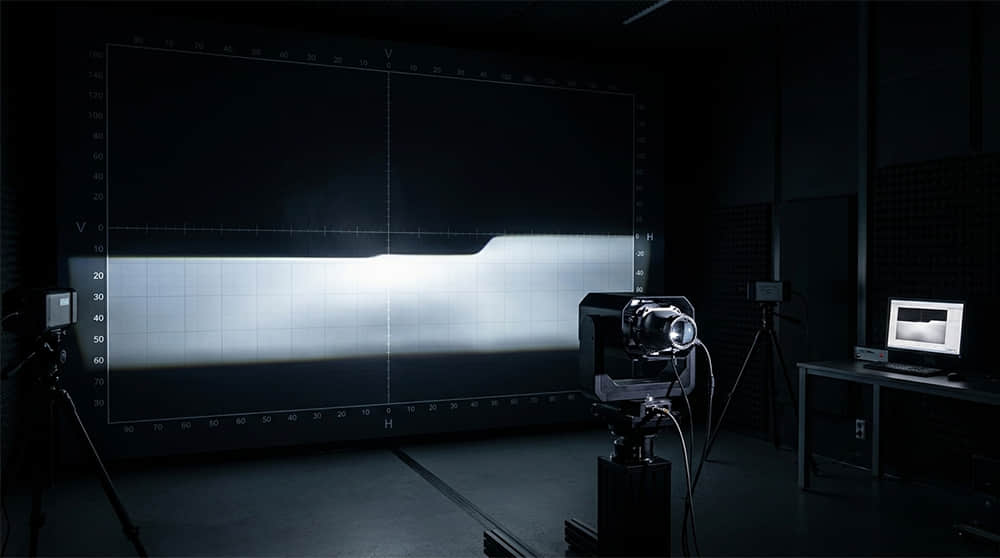
In a Low Beam application, the primary goal is to illuminate the driver's path while maintaining a razor-sharp cut-off line to prevent blinding oncoming drivers. This is where the quality of the headlight lens is tested to its absolute limits.
If the lens surface has microscopic defects, tool marks, or poor injection molding precision, the light will scatter, creating dangerous glare and a blurry cut-off line. A perfectly crafted LED headlight lens ensures that every photon is directed exactly below the legal horizon line, delivering high-contrast, uniform illumination that significantly enhances nighttime driving safety.
Compact Dimensions and Multi-Module Freeform Lenses
Beyond efficiency, one of the most celebrated advantages of LED technology is its extremely compact dimensions. A high-performance LED chip occupies only a fraction of a millimeter. This microscopic footprint has liberated automotive designers from the bulky constraints of traditional halogen reflectors, paving the way for ultra-slim, aggressive, and highly stylized headlight aesthetics.
However, squeezing high-output lighting into narrow, complex housings requires an evolutionary leap in lens design. Modern vehicles no longer rely on a single, massive lens. Instead, they utilize Combined LED Modules, where multiple miniaturized lenses work in perfect concert to generate various lighting functions:
-
High Beam & Low Beam Modules: Separate freeform lenses dedicated to projecting light over long distances or keeping it wide and low with a sharp cut-off line.
-
Adverse Weather Light: Specialized lenses designed to widen the beam horizontally, reducing the glare caused by light reflecting off fog, rain, or snow.
-
Matrix and Adaptive Driving Beam (ADB) : Arrays of micro-lenses where individual LED pixels can be dimmed or turned off dynamically. This allows the headlight to cast a continuous high beam while simultaneously masking out oncoming vehicles.
To execute these multi-module functions, optical engineers employ freeform lens design. Unlike simple spherical lenses, freeform lenses feature highly complex, non-symmetrical, and mathematically calculated surface curves.
The Manufacturing Barrier: Ultra-Precision Machining of Freeform Optics
Designing a brilliant freeform LED headlight lens in optical simulation software is only half the battle. The true industry bottleneck lies in the physical manufacturing. If the mold tooling deviates by even a fraction of a millimeter, or if microscopic machining marks remain on the lens surface, the carefully calculated light distribution will be destroyed, resulting in severe stray light, legal non-compliance, and dangerous glare.
At Asahi Optics, we understand that conquering complex automotive optics demands absolute manufacturing supremacy. We have built an uncompromising tooling and injection ecosystem to translate visionary optical designs into flawless physical components.
World-Class CNC Tooling for Complex Geometries
Crafting molds for multi-module and freeform LED lenses requires machining capabilities far beyond standard industry practices. Our in-house mold facility is powered by a fleet of 19 state-of-the-art CNC machining centers.
To tackle the intricate curves and micro-structures of modern headlight lenses, we deploy 2 ultra-precision Toshiba CNC machines from Japan, working alongside 5 high-speed Roeders, Apas, and Xinquan CNCs. This elite hardware allows us to machine complex freeform mold cavities and delicate optical teeth with an astonishing dimensional tolerance of within 0.01 mm.
SPI A1 Mirror Polishing: Eradicating Stray Light
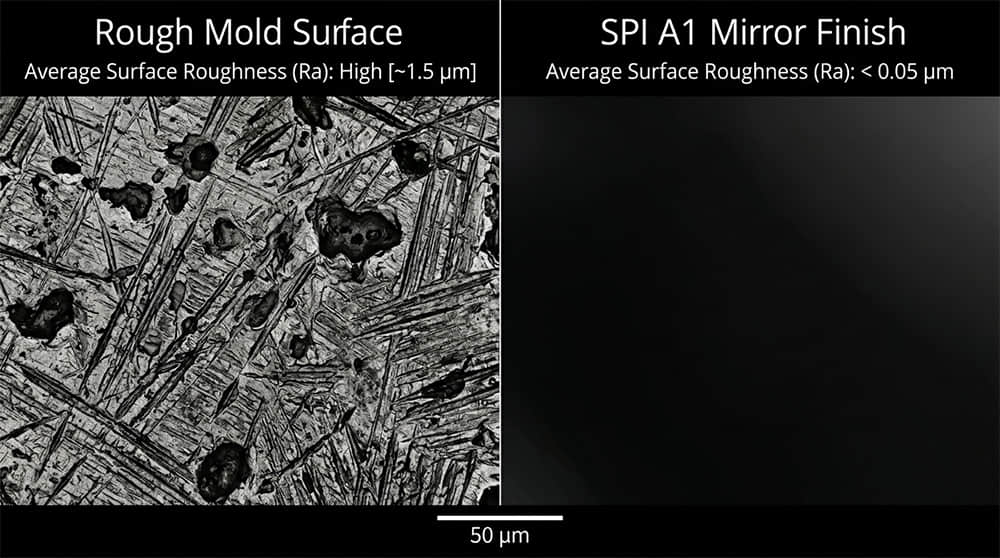
The surface finish of an optical mold directly dictates the clarity and glare-limitation of the final LED lens. Even the finest CNC tool paths leave microscopic ridges that act as unwanted prisms.
Our master polishing craftsmen meticulously hand-finish and automate the polishing of every optical mold to an SPI A1 mirror finish, achieving a surface roughness of just 0.001 mm. This flawless, glass-like smoothness ensures that the injected lens transmits light with zero distortion, guaranteeing the razor-sharp low-beam cut-off lines that premium automakers demand.
Precision Injection and Zeiss CMM Validation
Within our 10K-class cleanroom, we execute ultra-precise injection molding processes to ensure every freeform curve and micro-structure is perfectly replicated in mass production without shrinkage or internal stress.
To close the loop on quality, every batch of automotive lenses undergoes rigorous dimensional validation using industry-leading Zeiss Coordinate Measuring Machines (CMM) . We verify that the physical lens perfectly matches the theoretical freeform CAD model, ensuring that the final light distribution on the road is exactly as the optical engineers intended.
Conclusion: Partnering for Automotive Optical Excellence
The transition to LED automotive lighting has brought unprecedented benefits in efficiency, design flexibility, and driving safety. However, as we have explored, the raw power of a Lambertian LED chip is completely dependent on the precision of the optical system that surrounds it. From capturing the initial 120-degree emission to projecting a flawless, glare-free cut-off line through complex freeform surfaces, the headlight lens is the undisputed core of modern automotive illumination.
Achieving this level of optical magic is not merely a design challenge; it is a profound manufacturing test. Without ultra-precision mold tooling and strictly controlled injection environments, even the most brilliant optical concepts will fail on the road.
At Asahi Optics, we do not just manufacture plastic; we engineer optical perfection. By combining our deep understanding of automotive light distribution with an elite arsenal of Toshiba and Roeders CNC machines, micrometer-level SPI A1 polishing, and Zeiss-validated injection molding, we empower top-tier automotive lighting manufacturers to turn complex LED concepts into flawless physical reality.
Are you developing the next generation of matrix headlights, adaptive driving beams, or combined LED modules? Do not let manufacturing limitations compromise your optical design. Contact Asahi Optics today to discuss your precision tooling and freeform lens injection molding needs.