In the context of the global upgrade of sports infrastructure in 2026, the North American market remains a primary benchmark for the implementation of advanced sports lighting technologies. Recently, the technical team from Asahi Optics conducted a field survey across several U.S. states and engaged in technical exchanges with industry leaders, including Musco Lighting and GigaTera Lighting. These observations provide critical insights into the current trajectory of sports lighting engineering.
The Standardization of U.S. Sports Infrastructure
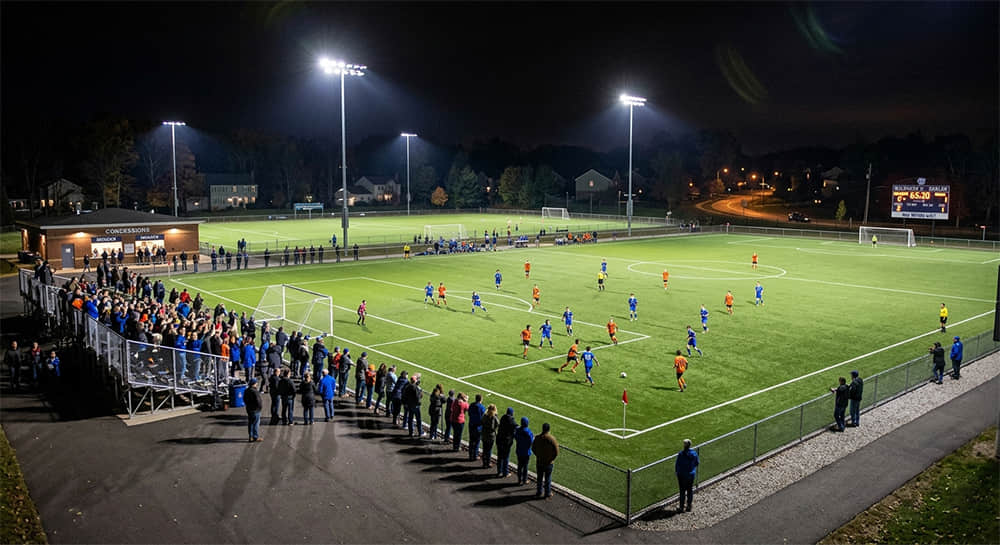
From high school soccer pitches to collegiate stadiums, American sports facilities exhibit a high degree of maturity in infrastructure standardization. The survey revealed that lighting systems are not treated as isolated hardware installations but rather as integrated engineering systems:
-
Standardized Civil Engineering: Pole foundations, power distribution systems, and control interfaces follow strict industry codes, ensuring physical stability and electrical reliability under diverse environmental conditions.
-
Pre-emptive Optical Planning: Lighting design is integrated into the early stages of venue planning. By pre-determining pole coordinates and mounting heights, the requirement for excessive post-installation optical correction is significantly reduced.
Technical Trends from Industry Leaders
Discussions with technical experts from Musco Lighting and GigaTera Lighting an uncompromising focus on "Luminous Flux Management." Technologies such as Musco’s TLC for LED™ emphasize the precision of light spill control. This focus serves a dual purpose: meeting the rigorous visibility requirements of the sport while complying with increasingly stringent municipal light pollution ordinances.
These industry observations confirm that as LED power density increases, raw lumen output is no longer the primary competitive differentiator. Instead, the technical benchmark has shifted toward the efficiency of the secondary optical system—specifically, the ability to direct energy precisely to the field of play while achieving a sharp cutoff to mitigate skyglow and light trespass.
Sports Lighting Design Process & Standards
To ensure a soccer field meets professional operational requirements, the design must adhere to established international benchmarks, primarily IES RP-6-24 (North America) and EN 12193 (Europe). These standards define the quantitative metrics necessary for player safety, spectator visibility, and high-definition broadcasting.
1. Classification of Competition Levels
Lighting requirements are categorized into levels based on the intensity of the competition and the number of spectators. For soccer, these are typically divided into:
-
Class I: Professional and international matches with major spectator capacities and national/international broadcast requirements.
-
Class II: High-level collegiate or regional competitions with moderate spectator seating.
-
Class III: Local club matches and high school sports with limited spectator facilities.
-
Class IV: General training and recreational use.
2. Critical Quantitative Metrics
The design process focuses on three primary optical performance indicators:
-
-
Horizontal Illuminance (Eₕ) : Measures the brightness on the turf. Professional soccer (Class I) typically requires ≥ 800 to 1000 lux.
-
Vertical Illuminance (Eᵥ) : Critical for 4K/8K cameras to capture the athletes' movements and ball trajectory in a 3D space. Broadcast levels often require Eᵥ to be within 70% to 80% of Eₕ.
-
-
Uniformity (U₀, U₁, U₂) :
Eliminating "dark spots" or "zebra patterns" is essential for visual consistency. The most common metric is U₂ (Min/Max), where a ratio of ≥ 0.7 is standard for professional pitches to prevent visual fatigue and tracking errors. -
Glare Rating (GR) :
Glare is a quantified assessment of visual discomfort. For soccer, a GR ≤ 50 is mandatory for Class I and II venues. Achieving this requires precise control over the beam angle and mounting heights to ensure the light source is outside the athletes' primary field of vision during high-angle play.
3. The Digital Simulation Workflow
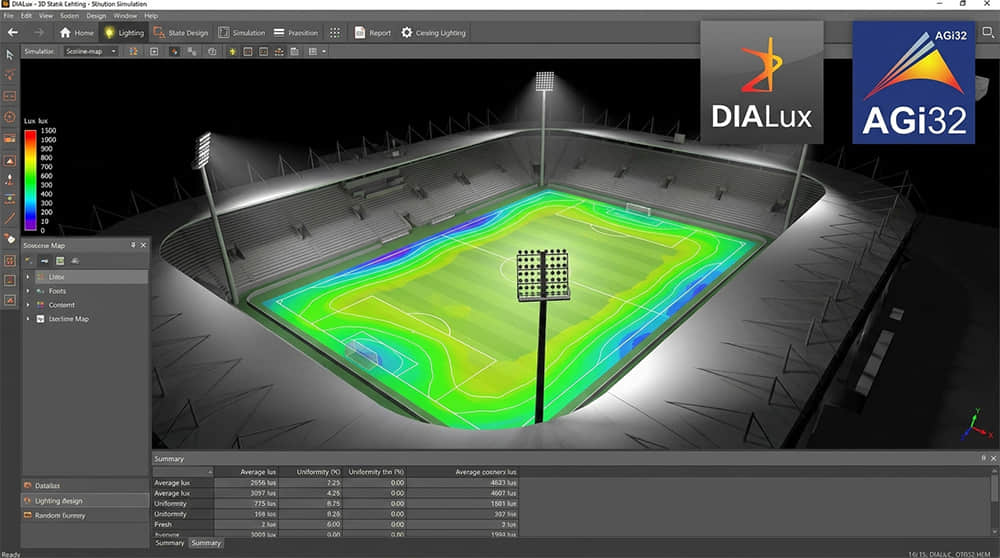
Modern sports lighting design is validated through predictive modeling using software such as DIALux or AGi32. The process involves:
-
Modeling the Site: Defining the field dimensions, pole locations, and mounting heights.
-
Photometric Integration: Importing the .IES files of the selected luminaires.
-
Calculation & Optimization: Iteratively adjusting the aiming angles of each fixture to achieve the target uniformity and lux levels while monitoring the glare index.
Luminaire Selection & Technical Specifications
The selection of LED floodlights for a soccer stadium is an engineering decision that balances luminous flux, thermal integrity, and optical precision. In the high-power range typical of sports applications—ranging from 600W to 1500W per fixture—minor inefficiencies are magnified, potentially leading to system failure or non-compliance with international broadcast standards. Below are the critical technical specifications that define a professional-grade sports luminaire.
1. Luminous Efficacy and Luminous Flux Maintenance
While raw lumens are often the primary focus of procurement, System Efficacy (lm/W) is the more relevant metric for engineering sustainability. Professional luminaires in 2026 typically operate at ≥ 140 lm/W at the system level (including driver and optical losses).
-
L70/B10 Ratings: For sports venues, fixtures must maintain at least 70% of their initial light output for a minimum of 50,000 hours. High-power LEDs generate significant junction heat; therefore, the choice of substrate (Metal Core PCB) and the thermal interface material (TIM) is critical to prevent premature lumen depreciation.
2. Color Quality for Ultra-High-Definition (UHD) Broadcasting
In venues designed for television coverage, the Color Rendering Index (CRI) is insufficient as a standalone metric. Engineers now prioritize the Television Lighting Consistency Index (TLCI) .
-
TLCI ≥ 90 : This ensures that the lighting spectrum is optimized for CMOS sensors used in 4K and 8K cameras, reducing the need for costly post-production color grading.
-
CRI and R9 Value: A CRI of ≥ 80 is standard for spectator visibility, but for professional broadcasting, an R9 value > 0 (representing saturated red) is mandatory to ensure that skin tones and team colors are rendered accurately under high-intensity discharge.
3. Flicker Index and High-Frame-Rate (HFR) Replays
One of the most common failures in low-tier LED stadium lighting is visible flicker during slow-motion replays.
-
Flicker Index < 0.01 : To support high-frame-rate cameras (300 fps or higher), the LED driver must provide a ripple-free DC current. Any modulation in the light output will result in a "strobing" effect on screen, which is unacceptable for professional broadcasts. Compliance with IEEE 1789 standards for flicker is a non-negotiable requirement for Class I and Class II facilities.
4. Advanced Thermal Management Systems
Managing the thermal load of a 1200W LED array requires sophisticated passive or active cooling.
-
Heat Sink Design: Modern sports floodlights utilize 6063-T5 aluminum extrusions or cold-forged fins to maximize surface area.
-
Thermal-Optical Interaction: As temperature increases, the refractive index of the secondary optical lens can shift slightly. Professional fixtures maintain a "thermal buffer," ensuring that the LED junction temperature (Tⱼ) remains well below the manufacturer's maximum threshold, even in high-ambient-temperature environments like outdoor stadiums in the summer.
5. Ingress Protection (IP) and Impact Resistance (IK)
Outdoor sports lighting is exposed to wind, rain, and physical impact.
-
IP66 Rating: This ensures the luminaire is dust-tight and protected against powerful water jets, preventing moisture from condensing on the internal surface of the lens, which would distort the beam pattern.
-
IK08 or Higher: The fixture and its optical assembly must withstand the kinetic energy of stray balls. This is why high-impact Optical Grade Polycarbonate (PC) is the preferred material for the lens array over tempered glass in many modern designs.
6. The Critical Role of Accurate Photometric Data (.IES Files)
The luminaire is only as useful as the data describing its performance. An accurate IES or LDT file is a digital representation of the fixture’s spatial light distribution.
-
Goniophotometric Measurement: These files must be generated in a certified darkroom using a goniophotometer. Inaccurate IES files lead to "design-to-reality" gaps—where the simulated uniformity on DIALux matches the standard, but the actual field installation reveals shadows or glare spikes.
-
Beam Angle Diversity: A professional stadium lighting product line must offer a range of IES files, covering narrow (e.g., 10°–15°), medium (e.g., 30°–60°), and asymmetric distributions.
7. Electrical and Surge Protection
Given their mounting location on high masts, stadium lights are prone to lightning strikes and grid fluctuations.
-
10kV/20kV Surge Protection: Integrated Surge Protection Devices (SPD) are mandatory to protect the sensitive LED drivers and chips from transient overvoltages.
By selecting luminaires that meet these rigorous technical benchmarks, engineers can ensure that the physical hardware is capable of executing the complex light distribution required by modern sports lighting standards. In the next section, we will analyze the physics behind the secondary optics—the specific component that transforms the raw LED output into these precisely controlled beams.
Integrated Lens Engineering and Customized Design Solutions
In professional sports lighting, the secondary optical lens is not a peripheral accessory but a fundamental component that defines the luminaire's performance. The transition from raw LED output to a controlled, high-performance beam requires a symbiotic design relationship between the lens, the PCB layout, and the mechanical housing. At Asahi Optics, we advocate for an integrated engineering approach where the optical system is co-developed alongside the luminaire hardware to ensure maximum luminous efficiency and regulatory compliance.
The Necessity of Integrated Optical Design
An LED chip naturally emits light in a Lambertian distribution (approximately 120°), which is unsuitable for sports field applications requiring long-distance projection. To transform this into a functional beam—whether a 10° narrow spot or a complex asymmetric throw—the lens must be precisely matched to the PCB architecture and the mechanical constraints of the housing.
-
PCB Alignment: The optical center of each lens unit must align perfectly with the LED’s Light Emitting Surface (LES) . Any deviation, even at the sub-millimeter level, results in chromatic aberration and beam distortion.
-
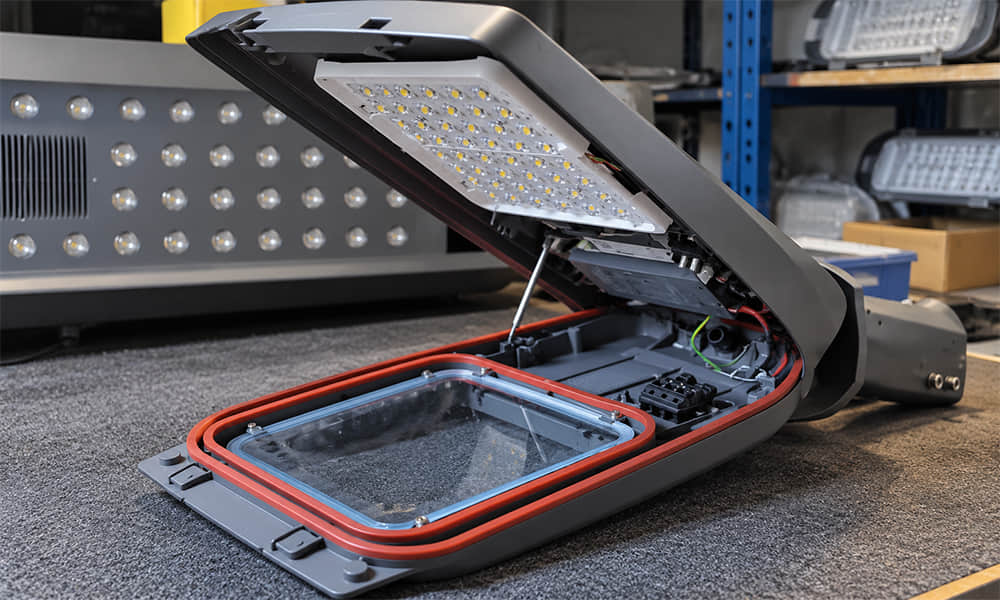
Thermal and Mechanical Synergy: The housing must provide adequate heat dissipation for the high-power LEDs (often 3535 or 5050 packages), while the lens must be engineered to fit the physical mounting points and gasket seals of the fixture to maintain IP66 integrity.
Customized Development
Standard "off-the-shelf" optics often fail to meet the specific demands of unique stadium geometries or strict municipal light-spill codes. Our engineering philosophy is centered on providing customized solutions that bridge the gap between theoretical design and field reality.
We leverage advanced software suites, including LightTools and Zemax, to simulate photon paths and optimize freeform surfaces. This process allows us to manipulate light with surgical precision, ensuring that the maximum amount of luminous flux reaches the play area while maintaining a sharp cutoff at the stadium boundaries.
Tailored Solutions for the Australian Market
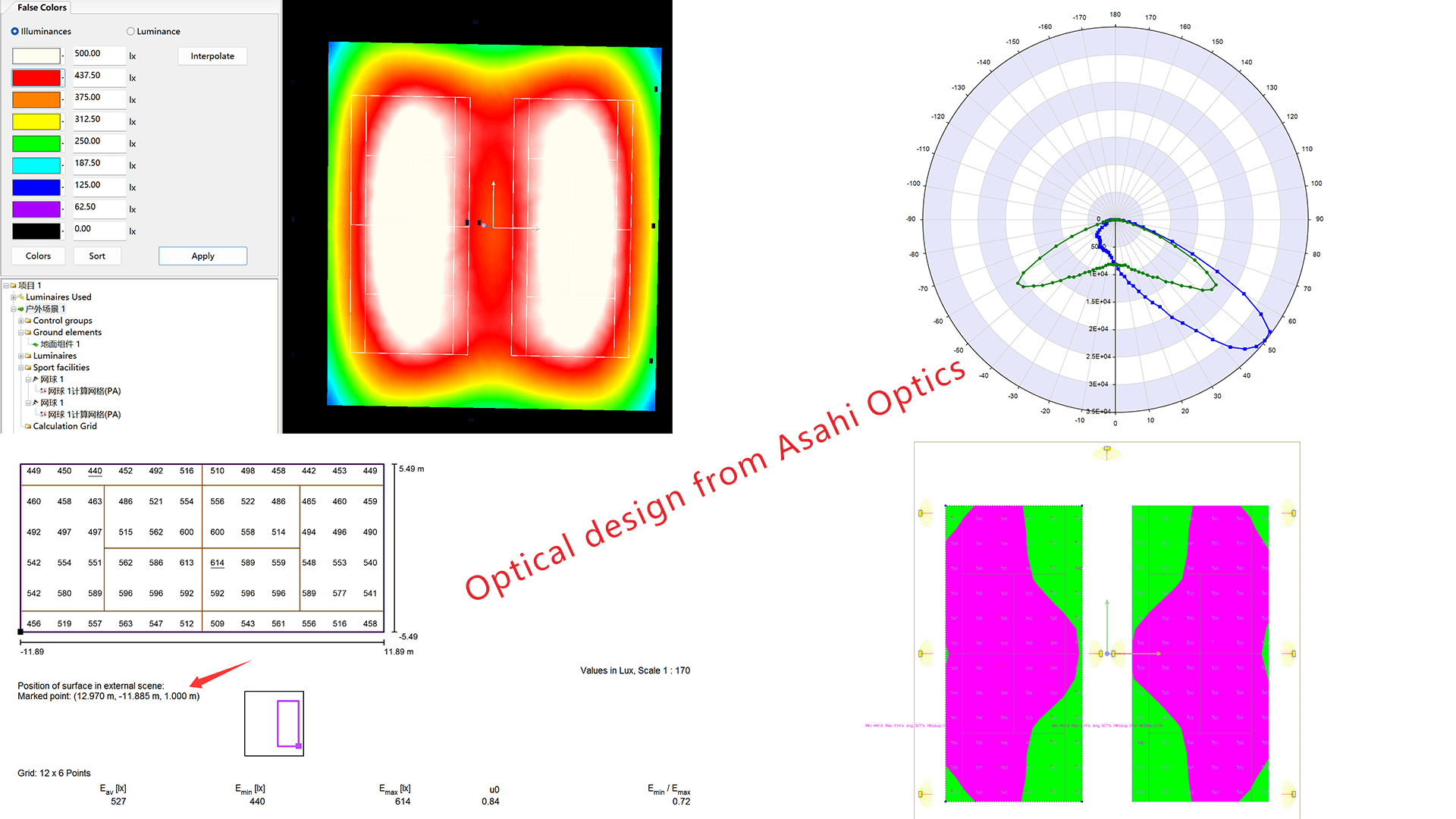
Our experience with an Australian tennis court project serves as a primary example of how customized lens engineering solves complex lighting challenges. The client faced a significant hurdle: their existing luminaires, equipped with standard symmetric optics, could not meet the local council’s audit requirements. The project suffered from high glare (GR > 55) and poor vertical uniformity, which interfered with high-speed ball tracking.
Our intervention involved a comprehensive design loop:
-
Diagnostic Simulation: We performed an initial DIALux simulation using the client's original fixture data to identify "hot spots" and spill zones.
-
Custom Optical Modeling: Based on the specific tennis court dimensions and pole heights, we developed a specialized Asymmetric Lens. This lens featured a surface micro-structure designed specifically to suppress high-angle brightness.
-
Digital Validation and IES Generation: We generated a custom .IES file for the new lens-fixture combination. This allowed the client to re-run their DIALux reports and prove to the local authorities that the Uniformity (U2) would exceed 0.8 while the Glare Rating (GR) would drop below 45.
Comprehensive Engineering Support
This project highlights our capability to act as an extension of our clients' R&D teams. We provide more than just the physical lens; we provide the digital infrastructure required to win contracts:
-
Custom IES and .LDT Files: Accurate photometric data tailored to your specific LED and current drive.
-
DIALux Consulting: Expert verification of light levels, uniformity, and spill light before a single unit is manufactured.
-
Prototyping to Production: Rapid iteration from optical design to 3D-printed prototypes, ensuring the final mass-produced lens matches the simulation perfectly.
By integrating lens design with the hardware architecture from the outset, we enable manufacturers to deliver luminaires that are not just powerful, but are engineered tools capable of meeting the world's most stringent sports lighting standards.
Conclusion – Engineering the Future of Sports Lighting
The evolution of soccer field lighting from simple illumination to high-precision energy management is a direct result of advancements in secondary optics. As demonstrated by the highly standardized U.S. market and specialized projects like the Australian tennis court upgrade, the ability to control light is just as vital as the ability to generate it. In the high-power domain of 600W to 1500W luminaires, the margin for error is non-existent; optical inefficiency translates directly into glare, light pollution, and wasted energy.
At Asahi Optics, we believe that the luminaire housing, the PCB, and the lens must function as a single, coherent instrument. By providing comprehensive engineering support—from custom LightTools modeling and IES file generation to DIALux validation—we empower our partners to meet the most demanding international standards. Whether the objective is Class I broadcast quality or strict "Dark Sky" compliance, precision-engineered optics are the key to a successful, future-proof installation that serves the athlete, the spectator, and the environment simultaneously.
FAQ: Addressing Engineering Realities in Sports Lighting
1. How do you ensure the digital IES file matches the physical performance of the final lens?
Precision is achieved through a closed-loop validation process. After the initial design in LightTools, we conduct a "virtual goniophotometer" test. Once a prototype is manufactured, it undergoes physical testing in a certified darkroom. We provide IES files based on these physical measurements, ensuring that when you run a DIALux simulation, the results on the field will match the digital twin with a high degree of accuracy, eliminating "design-to-reality" gaps.
2. What are the material implications of high-wattage LEDs on secondary optics?
High-power luminaires (1000W+) generate intense localized heat that can cause standard plastics to yellow or deform. We utilize high-temperature, optical-grade PC-1250Z. This material maintains refractive index stability and UV resistance, ensuring that the light distribution—such as a sharp asymmetric cutoff—remains consistent over a 10-year service life even under extreme thermal stress.
3. Can a lens be designed to accommodate different LED brands on the same PCB?
While many LEDs (like 3535 or 5050 packages) share similar footprints, their Light Emitting Surface (LES) and dome heights vary. A lens designed for one specific LED may lose 5–10% efficiency or exhibit beam artifacts if paired with a different brand. We recommend a "match-design" approach where the lens curvature is optimized for the specific photometric profile of your chosen LED chip to ensure peak performance.
4. What is the typical lead time for a customized lens solution?
For a professional sports lighting project, the timeline is structured for speed and precision:
-
Optical Design & Simulation: 3–10 working days.
-
Prototyping (CNC) : 5–15 working days.
This allows our clients to present a fully validated technical proposal to their customers within a few weeks.