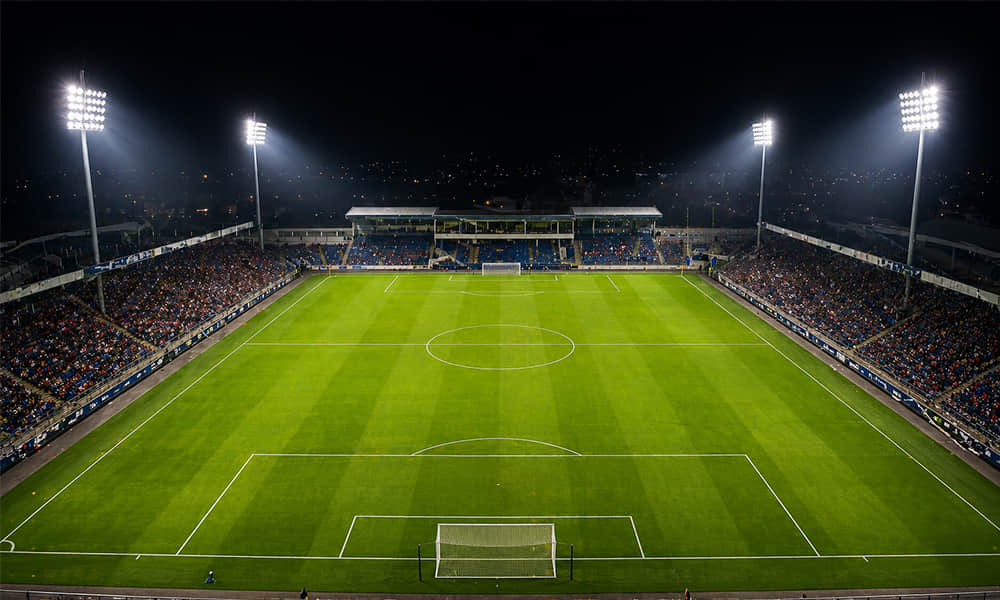
The 2026 World Cup kicks off in July, and then the eyes of all soccer fans will be on the tournament. As the final whistle blew during the UEFA Euro 2024 championships, the world’s attention was fixed on the celebrating athletes and the high-definition replays captured from every conceivable angle. While billions of viewers admired the clarity of the 8K broadcasts and the flawless slow-motion captures of decisive goals, very few gave a thought to the silent infrastructure making it possible: the stadium’s lighting array.
The evolution of sports lighting has moved far beyond simple illumination. Today, it is a sophisticated discipline of optical engineering driven by the transition from traditional metal halide lamps to advanced LED systems. This shift has unlocked unprecedented energy savings—often exceeding 75%—while providing the instantaneous control required for modern sports entertainment. However, as the global sports lighting market is projected to reach $1.45 billion by 2030, the industry faces new challenges. Requirements for professional venues are becoming increasingly rigorous, demanding extreme uniformity, minimized light spill, and specialized beam patterns to accommodate everything from local community pitches to Olympic-grade arenas.
This article provides a comprehensive technical breakdown of modern sports lighting design from the perspective of a precision optics manufacturer. We will analyze international standards such as IES RP-6-24, the critical importance of horizontal and vertical illuminance, and how secondary optical solutions—specifically high-density arrays like the Asahi Optics 96in1 series—are redefining what is possible in the stadium environment.
The Global Sports Lighting Market
The global sports lighting market is experiencing a period of rapid acceleration. Valued at approximately $883.1 million in 2025, the sector is expected to grow to $1.87 billion by 2035, maintaining a compound annual growth rate (CAGR) of 7.9%. This expansion is not merely about installing more lights; it is about a wholesale technological upgrade of global sporting infrastructure.
Several key factors are driving this momentum:
-
Energy Efficiency & Sustainability: LED systems are the cornerstone of the modern "green stadium." By replacing legacy lighting with LED floodlights equipped with high-efficiency optics, venues can slash energy consumption by up to 75% while significantly reducing maintenance costs due to a service life often exceeding 50,000 hours.
-
HDTV and 8K Broadcasting Requirements: Modern broadcasting standards are the primary drivers of technical complexity. Ultra-high-definition (UHD) cameras require exceptionally high vertical illuminance and a Television Lighting Consistency Index (TLCI) of 90 or higher. Without precision optics to manage light distribution, the resulting shadows and color shifts would be unacceptable for global television audiences.
In this competitive landscape, industry leaders such as Signify, Musco Lighting, and Cree Lighting continue to push the boundaries of luminaire design. However, the true innovation lies within the optical assembly. For manufacturers aiming to compete in this high-growth market, the ability to deliver precise, flicker-free, and glare-controlled light is the ultimate differentiator. As we will explore, achieving this requires more than just powerful LEDs; it requires secondary optics designed with surgical precision.
Key Sports Lighting Standards and Classifications
To engineer a stadium lighting system that meets professional expectations, designers must navigate a complex landscape of international regulations. The two most authoritative benchmarks in the industry are the IES RP-6-24 (the North American standard for Recommended Practice for Lighting Sports and Recreational Areas) and EN 12193 (the European standard for Sports Lighting). These documents provide the mandatory thresholds for illuminance, uniformity, and glare control, ensuring a level playing field for athletes and optimal clarity for spectators.
Understanding IES RP-6-24
The release of RP-6-24 represents a major technical revision, reflecting the industry's full transition to LED technology. Unlike older standards that focused primarily on horizontal ground brightness, the latest IES guidelines place a much heavier emphasis on Vertical Illuminance. This is critical for players to track a high-speed ball against a dark sky and for cameras to capture facial expressions and jersey numbers.
Furthermore, the updated standard aligns with the "Five Principles for Responsible Outdoor Lighting," demanding that stadium optics provide a sharp cutoff to prevent light trespass into neighboring communities and to protect the nocturnal environment—a challenge that can only be solved through high-precision secondary lenses.
IES Lighting Classifications (I to IV)
Both IES and EN standards classify sports venues into four distinct levels based on the level of competition and the size of the audience:
-
Class I (Professional / Top-tier Collegiate) : Designed for venues with more than 5,000 spectators and professional broadcasting requirements. These projects demand the highest lux levels and the most stringent uniformity ratios.
-
Class II (High-Level Collegiate / High School) : Suitable for stadiums with up to 5,000 spectators. The focus remains on high-quality competition, but with slightly lower illuminance thresholds than Class I.
-
Class III (Community / Amateur Leagues) : Aimed at local clubs and recreational sports with limited spectator seating.
-
Class IV (Training / General Recreation) : Focused on basic safety and visibility for practice sessions and community parks without fixed seating.
Typical Illuminance Requirements by Sport (Reference: IES RP-6)
The specific requirements vary drastically depending on the speed of the sport and the size of the object being tracked. A baseball moving at 100 mph requires far more light than a slow-moving football.
Vertical vs. Horizontal: Why Both Matter
In a professional soccer or football stadium, achieving 1,000 lux on the grass (Horizontal) is only half the battle. Engineers must also ensure sufficient Vertical Illuminance—the light hitting a vertical plane 1.5 meters above the ground. For 4K and 8K broadcasting, vertical light ensures that the "modeling" of the athletes is three-dimensional and that high-speed slow-motion replays (HFR) are crisp and free of digital noise.
Meeting these multi-dimensional requirements simultaneously is a geometric challenge. As we will discuss in the coming sections, it requires a sophisticated Lens Solution capable of projecting light at steep aiming angles while maintaining a clean, glare-free cutoff.
Sports-Specific Lighting Design Requirements
No two sports fields are the same. A basketball court is a compact, high-intensity indoor environment, while a baseball outfield requires light to travel hundreds of feet with pinpoint accuracy. Designing for these specificities requires more than just raw power; it requires a tailored optical strategy for each sport's unique geometry.
1. Soccer and Football Field Lighting
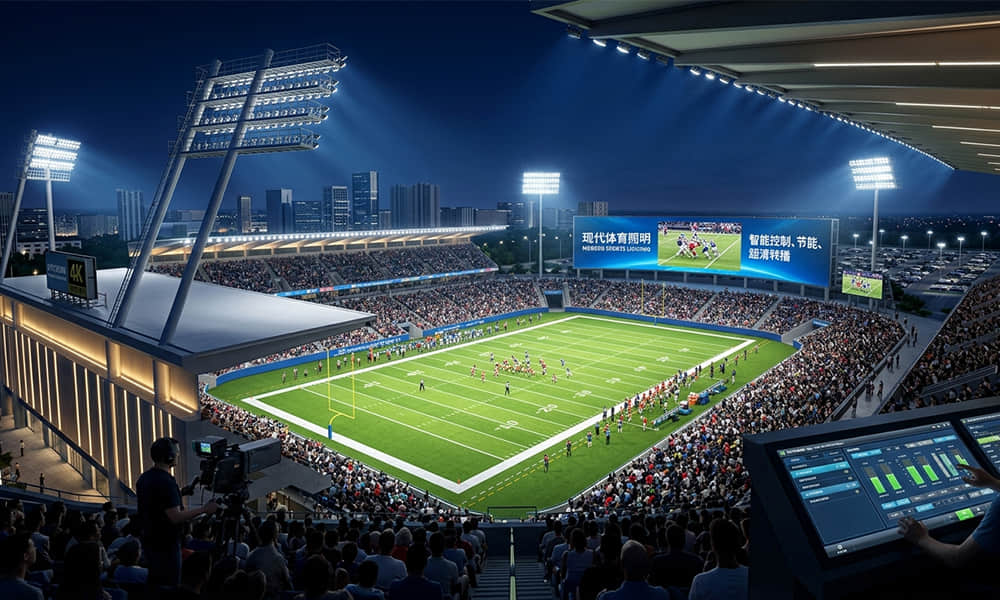
Soccer and American football fields are characterized by large rectangular areas where both horizontal and vertical uniformity are vital for tracking the ball across long distances.
-
Design Strategy: Typically uses a four-corner pole layout or a sideline arrangement.
-
Requirements: Professional matches require 800–1000+ lux. Because the action happens both on the ground and high in the air, the optics must provide a balanced vertical-to-horizontal ratio. For 2024 Euro-level standards, a U₂ uniformity of ≥0.7 is the baseline.
2. Baseball and Softball Field Lighting
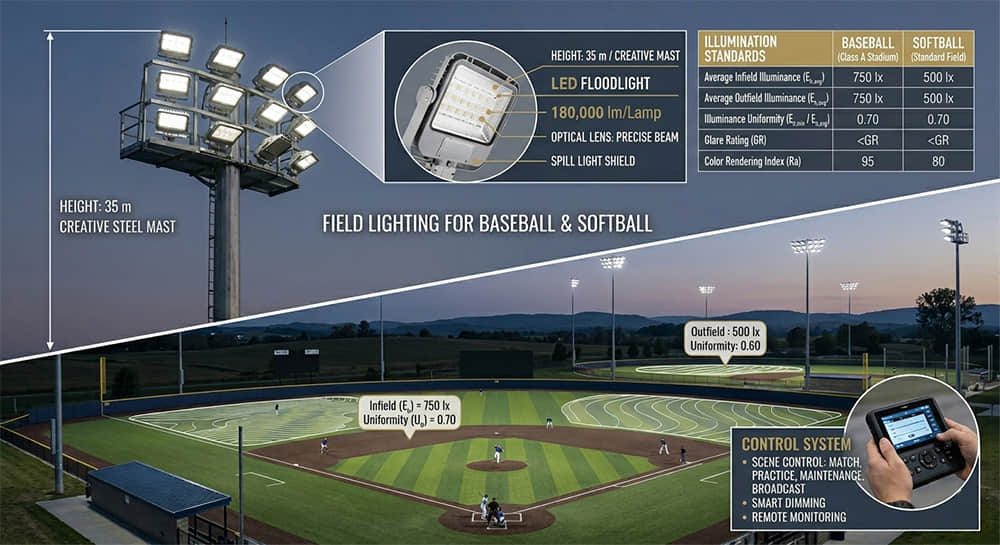
Baseball is arguably the most challenging sport to light due to the high speed of the ball and the vast difference between the Infield and Outfield.
-
Infield Focus: Requires significantly higher illuminance (100–150 fc) because the ball moves fastest here.
-
Outfield Strategy: Requires 70–100 fc but with extreme precision to prevent the ball from "disappearing" against the dark sky.
-
Layout: Usually involves 6 to 8 poles at specific heights (up to 80+ feet) to ensure that shadows are minimized regardless of the player's position.
3. Basketball Court Lighting
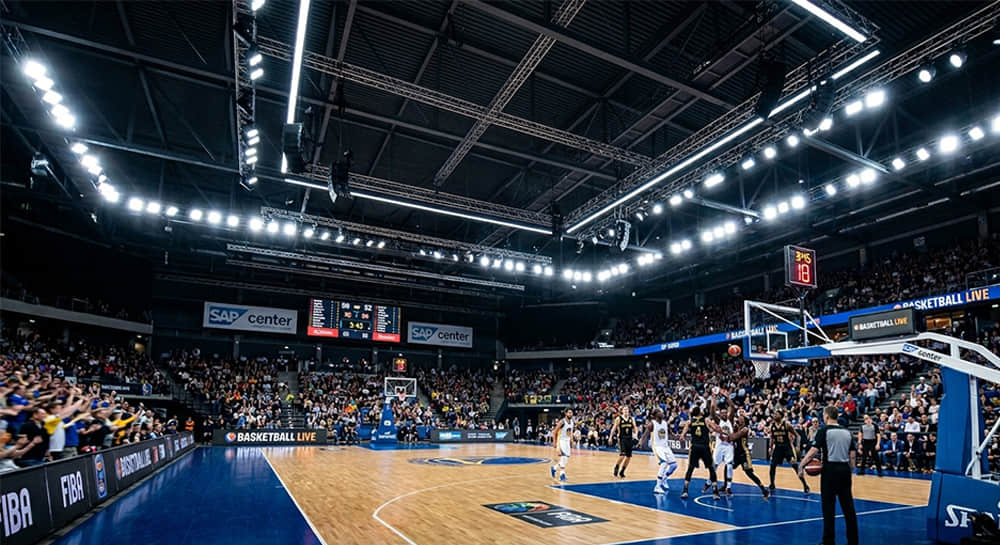
Whether indoor or outdoor, basketball demands high vertical illuminance to ensure spectators and cameras can see the players' faces and movements clearly under the hoop.
-
Requirements: Professional FIBA venues require ≥750 lux with a CRI ≥ 90.
-
Challenge: Because the ceiling heights in indoor arenas are relatively low compared to outdoor masts, glare control (UGR) is the top priority. Lenses must diffuse the light enough to prevent blinding the players during a jump shot or rebound.
4. Tennis Court Lighting
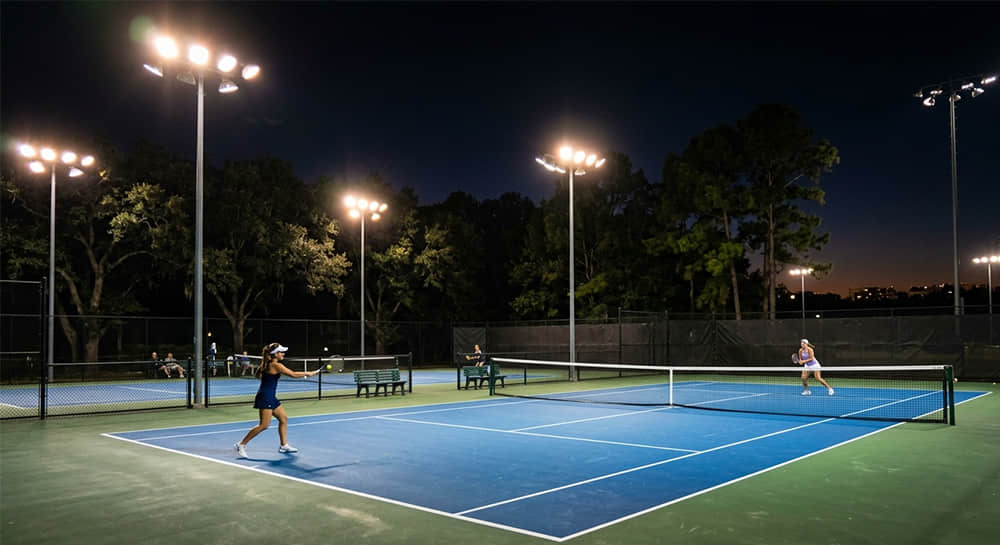
Tennis is a game of millimeters. Players need to see the spin of the ball and the exact point where it hits the line.
-
Layout: Typically uses a sideline layout with poles placed outside the player's primary line of sight.
-
Precision: Requires 800 lux for championships. The optics must ensure that there is zero "hot spotting" in the center of the court and that the perimeter is just as bright as the service line.
5. Swimming Pools and Aquatic Sports
The primary challenge in aquatic lighting is specular reflection. Light hitting the water's surface at the wrong angle creates a "mirror effect" that blinds swimmers and obscures the view for lifeguards and cameras.
-
Solution: Lights are usually placed along the sides and tilted at specific angles. Optics with asymmetric distributions are preferred to "throw" the light across the pool without creating a direct reflection back into the spectators' eyes.
By understanding these sports-specific nuances, Asahi Optics engineers lenses that aren't just "general purpose," but are optimized for the specific grid of a baseball diamond or the vertical requirements of a basketball arena.
How Optics Lenses Enable Precision Sports Lighting
The ultimate performance of a stadium floodlight is not determined by the power of the LED chip alone, but by the efficiency of the secondary optical system. In sports lighting, where light must often travel over 50 meters from a high mast to a specific coordinate on the field, the margin for error is zero. This is where Asahi Optics’ 96in1 series sets a new industry standard for precision, durability, and versatility.
1. High-Density Integration: The 96in1 Advantage
Modern stadium floodlights are pushing the limits of power density. The Asahi 96in1 series is engineered to accommodate this trend by integrating 96 optical units into a single high-efficiency array. This high-density design allows luminaire manufacturers to achieve massive lumen packages while keeping the fixture’s weight and wind-load surface (EPA) to a minimum—a critical factor for aging stadium masts during retrofitting projects.
2. From 10° Narrow Spots to T3VS Asymmetric
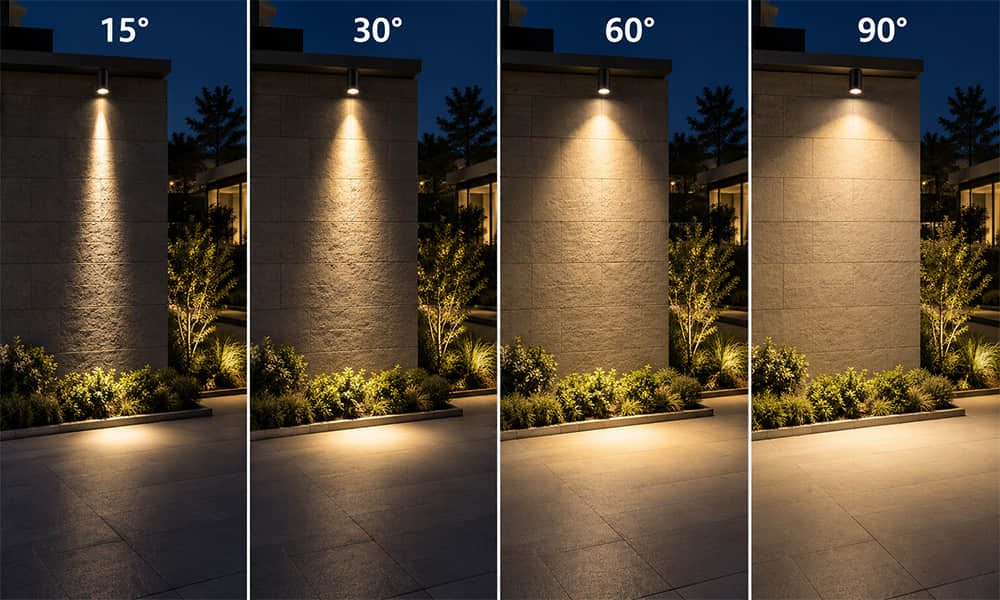
Different sports require different "light signatures." A baseball infield needs a high-intensity narrow beam to track a 100mph ball, while a soccer pitch requires wide, uniform coverage. The 96in1 series offers a comprehensive range of beam angles to solve these diverse challenges:
-
10° & 20° (Narrow Beam) : Designed for "High-Mast Long-Throw" applications. These ultra-narrow beams ensure that light reaches the center of the field from heights of 30+ meters with minimal scattering.
-
40° & 60° (Medium Beam) : Ideal for perimeter lighting and general field coverage, providing a smooth transition between high-intensity zones.
-
90° (Wide Beam) : Perfect for training areas and indoor multi-purpose halls where the mounting height is lower.
-
T3VS (Asymmetric Distribution) : This is the flagship solution for DarkSky compliance. The T3VS distribution projects light forward at a steep angle while maintaining a sharp rear cutoff. This ensures that the field is brilliantly illuminated, but the light is strictly forbidden from spilling into spectator stands or surrounding residential windows.
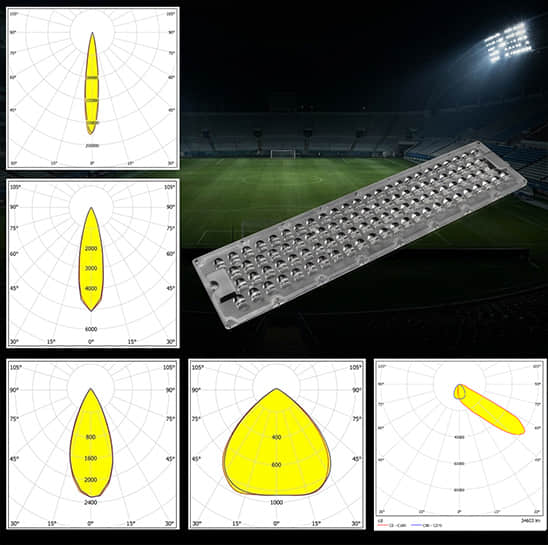
Made of PC-1250Z optical-grade polycarbonate, it combines high light transmittance, UV yellowing resistance, and heat resistance, ensuring long-term beam accuracy in demanding sports lighting environments. Its freeform optical design reduces glare and meets top-tier lighting standards such as IES and EN.
Stadium Lighting Layout: Pole Placement and Aiming Strategies
Even the most advanced optical lens is only as effective as the layout in which it is installed. In sports lighting, the positioning of light poles (masts) and the precise "aiming" of each fixture are the final steps in transforming a dark field into a professional arena. A poorly calculated layout can lead to "black holes" on the pitch, excessive light trespass into spectator stands, or blinding glare for the athletes.
1. Common Pole Configurations
Depending on the sport and the architectural constraints of the venue, engineers typically choose from three primary layout strategies:
-
Four-Corner Layout: The standard for soccer and American football. Poles are placed at the four corners of the field. This layout is excellent for minimizing shadows but requires high-intensity 10° or 20° narrow-beam lenses (like the Asahi 96in1) to "throw" the light to the center of the field from distances of 50 meters or more.
-
Sideline / Lateral Layout: Common for tennis courts and smaller community soccer fields. Poles are placed along the sides of the play area. This requires Asahi’s T3VS asymmetric optics to ensure that light is projected forward across the court while keeping the area behind the pole (the spectators) in relative darkness.
-
Multi-Pole Layout (6-8 Poles) : Mandatory for baseball and softball diamonds. Because the action is omni-directional, poles must be placed behind home plate, along the foul lines, and around the outfield arc to ensure that a fly ball is illuminated from multiple angles simultaneously.
2. Mounting Height and the 25° Rule
To control glare, the height of the light pole is just as important as the lens angle. As a general rule in sports lighting design, the mounting height should ensure that the aiming angle (the angle between the horizontal and the light beam) is greater than 25 degrees. If the poles are too low, the light becomes "shallow," entering the eyes of players and spectators directly, which leads to high Glare Ratings (GR) . For professional stadiums, mounting heights typically range from 25 to 50 meters.
3. Computer Simulation: The Role of IES Files
Before a single bolt is tightened on-site, the entire lighting system must be validated through computer-aided design (CAD) software such as DIALux or AGi32.
-
Photometric Data: Asahi Optics provides high-resolution .IES and .LDT files for all 96in1 lens configurations. These files allow engineers to simulate exactly how the 10°, 40°, and T3VS beams will interact on the field.
-
Aiming Points: The software generates an "Aiming Diagram," assigning a specific coordinate on the field to each individual floodlight. This ensures that the U₀ and U₂ uniformity targets are met and that the vertical illuminance is sufficient for 8K cameras.
4. Precision Aiming on Site
During installation, contractors use laser-aiming devices mounted to the floodlight chassis. By aligning the laser with the coordinates defined in the DIALux simulation, the physical installation perfectly matches the digital twin. Thanks to the PC-1250Z material’s high structural integrity, the beam remains perfectly aligned even under the mechanical stress of high-wind environments.
By combining strategic pole placement with the versatile beam angles of the Asahi 96in1 series, designers can create a lighting environment that is invisible to the players but brilliant for the cameras—the hallmark of professional stadium engineering.
Conclusion – The Future of Sports Lighting: Smarter, Greener, and More Precise
As we look beyond the high-intensity matches of 2024 and 2026, it is clear that stadium lighting has entered a new era. The transition from "adequate brightness" to "optical precision" is driven by a convergence of environmental responsibility, technological innovation, and the uncompromising demands of global broadcasting. Standards like IES RP-6-24 are no longer just recommendations; they are the blueprints for creating safer, more immersive, and more sustainable sporting environments.
The heart of this revolution is the secondary optical system. Through the use of advanced materials like PC-1250Z and high-density arrays like the Asahi Optics 96in1 series, the lighting industry can now achieve what was once impossible: projecting surgical beams of light over 50 meters while maintaining zero upward spill and perfect uniformities for 8K television. As sports venues continue to evolve into multi-purpose entertainment hubs, the role of precision optics will only become more vital. At Asahi Optics, we remain committed to defining the future of the field—ensuring that the next generation of athletes, spectators, and viewers see the game in its best possible light.
FAQ
Q: What is the most critical change in the IES RP-6-24 standard for sports lighting?
A: The most significant shift is the increased emphasis on Vertical Illuminance and the integration of the "Five Principles for Responsible Outdoor Lighting." The standard now demands much stricter control over glare and light trespass, emphasizing that professional broadcast quality must not come at the expense of the neighboring environment or nocturnal sky.
Q: Why is 5000K the preferred color temperature for professional sports broadcasting?
A: A Correlated Color Temperature (CCT) of 5000K is the industry favorite because it most closely mimics natural daylight. This allows broadcasting cameras to capture the most accurate colors with a high TLCI (Television Lighting Consistency Index) , reducing the need for digital color correction in post-production and ensuring skin tones and jerseys look natural on 4K/8K displays.
Q: How does the Asahi 96in1 lens help reduce the "Zebra Effect" on a soccer field?
A: The "Zebra Effect" (shadow stripes) is caused by uneven light distribution. The 96in1 series uses a high-density array of Free Form Optical Lenses. By precisely overlapping the light from 96 individual LED sources into a single, cohesive beam, it ensures a smooth transition between illumination points, achieving the U₀ ≥ 0.7 uniformity required for professional play.
Q: Can I use the same lens for a baseball infield and outfield?
A: Usually, no. Because the infield requires much higher illuminance (100-150 fc) and faster tracking, narrow-beam optics (like Asahi's 10° or 20° lenses) are used to concentrate light. The outfield typically uses medium-beam optics (like 40° or 60°) to provide broader coverage while maintaining safety and visibility over a larger area.
Q: What is the benefit of using PC-1250Z material for stadium lenses?
A: PC-1250Z is an optical-grade polycarbonate that offers a rare combination of 93% light transmission and high thermal stability. In the high-wattage environment of stadium floodlights, this material ensures that the lens does not deform under heat or yellow under intense UV exposure, keeping the beam angle (e.g., the T3VS asymmetric distribution) precise for over a decade.