The management of urban infrastructure in a major American city requires a rigorous adherence to technical standards that ensure public safety, energy efficiency, and long-term sustainability. In Columbus, Ohio, the responsibility for illuminating the public right-of-way falls under the jurisdiction of the Division of Power. With a vast network comprising approximately 59,000 streetlights, the city has embarked on a comprehensive modernization strategy guided by its official Street Lighting Design Guide. This framework is not merely a set of aesthetic preferences but a complex matrix of Material Installation Specifications (MIS) designed to standardize the performance of every luminaire installed across the municipal grid.
Why is the Columbus model particularly relevant for lighting engineers and optical designers today? The city is currently in the midst of a massive multi-year LED conversion initiative, aiming to replace its entire inventory of High-Pressure Sodium (HPS) lamps with advanced Light Emitting Diode technology. This transition represents a significant shift in optical requirements, moving away from the omnidirectional output of traditional lamps toward the highly directional and controllable nature of LED systems. For manufacturers and project managers, understanding this framework is essential for navigating the technical rigors of North American municipal bidding and implementation.
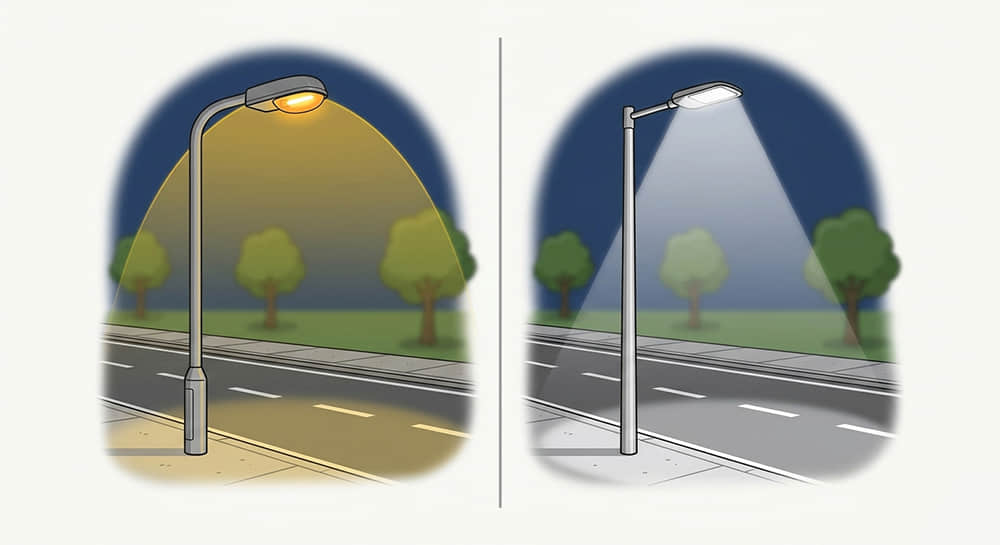
The City of Columbus LED Street Light Conversion: A Modern Roadway Transformation
The City of Columbus has committed to a systematic overhaul of its street lighting infrastructure, a project of considerable scale that reflects broader national trends in smart city development. Of the roughly 59,000 fixtures currently managed by the Division of Power, approximately 12,000 have already been transitioned to LED as of the most recent reporting periods. The primary objective is to complete the full LED conversion within a five-year window, a goal that necessitates a robust supply chain and precise adherence to municipal specifications. How does the city prioritize these replacements in a budget-conscious environment? While all new installations and unrepairable HPS units are replaced with LED luminaires, the city continues to maintain functional sodium lamps to maximize the lifecycle of existing assets, ensuring a fiscally responsible transition.
A cornerstone of this modernization effort is the Safe and Clean Corridors project. This initiative specifically targets high-traffic areas such as Sullivant, Parsons, and Livingston Avenue, where the city has allocated an estimated $1.25 million to install approximately 3,300 new LED units. The transition in these corridors is driven not only by energy savings—which are substantial—but also by the need for improved visibility and color rendering, which directly correlates with reduced crime rates and enhanced traffic safety. From an engineering standpoint, these projects require luminaires that can deliver consistent performance across varying road widths and pole configurations, placing immense pressure on the secondary optics to perform within tight tolerance levels.
The shift toward LED is underpinned by a Digital First approach to maintenance and monitoring. By converting to LED, the Division of Power can integrate smart photocells and control systems that allow for real-time fault detection and dimming capabilities. However, the success of this entire digital ecosystem depends on the fundamental quality of the light being delivered to the pavement. If the LED conversion does not meet the specified luminance and uniformity standards, the technological advantages of the smart grid are neutralized. Therefore, the selection of the optical assembly—specifically the LED lens—is the most critical variable in ensuring that the City of Columbus achieves its vision of a safe, efficient, and modern roadway network.
Technical Specifications of MIS-197, MIS-198, and MIS-200 LED Luminaires
To maintain consistency across its massive infrastructure, the City of Columbus Division of Power utilizes a series of Material Installation Specifications (MIS). These documents serve as the mandatory technical blueprint for any equipment intended for the municipal grid. Among these, three primary specifications define the visual and functional landscape of Columbus’s streets: MIS-197, MIS-198, and MIS-200. For an optics manufacturer, these specifications are more than just style guides; they dictate the photometric performance, thermal management, and physical housing requirements that the internal LED optical assembly must satisfy.
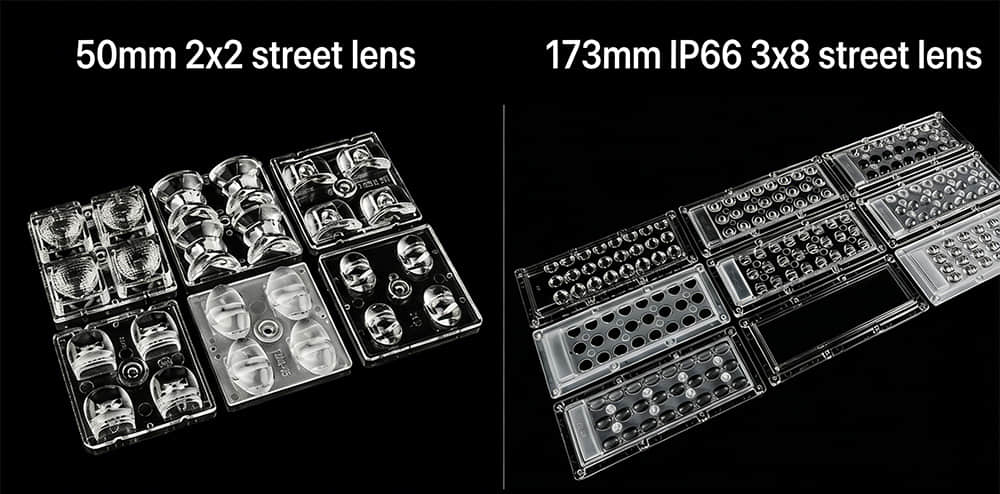
The MIS-197 specification focuses on the LED Cobra Head Style luminaire. This is the workhorse of the North American roadway system, favored for its aerodynamic profile and ease of maintenance. According to the Columbus design guide, the Cobra Head must deliver high-performance lighting that adheres to specific IES distribution types—typically Type II or Type III—to ensure the light is projected onto the roadway rather than wasted on private property. Meeting the MIS-197 standard requires a highly efficient 2x2 or multi-module lens array. For instance, an assembly utilizing a 4LED 2x2 50mm lens array is an ideal candidate for these fixtures. Such a design allows for modular scalability, where multiple 2x2 units can be combined to reach the lumen output required for major collector roads while maintaining a compact, low-profile Cobra housing.
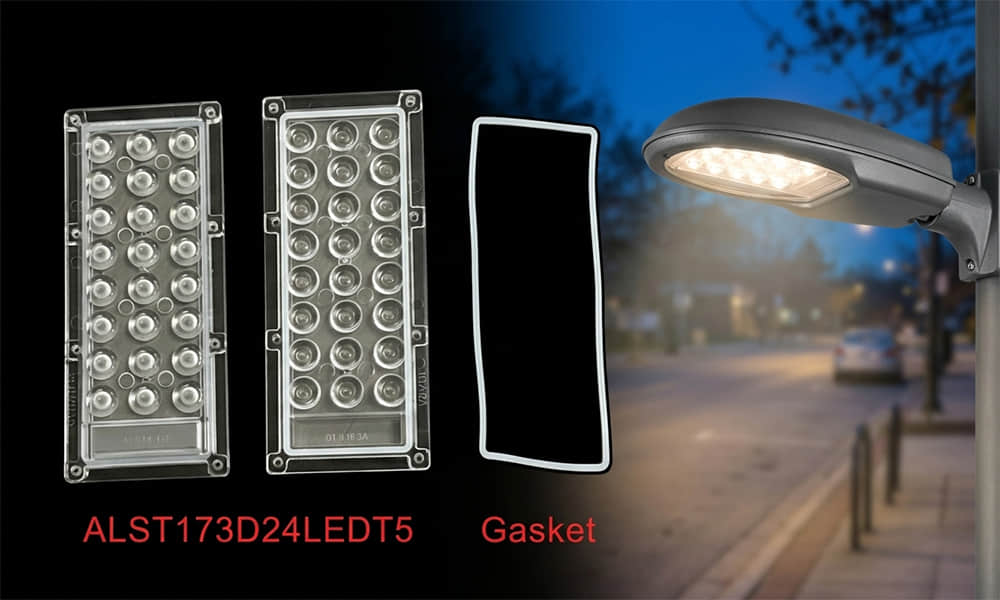
For areas requiring higher aesthetic integration, such as historic districts or commercial corridors, MIS-198 (LED Tear Drop Style) and MIS-200 (LED Traditional Style) are employed. The Tear Drop style is particularly challenging from an optical perspective because the luminaire’s shape often necessitates a pendant-mount configuration. This requires the secondary optics to compensate for the fixture's height and tilt to prevent excessive glare. Similarly, the Traditional Style (MIS-200) mimics the look of gas-lamp era fixtures but must perform with modern LED efficiency. In these applications, large-format lens modules, such as the IP66-rated 3x8 lens (173mm x 71.4mm) , offer a distinct advantage. These integrated modules provide a high-density light source with pre-engineered IES distributions, allowing manufacturers to fit powerful optical engines into the varied shapes of decorative housings without sacrificing the beam’s precision or the fixture's IP66 protection rating.
Beyond the external form, these MIS documents mandate rigorous internal standards. A critical requirement across all styles is the Cutoff or Full Cutoff classification. Why is this significant for the City of Columbus? Full cutoff optics ensure that no light is emitted above the 90-degree horizontal plane, effectively eliminating sky glow and minimizing light trespass. Achieving this requires the lens to have a very sharp light cutoff angle, a feat of engineering made possible through freeform optical design. At Asahi Optics, we understand that for a luminaire to be compliant with MIS-197 or MIS-198, the lens must be capable of reshaping the 120-degree output of a standard LED chip into a precise batwing or asymmetric pattern that meets the IES RP-8 requirements cited in the Columbus guide.
Furthermore, the specifications detail the environmental resilience required for municipal service. Lenses must be capable of withstanding the harsh Ohio climate, which includes significant UV exposure and temperature fluctuations. The Division of Power requires materials that maintain their refractive index and transparency over a long service life. By offering customized material options—allowing clients to specify high-grade PMMA or PC from leading global suppliers—Asahi Optics ensures that the optical components within these MIS-compliant fixtures do not yellow or degrade, preserving the initial lighting design's integrity for decades.
In summary, the MIS series represents a high barrier to entry that prioritizes quality and repeatability. Whether it is a standard Cobra Head for a highway or a decorative Tear Drop for a downtown plaza, the heart of the luminaire's compliance lies in its secondary optics. By aligning lens design with the specific module configurations (such as 50mm 2x2 or 173mm 3x8 arrays) mentioned in these specifications, manufacturers can provide the City of Columbus with lighting solutions that are both historically respectful and technologically superior.
IES RP-8 Roadway Lighting Standard: The Technical Backbone of North American Projects
When analyzing the City of Columbus Street Lighting Design Guide, one document emerges as the foundational authority for every technical decision: the IES RP-8 (Recommended Practice for Design and Maintenance of Roadway and Parking Facility Lighting). Published by the Illuminating Engineering Society, RP-8 is far more than a simple manual; it is a comprehensive scientific framework that defines how light should interact with the built environment to ensure human safety and operational efficiency. For municipal planners in Columbus, adhering to IES RP-8 is the primary method of mitigating liability while maximizing the visibility provided to drivers and pedestrians alike.
Why is IES RP-8 considered the technical backbone of North American roadway projects? Its scope is remarkably broad, covering everything from standard residential streets and high-speed multi-lane highways to complex intersections, tunnels, and pedestrian crosswalks. The standard shifts the focus from "quantity of light" (simply hitting a lumen target) to "quality of illumination." It introduces rigorous metrics for roadway lighting luminance, which measures the light reflected off the pavement toward the observer’s eye, rather than just the light falling onto the surface (illuminance). This distinction is critical for cities like Columbus, where varied pavement materials and weather conditions can significantly affect how a driver perceives obstacles at night.
A core objective of IES RP-8 is the optimization of visual contrast. The standard recognizes that for a driver to identify a hazard—such as a pedestrian stepping into a crosswalk or debris on the road—the object must be sufficiently contrasted against its background. To achieve this, the lighting design must be meticulously calculated to provide uniform brightness across the entire field of view. This brings us to the necessity of specific roadway lighting photometric distribution types, categorized by the IES as Type I through Type V. Each type defines a specific lateral and longitudinal light spread. For example, a Type II or Type III distribution is typically required for the narrow-to-medium width roads found in Columbus’s residential and collector areas, ensuring the beam is "stretched" along the roadway while being restricted from spilling into the front yards of homes.
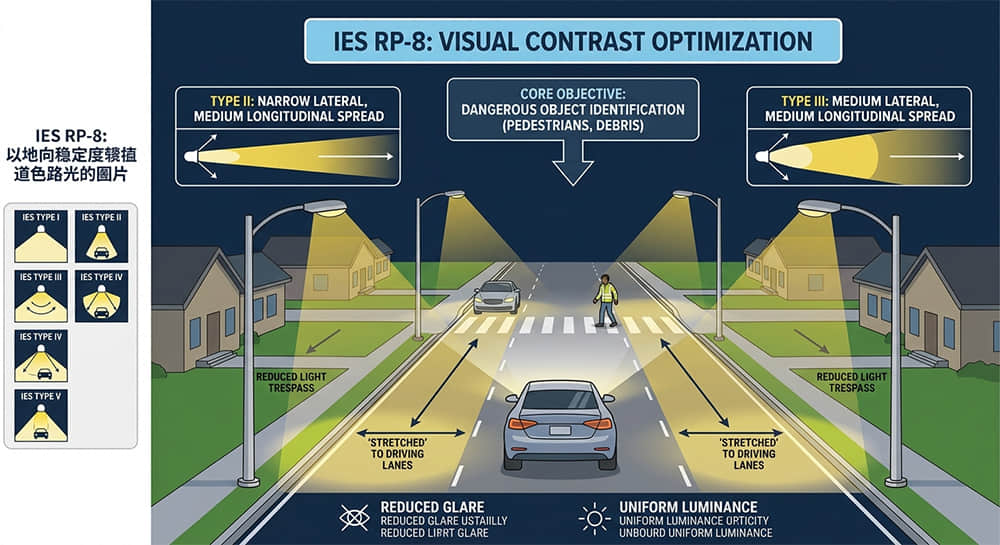
Environmental responsibility and the mitigation of light pollution are also central themes within the modern IES RP-8 framework. The standard provides clear guidelines for controlling Sky Glow and Light Trespass—issues that urban centers must address to maintain ecological balance and resident comfort. This is where the cutoff optical assembly becomes a non-negotiable component of the luminaire. By strictly limiting the amount of light emitted at high angles (near the horizon), engineers can reduce disability glare, which is the stray light that enters the eye and reduces a driver's ability to see objects clearly. For an optics manufacturer, translating these RP-8 requirements into a physical lens means engineering complex micro-structures that can bend light with surgical precision, ensuring that the luminaire remains Dark Sky compliant while still meeting the required lux levels on the ground.
Ultimately, the IES RP-8 standard serves as the bridge between theoretical physics and municipal application. In Columbus, every MIS specification (like MIS-197 for Cobra Heads) is built upon the assumption that the resulting installation will meet or exceed RP-8 criteria. For international manufacturers seeking to enter the North American market, understanding the nuances of this standard is the difference between providing a generic lighting product and delivering a precision-engineered municipal solution. As we transition to the specific metrics of uniformity, it becomes clear that the IES RP-8 is not just a hurdle to be cleared, but a roadmap to achieving the highest levels of roadway safety and efficiency.
Mastering Luminance Uniformity: Why U₀ and Uₗ Metrics Define Roadway Safety
In the technical lexicon of the City of Columbus Street Lighting Design Guide, the term "brightness" is rarely used. Instead, engineers focus on luminance uniformity, a precise measure of how light is distributed across the road surface. Why is uniformity considered more critical than raw lumen output for traffic safety? The human eye is highly adaptive, but it struggles with rapid fluctuations in light levels. When a driver moves through a series of bright spots and dark patches, the pupils must constantly dilate and constrict, leading to visual fatigue and a dangerous delay in reaction times. To prevent this, IES RP-8 and municipal specifications mandate strict adherence to two primary uniformity ratios: Overall Uniformity (U₀) and Longitudinal Uniformity (Uₗ).
Overall Uniformity (U₀) , defined as the ratio of minimum luminance to average luminance (Lₘᵢₙ / L'ₘₐₓ), provides a macro-view of the lighting quality. It measures the consistency of light across the entire roadway. In a municipal environment like Columbus, a low U₀ value indicates that while some areas are well-lit, others remain in deep shadow, creating a fragmented visual field. For major collector roads and highways, achieving a U₀ of 0.4 or higher is often the standard. If the U₀ drops below these levels, the perceived safety of the street diminishes, as pedestrians or obstacles in the "dark zones" become nearly invisible against the high-contrast bright spots under the lamp poles.
However, even a road with acceptable overall uniformity can suffer from a phenomenon known as the Zebra Effect. This is where Longitudinal Uniformity (Uₗ) becomes the decisive metric. Uₗ is calculated as the ratio of minimum to maximum luminance along the center line of a travel lane ($L'{min} / L'{max}$). When Uₗ is inadequate, the driver perceives a rhythmic pattern of bright and dark stripes—resembling a zebra crossing—stretching far into the distance. This effect is not merely an aesthetic nuisance; it creates a strobing sensation at higher speeds that can disorient drivers and mask the movement of other vehicles. According to standards often referenced in municipal planning, such as CJJ 45 which aligns with many IES principles, expressways require a Uₗ of 0.7 or higher, while collector roads may range between 0.5 and 0.7.
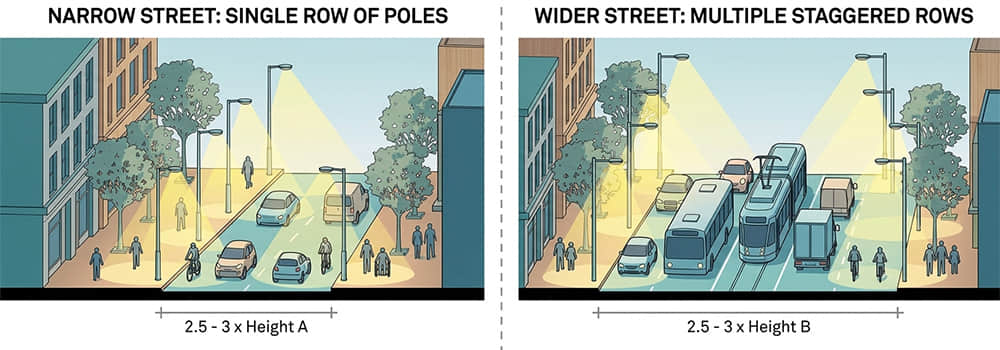
Achieving high Uₗ values is one of the most difficult challenges in roadway lighting design, as it requires the light to be projected at precise angles to fill the gap between poles without causing glare. This is particularly difficult in Columbus where pole spacing can be irregular. How can a lighting system meet these rigorous U₀ and Uₗ requirements simultaneously? It requires a sophisticated understanding of the Spacing to Height (S/H) ratio. If the poles are placed too far apart for the chosen lens distribution, the Uₗ will inevitably fail, regardless of the LED chip's power. Conversely, if the distribution is too wide, glare increases and U₀ may suffer due to excessive light spill.
For the Division of Power in Columbus, maintaining these uniformity standards is essential for the long-term success of the LED conversion program. High-quality municipal lighting should aim for a "seamless" carpet of light where the transition between luminaires is imperceptible to the human eye. By focusing on U₀ and Uₗ, the city ensures that its streets are not just "lit," but are engineered for optimal visual comfort and public safety. As we will explore in the next section, the ability to meet these demanding ratios depends entirely on the engineering of the secondary optical lens, which acts as the "director" of every photon emitted by the LED.
The Role of Secondary Optical Lenses in Meeting Columbus’s Requirements
The technical specifications outlined in the Columbus Street Lighting Design Guide create a demanding environment for luminaire manufacturers. To meet the required luminance uniformity and IES RP-8 standards, a standard LED chip's raw output is insufficient. This is because a bare LED chip typically exhibits a Lambertian distribution, where the light is most intense at the center and fades toward the edges in a circular pattern. On a long, narrow roadway, this results in excessive light directly under the pole and dark zones between poles. To bridge this gap, the secondary optical lens becomes the most critical component in the optical assembly, acting as the precise mechanism that reshapes and redistributes light to meet municipal rigor.
How does a lens transform a circular beam into a compliant roadway pattern? The answer lies in the engineering of Batwing Light Distribution. The goal of a batwing curve is to reduce the light intensity directly beneath the fixture (the nadir) and redirect it toward higher angles (typically 60 to 70 degrees). When plotted on a polar diagram, this distribution resembles the wings of a bat. By increasing the candlepower at these wide angles, the lens compensates for the increased distance the light must travel to reach the midpoint between two poles. This specific distribution is the secret to achieving the U₀ and Uₗ ratios demanded by the Division of Power, as it flattens the light "peaks" and fills the "valleys" on the pavement.
Achieving this level of control requires Freeform Lens Design. Unlike traditional spherical or aspherical lenses, freeform optics do not have a symmetrical axis of rotation. Using sophisticated software such as TracePro or LightTools, optical engineers at Asahi Optics calculate complex, non-uniform surfaces that can "stretch" the light spot into a rectangular shape. This ensures that the light is confined to the roadway—adhering to IES Type II or Type III distributions—while maintaining a sharp Cutoff to prevent light trespass into residential windows. For a city like Columbus, which values both safety and urban comfort, this precision is non-negotiable.
The choice of lens architecture—whether a modular 4LED 2x2 50mm array or a high-density IP66 3x8 lens—also plays a vital role in meeting these requirements. Modular designs allow for the precise tilting and aiming of individual optical segments, which can be critical when a project involves non-standard pole heights or steep road gradients. Furthermore, the material used in these lenses must maintain high optical efficiency. Asahi Optics utilizes high-grade PMMA with a light transmittance of $\geq 93%$, ensuring that the maximum number of lumens generated by the LED reaches the target surface. In an outdoor environment, these materials must also be engineered for UV stability to prevent the yellowing that can shift the color temperature and degrade the carefully designed batwing pattern over time.
Beyond just meeting the numbers, the secondary lens is the primary tool for glare control. By managing the cutoff optical assembly, the lens ensures that light is not emitted at high angles where it would cause disability glare for drivers. This is a central requirement of IES RP-8. When a lens is designed with a precise cutoff, it allows the City of Columbus to use higher-lumen LEDs for better visibility without compromising the safety of oncoming traffic or the quality of life for nearby residents.
Ultimately, the lens is where "specification" meets "application." For municipal projects in Columbus, the secondary optics are what turn an efficient LED into a safe, compliant, and high-performance street lighting system. By mastering the science of batwing distribution and freeform surfaces, Asahi Optics provides the technical foundation that allows luminaires to perform flawlessly within the strict framework of North American municipal standards.
Practical Design Parameters: Spacing, Mounting Height, and Photometric Simulation
Translating the City of Columbus Street Lighting Design Guide into a functional installation requires a meticulous balance of several physical and optical parameters. Even with a high-performance batwing lens, the final lighting quality—specifically the U₀ and Uₗ ratios—is heavily dependent on how the luminaires are positioned in the physical environment. For lighting engineers working on municipal bids, understanding the relationship between pole geometry and optical distribution is the final step in ensuring a project’s compliance with IES RP-8.
One of the most critical metrics in roadway engineering is the Spacing to Height (S/H) Ratio. This ratio determines how far apart poles can be placed while still maintaining a seamless "carpet of light." For standard municipal applications in Columbus, a typical S/H ratio ranges from 3:1 to 4:1. This means that if a luminaire is mounted at a Pole Height of 10 meters, the distance between poles should generally not exceed 30 to 40 meters. If the project requires wider spacing to reduce infrastructure costs, the secondary optics must be engineered with a wider longitudinal throw. By utilizing Asahi’s high-precision Type II or Type III lenses, designers can often push these boundaries without creating the dreaded zebra effect, provided the photometric simulation validates the results.
Mounting height itself varies significantly based on the road classification within the Columbus grid. Residential streets often utilize lower heights of 4 to 6 meters to maintain a human scale and minimize light spill into second-story windows. Conversely, major arterial roads or highways require heights of 8 to 12 meters to allow for powerful, wide-reaching beams that cover multiple travel lanes. When the mounting height changes, the intensity and spread of the beam must be adjusted. This is why Asahi Optics offers modular lens solutions; a 4LED 2x2 50mm array can be driven at different currents or combined in various quantities to match the lumen density required for specific heights, ensuring that the ground-level lux requirements are met precisely.
Another often overlooked parameter is Luminaire Tilt and Overhang. In many traditional designs, cobra head fixtures are tilted upward by 5 to 10 degrees to cast light further across wide roads. However, excessive tilt can increase glare and violate Full Cutoff requirements. Advanced freeform lens design allows for asymmetric distribution, which can effectively project light across multiple lanes even when the luminaire is mounted at a 0-degree tilt (parallel to the ground). This not only improves the cutoff performance for Dark Sky compliance but also simplifies the mechanical installation for contractors working on Columbus Division of Power projects.
To prove that a proposed design meets the city’s rigorous uniformity standards, professional Photometric Simulation is mandatory. Designers typically use industry-standard software such as DIALux or AGi32. By importing the IES files (the digital "fingerprint" of the lens and LED combination), engineers can create a 3D twin of the Columbus street being designed. This simulation allows for the real-time calculation of U₀ and Uₗ before a single pole is installed. At Asahi Optics, we provide comprehensive IES data for all our roadway lens series, including the IP66 3x8 and 2x2 arrays, enabling our clients to verify that their fixtures will pass municipal inspection with a high margin of safety.
In conclusion, the path from a technical specification to a successful municipal installation is paved with data. By harmonizing pole height, spacing, and tilt with a precisely engineered secondary optical lens, and validating the entire system through DIALux simulation, manufacturers can confidently meet the City of Columbus’s vision for a safer, more efficient roadway network.
Conclusion – Future-Proofing Municipal Infrastructure with Advanced LED Optics
The Columbus Street Lighting Design Guide represents more than just a local regulatory document; it serves as a sophisticated blueprint for the future of municipal LED infrastructure across North America. By aligning its standards with the IES RP-8 framework, the City of Columbus has set a high bar for performance, safety, and environmental stewardship. For manufacturers, the challenge lies in translating these complex requirements—such as achieving precise U₀ and Uₗ ratios while maintaining Full Cutoff performance—into reliable, mass-produced lighting solutions.
As we have explored, the heart of this technical achievement is the secondary optical lens. Through advanced freeform optical design and the implementation of batwing light distribution, Asahi Optics empowers luminaire manufacturers to bridge the gap between abstract municipal specifications and real-world roadway safety. Whether utilizing a modular 2x2 50mm array or a high-density IP66 3x8 module, the precision of the lens determines the success of the entire LED conversion. As cities like Columbus continue to modernize, the role of high-performance optics will only grow in importance, ensuring that the roadways of tomorrow are not just brightly lit, but intelligently engineered for the benefit of all.
FAQ: Common Questions on Columbus Street Lighting and IES RP-8 Standards
In this section, we address the most frequent technical inquiries regarding municipal street lighting specifications and the role of secondary optics in meeting North American standards.
Q: What is the Columbus Street Lighting Design Guide and where can I find it?
A: The Columbus Street Lighting Design Guide is the official technical manual published by the Columbus Division of Power. It outlines the mandatory materials, installation methods, and photometric performance standards for all public roadway lighting in the city. Engineers and contractors can typically access the document and its associated MIS (Material Installation Specification) sheets through the City of Columbus's official Department of Public Utilities portal.
Q: How many streetlights does Columbus have, and how many have been converted to LED?
A: The City of Columbus manages a network of approximately 59,000 streetlights. As part of a massive modernization initiative, the city aims to convert the entire inventory to LED within a five-year period. As of the current project phase, approximately 12,000 units have already been transitioned, significantly reducing energy consumption and maintenance costs.
Q: What is the difference between MIS-197, MIS-198, and MIS-200 LED street light specifications?
A: These specifications define the physical and optical "style" of the luminaires:
-
MIS-197 covers the LED Cobra Head Style, the standard for highways and major roads.
-
MIS-198 covers the LED Tear Drop Style, used for architectural and historic aesthetic requirements.
-
MIS-200 covers the LED Traditional Style, mimicking gas-lamp era fixtures for specific neighborhoods.
Despite their different appearances, all three must meet the same rigorous IES RP-8 optical performance criteria.
Q: What are U₀ and Uₗ in road lighting uniformity standards?
A: These are the two primary metrics for lighting consistency:
-
U₀ (Overall Uniformity) is the ratio of minimum to average luminance (Lₘᵢₙ / L'ₘₐₓ). It ensures there are no excessively dark areas on the road.
-
Uₗ (Longitudinal Uniformity) is the ratio of minimum to maximum luminance along the center of a lane ($L'{min} / L'{max}$). It is designed to eliminate the zebra effect or flickering sensation for drivers.
Q: How does batwing light distribution improve roadway lighting uniformity?
A: Batwing light distribution redirects the intense light from directly under the pole toward wider angles (60°-70°). This allows the light to reach further down the roadway, filling the dark gaps between poles. By "flattening" the light intensity across the pavement, it allows for wider pole spacing while still achieving the required Uₗ and U₀ ratios.
Q: What is the typical spacing to height ratio for LED street lights?
A: In most Columbus municipal projects, the Spacing to Height (S/H) ratio typically falls between 3:1 and 4:1. For example, a 10-meter pole would have a spacing of 30 to 40 meters. However, with high-performance secondary lenses, some designs can achieve wider spacing while remaining compliant with IES RP-8 standards.
Q: How can I bid on Columbus street lighting projects?
A: Bidding is managed through the City of Columbus's Office of the Purchasing Agent. Contractors and manufacturers must ensure their products are pre-approved and meet all relevant MIS technical specifications. Providing detailed DIALux or AGi32 photometric simulations using verified IES files is a standard requirement for demonstrating that your proposed solution meets the city's performance mandates.