Now recognized by international regulatory bodies as the "fifth major pollutant"—alongside air, water, waste, and noise—light pollution has become a critical focal point for urban planners and lighting engineers. The challenge for the modern lighting industry is no longer simply "how to illuminate," but "how to illuminate responsibly."
Why has the focus shifted so dramatically toward light pollution and glare control? The answer lies in the realization that wasted light is not merely an aesthetic issue or a loss of energy; it is a direct interference with human health and ecological balance. From an optical engineering perspective, light pollution is fundamentally a failure of beam control. When light is allowed to scatter into the atmosphere or trespass into residential windows, it indicates an inefficiency in the secondary optical system. As a leading manufacturer of precision LED optics, Asahi Optics views the mitigation of glare and light pollution not as a secondary requirement, but as a primary design objective. By integrating advanced anti-glare lens technologies, we can ensure that every lumen generated by an LED chip serves its intended purpose without becoming a pollutant.
What Is Light Pollution?
To effectively combat the adverse effects of artificial light at night, one must first understand the technical definition of light pollution. It is defined as the presence of unnecessary, uncontrolled, or irrational artificial light radiation that interferes with human vision, the environment, and astronomical observation. It is the result of light being misused in terms of spatial distribution, timing, and direction. International organizations such as the CIE (International Commission on Illumination) and the IDA (International Dark-Sky Association) categorize light pollution based on its specific impact on the environment, moving beyond simple brightness to evaluate the "obtrusiveness" of the light source.
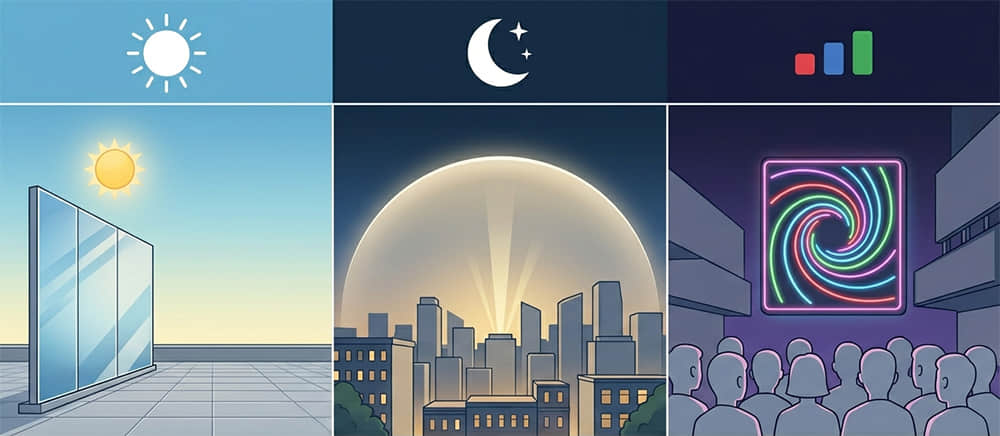
The classification of light pollution is generally divided into three major categories based on the source and effect:
White Light Pollution
This occurs primarily during daylight hours but has significant visual consequences. It refers to the intense reflection of sunlight from glass curtain walls, glazed tiles, and polished metal surfaces on modern buildings. High-performance mirrored glass can have a reflection coefficient as high as 82% to 90%—nearly ten times higher than natural surfaces like forests or grasslands. This "specular reflection" creates extreme visual discomfort and can even pose safety risks to drivers and pilots.
Artificial Daylight (Skyglow)
This is perhaps the most pervasive form of nocturnal pollution. It is caused by the collective upward scattering of light from commercial advertisements, neon signs, and unshielded architectural floodlights. This cumulative effect creates a luminous dome over urban areas, making the night sky appear bright and obscuring celestial bodies. In many metropolitan centers, the night sky is now hundreds of times brighter than its natural state.
Color Light Pollution
This involves the chaotic and high-intensity use of colored light sources, such as those found in entertainment districts or aggressive digital signage. These flickering and rotating lights not only create visual clutter but can also cause physiological distress, including headaches and disorientation, when the spectral output is not properly managed.
For lighting designers and optical manufacturers, these classifications serve as a roadmap for innovation. If light pollution is the result of uncontrolled radiation, then the solution must be found in Optical Containment. By defining exactly where light should go—and, more importantly, where it should not go—we can transform artificial illumination from a pollutant back into a precision tool for human advancement.
Glare: The Primary Culprit of Visual Pollution
While light pollution is often discussed in terms of its global environmental impact, glare represents its most immediate and visceral form. In the field of optical engineering, glare is defined as a visual condition caused by an excessive contrast between a high-intensity light source and the surrounding environment, or an unsuitable distribution of luminance in the field of view. It is not merely "too much light"; rather, it is light in the wrong place at the wrong intensity, causing the human eye to reach its physiological limit of adaptation. When the retina is exposed to these extreme brightness differentials, the resulting visual interference can range from minor annoyance to temporary blindness.
To effectively design anti-glare solutions, we must categorize glare based on its physiological and psychological effects on the human observer. International standards, including those from the CIE, typically divide glare into three distinct levels of severity:
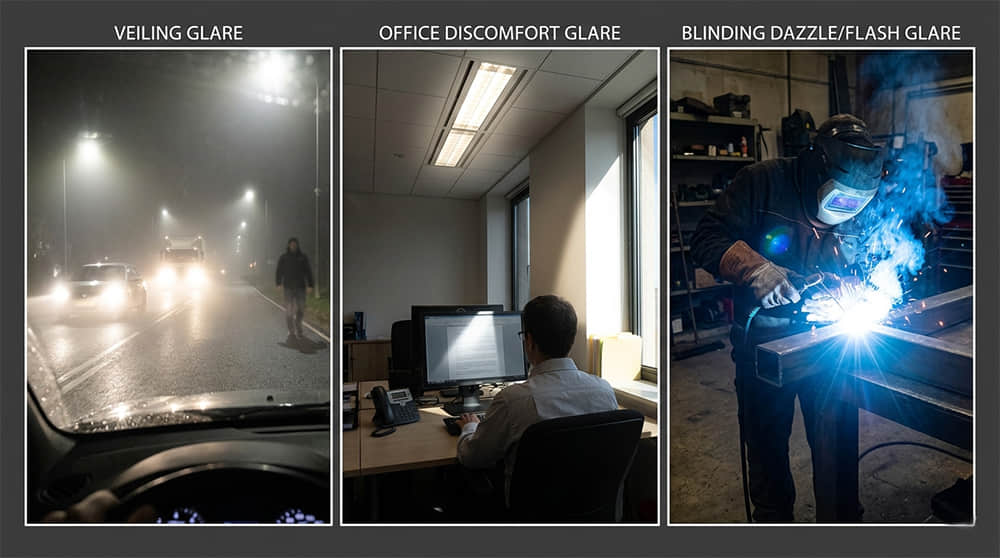
Discomfort Glare
This is the most common form found in indoor and outdoor environments. It produces a sensation of annoyance or even physical pain, leading to eye fatigue and a desire to look away from the light source. Crucially, discomfort glare does not necessarily impair the observer's ability to see objects; a worker in an office with poorly shielded LED panels may still be able to read their screen, but the constant strain will lead to decreased productivity and headaches over time.
Disability Glare
This is a much more critical safety concern, particularly in roadway lighting. Disability glare occurs when stray light enters the eye and scatters within the intraocular media (the lens and vitreous humor), creating a "veil" of brightness over the retina. This veil reduces the contrast of the visual image, making it difficult or impossible to distinguish objects, such as a pedestrian crossing a dark street. For drivers, disability glare from oncoming high-beams or unshielded streetlights is a leading cause of night-time accidents.
Blinding Glare
The most extreme form, blinding glare occurs when a light source is so intense that it completely overwhelms the visual system for a significant period. This is often encountered in industrial settings, such as arc welding, where specialized protective equipment is mandatory to prevent permanent retinal damage.
Beyond physiological effects, the mechanism of glare is further classified by how the light reaches the eye. Direct glare occurs when the light source itself—such as a bare LED chip—is within the field of vision. Reflected glare, often called "veiling reflections," occurs when light bounces off a smooth or polished surface (like a computer screen or a wet road) and enters the eye. Finally, contrast glare arises when the background is too dark relative to the light source, a frequent issue in poorly designed landscape lighting where a single bright spotlight is placed against a pitch-black sky.
Discomfort glare in an office can be mitigated using micro-lens arrays that diffuse the light, whereas disability glare on a highway requires precise beam-shaping and cutoff angles to ensure that no light is emitted directly into the driver's line of sight. By understanding the physics of glare, we move from generic lighting to "vision-centric" design, ensuring that artificial light supports, rather than subverts, human visual performance.
Beyond the Visible
Light pollution is not confined to the discomfort felt by an observer looking at a lamp; its impact radiates across spatial boundaries and spectral ranges. In modern urban environments, light frequently behaves as an "invasive species," crossing property lines and disrupting natural cycles. For optical designers, managing these three phenomena—light trespass, skyglow, and blue light hazard—is the key to creating "good neighbor" lighting that respects both the community and the cosmos.
Light Trespass
Occurs when artificial light falls where it is not intended, wanted, or needed. A classic example is a municipal streetlight that illuminates a bedroom window instead of the sidewalk. This is not merely an inconvenience; it is a violation of privacy and a disruption of the domestic environment. Light trespass is often the result of using "wide-angle" luminaires without proper secondary optics. Without a precise cutoff optical assembly, light spills horizontally and vertically beyond the target zone. In the residential sectors of cities like Columbus or London, light trespass is a leading cause of neighborhood complaints and a primary driver for the adoption of fully shielded luminaires.
Skyglow
While light trespass affects our homes, skyglow affects our connection to the universe. Skyglow is the bright halo that hangs over urban areas, caused by light that is emitted directly upward or reflected off the ground and subsequently scattered by dust and gas molecules in the atmosphere. The impact is staggering: as of 2026, research indicates that the global night sky is brightening at a rate of approximately 10% per year. Today, approximately one-third of the global population can no longer see the Milky Way from their homes. Skyglow is the ultimate indicator of wasted energy; every photon contributing to skyglow is a photon that failed to illuminate its intended target on the ground.
Blue Light Hazard
Beyond spatial distribution, the spectral composition of light introduces the Blue Light Hazard. Many standard LED chips exhibit a significant "blue peak" in their spectrum. While blue light is essential during the day for alertness, excessive exposure at night—whether from digital screens or high-color-temperature (5000K+) streetlights—suppresses the production of melatonin. This hormone is vital for regulating the circadian rhythm (the body's internal clock). The disruption of this rhythm is linked to a range of chronic health issues, from insomnia to more severe metabolic disorders. Why do the IDA and other regulatory bodies now recommend a correlated color temperature (CCT) of 3000K or lower for outdoor lighting? Because warmer tones contain less short-wave blue light, thereby reducing the impact on both human biology and the nocturnal environment.
For a lens manufacturer like Asahi Optics, these challenges define the mission of secondary optics. Preventing light trespass requires lenses with sharp, asymmetric beam control. Reducing skyglow requires a Zero-Uplight (ULOR=0%) design. Managing blue light involves ensuring that our optical materials and coatings are optimized for the warmer, more sustainable spectral outputs of the next generation of LEDs. By addressing what is "beyond the visible," we ensure that modern lighting contributes to a healthier, darker, and more efficient world.
The Human and Ecological Cost of Poor Lighting Design
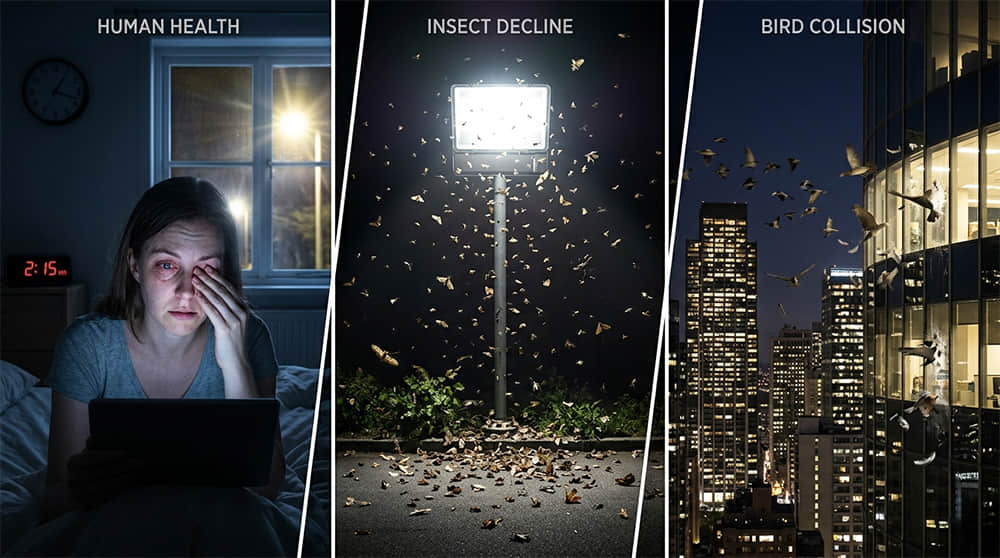
The consequences of excessive artificial light at night (ALAN) extend far beyond the loss of the starry sky. As research into "the fifth pollutant" matures, the evidence reveals a profound impact on biological systems and global resources. When light is poorly managed, the costs are measured in human health, biodiversity loss, and billions of dollars in wasted energy. For the lighting industry, these data points serve as a powerful catalyst for the adoption of more precise optical solutions.
Impact on Human Health and Vision
The human eye and endocrine system have evolved over millions of years to a natural cycle of light and dark. Modern White Light Pollution from glass facades and unshielded LED sources disrupts this equilibrium. Prolonged exposure to high-intensity reflected light can cause cumulative damage to the retina and iris. Scientific studies have shown a troubling correlation between light pollution and ocular health, with some reports indicating that the incidence of cataracts in areas with severe light pollution can reach as high as 45%.
Beyond direct vision damage, the suppression of melatonin—as discussed in the context of the blue light hazard—leads to circadian rhythm disruption. This is not merely a matter of poor sleep; chronic disruption of the internal clock is linked to increased risks of neuroneurasthenia, including symptoms such as insomnia, dizziness, and mood disorders. Recent medical studies even suggest a link between excessive nocturnal light exposure and a higher prevalence of metabolic diseases like diabetes and obesity, as the body's hormonal regulation becomes compromised in a "perpetual daylight" environment.
Ecological Consequences for Wildlife
The natural world is perhaps even more sensitive to light pollution than humans. For many species, light is a primary signal for migration, reproduction, and foraging.
-
Insects: Nocturnal insects, such as moths and fireflies, are fatally attracted to unshielded light sources, leading to a massive decline in their populations. This ripples up the food chain, affecting the birds and bats that rely on them.
-
Birds: Migratory birds often navigate by starlight. Bright city lights can disorient them, leading to fatal collisions with buildings—an estimated hundreds of millions of birds die this way annually in North America alone.
-
Plants: Excessive artificial light can disrupt the photoperiod of plants, affecting their growth cycles and even their ability to withstand frost or drought.
The Economic Burden of Wasted Energy
From a sustainability perspective, light pollution is the literal definition of inefficiency. Every lumen that shines into the sky or into a neighbor's window is energy that has been paid for but provides no benefit. According to the "Natura at Night" research report, it is estimated that the European Union loses approximately €5.2 billion annually due to energy wasted by poor lighting design. This represents nearly 50% of the total energy consumed by public lighting in some regions. Conversely, implementing well-designed, optically controlled systems can reduce energy consumption by 60% to 70% without sacrificing the safety or quality of ground-level illumination.
As we analyze these costs, it becomes clear that "dark sky friendly" lighting is not just an environmental luxury; it is a public health necessity and an economic imperative. By utilizing secondary optics that prevent light spill and glare, we protect not only the integrity of our vision but also the health of our planet and its resources.
Quantifying Glare – UGR, BUG Rating, and Other Metrics
To transition from identifying light pollution to effectively mitigating it, engineers rely on standardized metrics that quantify light's behavior in specific environments. Without these mathematical benchmarks, it would be impossible to define what constitutes "good" or "bad" lighting in a municipal bid or an architectural project. Today, three primary systems—UGR, BUG Rating, and Cut-off classifications—form the technical language of glare and light spill management.
Unified Glare Rating (UGR): The Indoor Standard
The Unified Glare Rating is a metric developed by the CIE to quantify discomfort glare in indoor environments, such as offices, schools, and hospitals. Unlike simple lumen output, UGR accounts for the background luminance, the luminance of the luminous parts of each luminaire, and the observer's position.
The UGR scale typically ranges from 5 to 40. A lower value indicates less glare. For example:
-
UGR ≤ 10: Glare is practically imperceptible.
-
UGR ≤ 19: This is the industry-standard threshold for high-quality office environments. Achieving a UGR of 19 or lower is essential for preventing long-term visual fatigue and maintaining concentration.
-
UGR ≥ 28: The glare is considered "unbearable" and fails most international workplace safety standards.
It is critical to note that a luminaire itself is not "UGR 19." Rather, the rating describes the performance of the luminaire within a specific room geometry. However, as an optics manufacturer, Asahi Optics designs lenses with precise micro-structures that significantly lower the light's intensity at high viewing angles, making it much easier for designers to achieve a compliant UGR in their space.
BUG Rating: The Outdoor Sentinel
For outdoor lighting, the industry uses the BUG Rating system (Backlight, Uplight, and Glare), established by the IES (TM-15). This system evaluates the lumen distribution of a luminaire in three critical directions:
-
Backlight (B) : Light directed behind the pole, which often causes light trespass into buildings.
-
Uplight (U) : Light directed toward the sky, contributing to skyglow (a BUG rating of U0 means zero light goes above 90°).
-
Glare (G) : Light emitted at high angles that enters a driver's or pedestrian's eyes.
Each category is rated from 0 to 5. A B1-U0-G1 rating, for example, represents an exceptionally well-controlled luminaire suitable for environmentally sensitive areas. This rating system is now a mandatory part of many "Dark Sky" municipal projects in North America and Europe.
Cut-off Angles and Shielding
A more traditional but still vital classification is the Cut-off Angle. This defines the angle between the vertical axis and the first line of sight where the light source (the LED chip) is no longer visible.
-
Full Cutoff: No light is emitted at or above the horizontal plane (90°). This is the gold standard for reducing skyglow.
-
Cutoff: Only a tiny fraction of light (less than 2.5% of lumens) is allowed at or above 90°.
By integrating these metrics into the design phase, we move beyond guesswork. Whether through Threshold Increment (TI) in roadway lighting—which measures the reduction in visibility due to glare—or the BUG system, these quantifications allow Asahi Optics to engineer lenses that are not just bright, but are "precision-weighted" to meet the highest international standards of environmental responsibility.
International Standards and Regulations for Light Pollution Control
As we navigate through 2026, the regulatory landscape for artificial light has reached a critical inflection point. Governments and international bodies no longer view light pollution as a localized nuisance but as a systemic environmental hazard. For manufacturers and engineers, compliance with these evolving standards—such as CIE 150:2017 and the IDA DarkSky program—is now the primary prerequisite for entering high-value municipal and architectural markets.
CIE 150:2017 – The Global Benchmark for Obtrusive Light
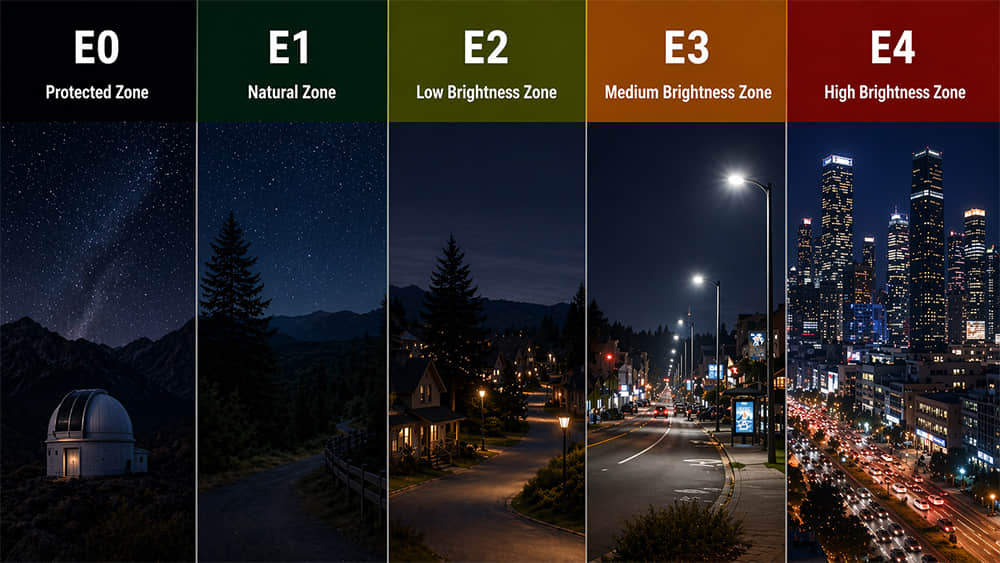
The CIE 150:2017 (Guide on the Limitation of the Effects of Obtrusive Light from Outdoor Lighting Installations) serves as the most authoritative technical reference for assessing environmental impact. This standard categorizes environments into five distinct zones (E0 to E4) based on their sensitivity to light:
-
E0 (Protected) : Dark landscapes like national parks or astronomical observatories where ALAN is strictly prohibited.
-
E1 (Natural) : Intrinsic dark areas like relatively uninhabited rural lands.
-
E2 (Low District Brightness) : Sparsely inhabited rural areas or suburban residential zones.
-
E4 (High District Brightness) : High-density city centers with intensive nighttime activity.
For each zone, CIE 150 specifies strict limits on parameters such as Vertical Illuminance on Windows (Eᵥ) to prevent light trespass, and Luminous Intensity (I) of luminaires in designated directions. Controlling these values at the design stage ensures that a project does not become a target for legal complaints from neighboring residents.
IDA DarkSky Approved Luminaire Program
The International Dark-Sky Association (IDA) sets the gold standard for "eco-friendly" lighting. To obtain DarkSky Approval, a luminaire must meet three uncompromising criteria:
-
Shielding: The fixture must be fully shielded so that no light is emitted above the 90-degree horizontal plane (ULOR=0% ).
-
Color Temperature: The CCT must be 3000K or lower, minimizing the suppression of melatonin and the impact on the nocturnal ecosystem.
-
Dimming Capability: The luminaire must be capable of dimming to at least 10% of its full output, allowing for "lighting on demand" during late-night hours.
The 2026 Shift: New Regulations in China
China has rapidly advanced its legislative framework to address light pollution. Following the success of the Shanghai Environmental Protection Regulation (2022), which was the first local law to impose fines for light pollution (up to 50,000 yuan), a national standardization movement is underway.
-
GB/T 46390-2025 (Requirements for Examination and Evaluation of Urban Luminous Environment): Formally published in late 2025, this standard will take effect on May 1, 2026. It provides a comprehensive framework for auditing city-wide light quality, focusing on skyglow, glare indices, and light trespass.
-
The new Ecological and Environmental Code (Draft) also integrates light pollution into national pollution prevention protocols, signaling that unshielded advertising screens and glass facades will face much stricter oversight in the coming years.
Why are these regulations becoming so stringent? Because the cost of non-compliance is no longer just ecological; it is legal and financial. From the IES/IDA Model Lighting Ordinance (MLO) in North America to the new GB/T standards in China, the message is clear: "Precision" is the new mandate.
The Lens Solution
The transition from a regulatory standard to a compliant lighting fixture depends entirely on the precision of the secondary optical assembly. While an LED chip provides the raw energy, the optical lens acts as the "intelligence" of the system, determining the exact path of every photon. At Asahi Optics, our approach to mitigating glare and light pollution is rooted in three engineering pillars: precise beam shaping, advanced surface texturing, and modular material science. By addressing light distribution at the source, we enable luminaires to meet the most stringent UGR < 19 and DarkSky requirements.
1. Micro-Structure and Embossing Technology for Low UGR
One of the most effective ways to reduce discomfort glare in indoor and pedestrian environments is through the integration of micro-structures on the lens surface. For our Zhaga-standard linear lenses (e.g., 280x40mm series), Asahi Optics utilizes high-precision embossing techniques. Instead of a perfectly smooth surface, which can lead to high-intensity "hot spots" and direct glare, we can customize lenses with nano-optical textures or hexagonal micro-arrays.
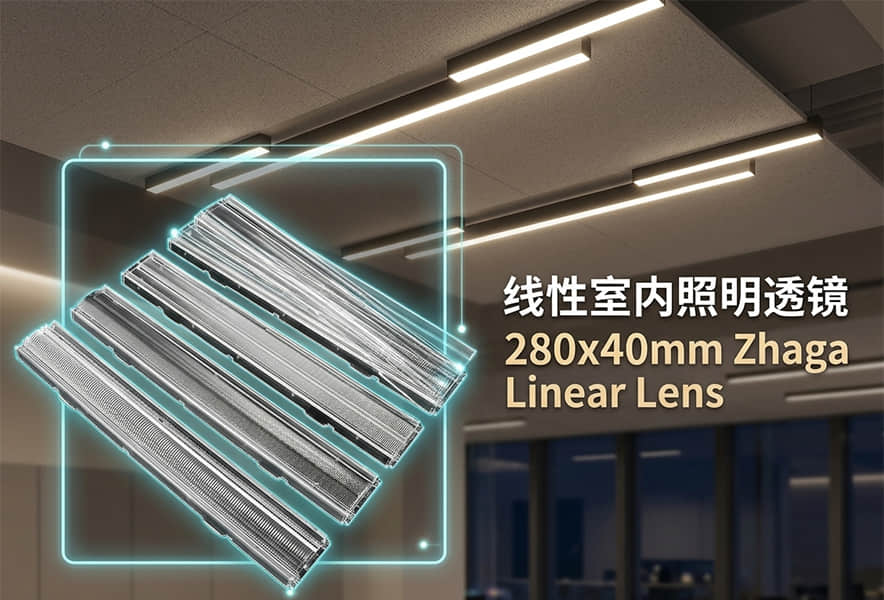
These micro-structures serve to diffuse the light slightly at high viewing angles (above 65°) without compromising the overall light transmission (≥93%). By breaking up the point-source nature of the LED chips, this technology allows office and commercial fixtures to achieve a UGR as low as 16 to 19, significantly reducing visual fatigue for occupants.
2. Precision Extrusion Lenses for Wall Washing and Facade Lighting
Facade lighting is a primary contributor to White Light Pollution and skyglow if not controlled. Asahi Optics specializes in Extrusion Linear Lenses, which are engineered for architectural applications. Unlike traditional injection-molded lenses, our extrusion process allows for the creation of long, continuous optical profiles that maintain perfect beam consistency over several meters.
In wall-washing applications, our extrusion lenses are designed with narrow, asymmetric beam angles. This ensures that light is directed precisely onto the building surface with a sharp cutoff, preventing light from "spilling" into the atmosphere or through the windows of the building itself. This "targeted illumination" is the key to creating dramatic architectural effects while remaining compliant with CIE 150 zone requirements.
3. Mastering Freeform Distribution
To combat the Zebra Effect and disability glare in roadway lighting, we employ Freeform Optical Design. For our outdoor modules—such as the IP66-rated 2x6, 3x8 and 4x6 arrays—sharp cut‑off lenses are available. Furthermore, our lenses are designed to achieve ULOR=0% (Upward Light Output Ratio), ensuring that no light is emitted above the horizontal plane, thus preserving the integrity of the night sky.
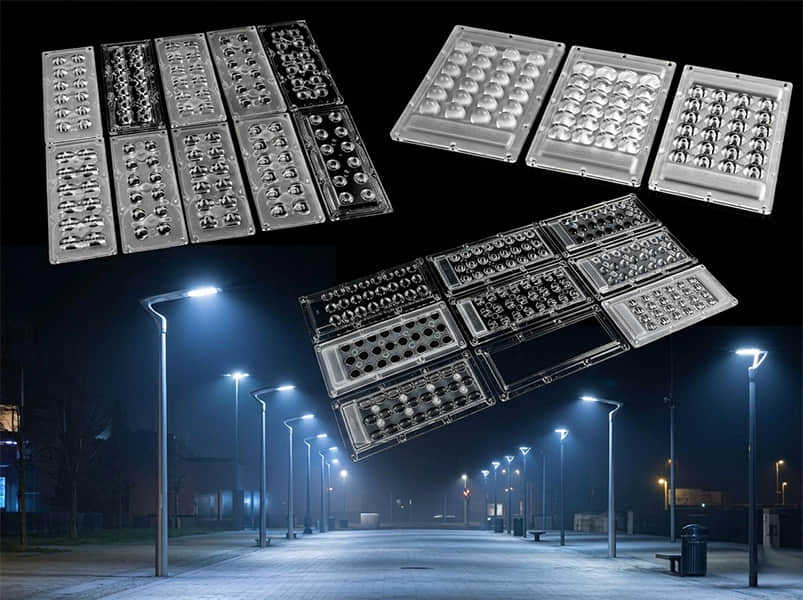
In summary, the solution to light pollution is not to use less light, but to use light more intelligently. Through the combination of Zhaga-compliant linear optics, custom micro-structures, and precision extrusion technology, Asahi Optics provides the tools necessary to build a future where urban illumination and environmental protection coexist in perfect harmony.
Conclusion – Good Lighting Starts with Good Optics
Light pollution and glare are no longer peripheral concerns for the lighting industry; they are the central challenges of 21st century urban development. As we have explored, the transition from "lighting up the night" to "responsible illumination" requires a deep understanding of both human biology and optical physics. From the discomfort of office glare to the ecological disruption of skyglow, the impact of unshielded, poorly distributed light is profound and costly.
However, the solution is not to return to the darkness, but to embrace optical precision. Through the engineering of secondary optics—such as Asahi Optics' Zhaga-standard linear lenses and customized micro-structure embossing—we can control the trajectory of light with surgical accuracy. By ensuring that every photon is directed only where it is needed, we can achieve the triple objective of modern lighting: enhancing human safety, protecting our health and environment, and drastically reducing energy waste. The future of the lighting industry lies in this harmony between technological brilliance and environmental stewardship.
FAQ: Addressing Light Pollution and Glare Challenges
Q: What is the fundamental difference between light pollution and glare?
A: Light pollution is a broad environmental term referring to any adverse effect of artificial light, such as skyglow or light trespass. Glare, on the other hand, is a specific visual sensation experienced by an individual when a light source is significantly brighter than the surrounding environment, causing either discomfort or a loss in visual performance (disability glare).
Q: Why does the IDA recommend 3000K or lower CCT for outdoor lighting?
A: Higher Color Temperatures (5000K+) contain a larger proportion of short-wave blue light. Blue light scatters more easily in the atmosphere, exacerbating skyglow, and is more effective at suppressing melatonin in humans and wildlife, which disrupts circadian rhythms. A CCT of 3000K or lower balances visibility with environmental safety.
Q: What is UGR and what is an acceptable value for professional office lighting?
A: UGR (Unified Glare Rating) is an international metric used to quantify discomfort glare in indoor settings. The scale ranges from 5 to 40. For a professional office environment, a UGR ≤ 19 is the standard requirement to ensure visual comfort and prevent eye strain during long working hours.
Q: How can optical lenses reduce light trespass in residential areas?
A: Secondary optical lenses, particularly those with asymmetric or freeform designs, can create a sharp cutoff at the edge of the beam. This allows the light to be focused entirely on the roadway or sidewalk while preventing it from spilling vertically or horizontally into nearby bedroom windows or private properties.
Q: What are the requirements for a luminaire to be "DarkSky Approved"?
A: To receive IDA DarkSky certification, a fixture must be fully shielded (meaning no light is emitted above the 90° horizontal plane, or ULOR=0% ), use a CCT of 3000K or warmer, and possess dimming capabilities to reduce light levels during hours of low activity.