In the era of solid-state lighting, Light Emitting Diodes (LEDs) have revolutionized how we illuminate our commercial, medical, and residential spaces. They deliver unparalleled energy efficacy, rugged durability, and extreme design flexibility. Yet, accompanying this technological triumph is a persistent, industry-wide, and often misunderstood concern: the blue light hazard.
As awareness of photobiological safety and Human-Centric Lighting (HCL) grows, luminaire manufacturers, lighting designers, and end-users are increasingly anxious about the potential negative effects of blue light on the human eye and circadian rhythms. This concern has reached critical levels in highly demanding applications, such as healthcare facilities, educational institutions, and high-end office environments, where strict safety standards like the RG0 (Risk Group 0 - Exempt) classification are mandatory.
However, much of the public discourse surrounding blue light borders on unwarranted panic. Blue light is not an inherent toxin or a manufacturing defect; it is a fundamental, inescapable component of the physics that allow commercial white LEDs to function. The key to creating safe, visually comfortable, and biologically responsible lighting is not to artificially eliminate blue light—which would severely compromise luminous efficacy and color rendering—but to scientifically understand its origins, manage the factors that amplify it, and ultimately, control its spatial distribution and radiance intensity.
This is exactly where advanced secondary optics play a pivotal role. In this comprehensive guide, we will explore the true nature of LED blue light, examine its physiological impacts, and reveal how Asahi Optics engineers precision lenses—incorporating micro-structures and targeted diffusion—to meticulously control blue light exposure, ensuring your luminaires meet the highest standards of photobiological safety.
How is Blue Light Generated in White LEDs?
To fully grasp the concept of the blue light hazard, we must first look beneath the surface of the luminaire and examine the semiconductor physics of the LED chip itself.
A common misconception among the general public is that a white LED inherently produces a balanced, continuous spectrum of white light, much like the sun or an old-school incandescent bulb. In reality, the vast majority of commercial white lighting today relies on a technology known as the Phosphor-Converted LED (PC-LED) .
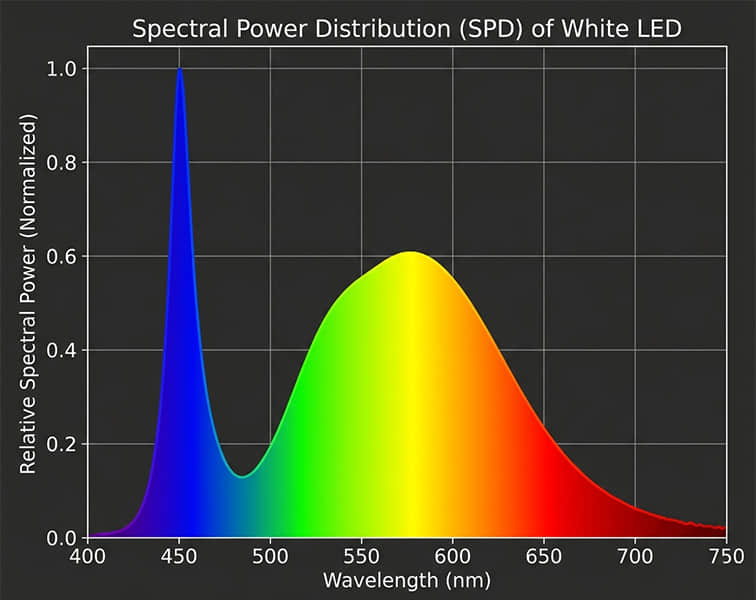
At the very heart of a standard white PC-LED package is not a white light emitter, but an Indium Gallium Nitride (InGaN) blue pump chip. This semiconductor die is engineered to emit highly concentrated, high-energy monochromatic blue light, typically peaking at a wavelength between 440nm and 460nm.
To create the white light that our eyes perceive, this bare blue chip is coated with a layer of luminescent material, most commonly a yellow-emitting Yttrium Aluminum Garnet (YAG) phosphor. When the LED is powered on, the high-energy blue photons strike the phosphor layer. The phosphor absorbs a portion of these blue photons and, through a process called the Stokes shift, down-converts their energy, re-emitting them as lower-energy, broad-spectrum yellow and red light.
However, the phosphor layer does not absorb all of the blue light. A carefully calculated percentage of the original, unadulterated blue light deliberately leaks through the phosphor coating. When this highly energetic blue light mixes with the broad-spectrum yellow light emitted by the phosphor, the human brain synthesizes the combination and perceives it as white light.
Because this direct blue light is essential to the color-mixing process, if you look at the Spectral Power Distribution (SPD) graph of almost any standard white LED, you will see a massive, sharp spike in the blue wavelength region (around 450nm). This is commonly referred to as the blue spike. It is not a flaw in the manufacturing process; it is the very engine driving the luminaire. The hazard does not arise simply because this blue spike exists, but rather how intensely this concentrated energy is allowed to reach the human eye without proper optical mitigation.
What Factors Drive Up Blue Light in LED Illumination?
Understanding the PC-LED mechanism reveals that the intensity of the blue light spike is not a constant; it is dictated by several critical engineering and physical variables. In luminaire manufacturing, the following three core factors directly influence the final blue light output:
-
Correlated Color Temperature (CCT) : This is the most direct factor. To produce high-CCT white light (e.g., 6000K cool white), manufacturers use a thinner layer of yellow phosphor, allowing more of the underlying blue pump light to transmit directly. Consequently, cool white LEDs exhibit a much higher blue spike. Conversely, low-CCT LEDs (e.g., 2700K warm white) require a thicker phosphor layer, resulting in significantly lower blue light radiation.
-
Phosphor Quality and Coating Consistency: The uniformity of the phosphor layer is paramount. If an LED packaging facility utilizes substandard phosphor or a flawed coating process, blue light will aggressively leak through the thinner areas. This uncontrolled leakage not only causes severe Color Spatial Uniformity issues but also creates harsh, localized hotspots of high-intensity blue radiation.
-
Thermal Degradation and Overdriving: As established in core thermal management logic, the phosphor conversion process generates significant heat. If a luminaire's heat sink is poorly designed, prolonged high junction temperature will accelerate thermal degradation of the phosphor layer. Over time, as the phosphor loses its down-conversion efficacy, an increasing amount of high-energy blue light penetrates through directly. This is why inferior LED fixtures often exhibit a noticeable blue shift as they age.
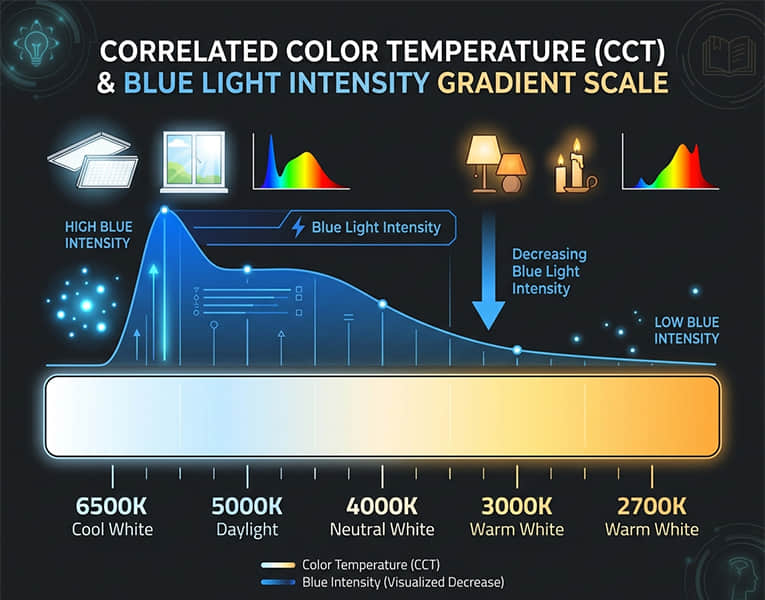
The True Impact of Blue Light on Humans and Lighting Projects
The intense focus on blue light is fundamentally tied to photobiological safety and human well-being. For manufacturers targeting high-end commercial, medical, and educational lighting projects, a scientific approach to mitigating blue light is a critical prerequisite.
-
Interference with Circadian Rhythms: The human retina contains specialized photoreceptor cells (ipRGCs) that are exceptionally sensitive to short-wavelength blue light. During the day, blue-enriched light suppresses melatonin production, keeping us alert. However, prolonged exposure to uncontrolled, high-intensity blue light in indoor environments during the evening disrupts our biological clock. This physiological reality is the driving force behind modern Human-Centric Lighting (HCL) , which demands precise control over blue light dosage.
-
Photobiological Hazards and Project Compliance: If an extremely concentrated beam of blue light enters the eye directly, its high energy can penetrate the lens and reach the retina, potentially causing irreversible photochemical damage. To mitigate this risk, authoritative bodies like the International Electrotechnical Commission (IEC) have established rigorous photobiological safety standards. In highly sensitive projects—such as hospital operating rooms, school classrooms, and premium office buildings—luminaires are often legally required to achieve the RG0 (Risk Group 0 - Exempt) classification.
This undeniable reality means that a bare, high-brightness LED chip, operating without precise optical moderation, will absolutely fail these stringent engineering inspections. To tame this raw, concentrated energy, the precise intervention of secondary optics is the only viable solution.
How Lens Design Scientifically Controls the Blue Light Hazard
Faced with stringent photobiological safety standards like IEC 62471, many manufacturers fall into a common trap: they attempt to pass blue light tests by drastically reducing drive currents or exclusively using ultra-low CCT LEDs. However, these crude compromises severely degrade luminous efficacy and color rendering.
As a premier optical manufacturer, Asahi Optics understands that the true solution lies in high-precision Secondary Optics. Our core design philosophy is not to simply filter out or absorb blue light—which would result in unacceptable lumen depreciation—but to utilize precise optical structures to achieve Spatial Mixing. By comprehensively mixing the highly directional blue light with the highly scattered yellow light, we fundamentally prevent high-intensity, direct blue rays from entering the human eye's field of view.
-
Strategy 1: Micro-structure Diffusion Surfaces: We engineer micron-level array structures—such as micro-lens arrays, beaded textures, or specifically calibrated frosted surfaces—onto the emitting face of the lens. These micro-structures deliberately disrupt standard total internal reflection, forcing highly directional blue light to refract multiple times and mix thoroughly with scattered yellow light. This physical mixing effectively eliminates the central blue spike and ensures highly consistent CCT across a wide viewing angle.
-
Strategy 2: Center Structural Optimization for TIR Lenses: To maximize Center Beam Candlepower (CBCP) , traditional Total Internal Reflection (TIR) lenses usually feature a convex collimator directly above the LED die, which heavily concentrates direct blue light. In our human-centric designs, we optimize this central zone by making it flat, concave, or frosted, forcing high-energy blue photons to deflect toward the TIR sidewalls for secondary spatial mixing.
-
Strategy 3: Utilizing Reflective Optical Paths: For applications like wall washing or indirect lighting, we manipulate internal lens geometry so emitted light primarily strikes the TIR reflective sidewalls before exiting. By reflecting the light, we increase its travel path and convert direct blue rays into angled light, allowing seamless mixing with yellow light before emission.
-
Strategy 4: Advanced Material Modification: For uncompromising safety requirements, we can modify base PC or PMMA resins. By adding trace amounts of high-precision blue light absorbers (targeting the narrow 415nm-445nm band), we guarantee RG0 compliance with only a minor 5%-15% sacrifice in luminous flux. Alternatively, incorporating high-concentration silica diffusion agents creates millions of microscopic scattering events, spreading blue energy over a larger solid angle.
-
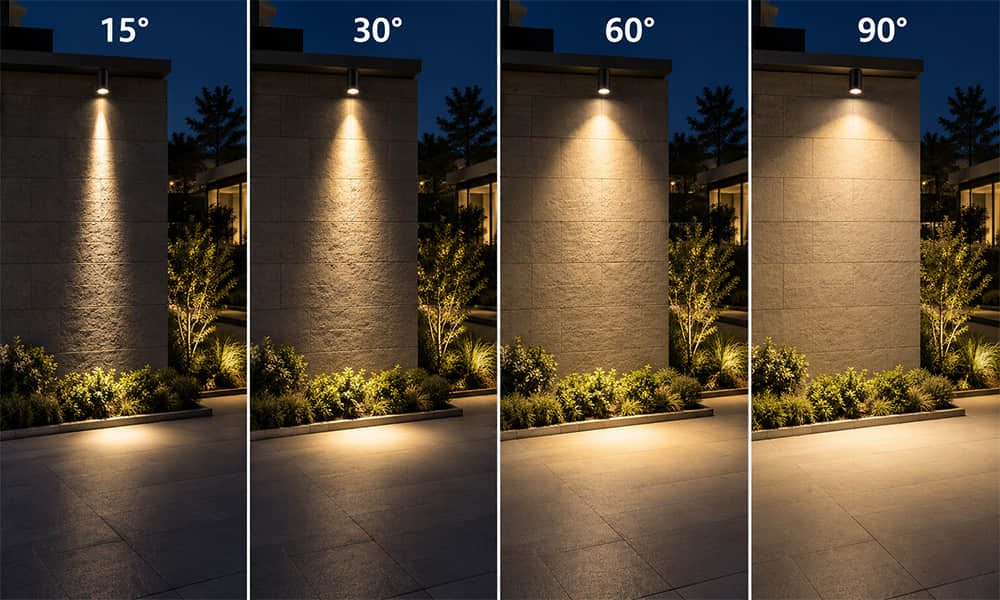
Strategy 5: Optimizing Light Distribution to Avoid Danger Zones: Blue light hazard evaluations are heavily dependent on radiance within a specific field of view. During optical design, we can mitigate this by widening the beam angle (e.g., from a harsh 15° to a smoother 36°) or employing asymmetrical distribution. For office lighting, our lenses are engineered with a sharp cut-off angle beyond 65°, completely eliminating high-angle blue light glare.
The Optical Balancing Act of a 5° Medical Spotlight
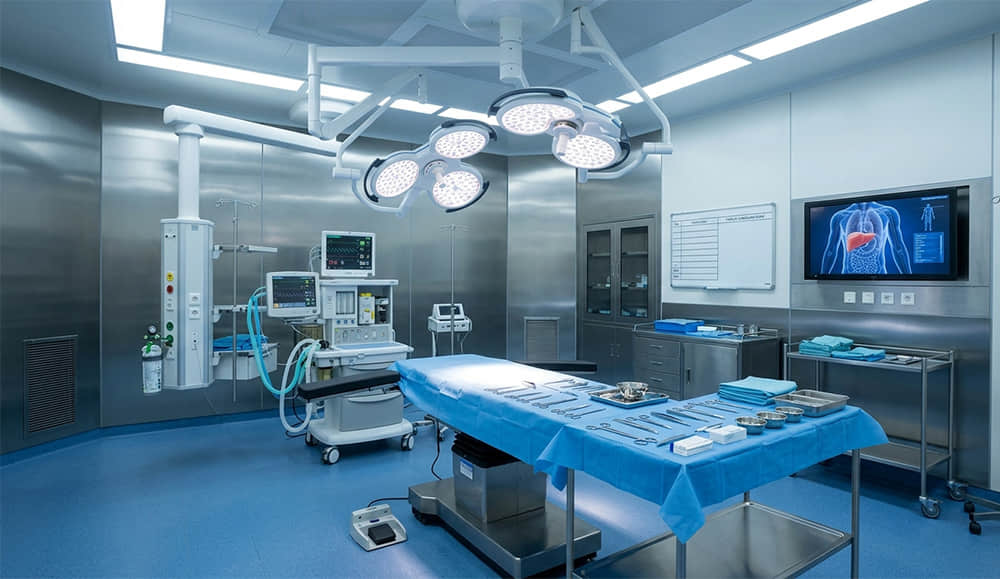
To demonstrate the real-world efficacy of these strategies, consider a recent custom project Asahi Optics completed for a high-end medical equipment manufacturer.
The Contradiction: The client was developing an auxiliary spotlight for precision medical examinations. Clinical requirements demanded an ultra-narrow 5° beam angle lens to provide immense CBCP and deep visual penetration. However, the narrower the beam, the more concentrated and aggressive the blue radiance becomes at 0°. Because this device operates closely to patients and within the doctor's direct line of sight, it absolutely had to pass the stringent RG0 (Risk Group 0 - Exempt) photobiological safety test. A traditional transparent 5° TIR lens could deliver the intensity, but would wildly fail the blue light spike test.
The Asahi Solution: Our optical engineers discarded the traditional convex-center design and integrated micro-structures with redirected optical paths:
-
Dispersing Direct Central Light: We modified the central incident profile of the TIR lens, deliberately weakening direct forward transmission. The energy that would normally form a 0° blue spike was forced to refract towards the outer TIR reflective sidewalls, lengthening the optical path and triggering spatial mixing.
-
Micro-structure Overlay: On the final exit surface, we meticulously layered a micro-lens array combined with a slight frosted surface.
The Engineering Result: Macroscopically, this combination flawlessly preserved the powerful penetration and central illuminance of the 5° beam, meeting strict medical requirements. Microscopically, the frosted surface and array successfully broke the absolute concentration of central blue photons, subjecting harsh high-frequency blue rays to controlled diffusion. This precise optical peak-shaving drastically lowered the blue radiance peak, allowing the luminaire to easily achieve RG0 certification without compromising its core performance.
Conclusion: Safeguarding Human Health with Precision Optics
Blue light is not the original sin of LED lighting; uncontrolled, concentrated blue light is. As we fully embrace the era of Human-Centric Lighting (HCL) , the criteria for evaluating luminaires have evolved from merely how bright it is to how healthy it is.
In this critical shift toward visual and biological safety, a bare LED chip is simply a photon engine. Professional secondary optics are the steering wheel and safety valve of your entire lighting system. As pioneers in precision optics, Asahi Optics does far more than mold PC and PMMA plastics. By deeply understanding micro-structures, ray tracing, and material physics, we transform harsh raw photons into safe, comfortable, and highly efficient luminous environments.
Do not let uncontrolled blue light derail your carefully designed luminaires. Partner with Asahi Optics today, and let our custom lens solutions secure the photobiological safety and commercial success of your next high-end medical or commercial lighting project.