For modern cities, the street lighting network is both a vital safety infrastructure and a significant financial burden. In many municipalities across the United States and Europe, street lighting can account for anywhere from 25% to 50% of the total municipal energy bill.
As energy prices fluctuate and sustainability mandates become more stringent, city planners and engineers are realizing that "efficiency" is no longer just about picking a bulb with a lower wattage. To achieve meaningful, long-term savings, we must shift toward a system-level approach that integrates high-performance hardware with intelligent software.
The Three Pillars of Efficiency
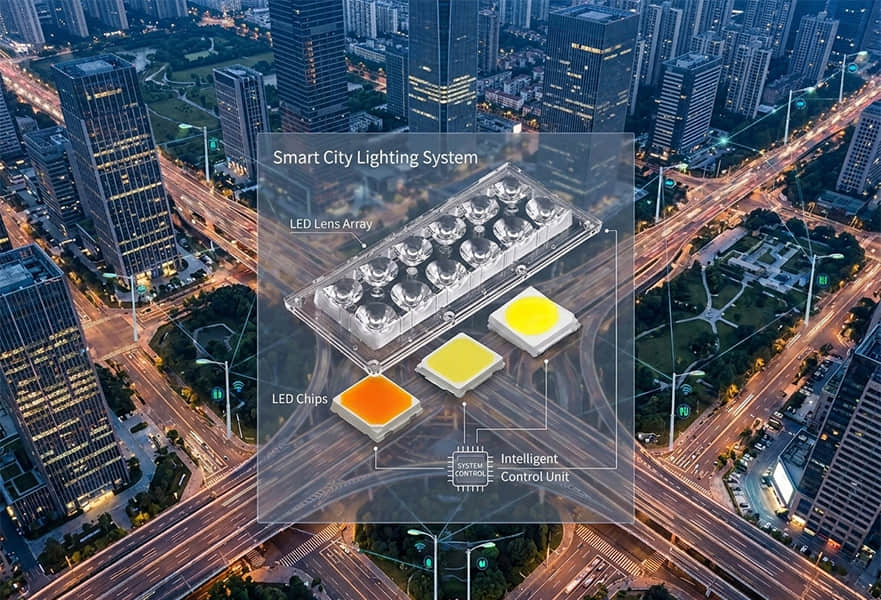
True energy efficiency in 2026 is driven by the synergy of three core technologies:
-
High-Efficacy LED Chips: Maximizing the light output per watt of electricity consumed.
-
Precision Secondary Optics: Ensuring that every generated lumen is directed onto the roadway, rather than wasted as skyglow or light trespass.
-
Smart Control Systems: Utilizing IoT connectivity to provide "light on demand" through adaptive dimming.
By treating these three pillars as a single integrated instrument, municipalities can reduce their energy consumption by up to 70–80% compared to legacy systems.
Why Simply Replacing Bulbs Isn't Enough
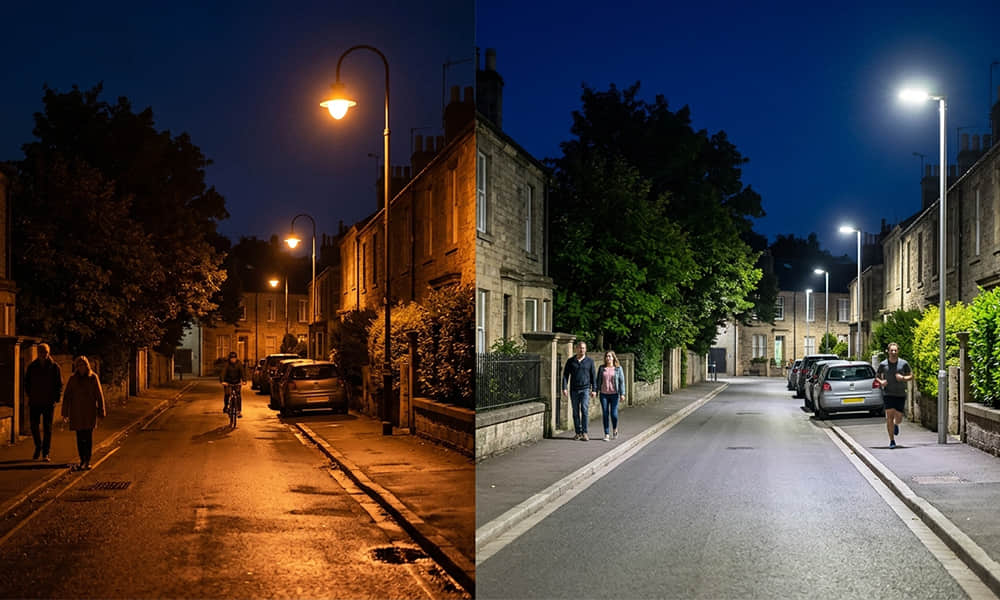
In the early days of the LED transition, many projects focused solely on "one-to-one" replacements—swapping a 250W High-Pressure Sodium (HPS) lamp for a 100W LED. While this saved energy, it often resulted in poor light uniformity, increased glare, and "hot spots" on the pavement.
Today, the goal is optimized illumination. High energy efficiency is now defined by how little power is required to meet strict safety standards (such as IES RP-8). This requires a luminaire where the LED source and the secondary lens are engineered together from the very beginning to eliminate waste.
High-Efficacy LEDs – Reducing Power at the Source
The foundation of any energy-efficient street lighting project begins with the light source itself. Over the past decade, Light Emitting Diode (LED) technology has undergone a radical transformation, moving from a novel alternative to the undisputed industry standard for roadway illumination.
The Massive Gap: HPS vs. Modern LED
Traditional roadway lighting relied heavily on High-Pressure Sodium (HPS) lamps. While reliable for their time, they are inherently inefficient by 2026 standards:
-
HPS Luminous Efficacy: Typically ranges from 60 to 90 lm/W. Furthermore, much of this light is lost due to the omnidirectional nature of the bulb, which requires large, inefficient reflectors to redirect light downward.
-
2026 LED Luminous Efficacy: Mainstream professional street lights now achieve 180 to 220 lm/W at the system level. High-performance models designed for maximum ROI can even push toward 250 lm/W.
By switching from HPS to high-efficacy LEDs, a municipality can immediately cut its energy consumption by 50% to 70% without any additional controls.
Economic Impact: Slashing the Municipal Budget
To put these numbers into perspective, consider a typical mid-sized city with 10,000 street lights. By upgrading from 250W HPS fixtures to 80W high-efficacy LED fixtures, the city can expect:
-
Energy Savings: An annual reduction of millions of kilowatt-hours (kWh).
-
Operational Savings: Beyond electricity, the lifespan of a modern LED (typically 100,000 hours) is nearly five times longer than an HPS bulb. This virtually eliminates the "truck roll" costs associated with frequent bulb replacements, which often represent a significant portion of the maintenance budget.
The Thermal Advantage
Efficiency is also a matter of heat management. Traditional lamps convert a vast majority of energy into heat rather than light. In contrast, high-efficacy LEDs operate much cooler. This reduced thermal stress not only protects the internal electronics but also slows the degradation of the LED chips, ensuring that the light output remains consistent for 15 years or more.
However, generating high-quality light efficiently is only half the battle. The next critical step is ensuring that light reaches the road—a task that falls entirely on the optical system.
Secondary Optics – The Vital Link in Luminaire Design
In the world of high-performance street lighting, optical efficiency is just as important as luminous efficacy. It is a common misconception that a lamp with a high lm/W rating is automatically "efficient." In reality, an LED chip is merely a source of raw light; without precision engineering, that light is wasted. This is where secondary optics—the lenses that sit directly over the LED chips—become the most critical link in the luminaire design.
The Problem with "Raw" Light
Standard LEDs emit light in a wide, circular Lambertian distribution (usually around 120°). If you were to install a high-powered LED on a street light pole without a secondary lens:
-
Light Trespass: Nearly 40% of the light would spill into residents' windows or the empty space behind the pole.
-
Skyglow: A significant portion of light would be emitted upward or at high angles, contributing to light pollution rather than road safety.
-
Uniformity Issues: The area directly under the pole would be blindingly bright (a "hot spot"), while the spaces between poles would remain dangerously dark.
Lenses as an Efficiency Multiplier
Secondary optics, specifically freeform TIR (Total Internal Reflection) lenses, are engineered to "reshape" every available photon. By integrating the lens as a core component of the luminaire, manufacturers can achieve several energy-saving goals:
-
Precise Beam Shaping: Lenses redistribute light into rectangular patterns (Type II, Type III, or Type IV distributions) that match the geometry of the roadway perfectly. This ensures that light is utilized only where it is needed—on the pavement and sidewalk.
-
Increased Pole Spacing: High-precision lenses can direct light further down the road at controlled angles. This allows for wider spacing between light poles, meaning a city might need 15–20% fewer fixtures to illuminate the same stretch of highway, drastically reducing the total power load of the project.
-
Maximum Coefficient of Utilization (CU): The CU measures the percentage of light that actually reaches the target area. A well-designed lens can improve a luminaire's CU from a mediocre 35% to over 75%, effectively doubling the "functional" efficiency of the lamp without increasing its wattage.
Smart Controls – Adaptive Dimming for On-Demand Lighting
If LEDs provide the efficient "engine" and secondary optics provide the "steering," then smart controls represent the "brain" of modern energy-efficient street lighting. Historically, street lights operated on a simple binary: they were either 100% on or 100% off. This meant that at 3:00 AM, a completely empty suburban street was being illuminated at the same intensity as a busy downtown intersection during rush hour.
Integrating Adaptive Lighting through IoT (Internet of Things) connectivity allows municipalities to capture a second wave of energy savings that hardware alone cannot achieve.
The Power of Adaptive Dimming
Smart lighting systems utilize Networked Lighting Controllers (NLC) to adjust brightness levels based on real-time needs. By following a pre-programmed dimming schedule or responding to live environmental data, cities can significantly reduce their carbon footprint:
-
Scheduled Dimming: Lights can be programmed to dim to 30% or 50% during deep-night hours when traffic volume is minimal, then return to full brightness before the morning commute.
-
Motion & Traffic Sensing: Using microwave or PIR sensors, individual luminaires can "wake up" when they detect an approaching vehicle or pedestrian and dim back down once the area is clear.
-
Constant Light Output (CLO) : LEDs naturally lose a small amount of brightness over many years. Instead of over-powering a new lamp to compensate for future loss, CLO technology starts at a lower power and slowly increases it over a decade, saving significant energy during the first several years of operation.
IoT and Maintenance Efficiency
A smart-controlled street light does more than dim; it communicates. Through a centralized management platform, the luminaire can report its exact energy consumption and health status in real time.
-
Automatic Fault Detection: If a light fails, the system sends an instant alert to the maintenance team with the exact GPS coordinates. This eliminates the need for manual "night-time patrols" to find burnt-out lights, reducing the fuel consumption and labor costs of maintenance fleets.
-
Precise Metering: Smart systems provide utility-grade energy metering, ensuring that municipalities pay only for the electricity they actually use, rather than an estimated "flat rate" based on old, inefficient technology.
Synergistic Savings
When smart controls are combined with high-precision optics, the results are compounded. Because the optics ensure the light is already highly concentrated on the road, dimming the light to 50% often still provides better visibility and safety than an un-dimmed, poorly-directed traditional lamp. This synergy allows for deeper dimming cycles without compromising public safety standards.
Real-World Case Studies in the U.S. & Europe
The transition to integrated energy-efficient street lighting is no longer a pilot concept; it is a proven financial strategy being deployed across major Western municipalities. By analyzing the data from these regions, we can see a clear pattern: the combination of high-efficacy LEDs, precision optics, and smart controls creates a compelling Return on Investment (ROI).
Washington D.C. Smart Lighting Project
The District undertook a massive conversion of 75,000 street lights to LED technology integrated with a remote monitoring system.
-
Results: The project achieved an immediate 70% reduction in energy consumption.
-
Long-term Value: Beyond energy, the city expects to reduce greenhouse gas emissions by 38,000 tons annually. The precision optics used in the luminaires significantly reduced light trespass into residential windows, a common complaint in the district’s older neighborhoods.
The Total Cost of Ownership (TCO) Model
When evaluating street lighting projects, savvy procurement officers in the U.S. and Europe are moving away from "lowest initial bid" and toward Total Cost of Ownership.
Why 3-5 Year Payback is the New Standard
While high-quality optics and smart sensors add to the initial cost of the fixture, they accelerate the ROI by:
-
Reducing total fixture count (better optics = wider spacing).
-
Slashing the utility bill (deeper dimming and higher efficacy).
-
Eliminating emergency repairs (smart diagnostics).
For most cities, the energy savings alone cover the debt service for the upgrade, making the transition "budget neutral" from day one.
Conclusion – The Future of Integrated Roadway Lighting
Achieving true energy efficiency in street lighting is a balancing act of physics, engineering, and digital intelligence. As we have seen, the most successful municipal projects in the U.S. and Europe are those that move away from viewing the street light as a simple commodity.
Instead, the modern luminaire must be viewed as an integrated system:
-
The LED provides the raw power.
-
The Smart Control provides the intelligence.
-
The Secondary Lens provides the precision.
As an optical manufacturer, we understand that the lens is the "final mile" of energy efficiency. By ensuring that every lumen is captured, reshaped, and delivered exactly where it is needed, we help our partners transform street lighting from a municipal expense into a high-performance asset. If your project requires a higher standard of efficiency, prioritize a design where optics and electronics work in perfect harmony.
FAQ – Common Engineering & Procurement Questions
Q: What is the most energy-efficient street lighting system available today?
A: The most efficient system is not a single component, but a synergistic luminaire that combines high-efficacy LEDs (200+ lm/W) with precision secondary optics and smart dimming controls. While the LED chip determines the power input, the secondary lens determines the "functional efficiency"—how much of that light actually reaches the road. A system that achieves a high Coefficient of Utilization (CU) through optical shaping is always more efficient than a high-wattage lamp with poor light distribution.
Q: How do secondary optics directly improve the ROI of a lighting project?
A: Secondary optics improve ROI in two ways: fixture count reduction and wattage optimization. By using lenses to direct light precisely along the roadway at controlled angles, engineers can increase the distance between poles (pole spacing). In many cases, using high-performance optics allows a city to use 15% fewer fixtures to meet safety standards. Fewer fixtures mean lower installation costs, fewer points of failure, and a lower total power load for the entire network.
Q: Does "Smart Lighting" really save enough to justify the additional upfront cost?
A: Yes. While smart controllers add to the initial capital expenditure, they typically provide an additional 20% to 40% energy saving on top of the LED transition through adaptive dimming. Furthermore, the IoT capabilities transform maintenance from a reactive model to a proactive one. Real-time fault reporting eliminates the need for night-time patrols, which drastically reduces labor and fuel costs, often leading to a full payback on the smart components within 2 to 3 years.
Q: What is the ideal luminous efficacy (lm/W) for roadway lighting in 2026?
A: For professional-grade roadway projects in the U.S. and Europe, the industry standard has moved to 180–220 lm/W at the system level (including driver and optical losses). While lower-cost LEDs may offer 130–150 lm/W, the higher-efficacy models provide a much faster ROI due to the compounding energy savings over a 15-year lifespan. When combined with a high-transmission lens (92%+), these high-efficacy models ensure the lowest possible Total Cost of Ownership.