
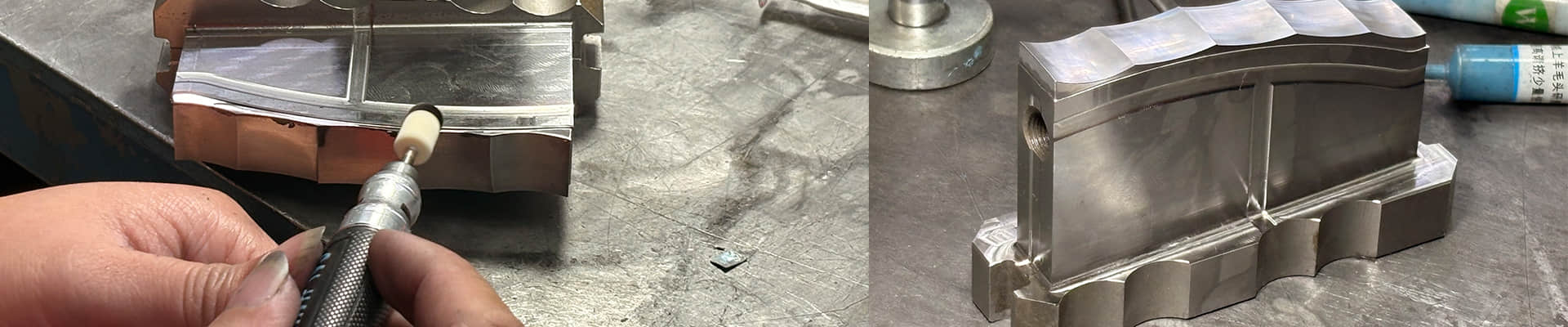
Manual polishing does not represent outdated technology, but rather a process where the experience, tactile sensitivity, and judgment of skilled polishing technicians cannot yet be fully replicated by any existing machinery. It serves as the final - and most critical - bridge connecting precision mechanical machining with optical lens mold perfection.
CNC machining leaves microscopic tool marks, while EDM creates a "pear-skin" textured surface. Though minute, these imperfections are directly replicated onto plastic lenses, causing light scattering, increased haze, and glare.
Optical lens mold cavities require mirror-like surfaces, typically with roughness values of Ra < 0.01 μm. Current CNC and EDM technologies cannot consistently achieve this level of surface finish directly.
Experienced polishers, using feedback from specialized equipment, can selectively and locally modify error-prone areas, bringing the mold geometry infinitely closer to the ideal optical design.
Manual polishing creates flawless mirror surfaces that guarantee optimal optical performance for LED lenses, minimizing light loss and scattering.
Experienced polishing technicians can fine-tune mold shapes through selective polishing, ensuring each lens meets stringent optical design specifications.
The exceptionally smooth mirror surface significantly improves the injection molding process, boosting production efficiency and yield rates.
Professional polishing treatment not only enhances product quality but also significantly prolongs mold service life, reducing long-term production costs.
Utilize 3D scanners or interferometers to obtain mold surface data, comparing it with theoretical models to identify high points (excess material areas) and low points (insufficient material areas) requiring correction.
Employ coarse diamond compounds (e.g., W7, W5) to rapidly remove machining marks from CNC or EDM processes while initiating macro-shape corrections. Tools may include pneumatic hand grinders or specialized polishing machines.
Use medium-grit diamond compounds (e.g., W3.5, W2.5) to further reduce surface roughness, establishing the foundation for mirror finish.
Apply ultra-fine diamond compounds (e.g., W1.0, W0.5) to achieve final mirror-grade surface finish. This stage demands exceptional skill and patience.
• Surface roughness tester: Quantitative measurement of Ra, Rz parameters
• Interferometer: Secondary surface profile verification for shape accuracy
• Visual inspection: Under specific lighting conditions, evaluate reflection integrity by observing potential distortions or defects in mirrored images
Asahi Optics welcomes your questions, inquires and feedback. Please use the form below or contact us at any of the addresses below. Our sales team will get back to you shortly.