Modern tunnel lighting equipment is no longer defined only by LED power output or fixture brightness. For professional tunnel lighting projects, the key challenge is how to deliver sufficient illumination to the road surface while maintaining uniformity, visual comfort, and energy efficiency.
The optical system inside a tunnel luminaire plays a critical role in achieving these goals. The combination of LED source, secondary optics, beam distribution, and fixture design determines how effectively light is delivered to the driving area.
A well-designed LED tunnel lighting solution requires careful consideration of light distribution patterns, glare control, installation geometry, and optical efficiency. This article explains how engineers evaluate tunnel lighting equipment and how advanced LED optics can improve lighting performance in demanding road environments.
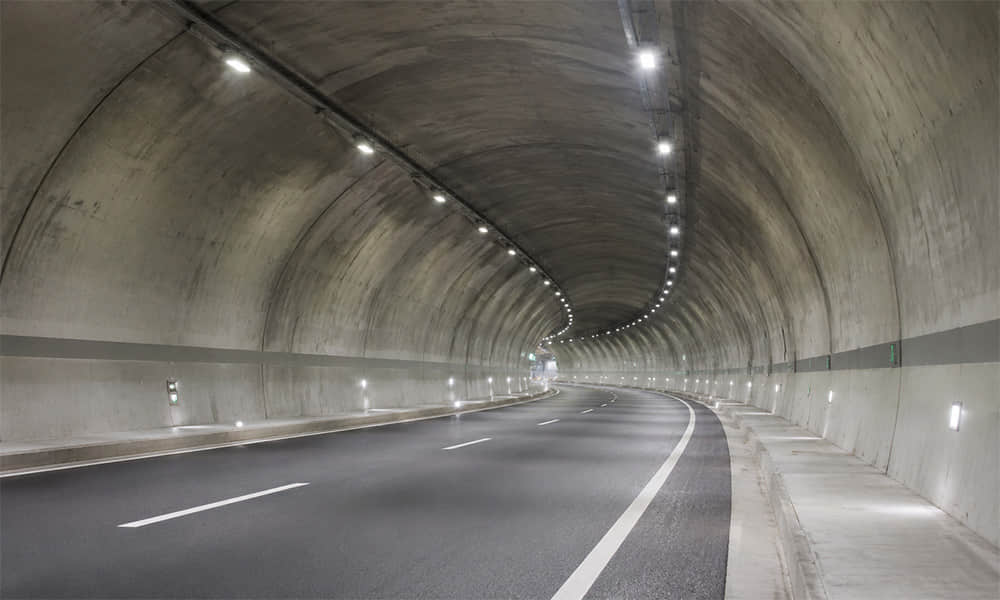
A Real Example of Modern LED Tunnel Lighting Equipment
A typical modern tunnel lighting system consists of several key components, including LED modules, drivers, thermal management systems, mechanical housing, and optical components. Among these elements, the optical system directly influences how LED output is distributed across the road surface.
For example, many professional tunnel luminaires used in highway applications are designed with the following specifications:
| Parameter | Typical Range | Purpose |
|---|---|---|
| LED Power | 100W - 150W | Provide sufficient illumination for tunnel environments |
| Luminous Flux | 15,000 - 25,000 lm | Deliver high output for large road areas |
| Luminous Efficiency | 130 - 160 lm/W | Improve energy efficiency |
| CCT | 4000K - 5000K | Provide comfortable visibility for drivers |
| Protection Rating | IP66 or higher | Protect against dust and moisture |
| Optical Distribution | Asymmetric / Wide Distribution | Control light direction and road coverage |
Although LED output determines the available light quantity, the optical lens determines where that light goes. Without proper optical control, high-output LEDs may create unnecessary brightness, uneven illumination, or excessive glare.
Therefore, selecting suitable tunnel lighting equipment requires not only evaluating electrical specifications but also understanding the optical performance behind the fixture.
What Optical Performance Should Tunnel Lighting Equipment Achieve?
Tunnel lighting design focuses on delivering predictable and controlled illumination. The objective is not simply to maximize brightness, but to achieve a balanced lighting environment where drivers can clearly observe road conditions.
Controlled Light Distribution
One of the most important factors in tunnel lighting is the distribution of light along and across the roadway. A properly designed optical system directs more light toward useful areas while reducing unnecessary upward or side emission.
Professional tunnel luminaires commonly use asymmetric optical designs because the road geometry is directional. Light needs to be distributed efficiently along the driving path rather than spreading equally in all directions.
The optical distribution pattern is usually evaluated through photometric data such as:
- Beam angle
- Candela distribution curve
- Forward throw performance
- Light utilization efficiency
A suitable LED optical lens can significantly improve the relationship between fixture spacing, mounting height, and road illumination performance.
Lighting Uniformity on Road Surfaces
Uniform illumination is one of the most important requirements for tunnel lighting. Uneven lighting can create visual discomfort and reduce the driver's ability to identify obstacles or changes in road conditions.
Engineers usually evaluate tunnel lighting performance through parameters such as:
- Average road luminance
- Overall uniformity
- Longitudinal uniformity
- Light distribution consistency
These requirements are widely discussed in international tunnel lighting recommendations, including CIE 88:2004 Guide for the Lighting of Road Tunnels and Underpasses.
The design of the optical lens directly affects these parameters. A poorly optimized lens may create concentrated hotspots directly below the luminaire while leaving insufficient illumination between fixtures.
Advanced LED optics design focuses on creating a controlled distribution pattern that improves spacing capability and reduces unnecessary light loss.
Glare Control for Driver Comfort
Glare is another important factor in tunnel lighting applications. Excessive high-angle light emission can reduce driver comfort and affect visual performance.
Low-glare optical designs control the direction of emitted light by modifying the lens structure and light distribution pattern. This helps reduce unwanted brightness while maintaining sufficient road illumination.
For this reason, modern tunnel lighting equipment increasingly relies on precision-designed secondary optics instead of simple reflective systems.
Why LED Lens Design Is Critical in Tunnel Lighting Equipment
An LED chip naturally emits light over a wide angle. Without secondary optical control, much of the emitted light may not reach the target area efficiently.
A secondary lens transforms uncontrolled LED emission into a specific optical pattern by using carefully calculated optical surfaces.
Lens Structure Determines Beam Pattern
The geometry of an optical lens directly influences:
- Beam width
- Light intensity distribution
- Peak intensity position
- Coverage area
- Optical efficiency
Through advanced optical simulation, engineers can optimize lens curvature, surface structure, and light extraction design to achieve the required distribution pattern for different lighting environments.
For tunnel applications, the ideal lens is usually not the one producing the strongest central brightness, but the one providing the most effective light utilization on the road surface.
Type IV Optics for Wide Area Road Illumination
Different lighting applications require different optical distributions. For large-area illumination, Type IV optics are commonly used because they provide wider forward illumination and improved coverage.
Asahi Optics developed the 5050LED Type IV Low Glare Area Illumination Optics Lens for applications requiring controlled wide-area light distribution.
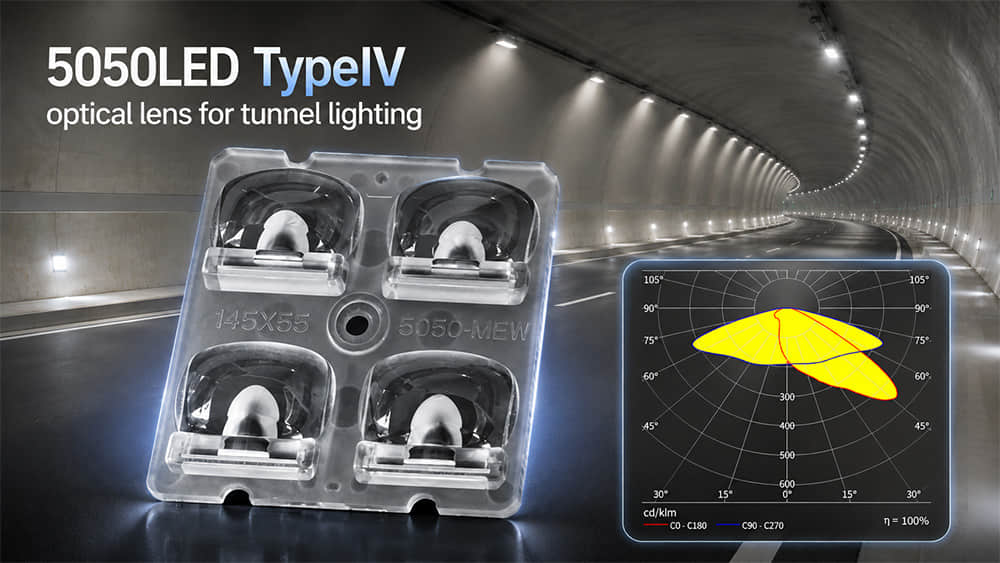
This optical lens is designed for 5050 LED packages and provides characteristics including:
| Feature | Optical Benefit |
|---|---|
| 5050 LED Compatibility | Suitable for high-power LED lighting systems |
| Type IV Distribution | Provides wide forward illumination coverage |
| Low Glare Design | Improves visual comfort by controlling high-angle emission |
| Optimized Optical Structure | Improves light utilization efficiency |
Case Study: Applying Type IV Low Glare Optics to Tunnel Lighting Applications
In tunnel and roadway environments, different areas may require different optical distributions depending on road width, mounting height, and lighting objectives.
The 5050LED Type IV Low Glare Area Illumination Optics Lens is particularly suitable for applications where wide-area coverage and controlled glare are required.
Its Type IV distribution characteristics make it suitable for:
- Roadway illumination
- Large-area outdoor lighting
- Tunnel connection areas
- Approach lighting applications
Compared with narrow beam optics, Type IV optical distribution can provide broader coverage, helping designers achieve better spacing between luminaires while maintaining effective illumination.
For tunnel lighting projects, optical selection should always be based on actual photometric simulation. Factors such as lane width, installation height, fixture spacing, and required luminance level must be considered before selecting the final lens solution.
How to Select Tunnel Lighting Equipment Based on Optical Parameters
Choosing suitable tunnel lighting equipment requires balancing several engineering factors. The optical system should match the physical characteristics of the tunnel and the requirements of the lighting project.
Match Lens Distribution With Road Geometry
Road width, ceiling height, and luminaire installation position determine the required light distribution pattern.
For example:
| Application Requirement | Recommended Optical Approach |
|---|---|
| Long-distance projection | Narrow beam optics |
| General tunnel illumination | Medium distribution optics |
| Wide-area coverage | Type IV or wide distribution optics |
Select LED Lens According to Coverage Requirements
A suitable optical lens should be selected according to:
- LED package type
- Required beam angle
- Mounting height
- Lighting spacing
- Target illumination area
Using the wrong optical distribution can lead to inefficient lighting layouts, increased energy consumption, or unnecessary fixture installation costs.
Balance Optical Efficiency and Glare Control
High efficiency does not simply mean producing maximum light output. Effective lighting design requires directing the available light precisely where it is needed.
A high-quality optical system improves useful illumination while reducing unwanted emission, creating a better balance between efficiency and visual comfort.
From Optical Simulation to Mass Production: Developing Tunnel Lighting Optics
The development of professional lighting optics requires a complete engineering process. Before mass production, optical performance must be verified through simulation and testing.
Optical Design and Simulation
Engineers analyze LED characteristics, required distribution patterns, and application conditions to develop the initial lens structure.
Prototype Verification
Prototype lenses are tested through photometric measurement to verify:
- Beam distribution
- Optical efficiency
- Light intensity pattern
- Application performance
Precision Mold Development and Production
After optical performance is confirmed, precision mold development ensures consistent lens quality during mass production.
This process is essential for maintaining optical accuracy in large-scale LED lighting projects.
Conclusion: Choosing the Right Optical Solution for Tunnel Lighting Equipment
Selecting professional tunnel lighting equipment requires more than choosing a high-power LED fixture. The optical system determines how efficiently light is distributed, how uniform the road surface appears, and how comfortable the environment is for drivers.
Advanced LED lenses, including Type IV low-glare optical solutions, provide lighting designers with greater control over beam distribution, coverage, and visual performance.
By combining precise optical design with reliable manufacturing capability, Asahi Optics provides advanced optical solutions for demanding LED lighting applications, helping lighting engineers achieve better performance in roadway, tunnel, and large-area illumination projects.
FAQ
Q: What factors should be considered when selecting tunnel lighting equipment?
Important factors include LED output, optical distribution, beam angle, installation geometry, protection rating, and lighting uniformity requirements.
Q: Why are LED lenses important in tunnel lighting systems?
LED lenses control the direction and distribution of light, improving coverage efficiency, reducing glare, and creating more uniform illumination.
Q: What is Type IV LED optics used for?
Type IV optics are designed for wide-area illumination applications where forward light distribution and broad coverage are required.
Q: Can LED optical lenses be customized for tunnel lighting projects?
Yes. Optical lenses can be developed according to LED type, beam requirements, installation conditions, and project-specific lighting targets.