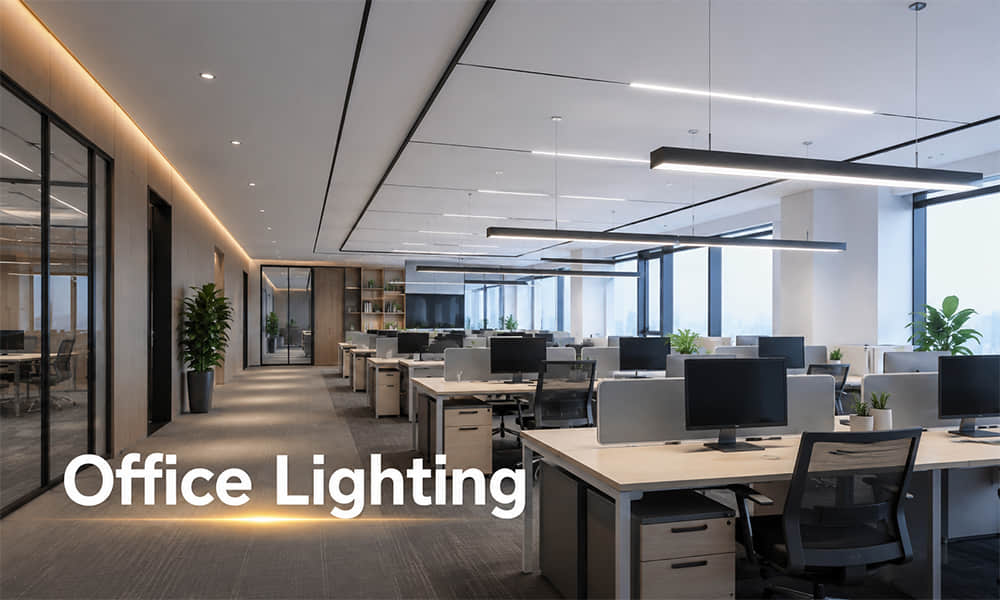
Office lighting standards help lighting designers, building owners, and luminaire manufacturers create workspaces that are bright enough, visually comfortable, energy efficient, and suitable for long hours of screen-based work. In modern offices, good lighting is not only about reaching a certain lux level. It also involves glare control, uniformity, color rendering, visual comfort, screen reflection, and the way light is distributed across desks, walls, ceilings, and circulation areas.
For LED office luminaires, the optical system plays a major role in meeting these requirements. A suitable office lighting lens can help control beam angle, reduce glare, improve working-plane uniformity, and support comfortable linear lighting design. This is especially important for recessed linear lights, suspended office luminaires, panel-style fixtures, and low-glare lighting systems used in open offices, meeting rooms, reception areas, and computer workstations.
This article explains the main metrics used in office lighting standards, including lux, UGR, CRI, uniformity, and CCT. It also explains how LED lenses and linear optics can help lighting manufacturers design office fixtures that perform better in real projects.
What Are Office Lighting Standards?
Office lighting standards are technical guidelines used to define how much light is needed in office spaces and how that light should perform. They are used in lighting design, project specification, luminaire development, and lighting simulation.
Office lighting standards normally consider:
- maintained illuminance, usually measured in lux
- glare control, often evaluated with UGR
- illuminance uniformity across the working area
- color rendering, usually expressed as CRI or Ra
- correlated color temperature, or CCT
- screen reflection and visual comfort
- energy efficiency and lighting controls
- task type, room function, and user needs
Different regions may use different standards or recommendations. For example, the Illuminating Engineering Society provides office lighting recommendations such as ANSI/IES RP-1-24 Recommended Practice: Lighting Office Spaces. In Europe and many international projects, office lighting is often designed with reference to EN 12464-1 or related indoor workplace lighting requirements.
Because standards are updated over time and may be applied differently by country, project type, or local code, the values in this article should be treated as common reference points. Final compliance should always be confirmed against the latest applicable standard and local project requirements.
Common Office Lighting Standards and Guidelines
ANSI/IES RP-1 for Office Lighting
In North America, IES recommendations are widely used for office lighting design. The current IES office lighting recommended practice includes guidance on illuminance, luminance, glare, color, flicker, visual displays, controls, daylight interaction, and different office areas.
The IES also provides tools and references for maintained illuminance and uniformity recommendations through its Lighting Library resources, including the IES Illuminance Selector.
EN 12464-1 for Indoor Workplace Lighting
EN 12464-1 is one of the most commonly referenced standards for indoor workplace lighting in Europe. For office projects, it is often used to define maintained illuminance, UGR limits, uniformity, and color rendering requirements for different visual tasks.
Commonly referenced office values include 500 lx for writing, reading, typing, and data processing; UGR 19 for typical office work; and Ra 80 for color rendering. More demanding tasks, such as technical drawing, may require higher illuminance and stricter glare control.
Workplace Safety and Visual Comfort Guidance
Workplace lighting guidance also emphasizes real human comfort. For example, the UK Health and Safety Executive notes that directional light can reflect from display screens and create glare, and that lighting should consider screen reflection, surface brightness, and the work environment. You can review its general workplace lighting guidance here: HSE lighting at work guidance.
This is why office lighting should not be designed only around brightness. A workspace can reach 500 lux and still feel uncomfortable if the luminaire creates glare, harsh contrast, or reflected light on computer screens.
Key Metrics in Office Lighting Standards
Maintained Illuminance: How Many Lux Does an Office Need?
Office lighting lux level is one of the first metrics designers check. Lux describes how much light reaches a surface. In office projects, the most important surface is usually the working plane, such as a desk or table.
For many standard office tasks, 500 lx is a commonly referenced maintained illuminance value. This is often used for writing, reading, typing, and data processing. Support spaces such as corridors, archives, and reception areas may use different levels depending on the task and local standard.
However, lux alone does not define good office lighting. If light is uneven, too directional, or poorly controlled, the workspace may still cause eye strain even when the lux value looks correct in a calculation.
UGR: Why Glare Control Matters for Office Workers
UGR, or Unified Glare Rating, is used to evaluate discomfort glare from a lighting installation. In office lighting, glare control is critical because workers often look between screens, paper documents, keyboards, desks, and other reflective surfaces throughout the day.
For typical screen-based office work, UGR 19 is commonly referenced as a target limit. More visually demanding tasks may require stricter glare control, depending on the applicable standard and project specification.
A low-glare office luminaire is not created only by using fewer watts or adding a simple cover. The optical structure, lens surface, light cut-off angle, LED position, fixture depth, and installation layout all influence glare performance.
Uniformity: Avoiding Bright and Dark Zones
Office lighting uniformity describes how evenly light is distributed across the working area. Poor uniformity can create bright spots under luminaires and darker zones between fixtures. This forces the eyes to adapt repeatedly and can reduce visual comfort.
Uniformity is especially important in open-plan offices, meeting rooms, training rooms, and shared workspaces. A well-designed optical lens can help spread light more evenly and reduce strong contrast on the desk surface.
CRI / Ra: Color Rendering for Workspaces
CRI, also called Ra in many standards, describes how accurately a light source renders colors compared with a reference light source. For many office applications, Ra 80 is commonly referenced as a minimum value.
Good color rendering helps people read printed materials, recognize objects, view product samples, and work comfortably in the space. For special tasks involving color judgment, higher color rendering may be required.
The lens does not create CRI by itself, because CRI mainly depends on the LED source. However, the lens material and optical design should avoid unwanted color shift and should preserve the light quality of the LED package as much as possible.
CCT and Visual Comfort
CCT, or correlated color temperature, describes whether the light appears warm, neutral, or cool. Office lighting often uses neutral white or cool white light, depending on the region, user preference, interior design, and project requirement.
CCT should not be chosen in isolation. A 4000K office light can feel comfortable or harsh depending on glare, uniformity, brightness, wall brightness, ceiling brightness, and the optical design of the luminaire.
Typical Office Lighting Requirements by Area
The following values are commonly referenced in office lighting design. They should be used as a practical guide, not as a replacement for the latest official standard or local code.
| Office Area or Task | Common Maintained Illuminance | Common UGR Limit | Common CRI / Ra | Lighting Notes |
|---|---|---|---|---|
| Writing, reading, typing, data processing | 500 lx | 19 | 80 | Typical desk-based office work |
| CAD or technical workstations | 500 lx | 19 or stricter by project | 80 | Screen reflection and task detail should be considered |
| Technical drawing | 750 lx | 16 | 80 | Higher visual demand and stricter glare control |
| Conference and meeting rooms | 500 lx | 19 | 80 | Dimming and scene control are often useful |
| Reception desk | 300 lx | 22 | 80 | Visual comfort and brand presentation both matter |
| Filing, copying, support tasks | 300 lx | 19 to 25 depending on task | 80 | Task visibility and vertical surfaces should be checked |
| Corridors and circulation areas | Project-dependent | Project-dependent | Project-dependent | Transition, safety, and wayfinding are important |
Why Office Lighting Is More Than Just Lux
Many office lighting problems happen because the design focuses only on illuminance. A project may reach the required average lux level, but still fail in comfort and usability.
Common problems include:
- direct glare from exposed LEDs or high-brightness luminaire surfaces
- reflected glare on computer screens
- dark zones between fixtures
- strong contrast between desk, wall, and ceiling brightness
- poor vertical illumination on faces and room surfaces
- visible LED dots or harsh light lines in linear fixtures
- inconsistent appearance between luminaires
For this reason, office lighting design should consider the complete visual environment. The luminaire, lens, diffuser, ceiling layout, desk position, screen location, wall reflectance, and control system all affect the final result.
How LED Lenses Help Meet Office Lighting Standards
Controlling Beam Angle
An office lighting lens helps define how light exits the luminaire. In linear office fixtures, the beam angle affects desk illuminance, spacing between luminaires, wall brightness, and overall room appearance.
A wide beam can help distribute light across a larger working area. A more controlled beam can help reduce spill and improve task lighting direction. The right choice depends on fixture type, mounting height, room size, and lighting target.
Reducing Glare for UGR-Oriented Fixtures
Low-glare office lighting depends heavily on optical control. A suitable lens can reduce high-angle light that may cause discomfort glare, especially in recessed or suspended linear luminaires.
For office luminaires designed around UGR requirements, the lens surface, optical structure, LED position, and fixture depth should be evaluated together. This is why manufacturers often test luminaires with IES files or lighting simulation before finalizing the optical component.
Improving Uniformity on the Working Plane
Good office lighting design standards require more than average brightness. Uniformity across the desk surface is important for comfortable long-term work.
A well-selected linear lens can help spread light more evenly, reduce hot spots, and improve overlap between fixtures. This is useful for open offices, shared desks, meeting rooms, and training spaces.
Supporting Linear Office Lighting Design
Linear lighting is widely used in modern office spaces because it works well with clean ceiling designs, suspended lighting systems, continuous light lines, and recessed luminaires.
Asahi Optics provides linear LED lens solutions for different office and indoor lighting fixtures. These optical components can help manufacturers develop luminaires with controlled beam distribution, improved efficiency, and better visual comfort.
Improving Optical Efficiency
Optical efficiency affects how much LED output becomes usable light in the room. A poor optical structure may waste light or scatter it into directions that do not help the working plane.
A high-quality LED lens helps guide light where it is needed. This can support better luminaire performance, lower power consumption, and more reliable lighting calculations.
Recommended Asahi Optics Lens Options for Office Lighting
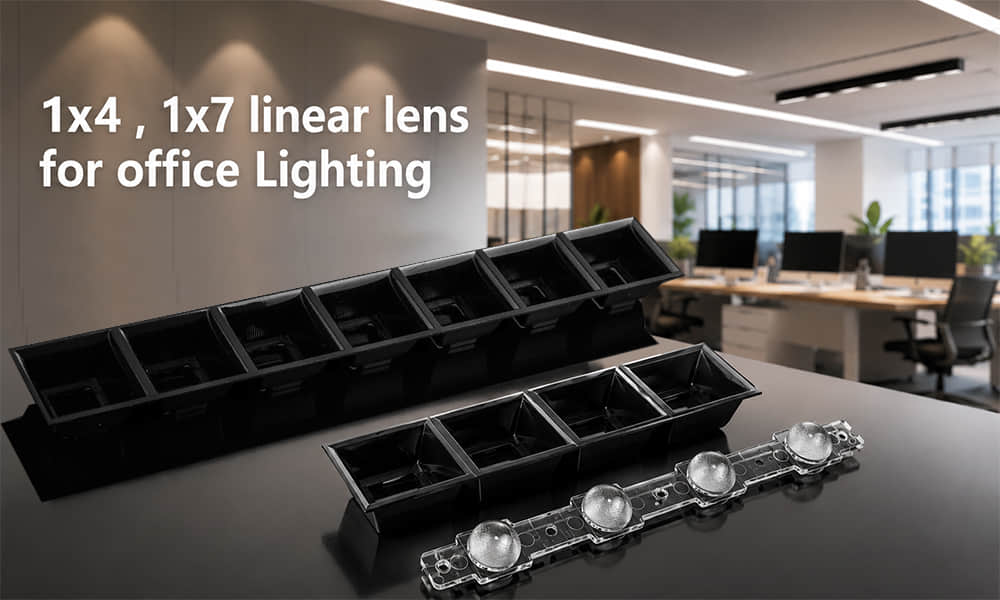
For office lighting projects, Asahi recommends starting with linear lens solutions because many modern office luminaires use linear LED modules, recessed channels, suspended profiles, or continuous light lines.
Linear Office Lighting Lens With Recessed Luminaire
The Linear Office Lighting Lens With Recessed Luminaire is a relevant product option for office fixtures where glare control, beam shaping, and clean ceiling integration are important.
This type of lens can be evaluated for recessed office luminaires, meeting room lights, corridor-adjacent office areas, and other indoor spaces where the optical design must balance brightness and comfort.
1x4 Linear Lens Series
The 1x4 Linear Lens Series can be considered for compact linear fixtures and modular office lighting products. It is useful when the luminaire design requires a repeatable optical unit with controlled distribution.
1x7 Linear Lens Series
The 1x7 Linear Lens Series is another option for linear office lighting manufacturers. It can be reviewed when the fixture design uses a longer LED array and needs optical control for indoor lighting applications.
Lens Selection Tips for Office Linear Lighting Fixtures
To choose a suitable linear office lighting lens, manufacturers should evaluate the lens together with the complete luminaire structure.
Useful information includes:
- fixture type, such as recessed, suspended, surface-mounted, or linear profile
- mounting height
- desk height or working plane height
- target illuminance level
- UGR or glare control requirement
- LED package and PCB layout
- luminaire width and optical installation space
- target beam angle
- IES file or DIALux simulation target
- market standard, such as IES or EN-based project requirement
Providing this information makes it easier to determine whether an existing lens can be used or whether further optical evaluation is needed.
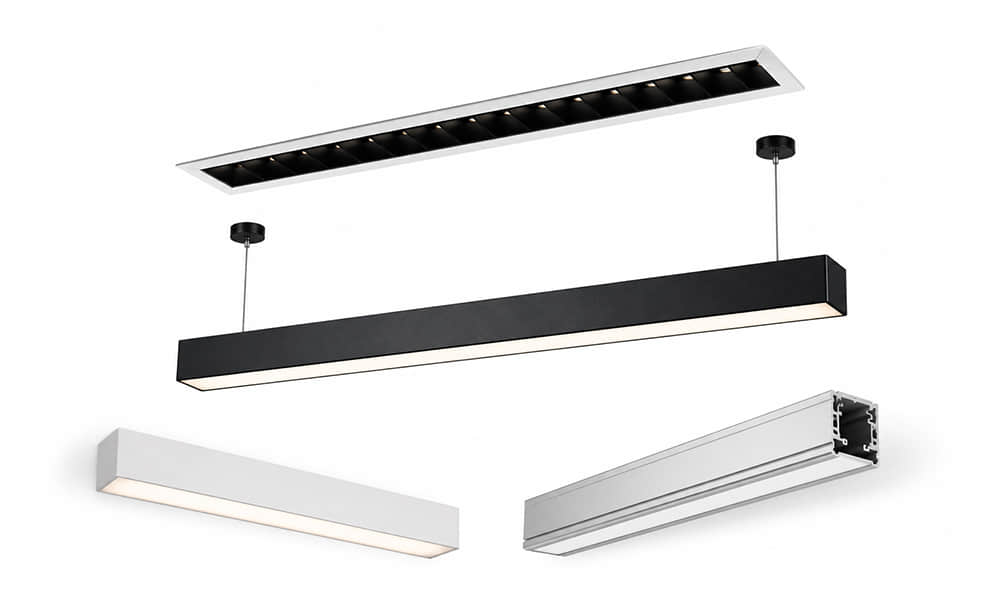
Office Lighting Application Support from Asahi Optics
If you are developing office luminaires, you can also review Asahi’s Office Lighting application page for more information about how optics support modern workplace lighting.
For projects where an existing lens does not meet the target beam angle, glare limit, LED layout, or mechanical structure, Asahi can provide LED optical design support for optical evaluation. This should be considered when the luminaire needs a special distribution, a specific UGR target, or a profile-matched optical structure.
Conclusion
Office lighting standards are not only about achieving a lux value. A good office lighting system should also control glare, improve uniformity, preserve color quality, reduce screen reflection, and create a comfortable visual environment for long working hours.
For LED office luminaires, the lens is a key part of this performance. The right office lighting lens can help manufacturers improve beam control, reduce glare, support UGR-oriented design, and create more uniform illumination across desks and workspaces.
If you are developing recessed, suspended, or linear office lighting fixtures, review Asahi’s linear LED lens products or contact Asahi Optics to request an existing lens recommendation for your office lighting project.