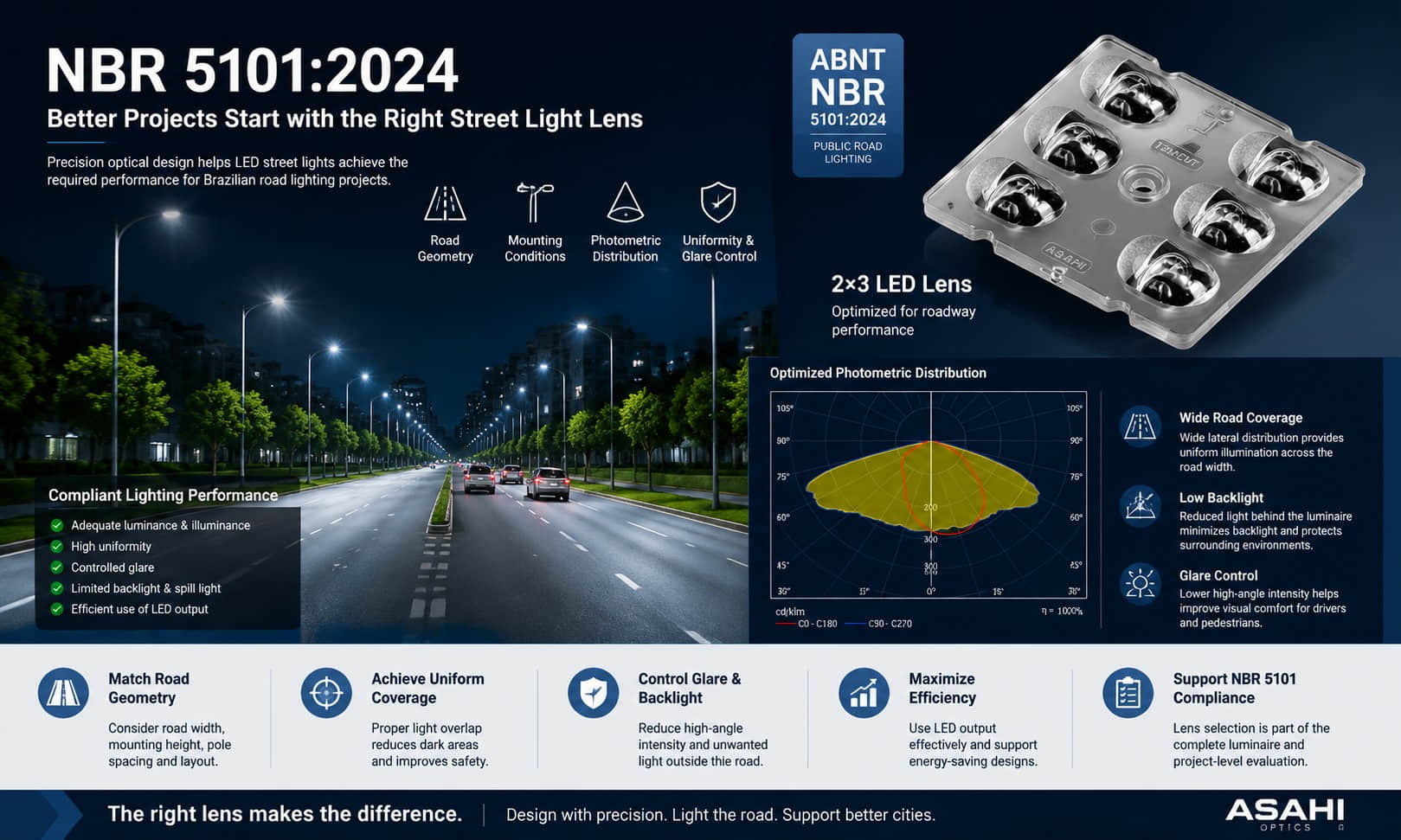
A successful public lighting project in Brazil requires more than a high-output LED luminaire. Road width, mounting height, pole spacing, luminaire position, photometric distribution, uniformity and glare control all influence how effectively the light reaches drivers, pedestrians and other road users.
ABNT NBR 5101:2024 provides an important technical framework for evaluating public road lighting in Brazil. For luminaire manufacturers, one of the key components affecting the final photometric result is the LED street light lens. The lens controls where the light travels, how far it reaches along the road and how evenly it covers the target area.
This guide explains how NBR 5101-related project conditions influence street light lens selection, how to evaluate an existing optical lens and when a custom roadway lighting optic may be necessary.
What Is ABNT NBR 5101:2024?
ABNT NBR 5101 is the Brazilian standard associated with public road lighting. It supports the planning and evaluation of lighting for roads, streets, pedestrian areas, crossings and other public spaces.
Brazil's public lighting infrastructure is generally managed at the municipal or district level. According to Brazil's National Electric Energy Agency, municipalities are responsible for the implementation, expansion, operation and maintenance of public lighting installations. More information about this division of responsibility is available from ANEEL's public lighting guidance.
The current article refers to NBR 5101:2024. Public documents released by Inmetro in 2026 continue to reference this edition when discussing road lighting performance and the Brazilian regulatory environment. The related regulatory analysis can be found in the Inmetro public road-lighting report.
Why NBR 5101 Matters When Selecting a Street Light Lens
Two LED luminaires with the same wattage and nominal luminous flux can produce very different results on a road. The LEDs generate the light, but the LED street lighting optics determine how that light is distributed.
A poorly matched lens may concentrate excessive light directly below the pole while leaving the far side of the road insufficiently illuminated. It may also send light behind the luminaire, toward nearby buildings or above the useful lighting area.
A suitable roadway lighting lens should help the luminaire:
- Distribute light across the required road width;
- Extend light along the road between adjacent poles;
- Reduce excessively bright and dark areas;
- Control unwanted backlight and spill light;
- Limit high-angle light that may contribute to glare;
- Use the available LED output more effectively.
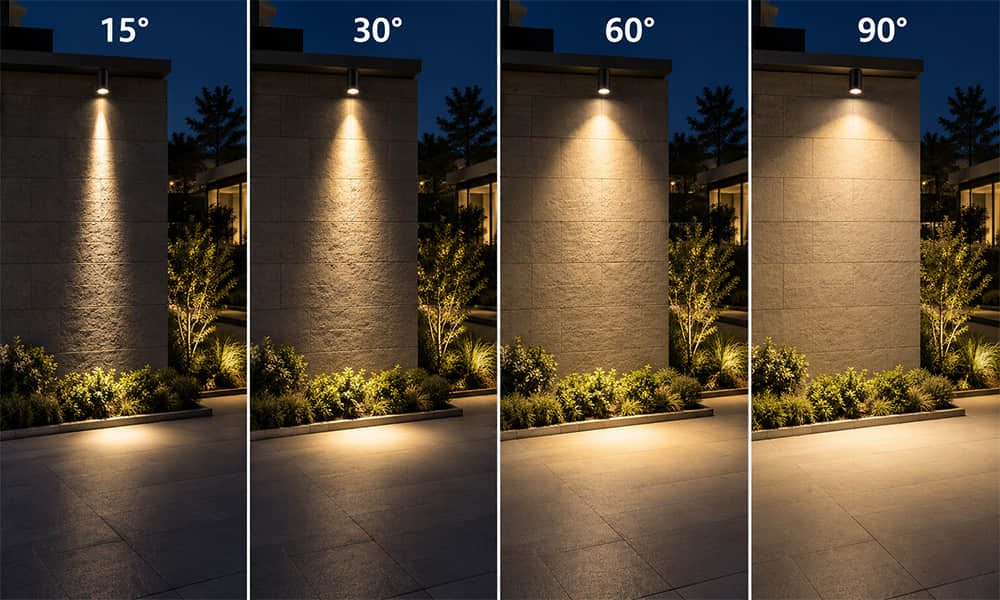
This is why street light lens selection cannot be based only on a general beam angle such as 60°, 90° or 120°. The full photometric distribution must be matched to the road geometry and installation conditions.
Key Photometric Factors for NBR 5101-Based Projects
Road Classification and Application Conditions
The lighting needs of a residential street are different from those of a multi-lane avenue, a high-traffic urban road or a pedestrian crossing. Traffic volume, vehicle speed, pedestrian activity and the complexity of the visual environment can influence the required lighting class and performance targets.
Before selecting a street light optical lens, the project team should identify the road classification and the applicable evaluation criteria. The lens can then be assessed as part of the complete luminaire and road layout.
Average Luminance and Illuminance
Luminance and illuminance describe different aspects of lighting performance.
Illuminance measures the amount of light reaching a surface and is normally expressed in lux. Luminance describes the light perceived by an observer from a particular direction and is commonly expressed in candelas per square metre.
These values should not be treated as interchangeable. The applicable metric depends on the road, area and evaluation method. The optical lens influences both by controlling the direction and intensity of the light leaving the luminaire.
Road Lighting Uniformity
High average brightness does not automatically mean that a road is properly illuminated. A road with strong bright spots and dark sections may reduce visual comfort and make obstacles more difficult to identify.
Street lighting uniformity depends on how the photometric distributions from adjacent luminaires overlap. A suitable lens should spread the light across the road and extend it longitudinally without creating excessive intensity directly below each pole.
Lens selection must therefore consider pole spacing as well as road width. A lens that performs well with a short distance between poles may not provide the same uniformity when the spacing is increased.
Glare, Backlight and Spill-Light Control
Excessive high-angle intensity can contribute to discomfort or disability glare. Uncontrolled backlight can also send light toward buildings, green areas or other locations outside the intended road surface.
A cutoff street light lens can help restrict light in unwanted directions. However, the final result also depends on the LED position, luminaire tilt, mounting height and mechanical relationship between the PCB and lens.
For a more detailed explanation, read our guide to asymmetric light distribution in LED street lighting.
How Road Geometry Determines the Required Lens Distribution
Road Width
A narrow local street and a wide multi-lane road require different transverse distributions. If the beam is too narrow, the far side of the road may remain dark. If it is too wide, part of the light may fall outside the useful area.
Mounting Height
Mounting height changes the distance between the luminaire and the road surface. A higher installation can cover a larger area, but the optical distribution and intensity must still provide the required performance at road level.
Pole Spacing
Increasing the distance between poles may reduce the number of lighting points, but it also makes uniformity more difficult to maintain. A lens for longer pole spacing normally needs an appropriate longitudinal distribution rather than simply a wider beam.
Pole Arrangement
Common road-lighting arrangements include:
- Unilateral installation on one side of the road;
- Staggered installation on opposite sides;
- Opposite installation with paired luminaires;
- Central-median installation.
Each arrangement changes the direction in which the light must travel. Side-mounted luminaires frequently require an asymmetric street light lens that pushes more light toward the carriageway.
Boom Length and Luminaire Tilt
The horizontal reach of the mounting arm and the tilt of the luminaire change the position of the optical centre relative to the road. These details must be included in the photometric simulation. A lens cannot compensate for every unsuitable mechanical installation.
Type II, T2M and Asymmetric Lenses for Brazilian Roads
Type II distributions are commonly considered for relatively narrow roads where luminaires are installed near the road edge. A Type II optic pushes light along the roadway while also providing transverse coverage.
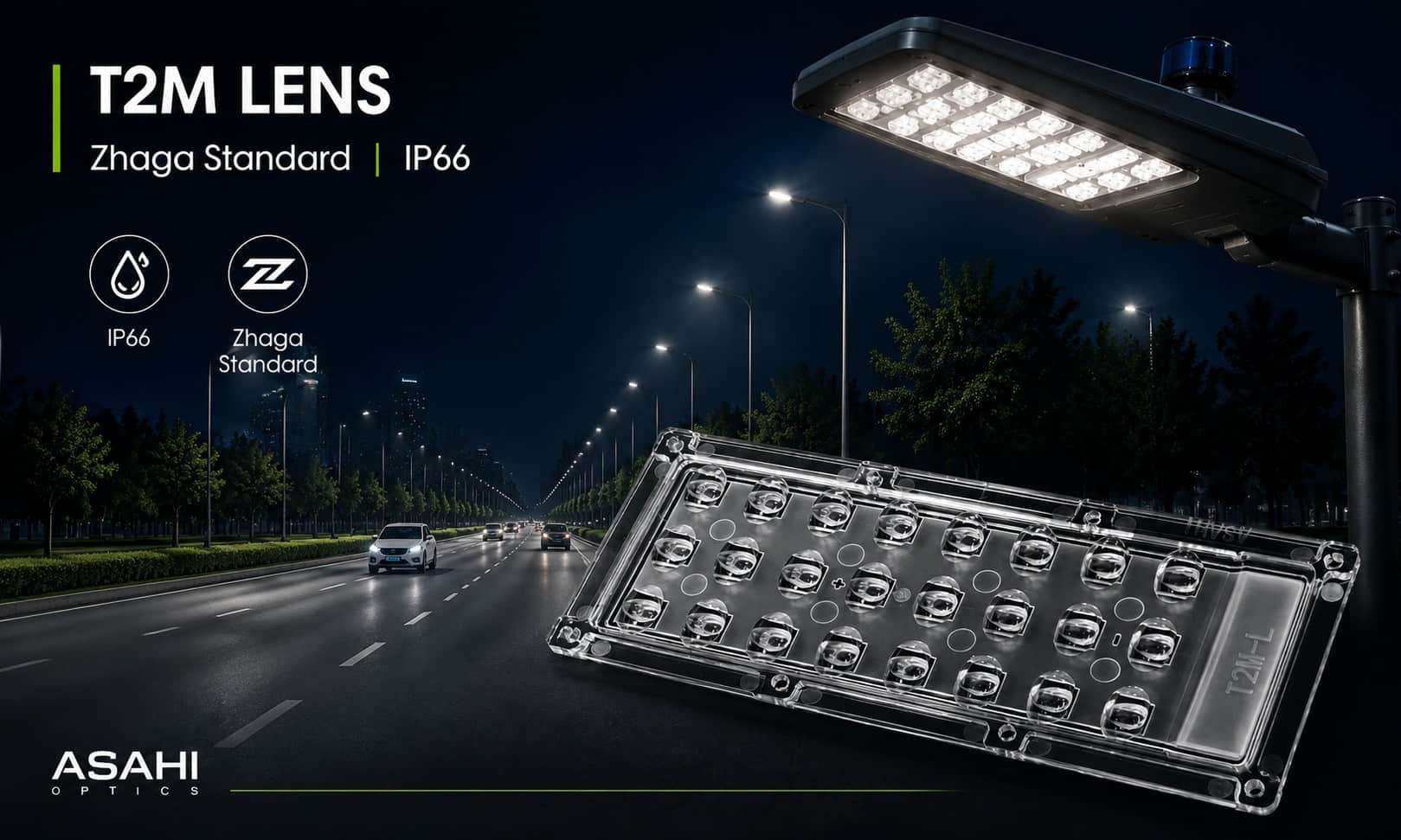
In the term T2M street light lens, “T2” indicates a Type II transverse distribution and “M” generally identifies a medium longitudinal distribution. It should not be interpreted as a single conventional beam angle.
A Type II or T2M lens may be a useful starting point for some Brazilian road-lighting projects, but it is not automatically suitable for every street. Road width, pole spacing, mounting height, luminaire position and the target photometric criteria must be evaluated together.
Learn more about Type I, Type II, Type III, Type IV and Type V light distributions and what T2M means in an LED lens.
Matching the Optical Lens to the LED and PCB
Photometric distribution is only one part of lens selection. The optical lens must also match the LED package, PCB layout and luminaire structure.
LEDs such as 3030, 3535, 5050 and 7070 have different light-emitting surfaces, package heights and optical characteristics. A lens designed around one LED may produce a different distribution when it is used with another package.
Important matching factors include:
- LED brand, model and package dimensions;
- Light-emitting surface size;
- Distance between the LED and the optical surface;
- LED centre position relative to each lens cell;
- Spacing between LEDs in the array;
- PCB thickness and assembly tolerance;
- Available mounting and sealing space.
Even a small alignment error can affect the final distribution. For this reason, an existing lens should be evaluated using the actual LED and PCB rather than selected only from a catalogue description.
Asahi provides LED optics design support for projects that require optical simulation, structural evaluation or a new lens design.
Existing Asahi Lens Options for Roadway Luminaire Development
The following products are existing optical options that can be evaluated for street-light luminaire development. Their suitability for a specific Brazilian project must be verified using the actual LED, PCB, luminaire structure and road layout.
173 mm 3×8 Integrated Street Light Lens Series
The 173 mm 3×8 street and area lighting lens series includes 24-LED integrated optical options for street and area lighting.
Relevant roadway models include:
- ALST173D24LEDT2M: 173 × 71.5 mm with T2M distribution and options compatible with selected 2835, 3030 or 5050 LEDs;
- ALST173D24LED5050T2M-cutoff: 173 × 71.5 mm, designed around 5050 LEDs with a T2M-cutoff distribution.
These integrated lens arrays can be considered when a luminaire design requires a larger multi-LED optical module. The LED position, PCB layout and sealing structure should be checked before selection.
50 × 50 mm 2×3 Modular Street Light Lens
The 50 mm 2×3 street light lens series provides compact six-LED optical modules.
The ARST50D6LED5050T2M-cutoff has a 50 × 50 mm format and is designed for a 2×3 array of 5050 LEDs. Its T2M-cutoff distribution makes it an option for modular roadway luminaires that require directional light control.
Multiple modules may be used to support different luminaire power configurations, but the combined photometric result must be tested and simulated as a complete system.
How to Evaluate an Existing Lens for a Brazilian Project
To recommend an existing LED street light lens, an optical manufacturer should review more than the desired beam type.
Useful project inputs include:
- Road width and number of traffic lanes;
- Sidewalk width and pedestrian areas;
- Mounting height;
- Distance between poles;
- Mounting-arm length;
- Luminaire tilt angle;
- Unilateral, staggered, opposite or central arrangement;
- LED brand, model and package;
- PCB drawing and LED positions;
- Luminaire mechanical drawing;
- Target photometric distribution;
- IES file or simulation target;
- Backlight, cutoff and glare-control requirements;
- Outdoor sealing and material requirements.
The lens and luminaire can then be evaluated through an IES file, a photometric test and lighting simulation using software such as DIALux.
When Is a Custom LED Street Light Lens Necessary?
An existing lens is normally the fastest option when its LED pitch, PCB dimensions, mounting structure and photometric distribution are compatible with the project.
A custom LED street light lens may be necessary when:
- The existing lens does not match the PCB layout;
- The project uses a different LED package or light-emitting surface;
- The luminaire has limited optical or mechanical space;
- A special transverse or longitudinal distribution is required;
- The target pole spacing cannot be supported by available optics;
- Backlight or high-angle intensity requires additional control;
- Existing IES simulations do not reach the project targets;
- A custom sealing or mounting structure is needed;
- A high-volume project requires a dedicated optical platform.
Asahi offers custom LED lens development based on the customer's LED, PCB, luminaire structure and target light distribution.
From Optical Simulation to Mold and Mass Production
Developing custom roadway lighting optics requires optical performance and production feasibility to be considered together.
- Requirement review: Review the road application, LED, PCB, luminaire structure and target distribution.
- Optical simulation: Develop and evaluate the light distribution through ray-tracing software.
- Structural design: Define the lens dimensions, mounting features and sealing interface.
- Optical mold development: Manufacture a precision mold suitable for reproducing the designed optical surfaces.
- Sample production: Produce samples for assembly and photometric testing.
- Project verification: Generate or test IES data and evaluate it within the intended road layout.
- Trial production: Confirm production stability through a small batch.
- Mass production: Scale production after the optical and mechanical requirements are approved.
This integrated process allows the optical design, mold structure and injection-molding conditions to be coordinated before mass production.
Public Brazilian Road-Lighting Reference
Public lighting modernization in Brazil demonstrates why energy efficiency and photometric performance must be evaluated together.
A Brazilian Ministry of Mines and Energy project page for Maringá describes a public lighting network with 49,269 lighting points, approximately 98% of which used sodium-vapour technology at the time of the assessment. The modernization initiative aimed to improve conformity with NBR 5101-related technical requirements, including lighting uniformity, while reducing electricity consumption.
The published project expectations included an estimated annual reduction of approximately 16 million kWh and annual municipal savings of BRL 6–8 million. The Maringá public lighting project illustrates that replacing conventional lamps with LEDs is not only a component change. The new luminaires must also distribute light effectively across the road.
For an LED luminaire manufacturer, this means optical selection should be part of the project from the beginning. High efficacy alone cannot correct an unsuitable photometric distribution, poor road uniformity or excessive light outside the target area.
Request an Existing Lens Recommendation
Selecting a lens for a Brazilian roadway project should begin with the actual road, LED and luminaire data. Asahi can evaluate whether an existing optical lens is suitable before recommending custom development.
Please send:
- Your LED brand, model and package;
- The PCB layout and LED positions;
- The luminaire drawing and available lens space;
- Road width and number of lanes;
- Mounting height and pole spacing;
- Pole arrangement and luminaire tilt;
- The target photometric distribution or IES requirement;
- Material, sealing and environmental requirements.
Request an Existing Lens Recommendation
FAQ About NBR 5101 and LED Street Light Lenses
Q: What is ABNT NBR 5101:2024?
ABNT NBR 5101:2024 is a Brazilian standard associated with the design and evaluation of public road lighting. It addresses the lighting conditions required for different roads and public areas. The official standard should be consulted for complete requirements and numerical criteria.
Q: Can an LED lens be certified to NBR 5101?
A lens alone should not be described as guaranteeing NBR 5101 compliance. Compliance must be evaluated using the complete luminaire, its photometric data and the actual road-lighting layout. A suitable lens helps the luminaire achieve the required distribution.
Q: Which LED lens is suitable for Brazilian roads?
There is no single lens for every Brazilian road. The correct lens depends on road width, mounting height, pole spacing, pole position, LED package, PCB layout and target photometric performance.
Q: Is a Type II lens always suitable for street lighting?
No. A Type II distribution may be suitable for some relatively narrow roads and roadside installations, but the final selection must be verified through IES data and project simulation.
Q: What is the difference between a symmetric and asymmetric street light lens?
A symmetric lens distributes light in a relatively balanced pattern around the luminaire. An asymmetric lens sends more light toward a selected direction, making it useful when the luminaire is installed at the side of a road.
Q: Can Asahi evaluate an existing PCB?
Yes. Asahi can review the LED package, PCB dimensions, LED pitch, mechanical drawing and target distribution to determine whether an existing lens may be suitable.
Q: Does Asahi provide IES files and samples?
Yes. Depending on the selected product and project stage, Asahi can provide IES files, datasheets, technical drawings and optical samples for evaluation.
Q: Can Asahi develop a custom roadway lighting lens?
Yes. Asahi supports LED optics design, optical simulation, lens structure design, optical mold development, sample testing, small-batch trial production and mass production.