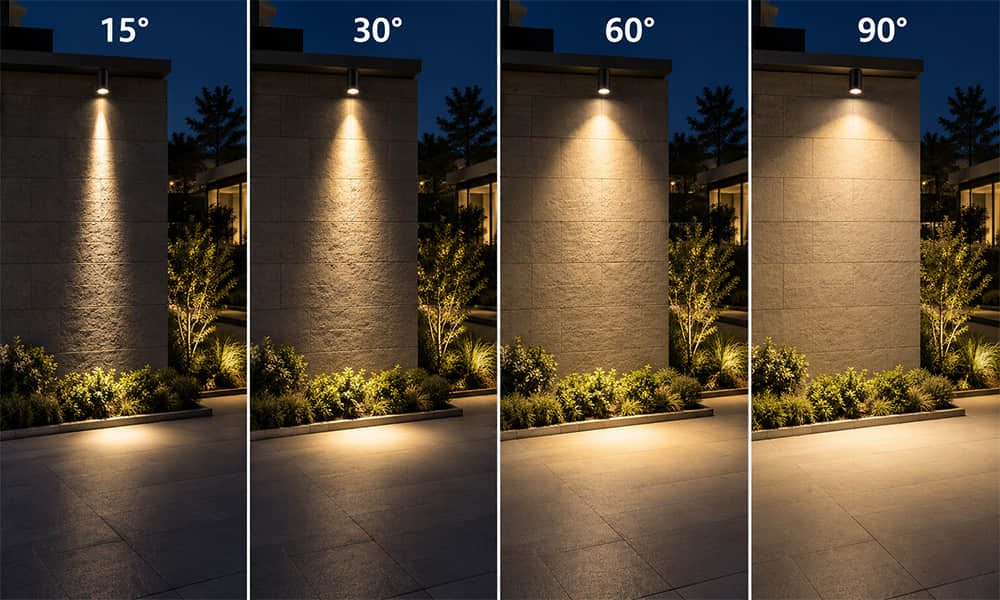
In LED street lighting, brightness alone does not decide whether a road is properly illuminated. A street light may look powerful, but if the light is not sent to the right area, the road can still have dark zones, glare, wasted light, or poor visual comfort.
This is why asymmetric light distribution matters. Unlike a symmetric beam that spreads light evenly around the fixture, an asymmetric beam is designed to push more light toward a specific direction. For street lighting, this is especially important because the pole is often installed at the side of the road, while the area that needs light is mainly the roadway, sidewalk, or parking area in front of it.
A well-designed street light lens helps control this beam direction. It can guide light across the road, improve uniformity, reduce unnecessary spill light, and make the fixture more suitable for real outdoor applications. For lighting manufacturers and project engineers, understanding asymmetric distribution is an important step when choosing an LED optical lens for roadway lighting.
What Is Asymmetric Light Distribution?
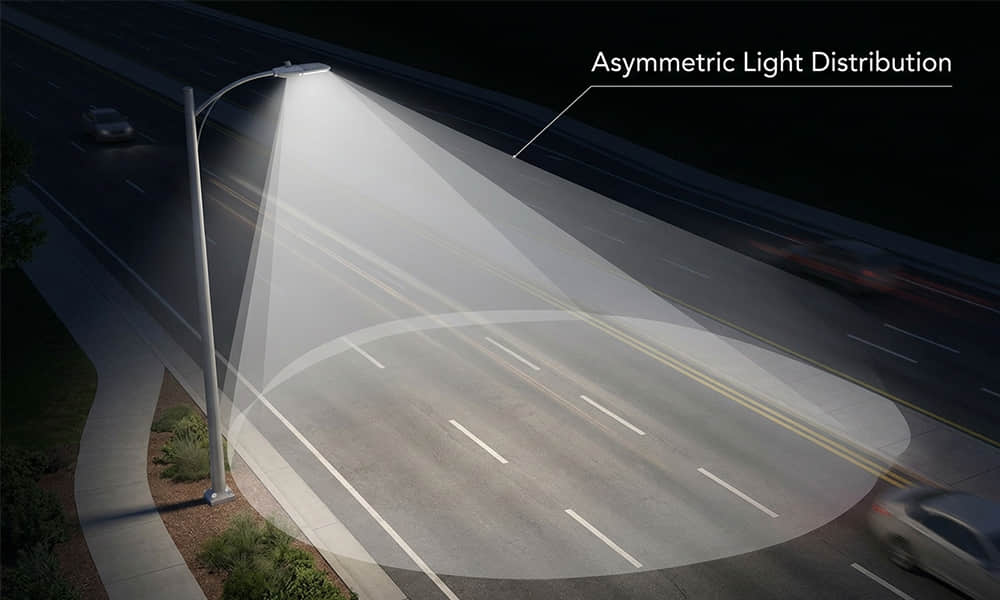
Basic Meaning of Asymmetric Light Distribution
Asymmetric light distribution means the light is not distributed equally in all directions. Instead, the optical system controls the beam so that more light is delivered toward one side, one direction, or one target area.
In simple terms, if symmetric distribution is like placing a light in the center and spreading light evenly around it, asymmetric distribution is like shaping the beam so it reaches farther in one direction. This is very useful in LED street lighting, because the lamp is often not installed directly above the center of the road.
For example, when a street light is mounted on the roadside, the lens needs to push light outward and forward across the road surface. If the light spreads evenly around the lamp, much of it may fall behind the pole, on nearby buildings, into green belts, or into areas that do not need illumination. An asymmetric lens helps redirect more useful light to the driving lane, sidewalk, or target zone.
This is one reason why the LED street light lens is more than a transparent cover. It is an optical component that decides where the light goes and how evenly it reaches the ground.
Symmetric vs Asymmetric Light Distribution
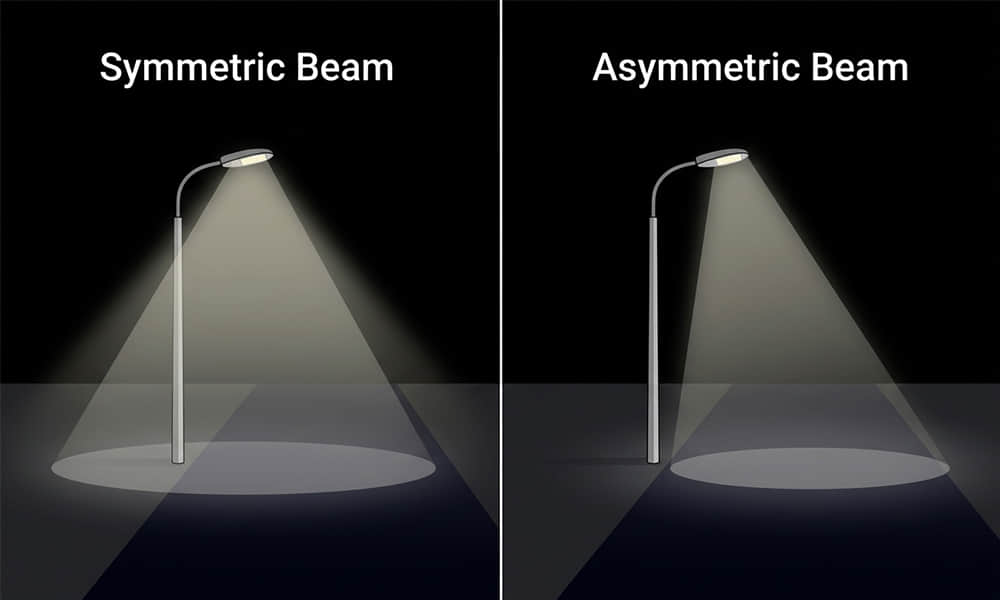
Symmetric light distribution spreads light in a balanced way around the fixture. It can be useful for open areas where the lamp is installed near the center of the target space, such as some courtyards, plazas, indoor high bay areas, or general area lighting applications.
Asymmetric light distribution is different. It is designed for situations where the fixture is installed at one side of the target area. In these cases, the beam needs to be pushed toward a specific direction instead of spreading evenly around the lamp.
For road lighting, parking lot edge lighting, pathway lighting, and some wall-mounted outdoor fixtures, asymmetric distribution is often more practical. It helps the light reach the area where people drive, walk, or work, while reducing light wasted in less useful directions.
This does not mean asymmetric distribution is always better than symmetric distribution. The better choice depends on the installation position and lighting goal. But for many roadway lighting lens projects, asymmetric distribution is essential because the fixture position is naturally offset from the area that needs illumination.
Why It Matters for Street Light Lenses
A street light lens with asymmetric distribution can help solve a common problem in road lighting: the light source is not in the center of the road. Without optical control, the illumination may be too strong near the pole and too weak on the far side of the road.
By using an asymmetric optical design, the lens can spread light more effectively across the road width. This supports better uniformity and reduces the contrast between bright and dark areas. For drivers and pedestrians, this can improve visibility and visual comfort.
In practical projects, asymmetric distribution is usually designed together with pole height, road width, pole spacing, fixture tilt angle, LED layout, and target lighting requirements. This is why choosing the right LED optical lens is not only about selecting a beam angle. It is about matching the lens to the full street lighting application.
Why LED Street Lighting Needs Asymmetric Light Distribution
Street Lights Are Usually Installed on One Side of the Road
In many roadway projects, street lights are installed on one side of the road, on both sides of the road, or along a central divider. In most cases, the fixture is not placed directly above the center of the target lighting area. This creates a natural challenge for LED street lighting: the light must travel farther in one direction than in another.
If the beam spreads evenly around the fixture, the area close to the pole may become too bright, while the far side of the road may not receive enough light. Some light may also be wasted behind the pole or outside the useful road surface. This is one of the main reasons why a standard symmetric beam is often not enough for roadway lighting.
An asymmetric lens helps solve this problem by pushing more light toward the road surface. Instead of allowing the beam to spread equally in all directions, the lens guides the light toward the lanes, sidewalks, or target areas that need illumination. This makes the street light lens more suitable for side-mounted and offset installation conditions.
For example, if a pole is installed near the edge of a road, the lens may need to send light forward and across the road width. If the road is wider, the optical design may need to push light farther. If the pole is higher, the beam angle and distribution must also be adjusted. This is why roadway lighting lens design is always connected with real installation conditions.
Better Road Uniformity and Visual Comfort
Good street lighting is not only about high brightness. It is also about uniformity. A road with strong bright spots and dark patches can create visual discomfort and make it harder for drivers or pedestrians to judge distance, obstacles, and road conditions.
Asymmetric light distribution can help improve road uniformity by spreading light more effectively across the target area. A well-designed LED optical lens can reduce the brightness difference between the area near the pole and the far side of the road. This creates a more balanced lighting effect.
For drivers, better uniformity can improve visual comfort. The eyes do not need to constantly adjust between bright and dark areas. For pedestrians, a more even lighting environment can make sidewalks, crossings, and public spaces feel safer and easier to navigate.
Uniformity is especially important in roadway lighting because movement is involved. Vehicles move quickly, and drivers need to see the road surface, lane edges, signs, pedestrians, and potential obstacles clearly. A suitable street lighting optics design helps make the lighting more useful, not just brighter.
Reducing Wasted Light
Another important reason for using asymmetric distribution is reducing wasted light. In outdoor lighting, not all light is useful. Light that goes behind the pole, into nearby buildings, above the fixture, or outside the target area may increase energy use without improving road visibility.
A well-designed street light lens helps direct more light to the road and less light to areas that do not need it. This can improve the effective use of LED output and support better lighting efficiency.
Reducing wasted light is also important for environmental and visual reasons. Excessive spill light can disturb nearby residents, create glare, or contribute to unnecessary sky glow. For lighting design references, organizations such as CIE and the Illuminating Engineering Society provide useful industry guidance on lighting quality and outdoor illumination.
With the right LED street light lens, light can be shaped more precisely than with uncontrolled output. The goal is not simply to produce more lumens, but to deliver useful light to the right place.
How a Street Light Lens Controls Asymmetric Beam Distribution
Lens Surface and Beam Angle Design
A street light lens controls asymmetric beam distribution mainly through its optical surface. The curve, thickness, angle, and microstructure of the lens all influence how light is refracted after leaving the LED source.
In a simple lighting product, the light may spread directly from the LED. But in LED street lighting, uncontrolled light is rarely enough. The beam needs to be shaped so that the road receives useful illumination across a specific width and distance. This is where the LED optical lens becomes important.
For an asymmetric beam, the lens surface is designed to send more light toward the target side. Some parts of the lens may push the beam farther across the road, while other parts may control the near-field area close to the pole. The purpose is to avoid a strong bright spot near the fixture and weak illumination at the far side of the road.
Beam angle design is also important. A narrow beam may not cover enough road width, while a beam that is too wide may create wasted light or glare. A suitable roadway lighting lens needs to match the actual pole height, road width, and fixture position.
Matching the LED Source and PCB Layout
A lens cannot be designed separately from the LED source. The size, position, quantity, and arrangement of LEDs all affect the final light distribution. Even if two fixtures use the same lens shape, the beam result may change if the LED package or PCB layout is different.
For example, a multi-LED street light module may need a lens array where each small lens controls the light from one LED. If the LED position is not aligned with the optical center, the beam may shift or become uneven. If the LED spacing changes, the combined light pattern may also change.
This is especially important for LED optics design. A good lens should work together with the LED source, PCB, housing, and installation angle. The goal is not only to create a good lens in theory, but to achieve a stable light distribution in the final fixture.
For lighting manufacturers, this means a street light lens should be selected or developed based on the real LED platform. When the lens and LED layout match well, the fixture can achieve better road coverage, more consistent uniformity, and more predictable performance during production.
Controlling Glare and Light Spill
An asymmetric lens does not only push light forward. It also needs to control unwanted light. In street lighting, glare and spill light are common problems when the beam is not properly shaped.
Glare can make drivers and pedestrians uncomfortable, especially when the fixture is installed at a lower height or when the beam is too strong at high angles. Spill light can go into nearby windows, building facades, gardens, or the sky instead of the road surface. Both problems reduce the quality of the lighting project.
A well-designed LED street light lens helps manage these issues by guiding the light into the useful area and limiting unnecessary high-angle output. This improves visual comfort and makes the lighting effect more controlled.
Why Optical Accuracy Matters
The final beam pattern depends on small optical details. A small change in lens curvature, surface quality, LED position, or mold accuracy can affect the light distribution. This is why street lighting optics requires precision.
For mass-produced LED street lights, consistency is also important. If one lens performs well but the next batch has dimensional variation, the lighting result may become unstable. Good mold quality and process control help keep the lens performance consistent from sample testing to mass production.
For a road lighting project, this consistency matters because fixtures are installed in rows. If the optical performance changes from one lamp to another, the road may show uneven lighting. A precise LED optical lens helps maintain a more stable and professional lighting result.
Common Roadway Applications for Asymmetric LED Lenses
Urban Road Lighting
Urban roads are one of the most common applications for asymmetric LED lenses. In city streets, the lighting fixture is usually installed along the roadside, while the target illumination area includes vehicle lanes, sidewalks, intersections, and pedestrian zones.
A suitable street light lens helps push light across the road surface and reduce the difference between the bright area near the pole and the darker area farther away. This supports better road visibility and creates a more comfortable lighting environment for drivers and pedestrians.
Urban road lighting also needs to consider nearby buildings, trees, signs, and residential areas. If the light distribution is not controlled, spill light may enter windows or illuminate areas that do not need strong light. An asymmetric beam can help keep more light on the road and reduce unnecessary light outside the target zone.
Parking Lots and Area Lighting
Asymmetric light distribution is also useful in parking lots and outdoor area lighting. In many parking projects, fixtures are installed along the edge of the area or on poles that are not positioned at the center of the lighting zone.
If a symmetric beam is used in these conditions, part of the light may be wasted outside the parking area. At the same time, the far side of the lot may not receive enough illumination. An asymmetric lens can help push more light into the parking area and improve the overall lighting balance.
This is especially helpful for parking lot entrances, perimeter lighting, loading areas, and open commercial spaces. These places need enough visibility for vehicles and pedestrians, but they also need controlled light to avoid glare and spill.
Pathway and Public Outdoor Lighting
Pathways, parks, campuses, residential roads, and public outdoor areas can also benefit from asymmetric distribution. In these locations, lighting fixtures are often installed along one side of a path or around the edge of a public space.
A controlled asymmetric beam can direct light toward the walking area while reducing unnecessary light toward grass, walls, or private spaces. This helps create a cleaner and more comfortable outdoor lighting effect.
For public lighting, visual comfort is important. Too much glare can make people uncomfortable, especially in pedestrian areas where lights may be installed at lower heights. A well-designed outdoor lighting lens can help shape the beam more carefully and reduce harsh light.
Key Factors When Designing an Asymmetric Street Light Lens
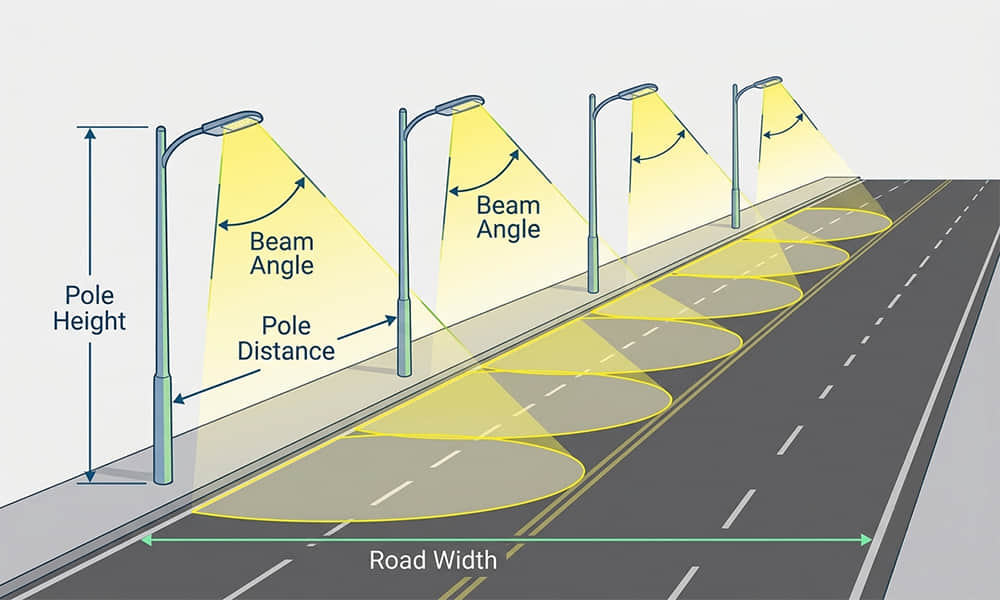
Road Width and Pole Height
The first factor in asymmetric street light lens design is the relationship between road width and pole height. These two conditions strongly influence how far the light needs to travel and how wide the beam should be.
If the road is narrow and the pole is relatively low, the lens may only need to push light across a short distance. If the road is wide or the pole is installed higher, the lens must deliver light farther while still keeping the near area under control. Without proper optical design, the result may be too bright near the pole and too dark on the opposite side of the road.
This is why a street light lens should be selected based on real installation data instead of only looking at a general beam angle. A lens that performs well at one pole height may not perform the same way at another height. The same lens may also behave differently on a narrow road, a multi-lane road, or a pedestrian pathway.
Pole Distance and Lighting Uniformity
Pole distance also affects the performance of an LED street light lens. Even if one fixture creates a good light pattern, the final road lighting effect depends on how multiple fixtures work together along the road.
If the poles are too far apart, dark zones may appear between fixtures. If the beam is not designed properly, the road may show strong bright spots near each pole and weak lighting in between. This can reduce visual comfort and make the lighting project look uneven.
An asymmetric lens should help create useful overlap between fixtures. The beam needs to cover the area in front of the pole, across the road, and partly along the road direction. This helps support continuous illumination instead of separate pools of light.
LED Power and Heat Conditions
LED power also matters when designing or selecting an asymmetric lens. Higher power can provide more lumen output, but it also creates more heat. The lens material and fixture structure must work with the thermal condition of the whole product.
If the lens is too close to a high-power LED source, heat may affect the material over time. Depending on the application, PC or PMMA may be selected based on optical clarity, impact resistance, heat conditions, UV exposure, and cost. For outdoor lighting, the material must also support long-term reliability.
Heat can also influence optical performance indirectly. If the fixture design does not manage temperature well, material aging, yellowing, deformation, or surface changes may affect the light distribution.
Lens Material and Outdoor Reliability
An outdoor lighting lens must survive more than optical testing. It may face sunlight, rain, dust, wind, temperature changes, vibration, and handling during installation. For street lighting, material reliability is part of optical reliability.
PC is often used when impact resistance and toughness are important. PMMA is often selected when high transparency and clean light output are the main goals. The final choice depends on the fixture structure, exposure level, impact risk, and target market requirements.
For road lighting projects, the lens should also work with the fixture’s waterproof and dustproof design. Although the lens itself is only one component, its shape, assembly fit, sealing area, and material stability can influence the long-term performance of the lighting product. Customers can also review related material specifications and certifications when evaluating lens materials.
Installation Angle and Fixture Structure
The installation angle of the fixture can also change the final light distribution. A small tilt angle may help adjust road coverage, but too much tilt can create glare or send light into unwanted areas.
A good street lighting optics design should reduce dependence on excessive fixture tilting. If the lens itself can guide light properly, the fixture can achieve the target distribution with a cleaner installation angle.
The fixture structure also matters. The lens must fit the housing, LED board, gasket, screws, and sealing design. If the lens position changes during assembly, the beam pattern may shift. For this reason, mechanical structure and optical design need to work together.
Why Custom Optical Design Matters for Street Lighting Projects
Standard Lenses Cannot Fit Every Road
Standard street light lenses are useful for many common lighting products, but they cannot fit every road condition. In real projects, road width, pole height, pole distance, installation angle, LED layout, and fixture structure can vary greatly. A lens that works well for one street light may not create the same result in another project.
For example, a narrow residential road, a wide urban road, a parking lot edge, and a pedestrian pathway all need different light coverage. If the lens distribution does not match the application, the lighting result may show dark areas, excessive brightness near the pole, glare, or wasted light outside the target zone.
This is especially true for asymmetric light distribution. The beam needs to be pushed in a specific direction, but how far and how wide it should go depends on the real installation condition. A general beam angle may not be enough to judge whether the lens is suitable.
Custom Lens Design Improves Project Matching
A custom LED lens can be developed based on the actual lighting requirement instead of forcing the project to adapt to an existing lens. This makes it easier to match the LED source, PCB layout, fixture housing, pole height, road width, and target light distribution.
For street lighting projects, custom optical design can help improve road coverage, reduce wasted light, control glare, and support better lighting uniformity. It can also help the lens fit the mechanical structure of the fixture, which is important for assembly, sealing, and long-term outdoor reliability.
Custom design does not always mean making the most complex lens. In many cases, it means adjusting the optical structure so the beam works better for the real application. If a standard LED street light lens cannot meet your roadway lighting requirements, you can contact Asahi Optics to discuss a custom optical lens solution for your street lighting project.
Conclusion
Asymmetric light distribution plays an important role in modern LED street lighting. Since street lights are often installed on one side of the road, the beam needs to be controlled carefully so that more useful light reaches the roadway, sidewalk, parking area, or public outdoor space.
A well-designed street light lens can help improve road uniformity, reduce wasted light, control glare, and make the fixture more suitable for real installation conditions. Instead of simply increasing LED power, good optical design helps deliver light to the right place more efficiently.
For roadway lighting projects, the lens should be selected based on pole height, road width, pole distance, LED source, fixture structure, material reliability, and target light distribution. If a standard lens cannot meet the project requirement, a custom LED lens can help improve matching and provide a more practical optical solution.
Asahi Optics supports customers with LED optical lens development for street lighting and outdoor lighting applications. If you need an asymmetric lens for an LED street light project, you can contact us to discuss a custom optical design based on your real application.
FAQ About Asymmetric Light Distribution
Q: What is asymmetric light distribution in street lighting?
A: Asymmetric light distribution means the beam is designed to send more light toward a specific road area instead of spreading light equally in all directions.
Q: Why do LED street lights use asymmetric lenses?
A: LED street lights use asymmetric lenses because the fixture is often installed beside the road, while the light needs to reach across the roadway.
Q: Is asymmetric light distribution better than symmetric light distribution?
A: It depends on the application; asymmetric distribution is usually better for roadway and side-mounted outdoor lighting, while symmetric distribution can be suitable for open central areas.
Q: Can asymmetric street light lenses be customized?
A: Yes, an asymmetric street light lens can be customized based on road width, pole height, LED layout, fixture structure, and target light distribution.
Q: What material is suitable for asymmetric LED street light lenses?
A: PC and PMMA are common materials; PC is often chosen for impact resistance, while PMMA is often chosen for high optical clarity.