When selecting an LED lens material for a lighting project, optical design is only one part of the decision. The material used for the lens also affects light transmission, impact resistance, UV stability, thermal behavior, processing consistency and the long-term performance of the complete luminaire.
In LED lighting, the most common lens materials are PC, PMMA and glass. PC and PMMA are widely used for plastic lighting optics because they are lightweight, suitable for precision molding and practical for many optical structures, including single lenses, lens arrays, linear optics and outdoor lighting modules.
Glass also has value in selected high-temperature or specialty applications. However, it is heavier, more brittle and less flexible for many complex optical structures. This guide compares PC vs PMMA vs glass lens options to help lighting manufacturers select a material according to the application environment, optical target and mechanical requirements.
Why Lens Material Matters in LED Lighting
Lens Material Affects Optical Performance
The purpose of an LED lighting lens is to guide, distribute and control light. The lens material needs to allow light to pass through efficiently while helping the finished luminaire maintain its intended beam angle, light pattern, optical uniformity and visual appearance.
A PMMA lens is often valued for high optical clarity and good light transmission. It can be suitable when brightness, clean transparency and efficient light output are important. A PC lens is often selected when the project needs stronger impact resistance, better toughness or more reliable mechanical performance in demanding environments.
In practical lighting projects, the best material is not always the one with the highest transmittance. The correct choice depends on the LED power, operating temperature, installation environment, lens geometry, mechanical risk, maintenance conditions and expected service life of the fixture.
Material Choice Influences Durability
LED luminaires may be exposed to dust, rain, UV radiation, temperature cycling, vibration, cleaning agents and possible physical impact. These factors are especially important for outdoor lighting optics, roadway luminaires, industrial fixtures, tunnel lighting and public-area lighting.
If an unsuitable material is selected, a lens may yellow, crack, deform, lose transparency or fail to maintain the original optical distribution. Once lens performance changes, the lighting effect also changes. This can reduce useful illumination, create uneven brightness, increase unwanted glare or affect the long-term reliability of the fixture.
PC vs PMMA vs Glass: LED Lens Material Comparison
| Material | Main Strength | Main Limitation | Common LED Lighting Use |
|---|---|---|---|
| PC Lens | High impact resistance, toughness and mechanical durability | Optical clarity may be lower than PMMA; outdoor grades should be evaluated for UV performance | Street lighting, public lighting, industrial lighting, tunnel lighting and demanding outdoor fixtures |
| PMMA Lens | High transparency, clean optical appearance and good weathering performance with suitable grades | Lower impact resistance than PC and more sensitive to mechanical stress | Linear lighting, commercial lighting, architectural lighting, decorative lighting and protected outdoor fixtures |
| Glass Lens | Thermal stability, surface hardness and good resistance to weathering | Heavy, brittle and less flexible for complex molded optical structures | Special high-temperature, chemical-resistant or specialty lighting applications |
This comparison is a starting point rather than a final specification. Different optical grades of PC and PMMA can perform differently depending on their additives, UV stabilization, molding conditions, lens thickness and optical surface design.
What Is a PC Lens?
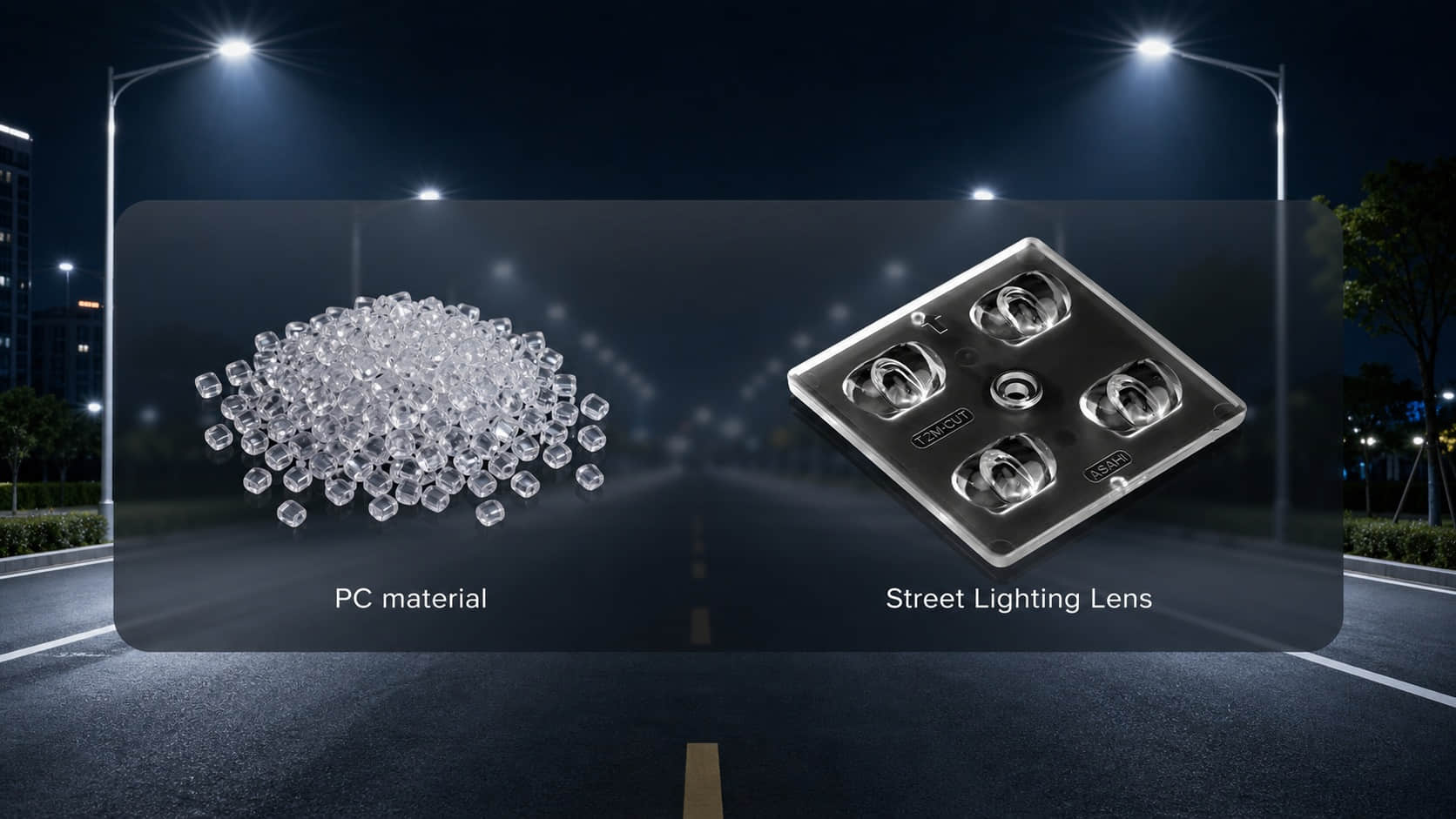
A PC lens is an optical lens made from polycarbonate. In LED lighting, PC is used for lenses, optical covers and protective optical components because it provides strong toughness, good impact resistance and stable processing performance.
For many LED lighting applications, especially public and outdoor fixtures, the lens must do more than shape light. It may also need to tolerate transportation, installation pressure, wind vibration, maintenance activity, temperature change and accidental impact. In these conditions, a polycarbonate lens can be a practical material to evaluate.
Main Advantages of PC Lenses
The main advantage of a PC lens is impact resistance. Polycarbonate is less likely to break under mechanical stress than more brittle materials. This is relevant for LED street lights, tunnel lights, industrial lights, parking-area fixtures and other outdoor luminaires installed in public or higher-risk environments.
PC can also support complex molded optical structures. It can be used for different beam angles, asymmetric distributions, multi-lens arrays and outdoor optical modules where the lens needs to provide both light control and mechanical strength.
For products that are handled frequently, installed at accessible heights or exposed to possible external contact, PC can help improve the mechanical robustness of the optical component. The fixture housing and lens mounting method must still be designed correctly, because a strong material cannot compensate for a poor mechanical structure.
Limitations of PC Lenses
Although PC offers strong mechanical properties, it also has limitations. PMMA usually provides higher optical clarity and light transmission. If a project prioritizes maximum optical efficiency, low haze and a very clear appearance, PMMA may be the more suitable material.
PC can also require careful material-grade selection for outdoor applications. UV exposure, additive systems, surface protection and the expected service environment should all be reviewed. A lens described simply as “PC” does not provide enough information to predict long-term outdoor performance.
For high-power LED fixtures, PC should be evaluated with the complete thermal system. Lens-to-LED distance, PCB temperature, heat sink performance, driver location, ventilation and enclosed-air temperature all influence the actual lens condition after installation.
Where PC Lenses Are Commonly Used
A PC LED lens is often used in street lighting, roadway lighting, tunnel lighting, industrial high-bay lighting, outdoor area lighting and public facility lighting. It is generally a good option when the project needs stronger impact resistance, stable molding and reliable performance in more demanding environments.
PC can be especially useful when the lens is part of the exposed structure of the luminaire or when the fixture is installed in a public, industrial or outdoor area where mechanical damage is more likely.
What Is a PMMA Lens?
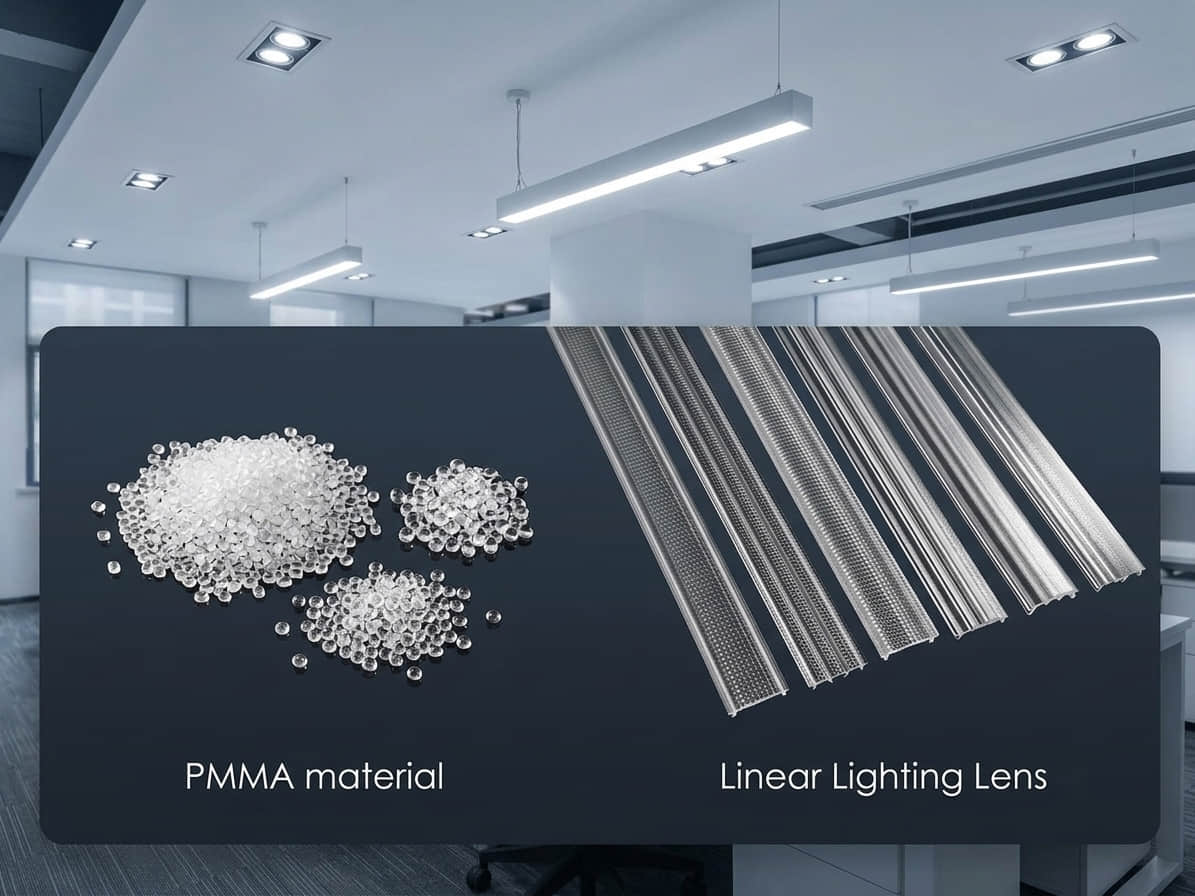
A PMMA lens is made from polymethyl methacrylate, commonly known as acrylic. In LED lighting, PMMA is widely used because of its optical clarity, good light transmission and clean surface appearance.
Compared with PC, PMMA is often selected when a lighting project focuses more strongly on optical efficiency, transparency and visual quality. For many LED optical components, especially where the lens needs to create a bright and clean light output, PMMA can be a practical material choice.
Main Advantages of PMMA Lenses
The main advantage of a PMMA lens is optical performance. PMMA can provide high light transmission and low haze, helping reduce unnecessary light loss as light passes through the lens. This makes it useful for applications where fixture efficiency and a clean beam appearance are important.
PMMA also offers good surface quality and surface hardness compared with many other plastics. This can help a lens maintain a clear appearance during normal use, particularly in indoor lighting, commercial lighting, architectural fixtures and linear lighting systems.
High-quality PMMA grades are also known for good weathering performance. This can make PMMA suitable for selected outdoor lighting applications when the fixture design protects the lens from high impact and the thermal condition is appropriate for the material.
Limitations of PMMA Lenses
Although PMMA has excellent clarity, it is more brittle than PC. A PMMA lens may crack or break more easily when exposed to strong impact, excessive assembly force or mechanical stress. This should be evaluated carefully for public areas, roadsides, industrial facilities and other locations with a higher risk of contact or damage.
PMMA is also not suitable for every high-temperature environment. The final result depends on the selected grade, lens thickness, LED heat management, mounting design and the conditions around the assembled fixture.
When a PMMA lens is used in an outdoor product, the design should account for impact protection, lens support, sealing, expansion behavior and the expected maintenance process. Material selection should always be matched to the full luminaire design rather than considered in isolation.
Where PMMA Lenses Are Commonly Used
A PMMA LED lens is often used in indoor LED lighting, commercial lighting, linear lighting, architectural lighting, decorative lighting and protected outdoor fixtures. It is a suitable option when high light transmission, stable visual quality and clean optical appearance are major priorities.
PMMA is particularly relevant where the lens is not exposed to high impact risk and where the lighting design benefits from optical clarity, controlled transmission and a well-defined beam pattern.
What About Glass Lenses?
Glass as a Comparison Material
A glass lens is an optical lens made from glass rather than plastic materials such as PC or PMMA. Glass can provide good transparency, strong surface hardness and stable optical properties under selected thermal, chemical or environmental conditions.
In LED lighting, glass may be used where temperature resistance, chemical resistance, scratch resistance or specific optical requirements are important. However, glass is not always the most practical choice for modern LED lighting fixtures that require low weight, complex lens geometry or high-volume production efficiency.
Why Glass Is Less Common for Many LED Optics
The main limitation of glass is brittleness. Compared with PC and PMMA, glass can break under impact and may create additional safety concerns in public lighting, industrial lighting, transportation-related fixtures and exposed outdoor installations.
Glass is also heavier than plastic. For fixtures that require lightweight construction, easier installation, lower shipping weight or complex optical structures, PC and PMMA are often more practical. Glass remains useful when its specific performance advantages justify these tradeoffs.
Key Differences Between PC, PMMA and Glass Lenses
Optical Clarity and Light Transmission
When comparing PC vs PMMA vs glass lenses, optical clarity is one of the first factors to review. The lens needs to transmit light efficiently while maintaining the intended beam pattern and minimizing unwanted haze or visual distortion.
PMMA is often selected when high transparency and clean light output are important. It can help support efficient fixture output and a clear optical appearance. PC also provides useful optical performance, but its main strength is typically the balance between light control and mechanical toughness.
Glass can provide good optical clarity, but it is less flexible for many modern lens arrays and complex molded optic structures. For applications that need lightweight plastic optics with intricate surface geometry, PC and PMMA are often easier to evaluate and manufacture.
Impact Resistance and Safety
Impact resistance is one of the clearest differences between the three materials. PC generally offers the highest toughness, making it relevant for fixtures exposed to vibration, transportation risk, installation stress or possible impact after installation.
PMMA performs well optically but is more brittle than PC. Glass is hard but also brittle, and breakage can create a safety concern. The correct choice depends on whether impact resistance is a central requirement for the product and installation environment.
Weather Resistance and Outdoor Use
Outdoor lighting materials must be reviewed for UV exposure, rain, dust, temperature change and long-term aging. High-quality PMMA grades can provide good weathering performance and stable visual appearance. PC can also be used outdoors, but the chosen grade should be suitable for the expected UV exposure and operating conditions.
Glass has strong weather and chemical stability, but its weight and brittleness can limit its practical use in many outdoor LED fixtures. For outdoor products, material choice should be combined with sealing, mechanical protection and the required optical distribution.
Processing and Production Consistency
For plastic LED optics, the material must support precise molding, stable dimensions, good surface quality and repeatable production. PC and PMMA can both be used for injection-molded lenses, lens arrays, street light modules, linear optics and other lighting components.
PC is often evaluated when the lens requires greater toughness. PMMA is often evaluated when the design prioritizes transmission and optical clarity. In either case, mold precision, material handling, molding conditions and surface quality affect whether the final lens can reproduce the intended distribution consistently.
Which Material Is Better for Outdoor LED Lighting?
When PC Is a Better Outdoor Choice
A PC lens is often a strong option when an outdoor fixture needs impact resistance and mechanical strength. This can be especially relevant for roadway lighting, public lighting, industrial outdoor fixtures and installations where the luminaire may experience vibration or accidental impact.
For example, a street light lens may experience transport, installation, maintenance activity, wind vibration and long-term outdoor exposure. PC can help reduce the risk of cracking or breakage in these conditions. For outdoor projects, view our street and area lighting lens products for common optical module formats.
When PMMA Is a Better Outdoor Choice
A PMMA lens can also be suitable for outdoor LED lighting, especially when the fixture design provides proper mechanical protection and the project values high transmission, clean appearance and weathering performance.
PMMA is often evaluated when optical efficiency is a key requirement. Its clarity can help reduce light loss and maintain a clean optical appearance. It can be suitable for protected architectural lighting, façade lighting, outdoor linear lighting and selected area-lighting applications.
Practical Recommendation for Outdoor Projects
For street lighting and higher-risk outdoor environments, PC is often one of the first materials to evaluate because of its toughness and impact resistance. For protected outdoor lighting and applications that prioritize transmission and visual clarity, PMMA may be a better fit.
The final material decision should be confirmed using the intended LED source, PCB, lens, housing and environmental conditions. A material comparison is useful at the specification stage, but system-level sample evaluation provides the most meaningful confirmation.
Material Verification, Datasheets and Sample Evaluation
Why Material Data Should Be Checked
When selecting a PC lens or PMMA lens, material names alone are not enough. Different suppliers and grades can perform differently even when they are described using the same base material name.
Important properties to review include light transmission, haze, impact strength, UV stability, heat resistance, flame-retardant requirements where relevant and any project-specific environmental conditions. ASTM D1003, for example, is commonly referenced when evaluating haze and luminous transmittance of transparent plastics.
Material documentation should support the design decision before production rather than become a final paperwork step. A suitable datasheet helps confirm whether the selected optical-grade material is appropriate for the luminaire’s operating condition.
Why the Complete Optical System Should Be Tested
A lens cannot be evaluated only as a separate transparent part. The final optical performance depends on the LED source, PCB layout, lens position, holder, housing, protective cover and thermal conditions. A small change in one of these factors can influence beam shape, intensity, uniformity or assembly fit.
For this reason, sample evaluation should review the lens in the intended fixture configuration. The practical check should include appearance, fit, beam distribution, operating temperature, surface quality and consistency between samples.
Material specifications and relevant documentation can also be reviewed through our certifications page when project requirements call for supporting material information.
Conclusion
Choosing between PC, PMMA and glass lenses is not only a material comparison. It is a practical decision that affects optical performance, durability, production stability and the long-term reliability of an LED lighting fixture.
For many LED lighting projects, PC and PMMA are the main materials to evaluate. PC is often preferred when impact resistance, toughness and mechanical durability are central requirements. PMMA is often preferred when high transparency, clean light output and optical efficiency are the main goals. Glass can be useful in selected applications, but it is less commonly chosen for lightweight and complex plastic optical structures.
For a broader view of available product types and lighting applications, explore Asahi Optics’ LED lenses. When requesting an existing lens recommendation, prepare the LED model, PCB layout, target beam distribution, available installation space and application conditions.
FAQ About PC, PMMA and Glass Lenses
Is PC or PMMA better for LED lenses?
PC is generally the stronger choice where impact resistance and toughness are important. PMMA is often preferred where high optical clarity and clean light output are the priority. The best choice depends on the complete fixture and installation environment.
Is PMMA suitable for outdoor LED lighting?
Yes. PMMA can be used for outdoor lighting when the selected grade, lens protection, operating temperature and impact risk are appropriate for the intended application.
Why is PC commonly used for street light lenses?
PC is often evaluated for street light lenses because it provides toughness and stronger impact resistance. The selected grade should still be checked for UV exposure, thermal conditions and long-term outdoor use.
Are glass lenses better than plastic lenses?
Not necessarily. Glass can provide thermal stability and surface hardness, while PC and PMMA are lighter and more practical for many precision-molded LED optical structures. The right choice depends on the project’s optical, mechanical and environmental requirements.