Linear lighting has become the backbone of modern commercial and industrial interiors, from the infinite aisles of supermarkets to the precision-demanding environments of automotive assembly lines. Its popularity lies in its ability to provide continuous, shadow-free illumination that follows the architecture of the space. However, for years, the linear lighting industry operated like the "Wild West"—manufacturers produced proprietary LED boards and lenses with unique screw hole positions and dimensions. This lack of standardization created a nightmare for inventory management and made future upgrades nearly impossible.
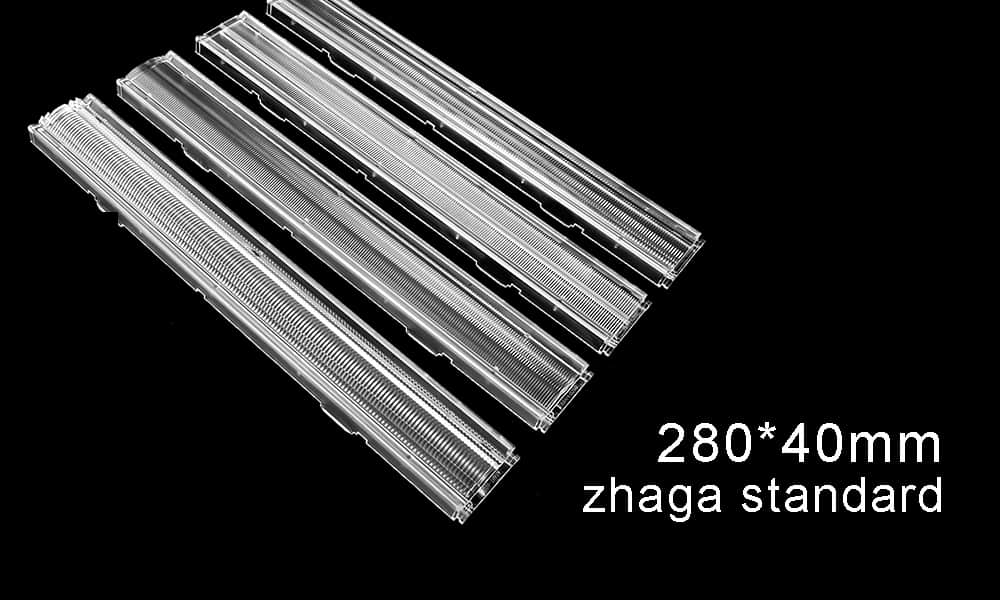
Enter the Zhaga Consortium, an organization dedicated to standardizing the interfaces of LED light engines. Specifically, the 280x40mm Zhaga Standard (often referred to in relation to Book 7) has emerged as the definitive footprint for linear lighting modules. This dimension is not just a number; it represents a universal language that allows fixture manufacturers to interchange components effortlessly. By adopting Zhaga Standard linear light components, OEMs can finally break free from the constraints of custom tooling, ensuring that their fixtures are versatile, future-proof, and globally compatible.

1. Linear Lighting Industry Pain Points
Before the widespread adoption of the Zhaga Book 7 interface, the linear lighting market was fragmented and inefficient. For lighting manufacturers (OEMs), designing a new linear fixture often meant starting from scratch—designing a custom PCB, creating a unique heat sink extrusion, and commissioning expensive custom molds for optical lenses. This "proprietary" approach created significant barriers to efficiency.
The SKU Nightmare for Manufacturers
Without a unified standard like the 280x40mm footprint, manufacturers were forced to maintain a massive inventory of incompatible components. If a client requested a 60° beam angle for an office project and a Double Asymmetric beam for a supermarket project, the manufacturer might have to source completely different LED boards because the lenses from different suppliers had different screw hole positions. This lack of interoperability inflated inventory costs and complicated production lines.
The "Locked-In" Risk for End-Users
For facility managers in warehouses or retail chains, proprietary systems are a long-term liability. If a specific driver or LED board fails five years after installation, finding a replacement component that fits the existing fixture housing is often impossible if the original manufacturer has discontinued that specific custom model. This leads to the expensive necessity of replacing the entire lighting infrastructure rather than performing a simple repair.
High R&D and Tooling Barriers
Developing custom optics is expensive and time-consuming. For small to medium-sized lighting brands, the cost of opening new molds for every beam angle (Narrow, Wide, Shelf-lighting) is prohibitive. This limited their ability to bid on diverse projects. The industry desperately needed a "Lego-like" system where one standardized module could adapt to any application—which is exactly what the Zhaga standard delivers.
2. What is Zhaga Standard?
The Zhaga Consortium is a global association of lighting companies that standardizes the interfaces of LED components. It is important to clarify that Zhaga does not define the quality of the light or the efficiency of the LED; rather, it defines the mechanical and photometric interfaces to ensure that parts from different suppliers fit together perfectly.
For linear lighting, the "Gold Standard" is Zhaga Book 7. This specification covers a variety of rectangular LED modules, but the most dominant and widely adopted form factor in the industry is the L28W4 category—which translates to the 280mm x 40mm dimension.
The "Magic Dimensions": 280mm x 40mm
Why 280mm? This length was strategically chosen because it allows modules to be tiled together to create standard fixture lengths. For example:
-
Two modules = ~2 feet (approx. 600mm)
-
Four modules = ~4 feet (approx. 1200mm)
-
Five modules = ~5 feet (approx. 1500mm)
For a lens manufacturer like Asahi Optics, the most critical aspect of this standard is the Fixing Hole Position. The Zhaga standard dictates exactly where the screws must go on the PCB. Our Zhaga Standard linear light lens series is engineered with this precise geometry. This means that if you have a PCB designed according to Book 7 specs, our lens will align perfectly with the LED light source and the mounting holes every single time. This "Plug-and-Play" capability is what defines modern, scalable manufacturing.
3. How Zhaga Standard Linear Light Lenses Solve Real Problems
The true power of the 280x40mm standard lies not just in its dimensions, but in the optical versatility it unlocks. By using a standardized Asahi lens footprint, lighting manufacturers can use a single PCB design to create a diverse range of fixtures suitable for almost any commercial environment. This "One Board, Multiple Optics" strategy drastically reduces R&D time.
The Warehouse Solution: Narrow Beams (30°)
In high-ceiling industrial warehouses (often 8-12 meters high), a standard wide beam is useless—it scatters light onto the top of the racking rather than down to the floor where the forklifts operate. Asahi’s 30° Narrow Beam lens is engineered for these "High Bay" linear applications. It punches light downwards with high intensity, ensuring that aisles are well-lit without wasting energy on the walls.
The Supermarket Revenue Booster: Double Asymmetric (DA25)
Retail lighting has a specific pain point: light needs to be on the products, not the floor. A standard diffuser creates a bright floor but leaves the shelves in shadow. This is where the Double Asymmetric lens (often marked as DA25 or Shelf Beam) changes the game.
Instead of shining down, this sophisticated optic splits the light beam into two separate directions, targeting the vertical surfaces of the shelves on both sides of the aisle. This improves the visual appeal of merchandise and reduces glare for shoppers walking in the aisle.
The Office & General Retail: Wide Beams (60° & 90°)
For open-plan offices, schools, or general retail areas with lower ceilings, uniformity is key. Asahi’s 60° and 90° lenses provide a soft, diffused light distribution that eliminates dark spots. These lenses are designed to work seamlessly with continuous Linear Trunking Systems. Because the Asahi 280x40mm lens features a "seamless connection" design, when multiple modules are snapped into a trunking rail, they create a continuous line of light with no visible gaps or dark breaks between the segments.
4. Conclusion
In the rapidly evolving lighting industry, proprietary designs are becoming a liability. The shift towards the 280x40mm Zhaga Standard represents a maturity in the market, prioritizing efficiency, interchangeability, and sustainability. For lighting manufacturers, adopting this standard is not just about compliance; it is a strategic move to streamline production and reduce SKU complexity.
By partnering with an optical specialist like Asahi Optics, you gain more than just a standard-compliant component. This allows you to build a versatile, "future-proof" linear lighting portfolio that can adapt to any project requirement without the need for expensive re-tooling.