In the field of outdoor and industrial LED lighting, reliability is the primary engineering constraint. Luminaires deployed in roadway, landscape, or high-bay applications are subjected to relentless environmental stressors, including precipitation, salt mist, and abrasive particulates. For the optical system—the heart of the fixture—there is no margin for error.
This article analyzes the critical necessity of waterproof and dustproof design through the strict framework of the IEC 60529 standard, guiding you to the most efficient solution for your specific project.
1. Decoding IEC 60529: What IP Rating for Optics
In the LED lighting industry, terms like "waterproof" or "weather-resistant" are frequently used in marketing materials. However, for engineering specifications, these vague terms are insufficient. To guarantee the reliability of an optical system, we must rely on the Ingress Protection (IP) code as defined by the IEC 60529 standard.
The IEC 60529 Standard
Developed by IEC Technical Committee 70, IEC 60529 is the international standard that classifies the degrees of protection provided by enclosures for electrical equipment.
For an LED luminaire, the enclosure is often the optical lens itself (in modular designs) or the glass cover protecting the internal components. The IP code consists of two numerals, each representing a distinct Line of Defense against environmental intrusion.
The First Numeral: Protection Against Solids (Dust)
The first digit indicates the level of protection against solid foreign objects, rated on a scale from 0 (no protection) to 6 (dust-tight).
-
IP5X (Dust Protected): This rating allows for limited ingress of dust, provided it does not interfere with the satisfactory operation of the equipment.
-
IP6X (Dust Tight): This rating allows no ingress of dust whatsoever under negative pressure testing for 8 hours.
Engineering Reality: For optical lenses, IP5X is a failure. Even microscopic dust particles settling on the inner surface will absorb light, reduce transmission efficiency (LOR), and potentially cause localized overheating. Therefore, high-performance outdoor LED lenses must strictly achieve IP6X.
The Second Numeral: Protection Against Liquids (Water)
The second digit indicates the level of protection against harmful ingress of water, rated on a scale from 0 (no protection) to 9.
-
IPX5 (Water Jets): Protection against water projected by a nozzle from any direction.
-
IPX6 (Powerful Water Jets): Protection against powerful water jets from any direction.
Engineering Reality: Outdoor street and area lighting fixtures are exposed to heavy rainstorms and high-pressure cleaning. A rating of IPX6 is the recommended baseline.
The Standard for Outdoor Optics: IP66
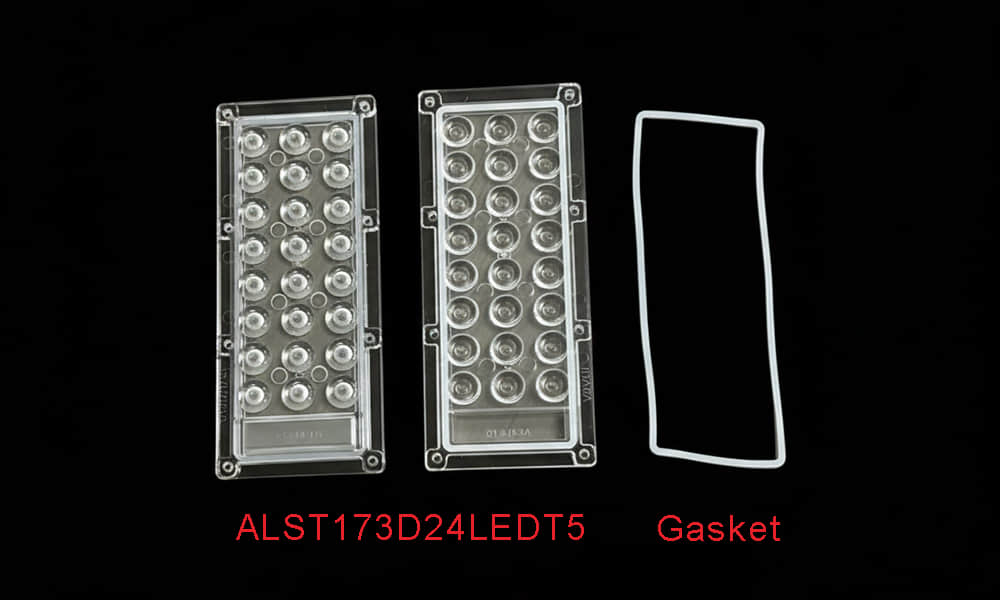
Combining these two requirements, IP66 (Dust-tight + Powerful Water Jet protection) is the industry standard for robust outdoor LED optical systems. This ensures the internal cavity remains a hermetically sealed environment.
2. The Imperative for Protection: Physics, Safety, and Economics
Without an IP66-rated enclosure, a fixture is destined for premature failure. Here is the technical breakdown of why protection is mandatory.
A. Protecting Core Optical Performance
The most immediate impact of ingress is the degradation of light quality.
-
Hazard of Water (Refractive Index Shift): Optical design assumes light travels from the lens material to Air (n ≈ 1.0). Condensed water droplets (n ≈ 1.33) on the inner lens surface act as micro-lenses, causing uncontrolled scattering, glare, and permanent mineral stains that destroy beam uniformity.
-
Hazard of Dust (Transmission Loss): Dust on the lens surface directly blocks photon transmission, reducing the Light Output Ratio (LOR) and system efficacy. It can also absorb moisture, creating a corrosive paste.
B. Ensuring Electrical Safety and Long-Term Reliability
Ingress poses a catastrophic threat to the electrical system.
-
Short Circuit & Corrosion: Moisture can bridge traces on the Aluminum PCB, causing short circuits and electrochemical migration. Humidity drives Galvanic Corrosion on solder joints and LED lead frames.
-
Thermal Management Failure: Dust acts as a thermal insulator. If it covers the LED chip or heat sink, it prevents heat dissipation, causing the Junction Temperature (T_j) to rise uncontrollably. This accelerates lumen depreciation and halves the LED lifespan for every 10°C over specification.
C. The Economics of Maintenance (OPEX)
-
Unsealed Fixture: Requires frequent, costly cleaning and repairs. For High Mast or Tunnel Lighting, a single maintenance run can exceed the fixture's cost.
-
IP66 Sealed Fixture: Virtually maintenance-free for its 5-10 year lifecycle, protecting both optics and electronics.
3. The Engineering Decision: Integrated IP Modules vs. Non-IP Lenses
When sourcing outdoor lighting optics, the choice between an IP-rated Module and a Non-IP Lens dictates the entire luminaire design and assembly process. The trade-off is between Design Flexibility and System Efficiency.
Non-IP Lenses
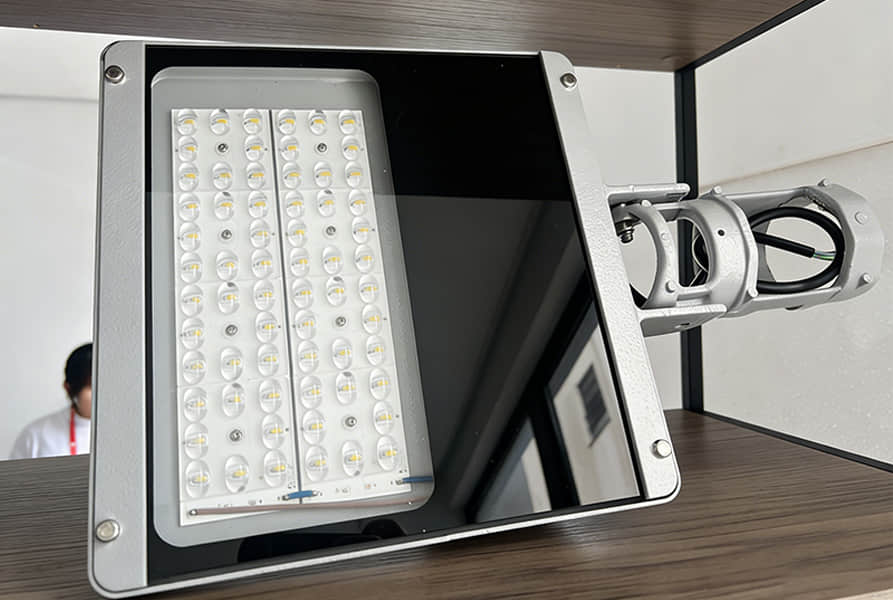
This approach uses small, unsealed clusters (e.g., 50mm arrays), requiring an external Tempered Glass Cover.
-
Advantage (Design Flexibility): Allows free-form PCB layouts for custom shapes, ideal for architectural lighting.
-
Disadvantage: Introduces ~10% transmission loss through the glass and creates a condensation-prone Air Gap. It is more complex and heavier.
Integrated IP66 Modules
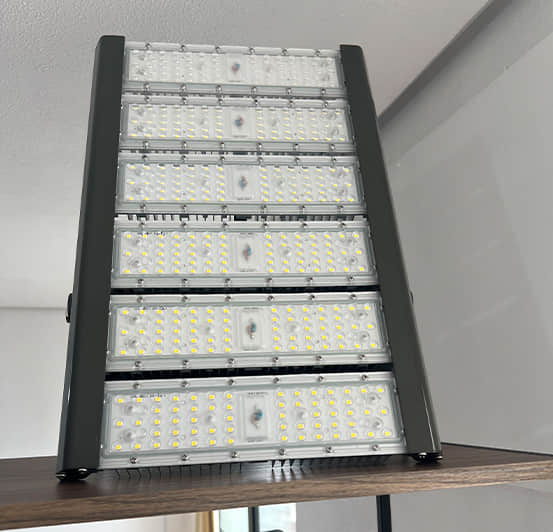
This approach uses Asahi’s multi-lens modules (e.g., 2x6, 3x8) with a built-in Silicone Gasket Channel, sealing directly to the heat sink.
-
Advantage (Efficiency & Cost):
-
Higher Efficacy: Eliminates glass absorption loss; light travels Lens → Air.
-
Simplified Assembly: One module replaces multiple parts, reducing BOM cost and assembly time.
-
Weight Reduction: Critical for pole-mounted fixtures.
-
How to Choose?
-
Choose Non-IP + Glass for highly customized aesthetic shapes.
-
Choose IP66 Integrated Modules for high-performance Street Lights, High Bays, or Tunnel Lights where System Efficacy (lm/W), reliability, and low OPEX are key.
4. The Asahi Optics Solution: Pre-Engineered IP66 Modules
To solve these challenges, Asahi Optics offers a comprehensive range of IP66 Integrated Multi-Modules. These provide a direct, reliable seal without the need for secondary glass covers.
Our Standard IP66 Lineup:
-
For Street & Roadway:
-
IP66 2x6 Lens (173mm): The global standard for street lighting modules.
-
IP66 3x8 Lens (173mm): For wider area coverage.
-
-
For High-Bay & Industrial:
-
IP66 4x6 Lens (135mm): Compact square module for factories and warehouses.
-
5.Conclusion: Protection is Performance
The selection of ingress protection is not a minor detail—it is the decisive factor in the longevity, safety, and performance of an outdoor luminaire. An IP66 rating is the fundamental guarantee that your optical design and LED system will deliver on their promise, season after season.
Don't let environmental ingress compromise your project's integrity. Equip your designs with optics engineered to survive the elements. Contact Asahi Optics today to discuss your application and test our IP66 modular solutions.