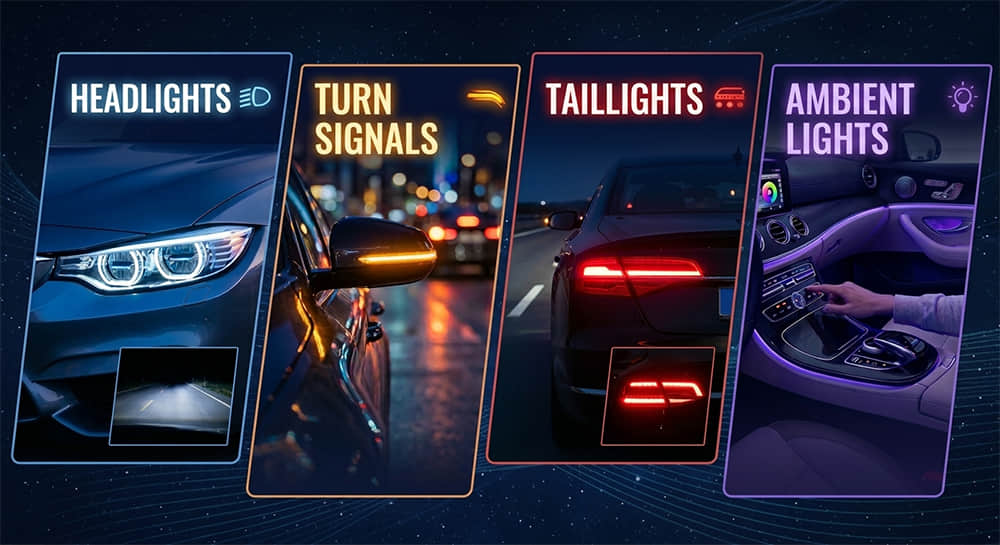
The automotive lighting industry is undergoing a visual revolution. From sweeping lightbars and adaptive driving beam (ADB) matrix headlights to glowing grilles and combined Daytime Running Lights, exterior lighting has evolved from a basic safety requirement into the defining signature of a vehicle's brand identity. However, as OEMs and Tier 1 suppliers push the boundaries of design, they are colliding with a persistent and complex optical challenge: LED color shift and visual mismatch.
Achieving a perfectly uniform, premium white light across multiple luminaire components is incredibly difficult. A slight yellow halo on the edge of a DRL or a noticeable color temperature difference between the headlamp and the grille light can instantly degrade the perceived quality of the vehicle. While high-quality LED chips are essential, the ultimate control over these visual effects lies in the component directly in front of the light source: the automotive LED lens.
In this deep dive, we will explore the underlying physical causes of LED color deviation and, more importantly, how advanced optical design, meticulous material selection, and ultra-precision plastic optical mold making serve as the ultimate solutions to overcome these optical bottlenecks.
Understanding LED Color Shift and Visual Mismatch
To solve the problem of uneven lighting, we must first understand the behavior of the light source. White LEDs used in automotive applications are typically created by coating a blue LED chip with a yellow phosphor. Because of this structural reality, the light emitted is not perfectly uniform in all directions.
When installed in an automotive luminaire, two primary factors cause color deviation:
1. Color over Angle (CoA) and Spatial Inconsistency
The most common cause of a yellow ring or uneven color distribution is the LED's spatial characteristic, known as Color over Angle (CoA) . Because the path length of the blue light through the yellow phosphor varies depending on the exit angle, the spectral composition changes. Light exiting directly straight ahead tends to be cooler (more blue), while light exiting at wider angles tends to be warmer (more yellow).
If the automotive LED lens is poorly designed or inaccurately manufactured, it fails to properly mix these varying light rays. As a result, the lens projects this spatial color discrepancy directly onto the road or across the vehicle's aesthetic light guide, creating a visually unappealing, cheap-looking illumination.
2. Temperature Fluctuations and Drive Current Effects
Automotive lenses operate in extreme environments. When a high-power LED illuminates, the junction temperature rises significantly. As the temperature shifts, the phosphor's conversion efficiency drops, and the dominant wavelength shifts, typically causing the light to appear cooler or bluer over time.
Furthermore, modern vehicles often repurpose LEDs using Pulse Width Modulation (PWM) to change brightness. However, when the input current deviates significantly from the LED's rated current, the peak wavelength shifts. This is precisely why a vehicle's primary headlight might look crisp white, while an adjacent glowing grille appears mismatched and slightly yellowish.
Overcoming these inherent LED flaws requires an optical lens that doesn't just transmit light, but actively corrects and homogenizes it.
Overcoming Optical Bottlenecks: Lens Design and Material Selection
When it comes to resolving LED Color over Angle (CoA) and thermal-induced color shifts, simply adjusting the drive circuit is far from enough. The true solution lies in the microscopic structural design and precise material selection of the front optical lens. The automotive lens is no longer just a protective cover; it acts as a highly sophisticated optical processor.
1. Precision Light Mixing Structures
When the peripheral light emitted by an LED exhibits a yellowish spectrum, the core mission of the optical lens is to scatter and flawlessly recombine these rays. For thick-wall light guides or Daytime Running Lights, we achieve this by engineering high-precision micro-prism arrays or fly-eye micro-structures on the rear or incident surface of the lens.
These micrometer-scale physical structures force the varying warm and cool light rays to undergo extensive Total Internal Reflection (TIR) and controlled refraction. By the time the light exits the lens surface, the uneven yellow halos have been completely neutralized, resulting in a uniform, premium, and pure white light.
2. The Material Gamble: PC vs. PMMA in Automotive Lighting
A flawless structural design must be executed using the optimal polymer substrate. In automotive lighting, material selection directly dictates heat resistance and light transmittance:
-
Optical-Grade PC (Polycarbonate) : Modern high-power Matrix LEDs generate extreme localized junction temperatures. Thanks to its outstanding thermal resistance, PC is the undisputed choice for primary optical lenses positioned close to the light source. It effectively prevents heat-induced lens yellowing and thermal deformation.
-
Optical-Grade PMMA (Acrylic) : For extended, continuous light components—such as illuminated brand badges, full-width taillights, or long DRLs—that require exceptional light transmittance, PMMA is the dominant force. Its superior light transmission and exceptional UV resistance ensure the light color remains pristine even after a decade of exposure.
The Core Barrier: Precision Optical Mold Tooling and Injection Process
No matter how perfect the light path looks in optical simulation software, if the mold tooling or injection process deviates by even a few micrometers, all color-correction designs will fail. At Asahi Optics, we know that manufacturing precision is the only way to break these optical bottlenecks.
1. Ultra-Precision Mold Tooling with World-Class Equipment
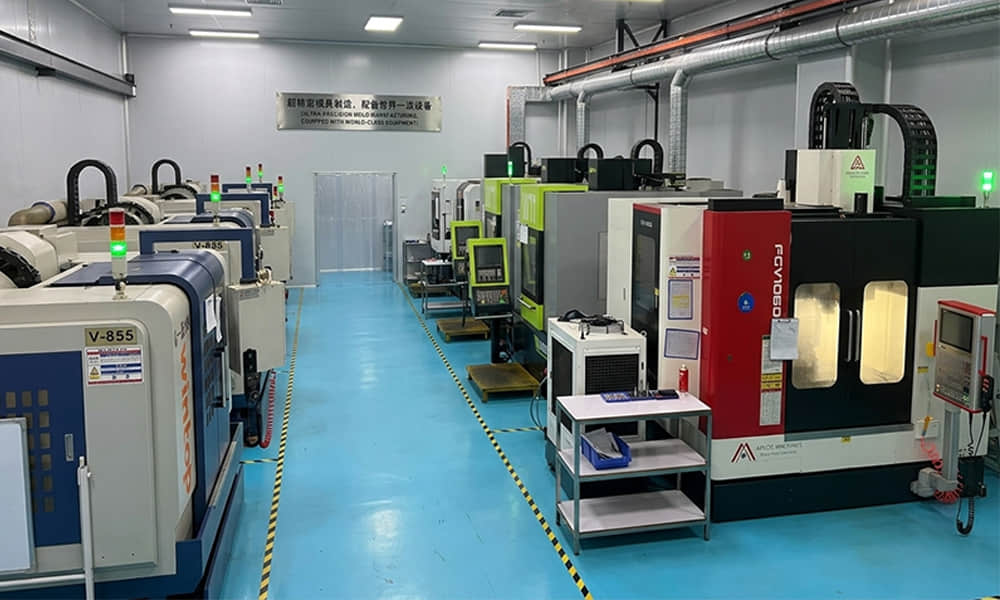
The flawless replication of optical micro-structures relies entirely on the absolute machining precision of the mold core. To conquer the immense challenges of automotive optical molds, our tooling facility operates 19 state-of-the-art CNC machining centers.
We have heavily invested in ultra-precision Toshiba CNC machines from Japan, supported by high-speed CNC machining centers from Roeders (Germany) , Apas, and Xinquan. Powered by this elite fleet and high-precision Wire EDM technology, we strictly control our mold dimensional tolerances to within 0.01 mm.
Crucially, our master polishing craftsmen are capable of elevating the optical mold surface roughness to an astonishing 0.001 mm (micrometer level, perfectly achieving the SPI A1 mirror finish standard). This flawless smoothness completely eradicates stray light and color distortion caused by microscopic machining tool marks.
2. Mastering the Optics Injection Molding Process
Optical-grade PC and PMMA are incredibly sensitive to barrel temperatures, shear stress, and holding pressure during molding. Inside our 10K-class cleanroom, we deploy a comprehensive lineup of precision injection machines ranging from 80T to 480T.
When molding thick-wall automotive lenses, it is dangerously easy to induce internal residual stress (which causes birefringence) and microscopic sink marks. These invisible defects act like tiny prisms, separating the white light and infinitely amplifying the LED's color shift. Our molding experts counter this by utilizing advanced Injection Compression Molding (ICM) techniques, ensuring the plastic melt cools and solidifies in a perfectly uniform state.
Quality Validation and Global Compliance: Closing the Loop
As highlighted in leading automotive lighting research, a major pain point for engineers is the discrepancy between photometric test data and actual human visual perception. To eliminate this, manufacturing must be backed by a rigorous, closed-loop validation system.
At Asahi Optics, producing the physical lens is only the halfway point. We subject every automotive optical component to comprehensive validation:
-
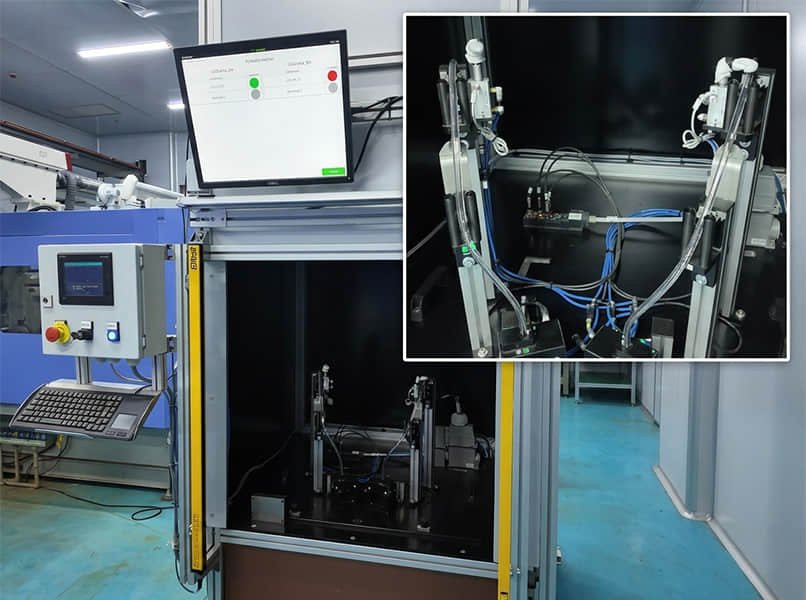
High-Precision Dimensional Inspection: The physical dimensions and micro-structures are verified using industry-leading Zeiss Coordinate Measuring Machines (CMM) , ensuring that precision achieved in tooling is perfectly transferred to the final part.
-
Photometric and Colorimetric Testing: We utilize advanced photometric laboratories to measure luminous intensity distribution and color coordinates (Cx, Cy) across the entire CIE color space.
-
Global Regulatory Homologation: Our lenses are engineered and tested to ensure compliance with global standards, including ECE (Europe) , SAE (North America) , and the rigorous GB4785-2019 (China) requirements.
Conclusion: Your Partner in Automotive Optical Excellence
The evolution of automotive exterior lighting has transformed the vehicle's aesthetic landscape. However, as designs become more intricate, the physical limitations of LEDs—such as spatial color inconsistency and thermal-induced wavelength shifts—threaten to compromise the premium feel of the vehicle.
Overcoming these optical bottlenecks requires the flawless integration of advanced optical structure design, meticulous material selection, and, most importantly, ultra-precision plastic optical mold making and injection molding.
At Asahi Optics, we bridge the gap between visionary automotive design and manufacturing reality. Equipped with world-class Toshiba and Roeders CNC machining centers, SPI A1 mirror polishing capabilities, and 10K-class cleanroom injection molding, we provide OEMs and Tier 1 suppliers with the ultimate solution to eliminate LED color mismatch and optical defects.
Are you developing a next-generation automotive lighting system and struggling with light uniformity, color shift, or complex thick-wall lens manufacturing? Contact Asahi Optics today to discuss your custom optical tooling and precision injection molding requirements.