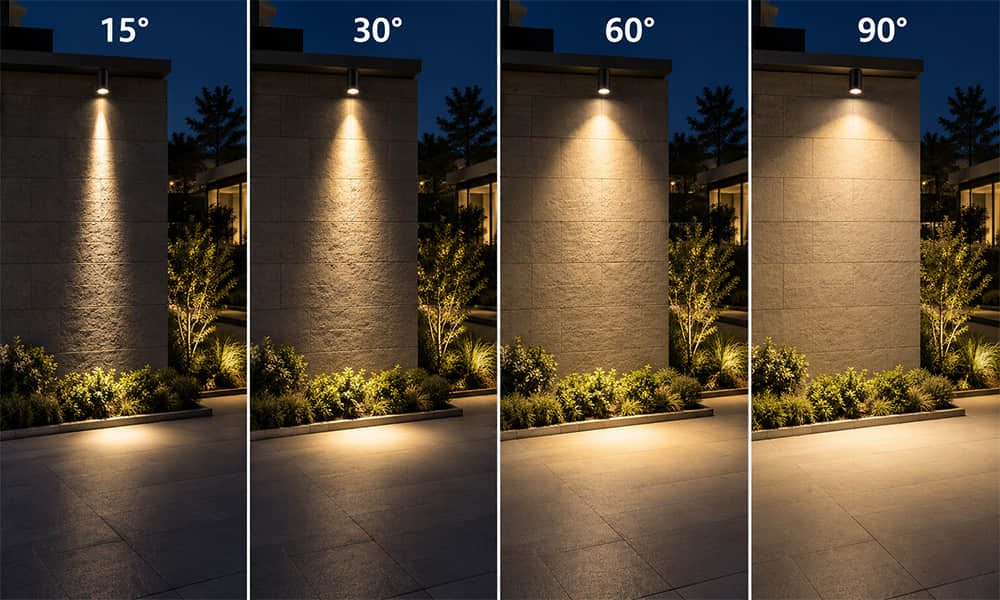
In LED optical design, many factors significantly influence light distribution. This article details the crucial role of the relationship between lens diameter, depth ratio, and beam angle in light distribution.
1. Why Larger Diameter Lenses Produce Narrower Beams
The Light-Gathering Ability of Large Direct Lenses
In optics, we use a metric called "Numerical Aperture" (NA) to measure a lens's ability to collect and control light beams. Larger lenses can collect and refract a wider range of light. When these rays are guided and focused at a single point, they converge into a narrower beam.
The larger the lens diameter, the more light it captures, resulting in a stronger NA. This leads to a smaller beam angle and higher light intensity at greater distances.
In LED lighting, this principle is crucial for applications such as accent lighting.
Larger apertures ensure that emitted light remains focused and bright, even when installed at high positions or at great distances.
Larger Diameter, Smaller Spot Size
Even the best lenses cannot focus light infinitely onto a single point; this is determined by the "physical limit" of light (diffraction limit).
According to the principles of physics, with a fixed focal length (distance from the lens to the focal point): the larger the lens diameter, the smaller the minimum focused spot size.
This principle tells us that large-diameter lenses are key to overcoming the limitation of beam concentration. They can more effectively utilize the properties of light, pushing the spot size to the minimum physical limit, thus achieving a finer, more concentrated beam.
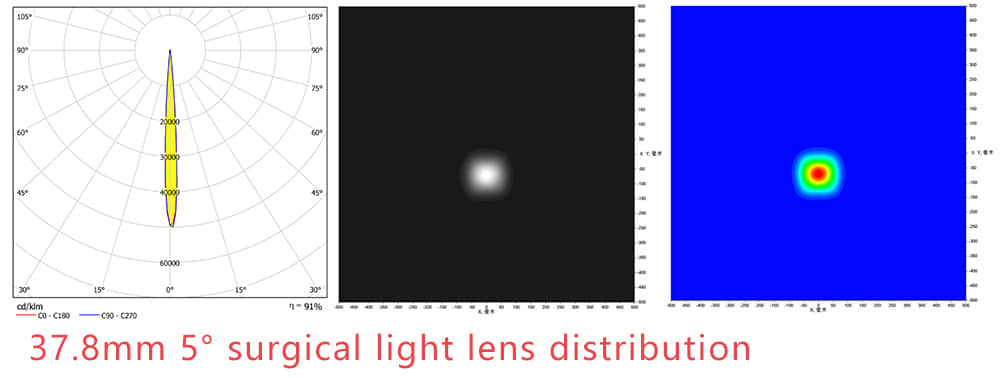
For example, Asahi's 37.8mm surgical light lens can achieve a narrow beam of only 5°, playing a crucial role in surgical shadowless lamps.
2. How the Diameter-to-Depth Ratio Affects the Beam Angle
Besides the lens diameter, the diameter-to-depth ratio (D/H) is another key parameter affecting beam formation. In optical design, the "D/H ratio" (the ratio of diameter to height) is commonly used to describe the shape and focusing characteristics of a lens.
In short, this ratio determines the concentration or diffusion of emitted light.
Generally, a deeper lens (i.e., a larger H) results in stronger refraction and convergence of light, forming a narrower, more focused beam; while a shallower lens (smaller H) causes the light to diffuse more, creating a wider, softer beam distribution.
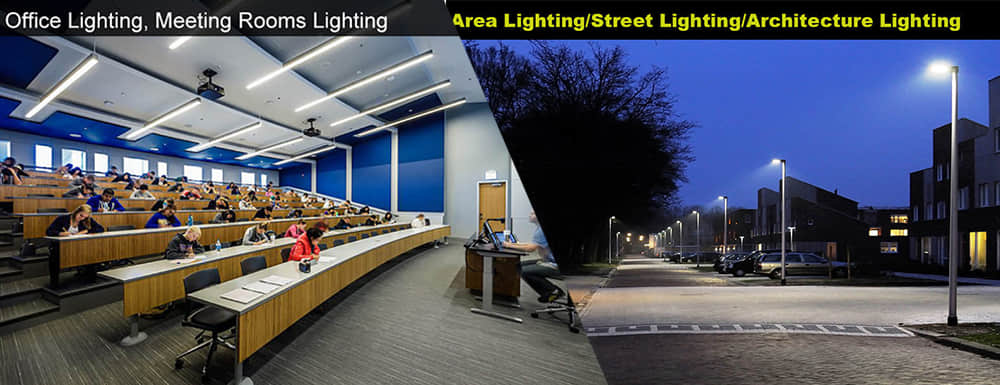
This geometric proportion controls the "divergence" and "uniformity" of light. For example, in street lighting, designers often increase the lens depth to extend the light projection distance; while in commercial or office lighting, shallower lenses are preferred to achieve a softer surface light source effect.
3. Conclusion
Understanding the relationship between lens diameter, depth ratio, and beam angle is fundamental to optical design.
By adjusting these parameters, optical engineers can precisely control the direction of light, improve energy efficiency, and achieve optimal visual comfort.
A larger diameter enhances focusing and light intensity, while the depth ratio fine-tunes the diffusion characteristics of light.
If you have an optical lens project that needs design, please contact us to discuss it!