
Industrial lighting must do more than make a facility look bright. In factories, warehouses, workshops, logistics centers, and equipment areas, the lighting system needs to place useful light on the working plane, maintain visibility between fixtures, control glare, and support safe movement around machines, racks, and vehicles.
For LED luminaire manufacturers, these results depend on the complete optical system. The LED type, PCB layout, mounting height, fixture spacing, housing geometry, and optical lens all affect the final light distribution. Asahi Optics provides industrial lighting optics for high-bay, linear, directional, and multi-module industrial fixtures, helping OEMs match lens performance to real installation conditions.
What Is Industrial Lighting?

Industrial LED lighting refers to functional lighting used in working environments such as manufacturing plants, assembly areas, warehouses, loading zones, workshops, and maintenance spaces. These installations normally operate for long hours and often use high-output fixtures mounted at different heights.
Industrial lighting is different from decorative “industrial-style” lighting used in homes, restaurants, or retail interiors. A professional industrial light fixture is selected for practical requirements including working-plane illuminance, beam coverage, glare control, mechanical installation, environmental conditions, and the layout of the facility.
Common industrial luminaires include:
- UFO high-bay lights for factories and warehouses
- Linear high-bay lights for aisles, production lines, and storage areas
- Low-bay and workshop lighting fixtures
- Industrial floodlights and directional task lights
- Outdoor industrial lights for loading areas and facility perimeters
The role of an optical lens is to collect LED output and distribute it where the project needs it. Instead of allowing light to spread randomly from the LED source, the lens can shape the beam for open factory floors, high racks, narrow aisles, production equipment, or other defined work zones.
Where Industrial Lighting Is Used
Manufacturing and Assembly Areas
Production floors often contain machinery, conveyors, workstations, inspection areas, and moving personnel. A factory light needs to create practical visibility across the working area without producing severe contrast between bright and dark zones.
In a manufacturing facility, the required beam pattern depends on the height of the ceiling, the distance between fixtures, and the location of the working plane. A wide beam may work well in a lower-ceiling assembly area, while a more concentrated distribution can be more appropriate for a taller production hall where the light must reach the floor efficiently.
The lens should also be evaluated together with the actual LED arrangement. A densely packed multi-LED board and a wider LED pitch can require different optical approaches, even when the lamp power is similar.
Warehouses and Logistics Facilities
Industrial warehouse lighting often combines open storage zones with narrow rack aisles. Open areas may require broad and uniform coverage, while aisle lighting may need an elongated or asymmetric beam that sends more light along the travel path instead of wasting output above racks or outside the aisle.
In high-rack facilities, glare is also important for forklift operators and workers looking upward toward stored goods. The beam angle, lens depth, luminaire shielding, mounting position, and viewing direction should all be considered together. For projects focused specifically on low-glare warehouse fixture selection, see our guide to selecting low-glare LED lenses for high-bay warehouse lighting .
Workshops and Maintenance Areas
Workshops and maintenance areas may use lower mounting heights than large warehouses, but they still require dependable illumination around tools, equipment, workbenches, and moving parts. In these environments, a lens helps prevent excessive concentration directly below each fixture while maintaining sufficient light around the task area.
The optical requirement may change when workers inspect reflective metal surfaces, operate machinery, or perform detailed assembly work. A practical industrial lighting design should evaluate not only peak lux directly beneath a fixture, but also the uniformity and visual comfort throughout the active workspace.
Loading Areas and Outdoor Industrial Spaces
Loading bays, entrances, outdoor storage yards, and industrial access roads need controlled illumination for people, vehicles, and goods movement. These applications can require broader outdoor coverage or directional lighting toward loading doors and circulation routes.
Industrial outdoor fixtures often operate in more demanding conditions than indoor luminaires. The optical component must fit the fixture’s sealing structure, mounting method, LED layout, and thermal design. Projects involving temporary outdoor work zones can also refer to our Construction Site Lighting application page for related fixture and beam-distribution considerations.
Lighting Problems in Industrial Facilities
Insufficient Light at the Working Plane
A high-lumen fixture does not automatically provide sufficient useful light where people work. When a luminaire is installed at a greater height, an overly wide beam can spread too much output outside the target area. The floor, workbench, conveyor, or machine surface may then receive less effective illumination than expected.
Industrial lighting optics help direct light toward the intended plane. The correct beam pattern depends on the mounting height, target area, fixture spacing, LED output, and the required illuminance level for the task.
Uneven Illumination and Dark Areas
Uneven lighting is common when fixtures are spaced without considering beam overlap. A narrow beam can create bright spots directly below each fixture and dark areas between them. A very wide beam may reduce those dark areas but can also lower useful illuminance or create unwanted spill light.
The final industrial lighting uniformity comes from the relationship between the lens distribution, fixture mounting height, fixture spacing, and room geometry. For this reason, a single lens should not be selected only by its nominal beam angle. The complete luminaire layout should be assessed through photometric data and lighting simulation.
Glare from High-Output LED Fixtures
Industrial fixtures often use high-output LEDs. If the LED source is directly visible or the distribution sends too much light toward the observer, workers may experience discomfort, reduced visual comfort, or difficulty seeing contrast around equipment and racks.
A lens can support industrial lighting glare control by directing a larger proportion of light toward the task area and reducing unnecessary high-angle output. However, the final glare result depends on the entire luminaire, including the optical lens, LED board, housing depth, diffuser or cover, installation height, room dimensions, and viewing angle.
A lens alone should not be claimed to guarantee a specific UGR value. UGR must be evaluated from the complete lighting installation.
Light Lost Above Racks or Outside the Task Area
In warehouse aisles and production lines, unrestricted light can illuminate the top of storage racks, upper walls, or unused floor areas instead of the main work zone. This lowers light utilization and may require additional fixtures to achieve the target illuminance.
Oval and asymmetric distributions can be useful when the target area is long, narrow, or close to a boundary. The purpose is not simply to make the beam narrower. It is to place the available light in a distribution that matches the geometry of the industrial space.
Changing Mounting Heights and Fixture Spacing
The same fixture can perform very differently when moved from a 6-meter workshop ceiling to a 12-meter warehouse ceiling. Mounting height changes the final spot size, intensity at the work plane, and overlap between nearby luminaires.
A practical lens recommendation therefore needs installation information. Luminaire wattage alone is not enough to select a suitable optical solution.
How Optical Lenses Affect Industrial Lighting Performance
Directing Light to the Required Area
An industrial lighting optical lens collects light from the LED and controls the direction in which that light leaves the luminaire. Depending on the lens geometry, the output can be concentrated for higher mounting positions, spread for wider areas, or shaped for an aisle or rectangular work zone.
This controlled distribution can improve light utilization by reducing the amount of output sent to areas that do not need illumination. The required optical effect must be evaluated together with the actual LED package and the dimensions of the lamp head.
Controlling Beam Width and Light Distribution
Round beam patterns are commonly used for open areas, while elongated or asymmetric patterns can be useful for aisles, conveyor lines, and edge-of-building installations. A 60°, 90°, or 120° distribution may appear straightforward, but its practical result changes according to the working distance and the surrounding layout.
For example, a 60° high-bay lens can support a more concentrated distribution at higher mounting positions, while a 90° lens can provide broader coverage in a medium-height open area. The best selection depends on the full lighting calculation rather than the angle alone.
Supporting Uniformity Between Fixtures
In a multi-fixture industrial project, each luminaire contributes to the total distribution on the working plane. The lens affects how each fixture overlaps with the next one. Proper overlap helps avoid visible dark bands, isolated hotspots, and large changes in brightness across the floor.
This is especially important for factory lights LED installations with wide fixture spacing, high ceilings, or defined operating aisles. IES data from the complete luminaire can be imported into lighting software to verify illuminance, uniformity, and spacing before production.
Reducing Direct View of High-Brightness LEDs
Deep optical structures, lens surface design, LED placement, and housing shielding can work together to reduce direct visibility of high-brightness LED sources. The lens is one part of this system, helping distribute light toward the intended area rather than allowing a wide uncontrolled emission pattern.
The final anti-glare performance must still be checked using the complete fixture. Optical performance can change when a cover, reflector, gasket, diffuser, or protective glass is added in front of the lens.
Matching the Lens to the LED and PCB
A lens only performs as intended when it is correctly matched to the LED and PCB. Important factors include:
- LED manufacturer, model, package, and emitting area
- Number of LEDs and center-to-center spacing
- Lens-to-LED distance and locating structure
- PCB dimensions, mounting holes, and component height
- Lens diameter, height, and mechanical clearance
- Housing, heat sink, cover, gasket, and sealing requirements
A small shift in LED position can affect beam direction, symmetry, and uniformity. For multi-LED industrial fixtures, the lens holder and PCB tolerances should therefore be reviewed before finalizing the luminaire structure.
Choosing Beam Angles for Industrial LED Lighting
The following table provides a starting point for lens selection. It is not a fixed rule, because the correct distribution also depends on mounting height, fixture spacing, target illuminance, and the geometry of the industrial facility.
| Distribution Type | Typical Industrial Use | Selection Purpose |
|---|---|---|
| Narrow or medium beam | Higher mounting positions or focused working zones | Direct more light toward a distant working plane. |
| 60° beam | Medium-to-high mounting heights | Balance concentrated output with practical area coverage. |
| 90° beam | Open factory floors and medium-height warehouse zones | Provide wider fixture-to-fixture overlap. |
| 120° beam | Lower mounting heights and broad open areas | Reduce excessive concentration below the fixture. |
| Oval or asymmetric beam | Rack aisles, production lines, and long work zones | Distribute light along the target direction instead of outside it. |
Before selecting a lens, the project should define the mounting height, fixture layout, required light level, work-plane height, and target beam shape. A final recommendation should be validated with photometric testing or simulation using the complete fixture.
Key Parameters for Selecting Industrial Lighting Optics
The following information helps Asahi recommend an existing industrial LED lens or identify whether a different optical configuration is needed:
| Project Input | Why It Matters |
|---|---|
| Facility length, width, and ceiling height | Defines the available installation geometry and coverage requirement. |
| Fixture mounting height | Changes the working distance, spot size, and illuminance at the target plane. |
| Fixture spacing | Determines how adjacent light distributions must overlap. |
| Required illuminance and uniformity | Helps determine the appropriate distribution and light utilization target. |
| LED model and package | Confirms compatibility between the LED emitting surface and the lens. |
| LED quantity and layout | Affects lens size, optical overlap, and complete fixture performance. |
| Target beam pattern | Determines whether a round, oval, asymmetric, narrow, or wide distribution is needed. |
| Luminaire housing dimensions | Limits the lens diameter, height, mounting points, and internal clearance. |
| Environmental and sealing requirements | Supports suitable material and structural decisions for the fixture. |
| IES file or lighting simulation target | Allows the proposed optical solution to be checked against the planned installation. |
Selecting Optics by Industrial Fixture Type
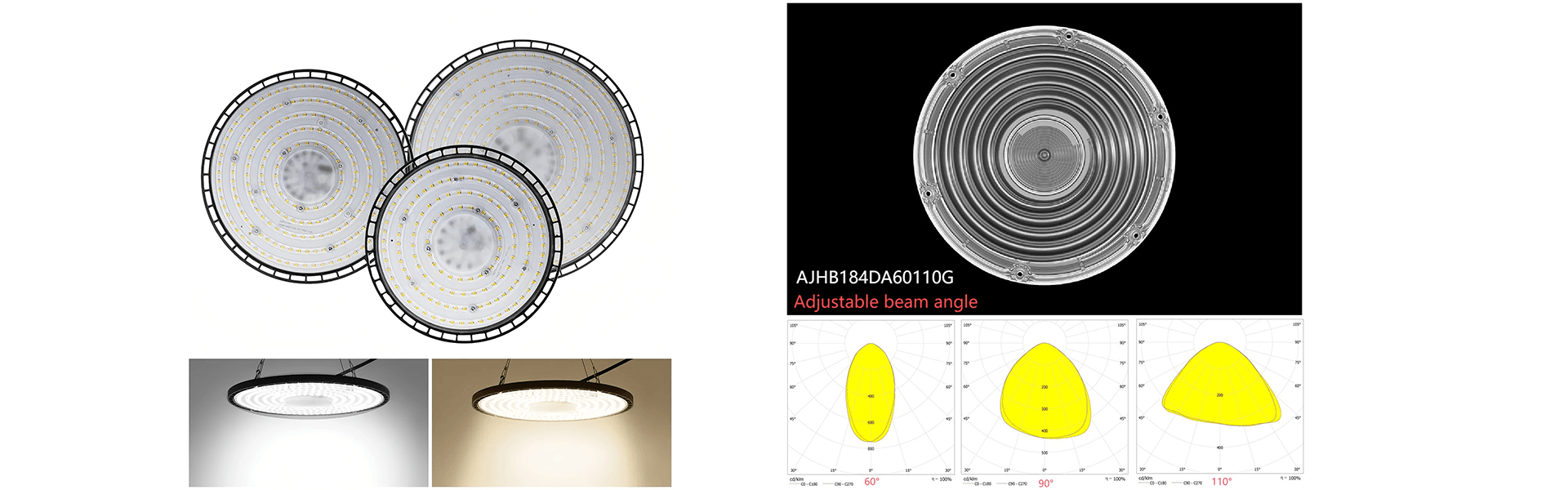
UFO High-Bay Lights
UFO high-bay fixtures are widely used for factory and warehouse lighting because they can integrate many LEDs within a round, compact lamp head. Their optical requirement varies with fixture diameter, LED count, mounting height, and required beam angle.
Asahi’s UFO High Bay Lens range includes multiple lens diameters and beam options for different industrial fixture structures. The correct choice should be based on the LED board and working environment, not only on the stated wattage of the fixture.
For example, a high-bay design installed in a tall warehouse may need a more concentrated beam than a lower-mounted production-floor fixture. The lens, housing depth, LED layout, and lamp spacing should be evaluated as one system.
Linear High-Bay and Aisle Lights
Linear fixtures are often used above long production lines, warehouse aisles, workstations, and equipment rows. Their rectangular shape can support a beam pattern that follows the direction of the space more effectively than a round high-bay fixture.
For these applications, a linear lens can provide symmetric, oval, or asymmetric distributions depending on the LED arrangement and installation target. Asahi’s Linear Lens collection includes options for different LED rows, PCB dimensions, beam patterns, and industrial luminaire structures.
Industrial Floodlights and Directional Task Lights
Industrial floodlights and directional task lights may be used around equipment, loading zones, tall machinery, or outdoor working areas. These fixtures can require a concentrated round beam, a broad flood distribution, or an elongated pattern aimed at a specific work zone.
Multi-lens modules are useful when a larger fixture needs to combine many LEDs while maintaining defined optical control. The final selection should consider the target distance, aiming direction, and whether the project requires an open-area or aisle-oriented distribution.
Recommended Asahi Optics for Industrial Lighting
264mm Round UFO Lens for High-Bay Lights
The 264mm Round UFO Lens for High-Bay Lights is designed for round industrial high-bay fixtures using 2835 or 3030 LEDs. It is available with 60° and 90° beam options, allowing the luminaire designer to compare a more concentrated distribution with a wider coverage pattern.
- Model: UFO265D528LED60,90G-200W
- Size: Ø264 mm
- Height: 12 mm
- Beam angles: 60° and 90°
- Material: PC
- Light transmission: >88%
- Compatible LED types: 2835 / 3030 LED
This lens is suitable for OEMs developing round high-bay fixtures for factory floors, warehouses, gymnasiums, and other high-ceiling spaces. The final fixture performance should be verified at the intended mounting height and LED drive condition.
84 LEDs Multi-Module Lens for High-Bay Lighting
The 84 LEDs Multi-Module Lens for Street and High-Bay Lighting offers 30°, 60°, 90°, and 80 × 150° distributions. Its multiple beam options allow designers to evaluate round distributions for open areas and an elongated pattern for industrial aisles or long working zones.
- Model: AJHB252D84LED
- Size: 252 × 70 mm
- Height: 7.8 mm
- Beam angles: 30°, 60°, 90°, and 80 × 150°
- Material: PC
- Light transmission: >88%
- Compatible LED types: 2835 / 3030 LED
The 80 × 150° distribution can be considered when an industrial lighting project requires greater coverage along one direction. The appropriate orientation and fixture spacing should be confirmed through simulation before finalizing the luminaire layout.
When an Existing Industrial Lighting Lens Is Not Enough
An existing lens may not match every industrial fixture. A different optical solution may be needed when the PCB hole pattern is fixed, the LED spacing is non-standard, the lamp head has limited internal height, or the project requires a special aisle or rectangular beam distribution.
In these situations, the first step is to review the LED data, PCB drawing, mounting space, target beam pattern, and photometric requirement. This helps determine whether an existing product can be adapted before a new optical design is considered. For a broader explanation of how secondary optics change raw LED output, see Raw LED vs. LED with Lens: Understanding the Optical Difference .
Request an Existing Industrial Lighting Lens Recommendation
To receive a practical lens recommendation for an industrial lighting project, please provide:
- LED manufacturer, model, and datasheet
- LED quantity, pitch, and PCB layout
- Luminaire drawing and available internal dimensions
- Fixture mounting height and planned fixture spacing
- Required illuminance and uniformity target
- Target beam pattern, such as round, oval, or asymmetric
- Existing IES file, lighting simulation, or reference beam image if available
- Environmental, sealing, and material requirements
With this information, Asahi can compare suitable existing industrial optical lenses and identify the most practical starting point for fixture development and photometric validation.