Whether it is warm, neutral, or cool—is defined by a metric called Correlated Color Temperature (CCT) . In the world of LED lighting, understanding CCT is the first step toward creating the right atmosphere, improving productivity, and ensuring long-term visual comfort.
In this guide, we will break down the science of the Kelvin scale, help you choose the best CCT for your specific application, and explain why high-quality optical lenses are critical for maintaining color stability over time.
The Science of Kelvin
To understand Correlated Color Temperature (CCT) , we have to look at a scientific concept called the Black Body Radiator.
Imagine a solid black object (like a piece of iron) sitting at room temperature. As you heat it up, it begins to glow.
-
At first, it glows a dim, deep red.
-
As the temperature rises, the color shifts to orange, then yellow.
-
Eventually, at extremely high temperatures, it glows brilliant white and then blue-white.
The Color Temperature of a light source is the temperature (measured in Kelvin) to which that theoretical black object would need to be heated to produce light of a similar color.
The Kelvin Scale at a Glance
It is important to remember that in lighting, the scale feels "backward" compared to weather temperatures: Higher Kelvin numbers represent "Cooler" colors, while lower Kelvin numbers represent "Warmer" colors.
-
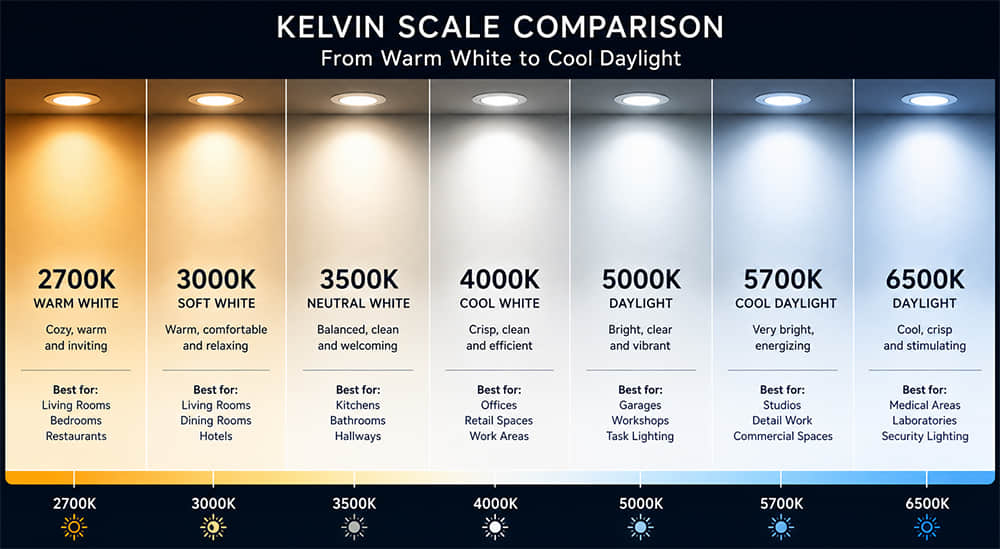
1800K – 2400K (Extra Warm White) : The soft, orange glow of a candle or a sunset. Ideal for creating an intimate, antique atmosphere.
-
2700K – 3000K (Warm White) : The classic look of traditional incandescent bulbs. This range provides a cozy, inviting feel that is familiar and comfortable.
-
3500K – 4000K (Neutral/Bright White) : A clean, balanced white that lacks a strong yellow or blue tint. It mimics natural morning light.
-
5000K – 6500K (Cool White/Daylight) : A crisp, blue-toned white that resembles the bright sun at noon. This range is designed for high visibility and alertness.
Important: Temperature vs. Heat
A common misconception is that a Cool White 5000K LED bulb is physically hotter than a Warm White 2700K bulb. This is false. The Kelvin rating describes the spectral color of the light, not the thermal heat generated by the fixture. An LED bulb can feel cool to the touch while emitting a 6500K Daylight beam.
Warm White vs. Cool White: Navigating the Kelvin Scale
Choosing the right color temperature is about more than just picking a favorite color; it is about matching the light to the function of the space. To help buyers and designers make the right choice, the lighting industry uses standardized labels that vary slightly by region.
Commercial Labeling: North America vs. International Markets
In North America, you will often find descriptive names on retail packaging, whereas international and professional markets rely strictly on the Kelvin number or a three-digit "color code" (e.g., 830, 840).
| CCT Range | US Market Labels | International Label | Visual Feel |
| 2200K - 2700K | Soft White / Extra Warm | Extra Warm White | Cozy, relaxing, intimate |
| 3000K - 3500K | Warm White | Warm White | Inviting, soft, familiar |
| 4000K - 4500K | Bright White / Cool White | Neutral White | Clean, balanced, efficient |
| 5000K - 6500K | Daylight | Cool White / Daylight | Energetic, clinical, crisp |
The Visual Psychology of Light
The spirit of a room changes instantly with the CCT.
-
Warm Light (2700K-3000K) tends to highlight textures and creates a sense of comfort. It is psychologically associated with firelight and the end of the day, making it perfect for areas where people gather to unwind.
-
Neutral Light (4000K) is often considered the "sweet spot." It provides enough contrast for reading and working without being overly harsh.
-
Cool Light (5000K+) provides the highest contrast. It makes colors pop and details stand out, which is why it is preferred for security lighting, warehouses, and high-precision task areas.
Human-Centric Lighting: How CCT Affects Your Health
Modern science has shown that light does more than help us see; it regulates our Circadian Rhythm—the internal body clock that tells us when to wake up and when to sleep.
The Melatonin Connection
Our eyes contain non-visual receptors that are highly sensitive to blue light, which is most prevalent in high-CCT sources (5000K and above).
-
Alertness and Productivity: Exposure to 4000K-5000K light during the day suppresses the production of melatonin (the sleep hormone). This keeps us alert, focused, and productive, making it the ideal range for offices and schools.
-
Relaxation and Sleep: As evening approaches, our bodies need lower CCT light (below 3000K). Warm light mimics the setting sun, allowing our bodies to begin producing melatonin, signaling that it is time to rest.
Pro Tip: Using 6500K Daylight bulbs in a bedroom or a late-night study area can lead to digital eye strain and disrupted sleep patterns.
Choosing the Right CCT for Every Scenario
1. Residential Spaces: Making a House a Home
-
Living Rooms & Bedrooms (2700K - 3000K) : Focus on warmth to promote relaxation.
-
Kitchens & Bathrooms (3000K - 4000K) : Use neutral tones to ensure safety while preparing food or applying makeup, where accurate visibility is key.
2. Commercial & Retail: Influencing Behavior
-
High-End Boutiques: Often use 2700K to create a sense of luxury and exclusivity.
-
Supermarkets & Pharmacies: Use 4000K to make the environment look clean, fresh, and modern.
3. Outdoor & Industrial: Safety and Performance
-
Stadiums & Sports Fields (5000K - 5700K) : This is the global standard. It mimics noon daylight, which is essential for athletes to track fast-moving balls and for high-definition television cameras to capture crisp, slow-motion replays.
-
Street Lighting: There is an ongoing shift from 4000K toward 3000K. While 4000K offers better visibility for drivers, 3000K is preferred in residential areas to reduce light pollution and protect local wildlife.
CCT vs. CRI: Understanding the Difference Between "Mood" and "Truth"
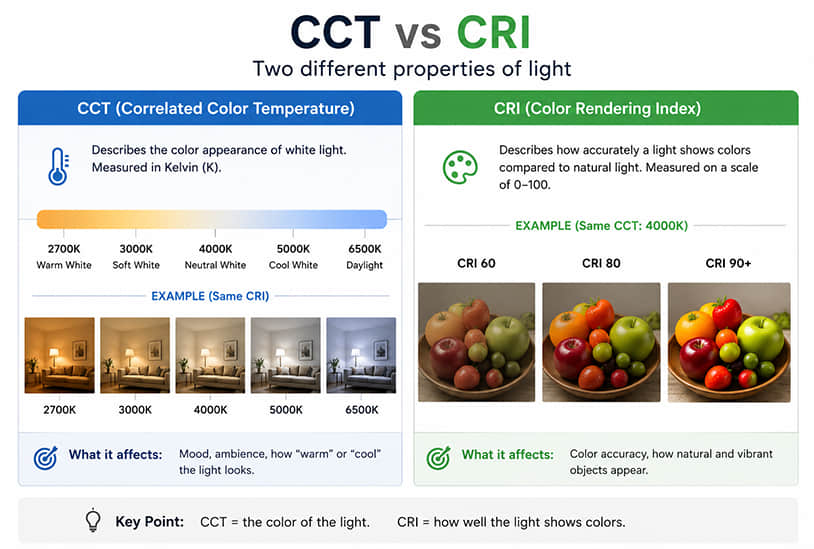
One of the most common mistakes in lighting procurement is assuming that Cool White light is inherently more accurate than Warm White light. To avoid this, we must distinguish between CCT and the Color Rendering Index (CRI) .
-
CCT (The "Mood") : Tells you the color of the light itself. Is the glow yellow or blue?
-
CRI (The "Truth") : Tells you how accurately that light reveals the colors of objects. On a scale of 0 to 100, how "real" do the colors look?
The Comparison: You can have a 2700K (Warm) LED with a high CRI of 95, which makes a red apple look vibrant and delicious in a cozy setting. Conversely, you can have a 5000K (Daylight) LED with a low CRI of 70, which makes the same apple look grey and unappetizing despite the "bright" light.
The Strategy: For retail, galleries, and residential spaces, always pair your desired CCT with a high CRI (90+) to ensure the atmosphere doesn't compromise the visual quality of your environment.
The Role of Optics: Does the Lens Affect CCT?
As a professional lens manufacturer, we often encounter a critical question: “If I buy a 5000K LED, will it stay 5000K once the lens is installed?” The answer depends entirely on the quality of the optical materials and the precision of the design.
1. Material Yellowing and CCT Shift
Standard plastic lenses (non-UV stabilized PMMA or low-grade PC) are susceptible to aging and thermal degradation. Over time, exposure to the UV rays in natural light and the heat generated by high-power LEDs causes the polymer chains to break down—a process known as yellowing.
-
The Result: A yellowed lens acts as a filter, absorbing blue light and shifting the output toward the yellow/green spectrum. Your crisp 5000K Daylight luminaire can shift down to 4500K or lower over two or three years.
-
The Impact: In large-scale projects like parking lots or stadiums, uneven aging causes some lamps to look yellow while others remain white, destroying the visual uniformity of the site.
2. Color-over-Angle (CoA) Consistency
Poorly designed lenses can cause a phenomenon where the light color isn't uniform across the beam. You might see a "blue center" and a "yellow halo" at the edges.
The Asahi Solution: By utilizing high-precision freeform surfaces and UV-stabilized optical-grade materials, we ensure that the CCT remains consistent from the center of the beam to the very edge, and stays stable for a 10-year lifespan.
How to Measure CCT and Ensure Consistency
For professional projects, "close enough" isn't an option. Lighting designers use two main tools to ensure color consistency:
-
Spectrometers: These devices measure the Spectral Power Distribution (SPD) of a light source to calculate the exact Kelvin value and the Duv (which measures how far the light deviates from the perfect black-body curve).
-
SDCM (Standard Deviation of Color Matching) : Also known as MacAdam Ellipses, this ranks how visible the color difference is between two LEDs.
-
SDCM < 3: Variations are virtually invisible to the human eye (Ideal for high-end retail/galleries).
-
SDCM < 5: Acceptable for most commercial and outdoor applications.
-
Conclusion
Correlated Color Temperature is the "emotional language" of your lighting system. From the 2700K sunset tones that help us sleep to the 5700K daylight used to broadcast the World Cup, CCT dictates how we feel and how we perform.
When selecting your next lighting solution, remember:
-
Choose the Kelvin based on the activity (Warm for rest, Cool for work).
-
Don't ignore the CRI (Ensure colors stay true).
-
Demand high-quality optics (Protect your CCT from shifting over time).
At Asahi Optics, we specialize in UV-resistant, high-transmission lenses that lock in your intended CCT for years to come. Whether you are building a stadium floodlight or an office troffer, our optics ensure that the color you design is the color that stays.
FAQ
Q: Is 5000K brighter than 3000K?
A: Not necessarily. Lumens measure brightness; Kelvin measures color. However, cool light (5000K) often appears brighter to the human eye because it provides higher contrast.
Q: What is the best CCT for eyes?
A: For reading and detail work, 4000K is best. For relaxing before bed, 2700K is best to reduce eye strain and promote sleep.
Q: Why do my LED lights look different even though they are all 3000K?
A: This is likely due to a high SDCM (Color Tolerance) or the use of different lens materials that have aged at different rates.
Q: Can I mix 3000K and 4000K in the same room?
A: Generally, it is best to stay within 500K of each other to avoid a "cluttered" look, unless you are using warm light for accent and neutral light for tasks.