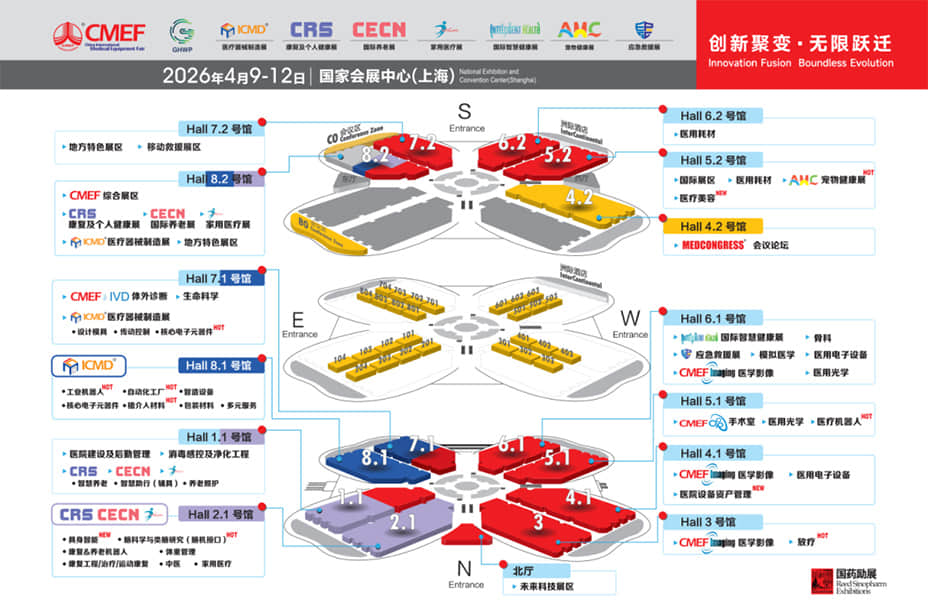
From April 9th to 12th, the 91st China International Medical Equipment Fair (CMEF 2026) successfully concluded at the National Exhibition and Convention Center in Shanghai. As one of the world's largest and most influential medical device exhibitions, this year's event attracted thousands of exhibitors and professional visitors from over 150 countries and regions.
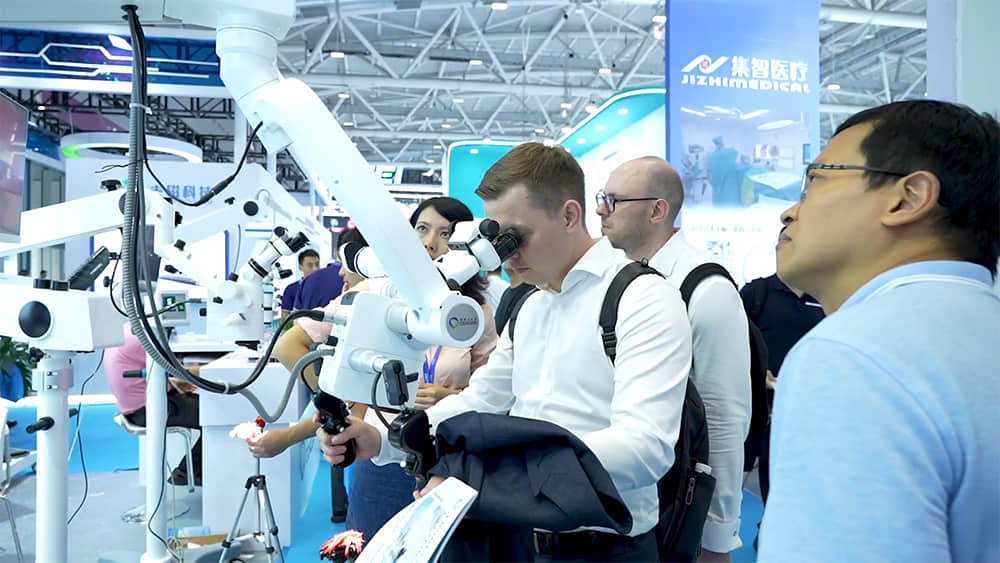
Walking through the massive halls, it was evident that the operating room equipment zone—specifically the booths showcasing medical shadowless lamps (also known as surgical lights) —became one of the most heavily trafficked areas for international buyers. The evolution of surgical lighting is no longer just about basic illumination; it has transformed into a highly sophisticated integration of optics, thermal management, and intelligent control.
As a long-term supplier of optical lenses dedicated to the medical lighting sector, through countless conversations and detailed observations of the exhibited products, I documented three major industry trends, two distinct types of market opportunities, and one profound technical upgrade direction that will define the future of surgical lighting.
The Brand Pavilion: Siemens, Philips, Mindray, and Shinva Competing on the Same Stage
The designated Brand Pavilion of this year's CMEF—the booths of four industry giants dominated the central area: Siemens Healthineers, Philips Healthcare, Mindray Medical, and Shinva Medical. Each brand presented its unique interpretation of the modern operating room.
Siemens showcased its new generation Artis series surgical light, emphasizing multi-modal image fusion lighting that seamlessly integrates with advanced surgical navigation systems. Philips, on the other hand, focused on human-centric design with its smart dimming shadowless lamps, allowing surgeons to intuitively adjust color temperature and illuminance via gesture control, ensuring a strictly sterile environment.
The Chinese giants were equally impressive. Mindray's HyLED series drew massive crowds of procurement teams, particularly from Southeast Asia and the Middle East, thanks to its exceptionally high Color Rendering Index (CRI) and ultra-low heat radiation technology. Meanwhile, Shinva Medical demonstrated highly reliable, cost-effective LED surgical light solutions tailored perfectly for the upgrading needs of primary hospitals worldwide.
However, from an optical engineering standpoint, the most striking observation inside the Brand Pavilion was a subtle yet significant shift in marketing strategy. These top-tier companies, without exception, dedicated substantial presentation time to their optical lens modules. From discussing the choice of lens materials (such as high-transmittance PMMA versus optical glass) to analyzing precise light distribution curves and anti-glare coating technologies, it is clear that the optical lens has moved from being an "invisible accessory" to the forefront as a core selling point for high-end surgical lights.
Who is Actually Buying Surgical Lights from China?
Throughout the four-day exhibition, engaging in deep conversations with dozens of international procurement teams revealed a clear stratification in the global demand for Chinese surgical lighting. The market can be distinctly divided into "hot" regions actively seeking immediate partnerships, and "cold" regions that remain largely observant.
The "Hot" Markets (Active Inquiries & Strong Intent to Sign)
-
Russia: Driven by current geopolitical and economic shifts, the supply of European medical brands has been severely restricted. Consequently, Russian buyers' demand for Chinese surgical lights has surged. They are particularly meticulous about CE certifications, IP protection ratings, and the ability of the fixtures to perform reliably in varying environments.
-
Africa: Procurement teams from countries like Nigeria, Kenya, and Ethiopia are heavily focused on public hospital infrastructure upgrade projects. They show a strong preference for highly cost-effective, durable LED shadowless lamps. For these buyers, long-lasting LED chips and easy-to-replace optical components are more attractive than overly complex smart features.
-
The Middle East: Buyers from Saudi Arabia, the UAE, and Qatar are sourcing for high-end private medical centers. With ample budgets, their focus is entirely on premium features: smart control systems, dynamically tunable color temperatures, and advanced low-glare optical designs to ensure maximum surgeon comfort during prolonged procedures.
-
Southeast Asia & South America: Southeast Asian nations (like Indonesia and Vietnam) are experiencing a boom in new hospital construction, leading to a strong demand for modular, easy-to-install surgical lighting systems. Meanwhile, South American buyers (from Brazil and Chile) remain highly price-sensitive due to currency fluctuations but strictly require compliance with local medical standards (such as ANSI/AAMI).
The "Cold" Markets (Observant & OEM-Focused)
-
Western Europe & North America: These markets remain notoriously difficult for Chinese finished-product brands to penetrate, as they are fiercely protected by entrenched local giants like Siemens, Philips, and Stryker. However, an interesting trend emerged: while they may not buy the finished lamps, Western manufacturers are actively scouting for high-quality OEM/ODM partners for core components, particularly in advanced thermal management modules and precision optical lenses.
The Footprint of Chinese Manufacturers: Mindray, Zhaofeng Optoelectronics, and the Supply Chain
Stepping away from the Brand Pavilion and moving into Halls 5.2 and 6.1, the sheer scale and capability of Chinese domestic surgical light manufacturers were fully on display. A complete industrial chain—from LED chip packaging and optical lens molding to final fixture assembly—has reached full maturity in China.
As mentioned earlier, Mindray Medical stood out with its new generation of full-spectrum LED shadowless lamps. By achieving a Color Rendering Index (Ra) of up to 98 and an R9 (saturated red) value exceeding 95, their lighting quality closely mimics natural sunlight, making the distinction between arteries and veins incredibly clear for surgeons.
We also observed highly specialized manufacturers like Hunan Zhaofeng Optoelectronics. As a dedicated surgical light producer, Zhaofeng highlighted its polarized lens surgical lights and versatile mobile shadowless lamps. Their low-power consumption lighting solutions, optimized for regions with unstable electricity grids, successfully secured multiple letters of intent from African procurement delegations.
The Optics Bridging the Gap in High-End Lenses
From the perspective of a lens manufacturer, observing these domestic brands reveals an industry-wide supply chain strategy: a hybrid approach using domestic structural components combined with imported LED chips and optics. While mid-range surgical lights increasingly utilize domestic lenses, high-end models still heavily rely on optical components from Germany or Japan. This highlights a crucial area where domestic medical-grade optics still have room for improvement, particularly regarding extreme light uniformity and long-term thermal stability.
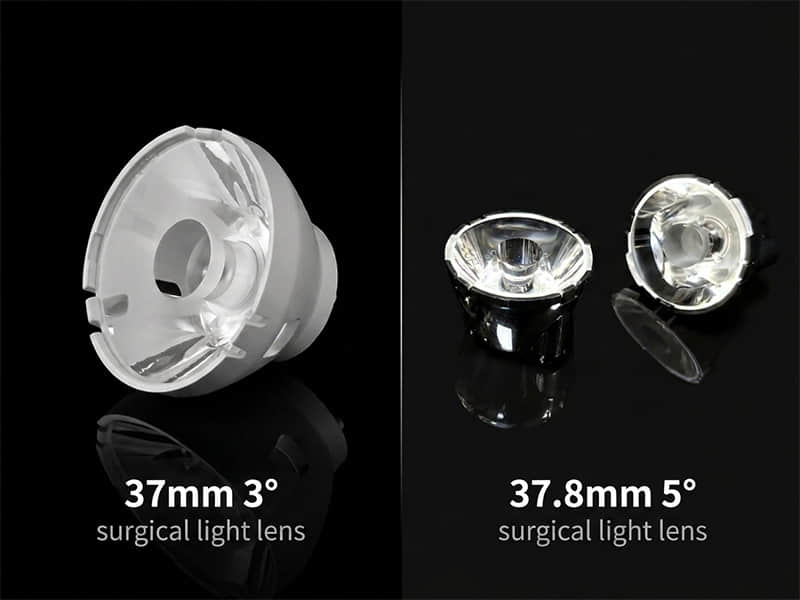
To achieve the perfect shadowless effect—where multiple light beams converge into a flawless, homogeneous cylinder of light without any color separation—requires specialized surgical light lenses. The precision of the secondary optic is non-negotiable.
For manufacturers looking to upgrade their optical engines to compete on a global scale, incorporating highly engineered components like the Asahi 37.8mm surgical light lens is a game-changer. Engineered specifically for the demanding environments of modern operating rooms, this caliber of lens ensures superior light transmittance, exact beam angle control, and the elimination of multi-color shadows, enabling fixture manufacturers to meet the stringent optical standards demanded by European and Middle Eastern buyers.
Retracing History: The Three Generations of Medical Shadowless Lamp Technology
To fully appreciate the current state of surgical lighting and the innovations showcased at CMEF 2026, it is necessary to briefly look back at how this technology has evolved. The journey of the medical shadowless lamp can be distinctly categorized into three generations:
| Generation | Light Source & Optics | Key Characteristics | Technical Limitations |
| First Generation | Halogen bulb + multiple reflective mirrors | High brightness, relatively low initial manufacturing cost. | High heat radiation (drying out tissues), short bulb lifespan, fixed and yellowish color temperature (~3200K). |
| Second Generation | Single-chip LED + primary lens | Highly energy-efficient, long lifespan, reduced heat generation, adjustable color temperatures. | Poor light spot uniformity, average Color Rendering Index (Ra < 85), and prone to creating multi-color shadows at the edges of the light field. |
| Third Generation | Multi-chip LEDs + secondary optical lens arrays | High CRI (Ra > 95), perfectly optimized shadow dilution, intelligent dimming, and excellent deep-cavity illumination. | Higher manufacturing costs, demanding strict thermal management requirements for the optical lenses to prevent yellowing and light decay. |
Currently, the mainstream high-end surgical lights have firmly established themselves in the Third Generation. The core differentiator in this era is no longer the LED chip itself, but rather the secondary optical lens array. By precisely calculating and controlling the beam angle, polarization direction, and overlapping area of each individual LED through advanced lenses, engineers can achieve a flawless column of light that penetrates deep surgical cavities without casting shadows, even when partially blocked by a surgeon's head or hands.
What Upgrades Are Needed for Future Surgical Lighting? — Five Insights from a Lens Manufacturer
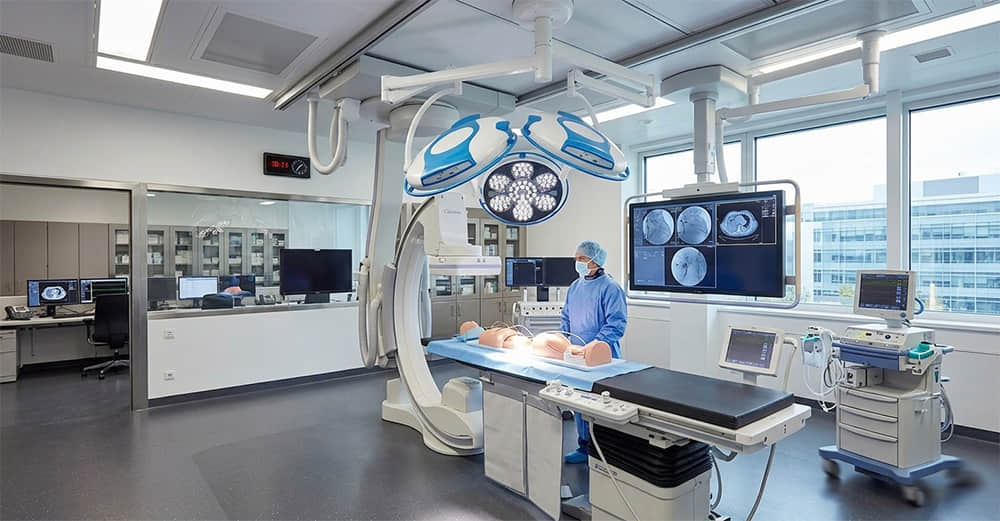
Standing amidst the bustling booths of CMEF 2026, it became abundantly clear that the hardware race in surgical lighting is far from over. As an optical lens professional, looking ahead to the next five years, I believe the upgrade path for medical shadowless lamps will heavily rely on breakthroughs in optical engineering. Here are five key directions:
1. Pushing the Color Rendering Index (CRI) to True "Surgical Grade"
While current industry standards dictate an Ra ≥ 90 and R9 ≥ 80, real-world surgical scenarios demand much more. For a cardiovascular or neurosurgeon, the ability to instantly distinguish between a bright red artery and a dark red vein is a matter of life and death. This requires an R9 (saturated red) value greater than 95. Achieving this without losing luminous efficacy requires optical lenses with exceptional spectral transmittance across the entire visible spectrum, combined with strict anti-UV properties to prevent the lens from altering the color temperature over time.
2. Evolving from "Shadowless" to "Intelligent Shadowless"
Traditional shadowless lamps rely on the static cross-projection of multiple light sources to dilute shadows. However, when a surgeon leans over the operating table, localized dark spots still occur. The future lies in dynamic, active compensation systems. By pairing advanced lens arrays with overhead camera sensors, the system can detect when a light path is blocked and instantly increase the brightness of specific unblocked LEDs. This requires lenses that can seamlessly blend light dynamically without creating harsh transitions or flickering.
3. Independent Control of Color Temperature and Illuminance
Different surgical procedures require completely different lighting environments. For instance, orthopedic surgeries often benefit from a crisp, high-color-temperature light (e.g., 4500K - 5000K) to highlight bone structures, while plastic surgeries might require warmer tones (e.g., 3500K - 4000K) for skin rendering. Currently, adjusting color temperature often results in a drop in overall illuminance. The solution is the development of dual-color temperature lens modules that can independently mix light from warm and cool LED chips within a single micro-optic, ensuring maximum lux output regardless of the selected CCT.
4. Mastering the Balance Between Thermal Management and Light Decay
A major hidden issue with high-power LED surgical lights is the heat concentrated exactly at the interface between the LED chip and the optical lens. Prolonged exposure to high temperatures accelerates lens yellowing (degradation of PMMA material), leading to severe light decay and a drop in optical safety. To combat this, future fixture designs must adopt high-temperature-resistant optical-grade PMMA or glass lenses, potentially coupled with specialized thermal-dissipation coatings on the back of the lens array to draw heat away from the critical optical pathway.
5. Embracing "Customized Optics" for Diverse Global Markets
As observed with the international buyers at CMEF, a "one-size-fits-all" approach no longer works. Russian markets demand lenses that will not become brittle and crack during extremely low-temperature startups. African markets require highly dust-resistant and anti-UV lens surfaces due to harsh climates. High-end Middle Eastern hospitals are pushing for ultra-thin lens modules to reduce the overall height and weight of the lamp head for sleeker operating rooms. Moving forward, providing region-specific, customized optical solutions will become the core competitive advantage for medical lighting suppliers.
Conclusion
As the doors closed on CMEF 2026 in Shanghai, the discussions surrounding the future of surgical lighting were far from over. From the dominance of international giants in the Brand Pavilion to the rapid rise and specialized innovations of Chinese manufacturers, it is evident that the medical shadowless lamp has evolved from a "standard operating room accessory" into a highly complex "technical core."
Whether meeting the urgent substitution demands in Russia, supporting the infrastructural upgrades in Africa, or fulfilling the ultra-premium requirements of Middle Eastern private hospitals, the trajectory of surgical lighting points squarely toward optical excellence. The optical lens—this seemingly small, transparent component—is ultimately dictating the performance ceiling of the entire fixture.
As a dedicated optical lens manufacturer, witnessing this evolution firsthand is both inspiring and challenging. The direction of light is, quite literally, the future of surgery. We look forward to continuing our deep partnerships with global surgical light enterprises, pushing the boundaries of secondary optics, and ensuring that every beam of light in the operating room is precise, pure, and flawlessly reliable.
FAQ: Frequently Asked Questions About Surgical Lighting & Optics
Q: How often do the optical lenses in medical shadowless lamps need to be replaced?
A: Under normal operating conditions (with an internal ambient temperature around 40℃), high-quality PMMA (acrylic) optical lenses typically have a lifespan of 5 to 8 years. Optical glass lenses can last even longer. However, hospital maintenance teams should monitor the lenses for surface scratches, dust accumulation inside the sealed housing, or any signs of yellowing. Once yellowing occurs, the light transmittance drops and the color temperature shifts, meaning the lenses (or the entire module) must be replaced immediately to ensure surgical safety.
Q: How can a buyer or hospital administrator tell if a surgical light's Color Rendering Index (CRI) is truly sufficient for complex surgeries?
A: Never rely solely on the general Ra value on a spec sheet. While an Ra ≥ 90 is the basic entry-level standard for medical lighting, you must specifically look for the R9 value (which measures the rendering of saturated red). In human tissue, differentiating between muscle, fat, arteries, and veins relies heavily on red tones. For high-end surgical applications, such as cardiovascular or neurosurgery, you should demand fixtures with an Ra ≥ 95 and an R9 ≥ 90.
Q: What exactly gives Chinese surgical lights such a strong competitive edge in the African and Southeast Asian markets?
A: The advantage goes far beyond just a high cost-performance ratio. Chinese manufacturers have optimized their products for the specific realities of these regions. This includes designing power supplies that can handle severe voltage fluctuations (often ranging from 170V to 250V without flickering), ensuring a rapid supply chain for maintenance parts, and designing modular fixtures that are incredibly easy for local technicians to install and repair. Furthermore, many of these highly durable products have already secured essential regional certifications like CE and SONCAP.