The automotive industry is undergoing a profound visual revolution, driven by the rapid evolution of advanced LED, matrix, and adaptive driving beam (ADB) lighting technologies. Today, an automotive lens is no longer just a functional protective cover; it is a highly engineered component that is absolutely crucial for driving safety, aerodynamic aesthetics, and vehicle brand identity. Whether it is the sharp, precise cut-off line generated by a complex injection lens mold, the seamless and uniform glow of daytime running lights, or the intricate light-guiding structures of modern taillights and interior ambient lighting, flawless Automotive Lighting Optics rely entirely on the foundation of ultra-precision manufacturing.
However, the secret behind high-performance automotive illumination does not solely lie in the initial optical design phase. It is fundamentally dictated by the mastery of plastic optical mold making. Achieving the exact photometric performance, zero-defect surface finishes, and strict dimensional tolerances requires an uncompromising approach to tooling. In this comprehensive guide, we will explore the critical journey of automotive optics—from the meticulous fabrication of an optics injection mold to flawless mass production—revealing how state-of-the-art engineering transforms raw polymer into the brilliant eyes of modern vehicles.

The Critical Role of Precision in Diverse Automotive Lighting Optics
The evolution of vehicle styling and safety technology has elevated the automotive lens from a simple protective polycarbonate cover to a highly sophisticated optical instrument. Today's dynamic automotive lighting systems demand unparalleled photometric accuracy, environmental durability, and flawless aesthetic appeal. Consequently, engineering and manufacturing advanced automotive lighting optics is an exacting science where there is absolutely zero margin for error. The performance of these lenses is inextricably linked to the microscopic precision achieved during the plastic optical mold making process. Even a micrometer of deviation in the mold cavity can lead to severe light scattering, hazardous glare, or a failure to meet stringent global automotive regulations, such as the European ECE or the North American DOT/SAE photometric standards.
When evaluating the diverse landscape of automotive illumination, each specific application presents unique manufacturing hurdles that can only be overcome with a flawlessly engineered optics injection mold.
Headlights: The Eyes of the Vehicle and the Projector Lens Challenge

The most critical and technologically demanding components are undoubtedly the front headlamps. Modern matrix LEDs and Adaptive Driving Beam (ADB) modules rely on complex freeform surfaces to dynamically shape the light beam. To achieve this, a high-quality projector lens mold must be engineered to yield a thick-wall polycarbonate or PMMA lens that delivers maximum light transmittance while projecting a razor-sharp cut-off line on the road. This sharp contrast between the illuminated area and darkness is mandatory to prevent blinding oncoming drivers while ensuring maximum forward visibility.
Furthermore, as automakers increasingly integrate high-resolution micro-optic arrays into intelligent headlight systems, the tooling must replicate nanometer-level optical microstructures flawlessly. Injecting a thick-wall automotive lens is notoriously difficult; the optics injection mold must feature advanced conformal cooling channels to manage the massive thermal load, preventing internal shrinkage, warpage, or birefringence. Any defect originating from the mold will permanently distort the focal point and ruin the beam pattern.
Taillights and DRLs: Mastering the Thick-Wall Light Guide Lens
Moving to the rear and the distinct front light signatures, taillights and Daytime Running Lights present their own unique optical and tooling challenges. The current industry trend heavily favors the use of a thick-wall light guide lens to create deep, homogeneous, and sweeping 3D-effect illumination. Unlike headlights that project light forward in a focused beam, these signal lights must capture light from edge-lit LEDs and distribute it evenly across long, highly curved, and complex geometric shapes.
Achieving this neon-like continuous glow without any visible LED hotspots requires extraordinary expertise in plastic optical mold making. The mold must be designed with precisely calculated draft angles, highly polished surfaces, and optimized gating systems. This ensures that the molten plastic flows evenly through the massive, elongated cavities without creating weld lines or flow marks, which would otherwise act as unwanted light-scattering defects.
Interior Ambient Lighting and Signaling Optics
Beyond exterior illumination, sophisticated optical components are playing a pivotal role in shaping the interior cabin experience. Modern ambient lighting relies on intricate optical light guides and micro-structured lenses to deliver soft, dynamic, and uniform color mixing throughout the vehicle's interior. Similarly, puddle light projection lenses and turn signal optics demand molds capable of producing extremely fine optical patterns—often incorporating micro-prisms or laser-etched textures directly into the steel core. The ability to precisely replicate these delicate light-extraction microstructures from the mold cavity directly to the final plastic part is what separates standard injection molders from true optical engineering experts.
Ultimately, whether manufacturing a massive rear lightbar, an intricate ambient light guide, or a highly precise matrix projector lens mold, the fundamental truth remains constant: superior automotive lighting performance is born in the tooling department. To guarantee that every single lens exiting the injection machine performs exactly as the optical simulation predicted, manufacturers must bridge the gap between theoretical optical design and ultra-high-precision mold fabrication.

Mastering Plastic Optical Mold Making and Production Capabilities
Translating a theoretical optical design into a physical, mass-producible automotive lens is the ultimate test of a manufacturer's capabilities. A flawless photometric simulation is rendered useless if the physical mold cannot replicate the mathematical model with absolute fidelity. At Asahi Optics, we understand that dominating the field of Automotive Lighting Optics requires massive investments in world-class machining, injection molding, and metrology infrastructure. It is this vertical integration—from raw steel to finished polymer—that allows us to guarantee consistency across millions of units.
Ultra-Precision Machining for Projector Lens Molds
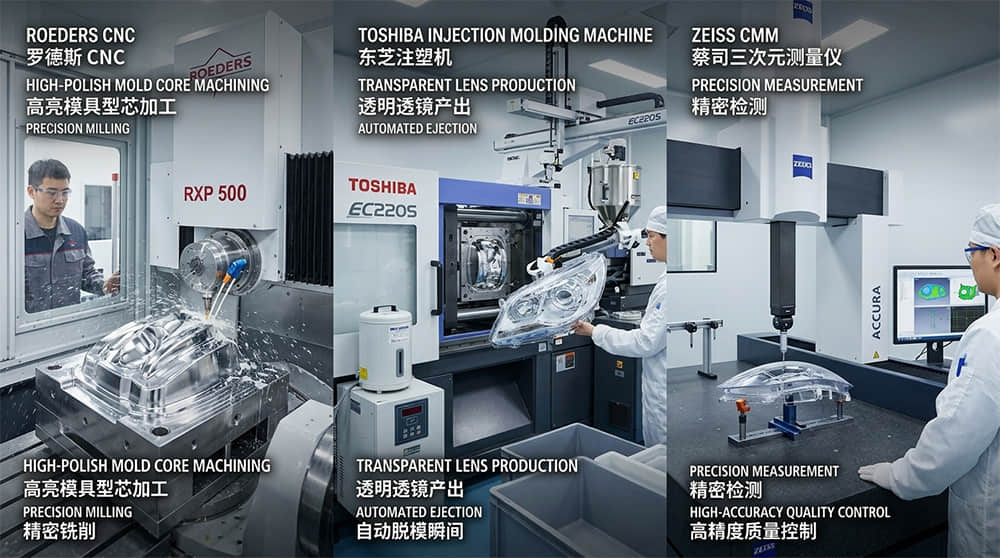
The heart of our manufacturing excellence lies in our plastic optical mold making facility. Creating the complex freeform surfaces of a projector lens mold or the intricate, nanometer-level textures required for micro-optic arrays demands equipment that operates at the very limits of physical physics. To achieve this, we have equipped our tooling workshop with a formidable fleet of top-tier CNC machining centers from globally renowned brands.
Our high-speed milling and precision tooling operations are powered by German Roeders and Beijing Jingdiao CNC machines, renowned for their unparalleled dynamic stiffness and extreme precision. For large-scale automotive molds and heavy-duty precision cutting, we deploy advanced Japanese Toshiba and Taiwanese Xinquan machining centers. By leveraging this elite combination of equipment, we achieve sub-micron level (less than 1 µm) machining tolerances on our mold cores and cavities.
Furthermore, because an optics injection mold requires an absolutely pristine surface to prevent light scattering, our polishing technicians achieve a flawless SPI A1 optical finish, with a surface roughness (Ra) strictly controlled to less than 0.01 µm. This mirror-like perfection is non-negotiable when creating the intricate geometries of a thick-wall light guide lens or a high-definition matrix headlight lens.
The Optics Injection Molding Process for Defect-Free Lenses
Once the optics injection mold is perfected, the challenge shifts to polymer processing. Injecting optical-grade Polycarbonate (PC) or PMMA is vastly different from molding standard plastics. Optical polymers are highly sensitive to thermal degradation, shear stress, and uneven cooling, which can lead to catastrophic optical defects such as birefringence, sink marks, yellowing, or black spots.
To conquer these challenges, Asahi Optics operates a state-of-the-art, dust-free injection molding facility featuring premium electric and hydraulic injection molding machines. Our production lines are anchored by Japanese Toshiba and JSW machines, alongside high-performance equipment from China's FCS. These machines provide the ultra-precise control over injection speed, holding pressure, and barrel temperature required for flawless optical molding.
For a massive, heavy component like a thick-wall light guide lens used in modern taillights, we utilize advanced injection compression molding techniques. This specialized process ensures that the polymer packs evenly into the far reaches of the mold cavity, virtually eliminating internal stress and dimensional warpage. By synchronizing our premium injection machines with conformal cooling channels designed into the mold, we dramatically reduce cycle times while maintaining absolute optical clarity and dimensional stability. To understand exactly how we integrate these capabilities into your specific project, you can explore our comprehensive custom optical mold manufacturing process.
Metrology and Quality Assurance: Validating Automotive Optics
Precision manufacturing must be validated by equally precise metrology. In the automotive industry, where a slight deviation can result in failing an ECE or DOT certification, rigorous inspection is paramount.
To guarantee the geometric and dimensional accuracy of every automotive lens and mold component, our quality control laboratories rely on ultra-high-precision Coordinate Measuring Machines (CMM) from the industry gold standard: Zeiss (Germany). These advanced Zeiss CMMs allow us to scan the complex 3D profiles of our optical parts, comparing the physical geometry directly against the original CAD data with microscopic accuracy. By combining this rigorous dimensional inspection with comprehensive photometric testing (using goniophotometers to measure the actual light beam distribution, cut-off lines, and lux values), we ensure that every lens delivered to an OEM perfectly matches both the optical design intent and the strict regulatory requirements of the global automotive market.
Conclusion: Partnering for Automotive Optical Excellence
To summarize, the journey from a conceptual optical design to a mass-produced, high-performance automotive lens is a rigorous process that demands uncompromising precision at every single stage. As vehicle lighting continues to evolve with complex matrix systems, ADB modules, and intricate light guides, partnering with a manufacturer who possesses end-to-end expertise in both plastic optical mold making and ultra-precision injection molding is no longer optional—it is an absolute necessity. At Asahi Optics, our globally sourced CNC machining centers, state-of-the-art injection technologies, and rigorous Zeiss metrology ensure that your most ambitious lighting concepts are realized with absolute fidelity, zero defects, and full compliance with international automotive standards.
Are you ready to elevate your next-generation vehicle lighting project? We invite automotive OEMs and Tier 1 suppliers to leverage our deep engineering expertise. Reach out to our team today for a comprehensive, free optical design evaluation. Whether you need to optimize an existing optics injection mold concept or require a full-service manufacturing partner from the ground up, we are here to help. Contact our automotive optics team today to submit your 3D drawings or technical requirements, and discover how Asahi Optics can brilliantly bring your vision to light.