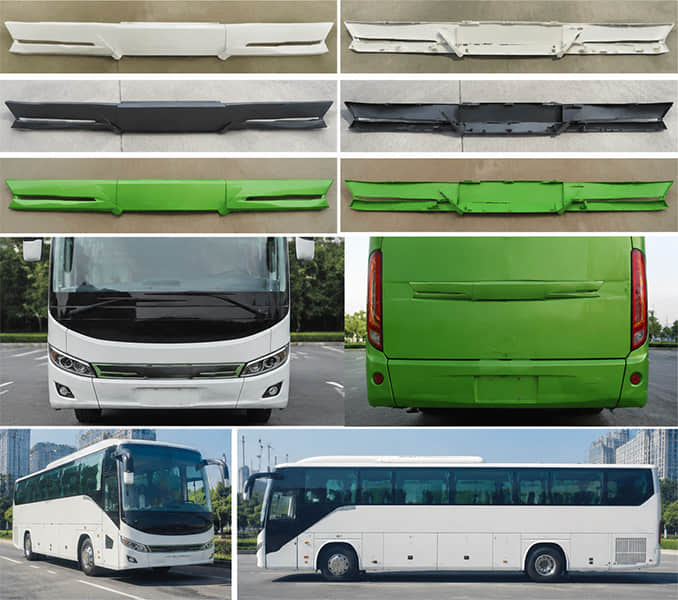
The design and manufacturing landscape of modern automotive exterior components has evolved significantly over the past decade. Driven by the aerodynamic requirements of electric vehicles (EVs) and the expressive aesthetic styles demanded by global consumers, components located at the front of the vehicle are no longer simple structural plastic covers. Elements such as the front bumper system, integrated grilles, and advanced light bar enclosures now serve as highly complex, multi-functional engineering assemblies. They must house essential radar systems, active air intake mechanisms, and intricate lighting sub-assemblies while maintaining rigid mechanical integrity and flawless surface finishes.
For original equipment manufacturers (OEMs) and international Tier-1 automotive suppliers, securing a manufacturing partner capable of executing large-scale, high-precision projects is a critical procurement requirement. Managing multiple separate sub-contractors—such as utilizing one vendor for mold construction, another for industrial injection molding, and a third for secondary surface coating—introduces severe supply chain risks. These risks include dimensional stack-up tolerance errors, paint adhesion failures caused by surface contamination during transit, and extended production lead times.
To eliminate these manufacturing bottlenecks, our factory delivers a mature, fully integrated, and long-established manufacturing solution tailored specifically for large-scale automotive parts injection molding. By consolidating automotive mold development, high-tonnage precision injection molding, and automated automotive exterior parts painting under a single, unified quality management system, we provide a complete from-blueprint-to-finished-component service. This long-standing vertical integration ensures that every structural and aesthetic specification required by global vehicle brands is locked into the production loop from day one.
Architectural Challenges and the Need for One-Stop Manufacturing Integration
The structural footprint of a modern vehicle's front profile demands an extraordinary level of manufacturing control. Large-scale exterior parts face a unique set of dual engineering constraints: they must remain flexible enough to absorb pedestrian impacts according to global safety crash ratings, yet rigid enough to resist high-speed wind loads and extreme ambient temperature fluctuations without warping.
The Material Layer: Why Automotive-Grade PP Demands Specialized Processing
To achieve this specific mechanical balance, the automotive industry relies heavily on vehicle-grade Polypropylene (PP) compounds, frequently modified with ethylene-propylene-diene monomer (EPDM) rubber and mineral fillers. While modified PP offers excellent impact resistance, high chemical durability, and low cost-per-kilogram, it introduces severe challenges during large-scale manufacturing:
-
High Linear Thermal Expansion and Variable Shrinkage: Large PP parts exhibit significant differential shrinkage rates across varying cross-sectional thicknesses. This requires highly sophisticated mold cavity pressure controls to prevent visible sink marks on the aesthetic exterior faces.
-
Low Surface Free Energy: Untreated PP is naturally hydrophobic and possesses low surface energy, making it inherently difficult for protective primer and color coats to bond permanently with the molded plastic substrate.
Consolidating Tooling, Molding, and Surface Finishing
Because the mechanical, chemical, and aesthetic properties of the final product are completely interdependent, a split supply chain frequently results in high scrap rates. For instance, if an injection molding facility uses incorrect parameter configurations or substandard mold release agents, the residual internal stresses and surface oils will cause severe paint peeling or cracking later in the production line, even if the molding appears visually acceptable immediately after ejection.
Our single-site engineering footprint eliminates this fragmentation. Our tooling engineers work closely with our injection molding and surface finishing divisions during the initial product design review stage. By analyzing the flow behavior of modified PP inside high-tonnage cavities and matching those parameters directly with the thermal baking requirements of our automated painting lines, we guarantee complete component stability, consistent coating adhesion, and predictable, optimized production lead times.
Comprehensive Component Manufacturing Spectrum: From Fascias to New Energy Light Bezels
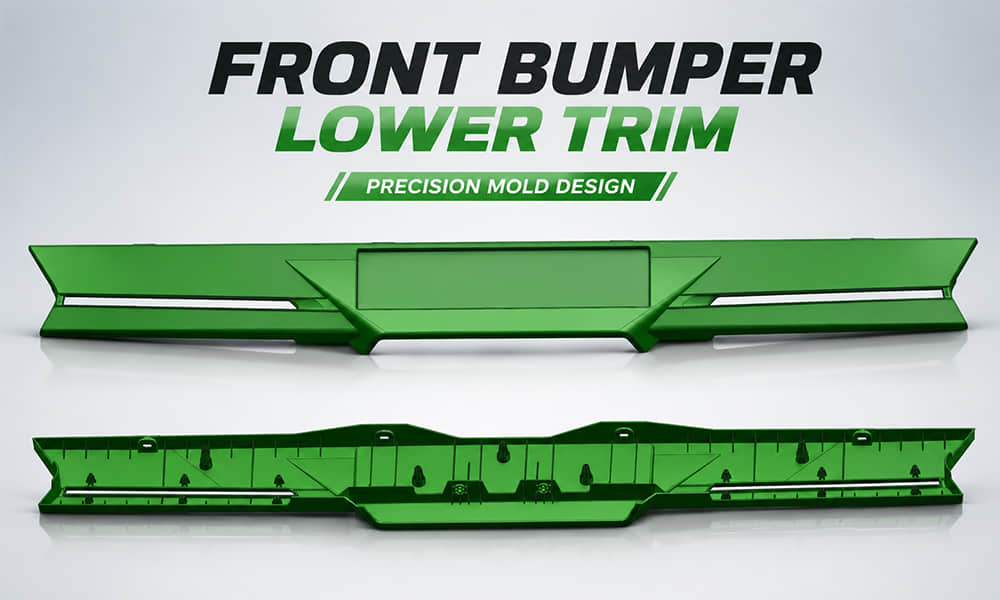
Our manufacturing lines are specifically optimized to process the full spectrum of front-end automotive exterior components. Rather than focusing solely on small-scale trim pieces, our facility specializes in the complex geometric shapes that form the visual identity of the vehicle.
Front Bumper Fascia
The Front Bumper Fascia represents one of the largest single injection-molded exterior components on a passenger vehicle. It defines the vehicle's front profile and serves as the structural skin that wraps around the impact-absorbing foam and bumper beams.
-
License Plate Bracket Area Management: Our tooling and molding lines ensure that the License Plate Bracket Area or integrated License Plate Frame is molded with optimized wall thickness transitions. This prevents structural stress concentration points while providing a highly rigid, flat surface capable of withstanding mechanical screw fastening without cracking.
-
Complex Long-Strip Openings: Modern vehicle styling requires the fascia to incorporate deep, elongated horizontal or vertical cutouts to accommodate accent trim and parking sensor brackets. Molding these long-strip openings requires precise sequential valve gating to prevent the formation of visible weld lines or structural weak points across the open spans.
Front Bumper Lower Trim
Positioned at the lowest edge of the vehicle front, the Front Bumper Lower Trim is subjected to continuous environmental stress, including stone impacts, water splashing, and potential scraping against road obstacles.
-
Aerodynamic Air Intake Vent & Air Duct Trim Integration: This component frequently incorporates functional Air Intake Vent arrays and Air Duct Trim elements designed to guide cooling airflow toward the radiator and front braking systems. Molding these structures requires complex multi-directional side-action cores within the mold tooling to form the precise louvers, attachment clips, and hollow air pathways without causing drag defects or part ejection binding.
Through-type Front Grille Trim
As internal combustion engine configurations give way to hybrid and pure electric powertrains, the traditional open radiator grille has transitioned into a solid, aerodynamic styling element. The Through-type Front Grille Trim serves as a dominant architectural feature that visually connects the left and right headlamp assemblies.
-
Through-type Light Bar Housing/Bezel: For electric vehicles, this trim component must act as the structural carrier for long, continuous LED lighting signatures. Our facility manufactures the specialized Through-type Light Bar Housing/Bezel and corresponding Light Strip Lens components, ensuring tight tolerance control so that the lighting elements fit seamlessly with zero moisture ingress risks.
Comprehensive Sub-Assembly Capabilities
Beyond these primary front-end components, our automated lines are configured to manufacture complementary exterior parts across the vehicle body. This includes side rocker panels, rear lower diffusers, wheel arch moldings, and integrated spoiler assemblies. Every part undergoes the exact same rigorous automotive-grade validation protocols to guarantee that when the full exterior kit arrives at the OEM assembly line, the color match, gloss consistency, and gap tolerances align perfectly with the vehicle chassis.
High-Tonnage Precision Injection Molding & Tooling: Engineering 1600-Ton Operations
The production of large-scale automotive exterior parts demands a massive mechanical footprint coupled with ultra-precise process control. Components like a fully integrated Front Bumper Fascia or a long-span Through-type Front Grille Trim cannot be manufactured effectively on standard industrial machinery. They require advanced, high-tonnage production cells capable of managing high injection pressures, extreme clamping forces, and highly sensitive polymer melt flows. Our facility addresses these challenges through a dedicated fleet of heavy-duty, automated injection molding cells anchored by machines operating at capacities up to a maximum of 1600 tons.
1 High-Precision Automotive Mold Development for Complex Geometries
Every successful production run begins with automotive mold development. Large-scale exterior components present complex geometrical challenges, including variable wall thicknesses, sweeping organic curves, and deep mechanical cutouts. Our internal tooling division specializes in high-precision automotive mold manufacturing, engineering molds that weigh up to several dozen tons yet maintain mechanical tolerances within hundredths of a millimeter.
-
Advanced Moldflow Simulation Protocols: Before cutting steel, our tooling engineers conduct rigorous Moldflow simulations to map the behavior of modified PP inside the cavity. We analyze filling patterns, volumetric shrinkage distributions, shear stress variations, and cooling circuit efficiencies. This predictive engineering is critical when developing a through-type front grille trim mold. Because this specific component has a long, narrow aspect ratio, improper gate positioning can cause the polymer melt to cool prematurely, resulting in incomplete filling (short shots) or localized material hesitation.
-
Optimized Cooling Line Layouts: To prevent uneven cooling—which is the root cause of component warpage and internal residual stress—our molds incorporate conformal cooling networks. These internal cooling channels follow the exact contour of the aesthetic surfaces, maintaining uniform cavity temperatures across both thin long-strip openings and thicker mounting brackets, such as the License Plate Frame reinforcement zone.
2 High-Tonnage Injection Molding Equipment Infrastructure
Our manufacturing floor utilizes a maximum clamping force of 1600 tons to process massive shot weights in vehicle-grade Polypropylene. This high-tonnage infrastructure provides the physical rigid platform necessary to secure large mold platens against the immense hydraulic pressure exerted during the polymer injection phase.
-
Closed-Loop Process Stabilization: Our 1600-ton machines are equipped with advanced closed-loop microprocessor controls that monitor and adjust critical molding parameters in real time. The injection velocity profile, cavity pressure transitions, and screw plasticizing speeds are strictly regulated. This precise control allows our automotive plastic parts injection molding process to achieve exceptional repeatability, ensuring that the dimensions of every single Front Bumper Lower Trim remain stable across an extended multi-thousand-part production cycle.
-
Dynamic Velocity-to-Pressure (V-P) Changeover: Managing the V-P changeover point is crucial when molding large-scale components. Changing over too early causes short shots, while changing over too late overpacks the cavity, resulting in flashing along parting lines and excessive internal stresses that compromise impact strength. Our 1600-ton systems utilize real-time cavity pressure transducers to trigger the changeover precisely when the cavity is 95%−98%95%−98% filled by volume, switching seamlessly to the holding pressure phase to compensate for polymer volumetric contraction without inducing mechanical stress.
3 Advanced Hot Runner Technology and Gate Management
To manufacture large components with pristine surfaces that are ready for car-grade painting, our molds utilize sophisticated hot runner systems equipped with sequentially timed valve gates.
-
Eliminating Weld Lines on Aesthetic Surfaces: When molding a large Front Bumper Fascia, multiple injection points are required to fill the expansive cavity. If these melt fronts meet uncontrolled, they form visible weld lines. These lines degrade the component's mechanical strength and create surface imperfections that cannot be hidden by paint. Our engineering team designs hot runner systems with sequential valve gating controlled by electronic timers linked directly to the screw position. The central gates open first to initiate the melt front; then, as the polymer flows past subsequent outer nozzles, those valve pins open in sequence. This continuous flow prevents melt fronts from colliding, eliminating weld lines across critical visual zones like the integrated Air Intake Vent arrays.
-
Reducing Material Waste: Hot runner systems maintain the modified PP resin in a molten state throughout the distribution manifold. This eliminates cold runners entirely, significantly reducing raw material scrap and eliminating the need for mechanical runner trimming, which can introduce particulate contamination onto the fresh molded parts.
4 Production Cycle Optimization and JIT Delivery Management
Operating at a 1600-ton scale requires maximizing production cycle efficiency while maintaining strict quality metrics. Through optimized mold designs, automated robotic part extraction, and synchronized auxiliary systems, we deliver highly competitive production lead times.
-
Robotic End-of-Arm Tooling (EOAT) : To prevent mechanical distortion during part removal, our 1600-ton injection cells utilize automated 6-axis linear robots equipped with custom-molded vacuum EOAT. The robot extracts the hot Front Bumper Lower Trim or fascia from the core side uniformly, transferring it directly to automated cooling fixtures. This controlled handling ensures that the critical clip profiles, alignment tabs, and fastening slots retain their exact positions as the plastic fully solidifies.
-
Just-In-Time (JIT) Supply Chain Alignment: Automotive OEMs operate on lean assembly schedules. Our optimized molding cycles allow us to scale production up rapidly to build reliable buffer stocks, ensuring a steady, uninterrupted flow of high-precision injection molding parts directly to customer painting or vehicle final assembly lines.
Advanced Automotive-Grade Surface Finishing: Automated Painting & Weatherability Testing
Achieving dimensional stability through 1600-ton injection molding cells is only the first stage in the production of high-end exterior components. The definitive value of a Front Bumper Fascia or a Front Bumper Lower Trim to an automotive OEM rests upon the execution of its secondary surface treatment. Because these components are directly exposed to aggressive environmental factors—including ultraviolet solar radiation, chemical de-icing salts, gravel impacts, and high-pressure jet washes—the surface coating must meet stringent automotive-grade performance metrics.
Our facility features an advanced, multi-stage automated automotive exterior parts painting line. Operating within a class 10,000 cleanroom environment, this continuous-loop finishing system is engineered to provide a flawless aesthetic finish alongside exceptional mechanical and environmental durability.
| Process Stage | Description |
|---|---|
| Power Wash Pre-Treatment | Multi-Stage Degreasing & DI Water Rinse |
| Flameless Flame Treatment | Thermal Surface Modification / Enhancing PP Energy |
| Electrostatic Spraying | Robot-Driven Primer, Basecoat, & High-Solid Clearcoat |
| Clean-Air Convection Baking | Controlled Thermal Curing for Optimum Cross-Linking |
1 Advanced Pre-Treatment and Chemical Surface Modification
As previously detailed, vehicle-grade modified Polypropylene (PP) is inherently hydrophobic and possesses low surface free energy, typically below 30 dyn/cm30 dyn/cm. This chemical characteristic makes untreated PP non-receptive to liquid coatings, which would inevitably lead to delamination and paint adhesion loss under standard road stress. To counter this, our automated finishing line subjects every raw injection molding part to a precise, multi-stage surface preparation sequence:
-
High-Pressure Chemical Degreasing: Components are conveyed through a multi-zone power wash system. Here, specialized alkaline cleaning agents remove residual mold release agents, surface oils, and static-bound airborne particulates. The parts are then thoroughly rinsed with deionized (DI) water with a conductivity profile maintained below 10μS/cm10μS/cm to prevent mineral spotting.
-
Robotic Flame Activation Treatment: Following a controlled forced-air drying cycle, the parts pass through a robotic flame treatment cell. A multi-axis articulated robot maneuvers a precise multi-orifice gas burner over the complex contours of the component, including deep recessions like the Air Intake Vent and Air Duct Trim geometries. The brief localized thermal exposure oxidizes the non-polar molecules on the PP surface, generating polar functional groups (such as hydroxyl and carboxyl groups). This treatment increases the surface free energy to a minimum threshold of 46 dyn/cm46 dyn/cm, ensuring complete chemical wetting and anchoring of the subsequent primer coat.
2 Multi-Coat Robotic Application Systems
Once surface activation is verified via automated dyne-pen testing loops, components advance into the pressurized, down-draft spray booths. The coating application is performed entirely by high-accuracy painting robots equipped with high-speed electrostatic rotary bell atomizers. This configuration maximizes transfer efficiency, minimizes paint waste, and ensures uniform film thickness distributions across wide components.
-
The Adhesion-Promoting Primer Layer: A specialized conductive primer layer is applied first. This coating serves a dual purpose: it establishes a permanent chemical bond with the flame-treated PP substrate and creates a conductive background that enhances the electrostatic attraction for the subsequent paint layers.
-
Basecoat Color Matching & Colorimetry Control: The color basecoat is applied using precise fluid delivery controls to achieve exact color matching with the vehicle's metal body panels. This layer requires strict monitoring when coating components with long horizontal surfaces, such as a Through-type Front Grille Trim or a Through-type Light Bar Housing/Bezel. The automated system maintains a wet-film thickness tolerance within ±2μm±2μm to prevent localized mottling, aluminum flake orientation defects, or color shifting across the component profile.
-
High-Solid Protective Clearcoat Layer: The final layer consists of a premium, high-solid two-component (2K2K) polyurethane clearcoat. This coating provides the deep visual gloss or refined matte texture required by the styling studio while acting as the primary defense shield against chemical and mechanical degradation.
3 Thermal Curing and Cross-Linking Optimization
After completing the application sequence, the wet painted components enter a clean-air convection baking oven. The oven is divided into progressive thermal zones to manage the flash-off of solvents before entering the high-temperature curing environment. Because PP substrate deformation can occur if baking temperatures are excessive, our thermal profiling systems maintain the oven at a precise temperature window (80∘C−90∘C80∘C−90∘C) for exactly 30 minutes. This provides the energy required to fully cross-link the polyurethane polymers, locking in structural hardness without inducing structural warping or thermal stress in the underlying plastic molding.
4 Rigorous Quality Validation and Laboratory Testing Protocols
To guarantee compliance with internal quality management standards and global OEM specifications, samples from every production batch undergo comprehensive laboratory testing:
-
Cross-Cut Adhesion Testing (ISO 2409 / ASTM D3359) : Operators perform cross-hatch incisions on the painted surfaces, applying and removing standardized adhesive tape to verify zero coating detachment along the cut edges.
-
High-Pressure Water Jet Resistance (DIN 55662) : The painted surface is scribed with a specific cross defect and subjected to a high-pressure water jet stream heated to 60∘C60∘C at a pressure of 100 bar100 bar. The coating around the scribe must exhibit zero peeling or undermining, simulating the real-world conditions encountered in commercial car wash facilities.
-
Accelerated Weathering and UV Degradation (Xenon Arc Testing) : Coated panels are exposed to intense Xenon arc lamp radiation and moisture cycling inside environmental chambers for up to 2,000 hours. The parts must display negligible color fade (ΔE≤1.0ΔE≤1.0) and retain more than 90%90% of their original gloss level, proving their long-term resistance to environmental weathering.
Through this end-to-end integration of mold manufacturing, high-tonnage molding, and car-grade surface finishing, our factory delivers completely verified, retail-ready exterior components that streamline your assembly logistics and eliminate sub-vendor quality disputes.
Conclusion: Your Long-Term Automotive Exterior Manufacturing Partner
The competitive landscape of the automotive industry requires tier-1 suppliers and OEMs to optimize every link within their procurement pipelines. As demonstrated across our operational workflows, producing highly complex, large-scale automotive components like the Front Bumper Fascia or the Front Bumper Lower Trim requires a deep understanding of polymer chemistry, mold mechanics, and surface science.
By operating a vertically integrated, long-established manufacturing system that pairs high-precision automotive mold development with up to 1600-ton injection molding and automated, automotive-grade painting, our facility eliminates the operational fragmentation that compromises project timelines. We remain dedicated to providing global automotive brands with robust, scalable, and high-yielding manufacturing solutions that transition seamlessly from initial engineering drawings into fully finished, showroom-ready components.