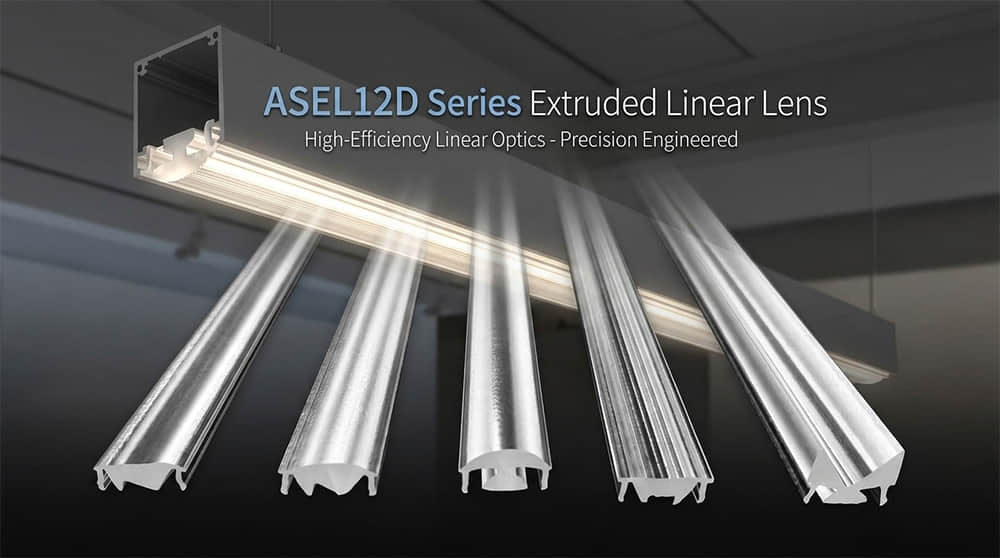
Standard diffusive covers or raw LED strips frequently fail to meet project specifications due to visible pixelation, high-angle glare, or an inability to redirect light into localized target zones. To address these spatial and optical challenges, Asahi Optics engineered the ASEL12D series. The ASEL12D extrusion lens can be used in display cabinets, under-cabinet lighting, freezers, Cove Ceiling, and staircases.
The underlying engineering reason this single optical series can span across these five highly diverse applications is its specialized dimensional profile and its flexible beam-angle matrix. Featuring a uniform, ultra-slim external width of exactly 12 mm, the ASEL12D is physically configured to insert into compact aluminum profiles, allowing it to disappear entirely into structural millwork, metal retail racks, refrigeration corners, slim graphic frames, and handrail recesses.
While its physical footprint remains identical across all installations, the internal micro-structured optical surfaces can be altered during the extrusion process to yield six distinct light distributions:
-
Symmetric Beams (30∘30∘, 40∘40∘, and 60∘60∘) for direct, functional task and accent downward coverage.
-
Asymmetric Beams (Asy 25∘25∘ and Asy 45∘45∘) for directional, oblique forward throws that eliminate glare.
-
An Ultra-Wide Beam (145∘145∘) optimized for close-range horizontal light blending.
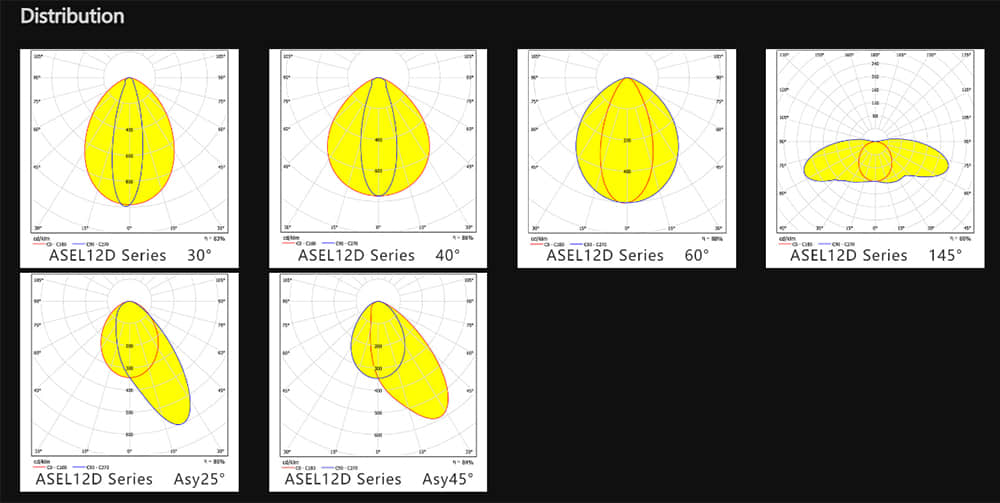
From a material performance standpoint, the series relies on a specialized high-diffusion polymethyl methacrylate (PMMA) grade, specifically Altuglas Diffuse 101. This material formulation provides high hiding power to eliminate LED hot spots at close range while maintaining an overall light transmission efficiency exceeding 90%90%. This ensures that whether the lens is deployed in a sub-zero retail freezer or a high-end kitchen cabinet, the light output remains uniform and smooth.
To provide a complete system solution for OEMs, luminaire manufacturers, and spatial contractors, Asahi Optics does not supply the plastic lens in isolation. We deliver the ASEL12D as a fully integrated hardware assembly, complete with matching slim aluminum extrusion profiles, mounting clips, and heavy-duty end-caps.
This comprehensive capability brief will systematically analyze how the geometric and optical properties of the ASEL12D series directly resolve the technical constraints inherent to display cabinets, under-cabinet installations, commercial freezers, Cove Ceiling, and structural staircases.
How Does the ASEL12D Extrusion Lens Optimize Illumination in Commercial Display Cabinets and Retail Shelves?
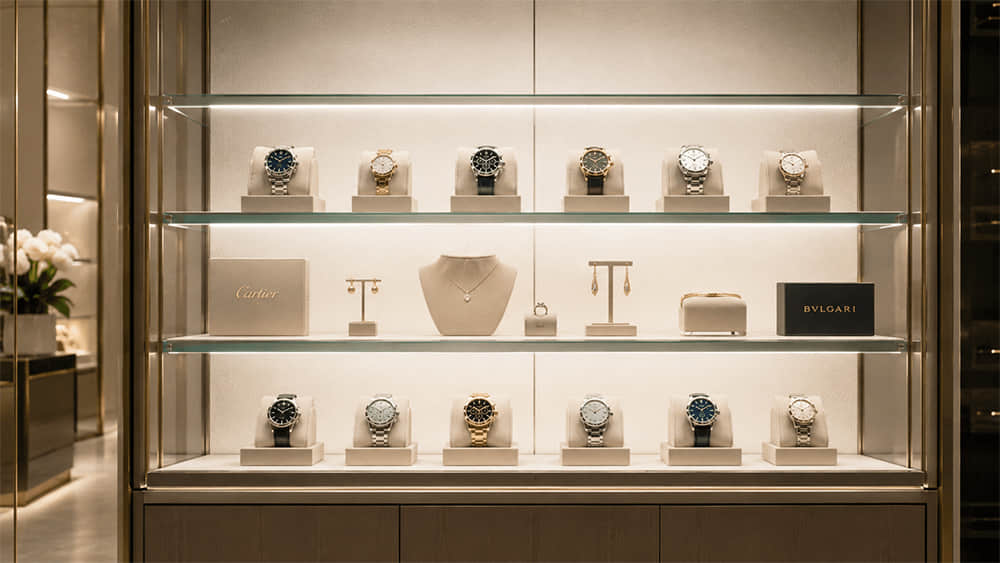
Commercial display cabinets, museum showcases, and luxury retail shelving present unique challenges for linear lighting integration. Designers must install luminaires within highly restricted space envelopes—such as the leading edge of a shelf, vertical metal frame channels, or glass-to-glass joints—while ensuring that the light uniformly covers the displayed merchandise without projecting direct glare into the eyes of customers. The architecture of the ASEL12D extrusion lens directly resolves these dual constraints.
1. Seamless Structural Integration via the 12mm Profile
In high-end retail environments, visible lighting hardware degrades the aesthetic value of the display cabinet. The 12 mm external width profile of the ASEL12D series allows the entire luminaire assembly to be completely recessed or surface-mounted flush with standard structural millwork and retail rack systems.
When installed inside our matching slim aluminum extrusion profile, the lens sits flush with the shelf border. This miniature footprint allows designers to place high-output linear lighting within the display cabinet without reducing the physical merchandising space or disrupting clean structural sightlines.
2. Eliminating Hot Spots and Reflected Glare on Merchandise
Displaying items with reflective surfaces—such as jewelry, watches, cosmetics, or glass-packaged goods—magnifies the defects of standard LED strips. Raw LEDs project intense, localized points of light that reflect off these products, causing severe visual discomfort and obscured branding labels.
The ASEL12D series addresses this by using the high-diffusion Altuglas Diffuse 101 matrix. The micro-particles embedded within the PMMA resin scatter the individual LED diode points over a short distance. This uniform light scattering converts the high-intensity point sources into a smooth, continuous band of light, ensuring that polished products inside the display cabinet are illuminated softly and evenly.
3. Implementing the Asy 45° Beam for Directional Shelf Coverage
Placing a standard symmetric wide-angle lens at the front edge of a retail shelf causes two primary optical errors: it wastes light by projecting it out into the store aisle, and it fails to illuminate the upper portion of products placed directly beneath the shelf edge.
To fix this, the ASEL12D offers a calculated Asy 45° asymmetric beam distribution, which optimizes light utilization through three specific mechanisms:
-
Oblique Forward Throw: The internal microstructure of the lens bends the peak luminous intensity 45∘45∘ away from the vertical axis, directing the light backward and downward onto the faces of the products.
-
Uniform Vertical Lux Distribution: This angled distribution ensures that the top, front, and center zones of the merchandise receive balanced illuminance, minimizing harsh structural shadows.
-
Integrated Glare Cutoff: The asymmetric geometry cuts off high-angle light spill directed toward the aisle. Consequently, customers can look closely at items inside the display cabinet without experiencing direct glare from the overhead shelf lighting.
Why Is the ASEL12D Extrusion Lens Suitable for Under-Cabinet Residential and Workspace Lighting?
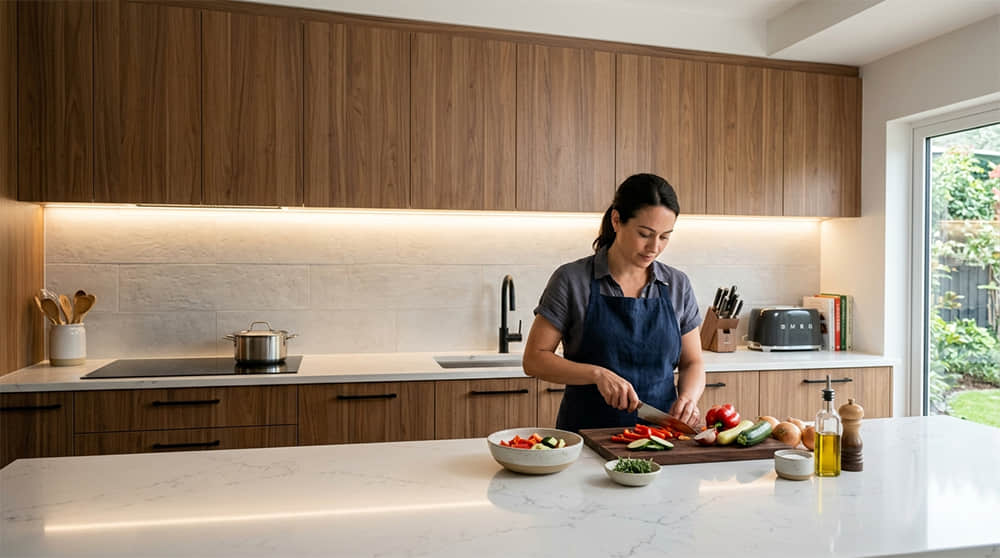
Under-cabinet lighting in residential kitchens, home offices, and corporate workspaces serves as critical task illumination. The primary objective is to deliver high-level, uniform illuminance down onto a flat working surface—such as a stone countertop or a desk—from a highly compact overhead structure. Traditional under-cabinet fixtures frequently project down a harsh, dotted pattern or present a bulky profile that protrudes past the cabinet fascia. The ASEL12D extrusion lens is engineered precisely to fit these compact spatial limits while maintaining optical performance.
1. Low-Profile Mechanical Integration into Shallow Millwork
Standard kitchen upper cabinets and office shelving units typically feature a bottom recess depth of only 10 mm10 mm to 15 mm15 mm. Thick linear light bars cannot be hidden within these dimensions without extending below the cabinet lip, which compromises clean architectural lines.
Because the ASEL12D series features a narrow 12 mm width profile, our matching slim aluminum extrusion track can be effortlessly router-recessed flush into the wood substrate. This enables furniture manufacturers and cabinet contractors to deliver a completely integrated lighting layout where the hardware disappears into the cabinetry, achieving a "light without the fixture" effect.
2. High Hiding Power to Eradicate "Dioding" on Polished Countertops
Modern kitchens and premium workspaces heavily utilize polished quartz, polished granite, and dark glass surfaces. These materials act as mirrors, reflecting the underside of the cabinet directly into the user's field of view. When standard clear or semi-frosted lenses are paired with low-cost LED tape, these reflective surfaces display an intense, dotted line of individual diodes.
The ASEL12D series resolves this specular reflection issue through the optical compounding of its raw material. By integrating Altuglas Diffuse 101 PMMA, the lens features an optimized haze-to-transmittance ratio. It splits the high-angle rays of the LED points and blends them directly at the lens interface. The result is a smooth, continuous ribbon of light projected onto the countertop, eliminating the visual fatigue caused by scattered glare and pixel reflections during precise culinary work or reading tasks.
3. Application of the 60° and 145° Beams for Uniform Workspace Tasking
Depending on the depth of the workspace countertop and the mounting height of the overhead cabinet, the ASEL12D series offers flexible beam configurations to match specific task criteria:
-
The 60° Mid-Symmetric Beam: This distribution focuses the luminous flux directly down onto the primary preparation or typing zone, preventing light from spilling back onto the backsplash walls or out into the room, thereby maximizing center-lux efficiency on the work surface.
-
The 145° Ultra-Wide Beam: For very shallow cabinets mounted close to the workspace, the 145∘145∘ distribution spreads the light broadly from the rear wall to the front countertop edge. This wide beam eliminates dark corners and ensures a balanced, shadow-free illumination field across the entire functional workspace.
What Are the Mechanical and Optical Advantages of Using the ASEL12D Extrusion Lens Inside Commercial Freezers and Refrigerators?
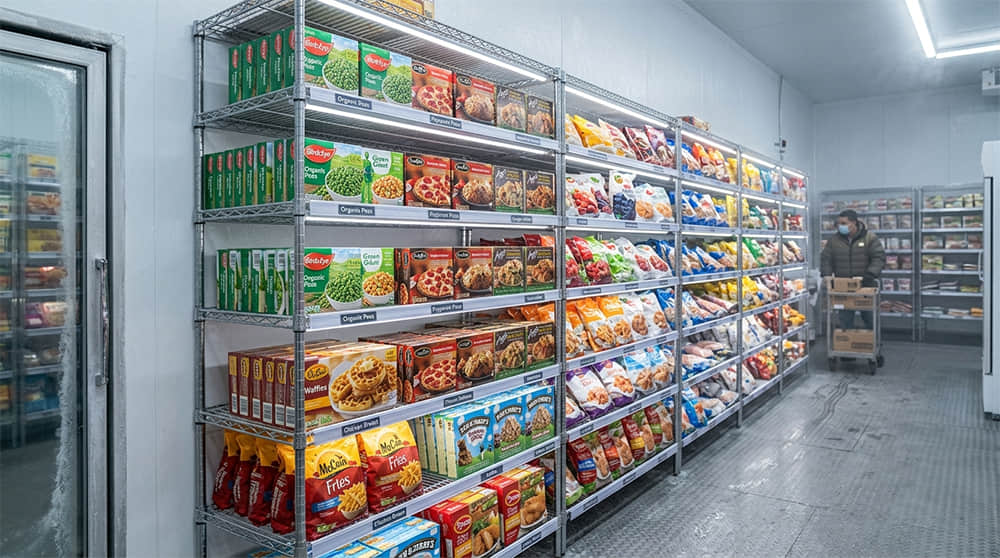
Commercial refrigeration units, walk-in freezers, and supermarket display coolers represent highly demanding operational environments for linear LED luminaires. LED optics deployed in these zones must withstand continuous sub-zero temperatures and high-humidity air circulation while occupying minimal physical space. Furthermore, the optical delivery must remain perfectly uniform to ensure that product labeling, food colors, and nutritional data are instantly legible to consumers through multi-layer glass doors.
1. Miniature 12mm Footprint Maximizes Internal Storage Volumetrics
In commercial grocery retail, spatial efficiency inside a freezer translates directly to product storage capacity. Traditional, bulky lighting tracks installed on the side pillars or mullions of a refrigerator protrude into the shelving area, increasing the risk of structural damage from product restocking clips and reducing the total usable stocking volume.
The 12 mm width profile of the ASEL12D extrusion lens minimizes this physical footprint. The compact lens and its matching aluminum extrusion track can be integrated directly into the corner joints or recessed within the vertical structural pillars of the refrigerator frame. This ensures that the entire lighting system remains completely out of the path of loading crates and sliding wire baskets.
2. Sub-Zero Dimensional Stability and Mechanical Integrity
Low-temperature environments cause many standard structural plastics to contract unevenly, deform, or experience molecular embrittlement, which can lead to stress-cracking under minor impacts. The ASEL12D series addresses these structural challenges through the properties of its underlying polymethyl methacrylate (PMMA) formulation.
The Altuglas Diffuse 101 compound maintains high dimensional stability and mechanical impact resistance at temperatures down to −20∘C−20∘C. The extruded profile undergoes zero warpage or shrinkage-induced bowing when exposed to rapid thermal transitions during standard defrost cycles, keeping the optical alignment locked over years of service.
3. Maximizing Visual Legibility and Eliminating Packaging Hot Spots
Frozen food packaging heavily utilizes high-gloss plastics and metallic foils that generate intense specular highlights under poor lighting conditions. If individual LED diodes are visible through the lens, these reflections create harsh hot spots that obscure pricing tags, brand names, and expiration dates.
The ASEL12D series leverages its balanced light diffusion properties to convert concentrated diode points into a smooth, homogeneous line of light. Depending on the depth and layout of the wire shelving, specific beam angles optimize performance:
-
The 40° and 60° Symmetric Beams: These options focus the luminous intensity straight back across the full depth of the wire shelves. This targeted distribution ensures that products positioned at the very back of the freezer stall receive identical illuminance to those stacked right at the glass front, eliminating dark pockets and maximizing merchandise visibility.
Additionally, when paired with our heavy-duty matching end-caps and appropriate secondary sealant or potting compounds by the luminaire OEM, the ASEL12D assembly successfully isolates the internal LED circuit from the high-humidity, condensing air stream, preventing premature electrical failure.
More extrusion lighting application scenarios
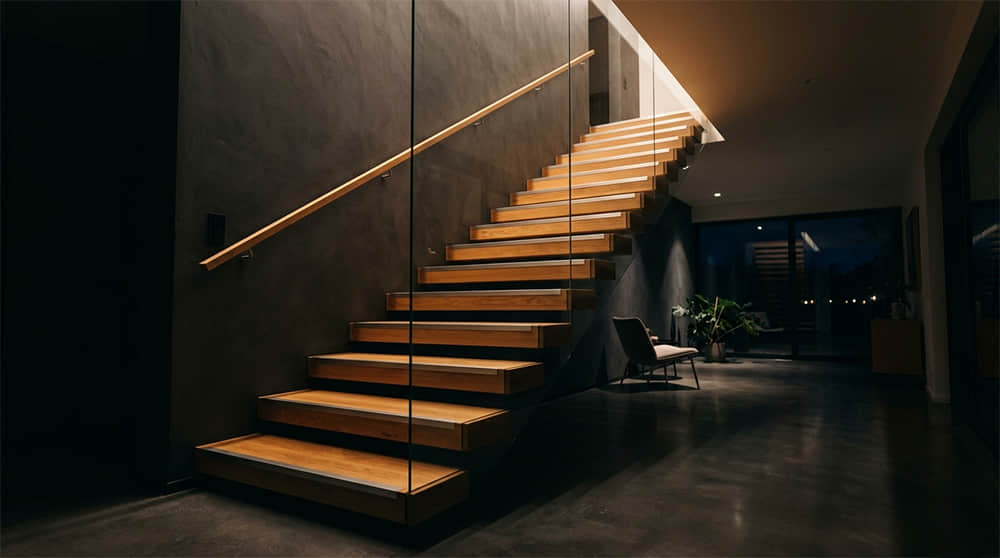
As graphic display panels and interior architectural pathways become more streamlined, LED optics must adapt to extremely short mixing distances. Standard diffusers often produce uneven light pooling or waste luminous flux via multi-directional spilling. The ASEL12D extrusion lens addresses these distinct requirements through two specialized, non-standard beam distributions.
1. Resolving the Close-Range Mixing Dilemma in Shallow Cove Ceiling Lighting
Architectural cove ceiling lighting requires achieving a completely seamless, uniform wash of light across the ceiling gradient, transforming the structural recess into a secondary reflective surface. However, modern interior architecture frequently utilizes shallow cove construction with a mixing depth of less than 30 mm−50 mm30 mm−50 mm from the LED source to the vertical back-wall. In these compact geometric recesses, standard symmetric lenses project concentrated beams that create harsh, localized "hot spots" and jagged shadow lines on the immediate ceiling edge, failing to achieve a smooth ambient gradient.
The ASEL12D series directly resolves this close-range architectural blending constraint by deploying its 145° ultra-wide batwing distribution lens:
-
Flat Batwing Lateral Output: Instead of channeling the luminous intensity vertically upward, the micro-convex surface of the 145∘145∘ lens suppresses the dead-center center-beam candlepower, flattening and pushing the peak output out laterally into a wide batwing profile.
-
Low-Profile Multi-Directional Blending: By projecting the light outward at an elongated 145∘145∘ trajectory, the light cones from closely spaced diodes intersect and merge instantly inside shallow cove tracks, eliminating individual pixelation marks right at the exit boundary.
-
Homogeneous Ceiling Gradient Wash: In combination with the high hiding power of the embedded Altuglas Diffuse 101 scattering polymer, this wide lateral distribution allows the light to transition smoothly across the drywall profile, creating a soft, uninterrupted ambient glow free from distracting thermal banding or aesthetic hot spots.
2. Providing Discrete, Glare-Free Directional Guidance in Staircases
Staircase handrail illumination requires balancing public safety with visual comfort. The luminaire must clearly illuminate individual floor treads and safety nosings to prevent falls, yet it must remain completely invisible to individuals walking up or down the stairs. Because handrails are narrow, curved, or rectangular architectural tubes, the internal installation space is typically under 15 mm15 mm.
The ASEL12D series adapts to these strict physical and optical criteria through its physical format and directional beam design:
-
Flush Structural Embedding: The 12 mm profile width allows the matching aluminum extrusion track to be router-recessed directly into the underside channel of wood, steel, or composite handrail structures.
-
Implementing the Asy 25° Asymmetric Beam: Rather than casting light straight down or scattering it across the walls, the internal micro-prisms of the Asy 25° variant reorient the peak luminous intensity 25∘25∘ forward and downward toward the walking steps.
-
Shielding the Viewer's Eyes: This calculated asymmetric trajectory focuses light exclusively on the path of travel while creating a sharp optical cutoff above the handrail plane. Consequently, pedestrians are guided by a clearly illuminated path, while their direct line of sight remains protected from high-angle glare.
Comprehensive Hardware Configurations, Beam Selection Summary
To deploy the ASEL12D series effectively across diverse spaces, engineers and lighting designers require access to exact hardware compatibility profiles and concise optical selection criteria. Rather than delivering a plastic optical component in isolation, Asahi Optics provides a fully configured hardware ecosystem. This system is designed to accelerate field assembly, ensure structural rigidity, and lock in long-term performance parameters across all commercial and residential project sites.
Integrated Hardware Assemblies and Components
Integrating linear lighting into high-end millwork, commercial refrigerators, or structural metal frames requires exact mechanical fits. Asahi Optics supports the ASEL12D series with three matched hardware components:
-
6063-T5 Slim Aluminum Channels: Extruded to high tolerances, this low-profile track matches the 12 mm optics perfectly, acting as a structural mounting base and an effective heat sink to minimize LED thermal degradation.
-
Heavy-Duty Spring and Surface Mounting Clips: Available in stainless steel and reinforced polymers, these fasteners support both flush-recessed and surface-mount clip-in arrays.
-
Precision Mechanical End-Caps: Supplied with or without wire-entry ports, these components align the lens edge to prevent light leakage at the terminal joints.
Optical Distribution Quick-Reference Selection Guide
To assist specification engineers during project procurement planning, the table below pairs the optical distributions of the ASEL12D series with their target physical layouts:
| Optical Distribution | Primary Profile | Targeted Application | Features |
| 30° / 40° Symmetric | Medium-Narrow Deep Cone | Deep Display Cases, Accent Trims | Focuses center-beam candlepower over longer distances. |
| 60° Symmetric | Medium-Wide Flat Face | Under-Cabinet Tasks, Refrigerator Shelves | Balances high floor lux with uniform horizontal spread. |
| 145° Ultra-Wide | Flat Convex Batwing Layer | Cove Ceiling Lighting | Eliminates hot spots within close-range ($15\text{ mm} - 30\text{ mm}$) cavities. |
| Asy 25° Asymmetric | Left/Right Micro-Prisms | Integrated Staircase Handrails | Throws light down onto walking steps while cutting off high-angle eye glare. |
| Asy 45° Asymmetric | Oblique Tilted Forward | Retail Shelving, Slanted Commercial Displays | Bends peak illumination backward onto product branding, avoiding aisle spill. |
Conclusion: Achieve Seamless Linear Integration with the ASEL12D Series
Miniaturized spaces no longer require compromise between clean design and precise light distribution. The ASEL12D extrusion lens can be used in display cabinets, under-cabinet lighting, freezers, Cove Ceiling Lighting, and staircases to provide uniform, glare-free illumination. By integrating a 12 mm footprint, a flexible six-angle optical matrix, and a complete hardware accessory eco-system, Asahi Optics provides a single-source manufacturing solution for premium commercial and residential lighting projects. Contact us now to get the latest samples.
FAQ
Q1: What base polymer is utilized for the ASEL12D series, and what are its optical characteristics?
A: The series is extruded using specialized Altuglas Diffuse 101 polymethyl methacrylate (PMMA) . This optical compound delivers high hiding power to eliminate individual LED diode pixelation at close proximity, while maintaining a light transmission efficiency exceeding 90%90%.
Q2: Which beam angle is recommended for illuminating products on deep retail shelves?
A: The Asy 45° asymmetric beam is highly recommended. It redirects the peak luminous intensity at an oblique angle onto the product faces, illuminating the merchandise uniformly while shielding the customer's eyes from high-angle glare.
Q3: Does Asahi Optics supply the necessary mounting accessories alongside the linear lenses?
A: Yes. We provide an integrated hardware solution that includes matching 6063-T5 aluminum channels, structural end-caps, and stainless steel or polymer mounting clips tailored to your specific architectural layout.
Q4: What is the standard ordering format and sample availability for testing?
A: We supply the ASEL12D lenses and matching aluminum tracks in standard custom-cut lengths. To support engineering validation and mockup testing, 1-meter evaluation samples can be requested directly through our engineering desk.