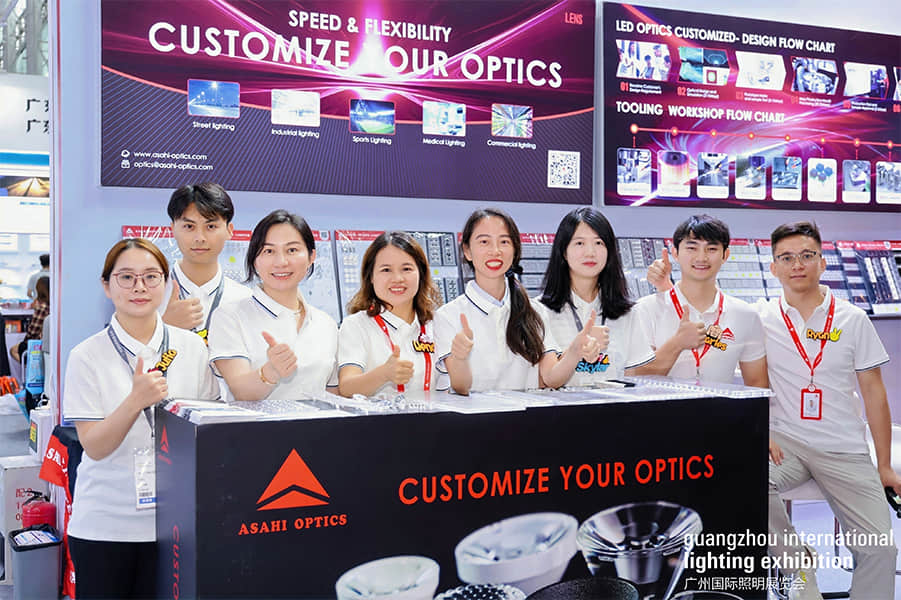
Returning to Frankfurt for the Light + Building 2026 exhibition was a moment of profound reflection and immense pride for the entire Asahi Optics team. Stepping onto the expansive grounds of Messe Frankfurt, surrounded by the world's most innovative minds in architecture and lighting technology, we were immediately struck by the evolving pulse of the global lighting industry. As a premier manufacturer of precision optical lenses, attending this biennial event is never just about showcasing our latest injection and extrusion manufacturing capabilities; it is about taking the temperature of the market, understanding the shifting paradigms of global buyers, and aligning our engineering roadmap with the visionary designs of tomorrow.
This year, the atmosphere in Frankfurt was distinctly different from our previous experiences. It offered a unique lens through which we could analyze the current state and future trajectory of the commercial and architectural lighting sectors.
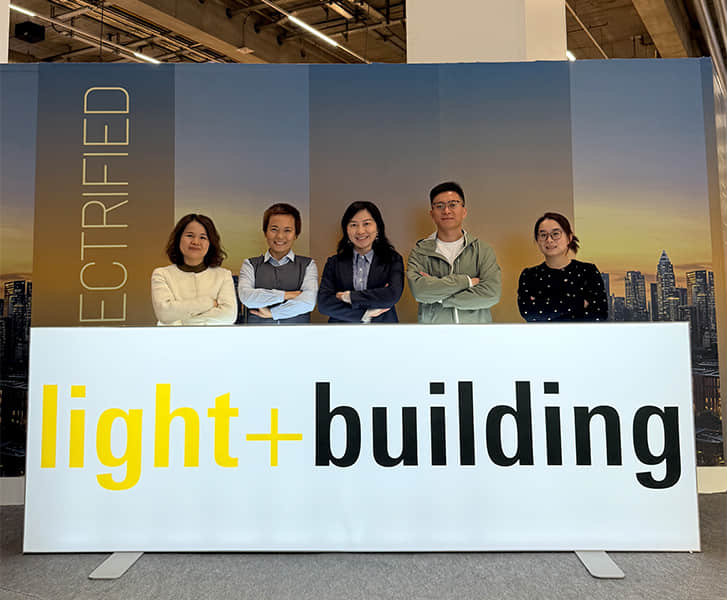
The Shifting Landscape of Light + Building 2026
For those of us who have walked these halls for years, the contrast was immediately apparent. Compared to the bustling, overflowing pavilions of 2024, this year's exhibition saw a noticeable decrease in both the total number of global exhibitors and the overall attendee foot traffic. However, rather than viewing this contraction as a negative indicator for the lighting industry, our team perceived it as a necessary and strategic distillation of the market.
The superficial noise of the industry has settled. The companies and professionals who made the journey to Frankfurt in 2026 were the serious players—the decision-makers, the dedicated optical engineers, and the visionary designers who are genuinely committed to pushing the boundaries of what is possible in illumination. The conversations we had at our booth were no longer just casual inquiries; they were deep, highly technical discussions about unified glare ratings (UGR) , freeform optical distributions, and complex extrusion die tooling. The lower attendance paradoxically resulted in a much higher quality of interaction, allowing for more focused, uninterrupted dialogues with our strategic partners.
Perhaps the most fascinating observation our team made during the event pertained to the marketing strategies of the industry's titans. In previous iterations of Light + Building, the exhibition halls, outdoor plazas, and even the surrounding transit hubs were heavily dominated by towering, aggressive advertising campaigns from the traditional heavyweights of the lighting world. This year, however, we observed a stark contrast: several major, long-established industry players noticeably scaled back or entirely eliminated their massive advertising presence at the event.
This quiet absence of flashy marketing speaks volumes about the current mindset of the lighting sector. It signals a definitive industry-wide pivot from marketing-driven competition to product-driven pragmatism. Today's buyers and Tier-1 lighting manufacturers are no longer swayed merely by large billboards or historical brand legacy. In an era defined by stringent energy efficiency regulations, the demand for sustainable materials, and the need for flawless visual comfort, the product itself must do the talking.
For a company like Asahi Optics, this shift is incredibly validating. We have always believed that true market leadership is not built on loud advertising, but on the micrometer-level precision of a CNC-machined mold core, the seamless continuity of an extruded linear lens, and the uncompromising quality of a perfectly clear optical-grade PC or PMMA component. The 2026 exhibition proved that the global market is increasingly aligning with our philosophy: prioritizing engineering substance, manufacturing reliability, and genuine optical innovation over superficial flash.
The Power of Face-to-Face: Catching Up with Old Friends
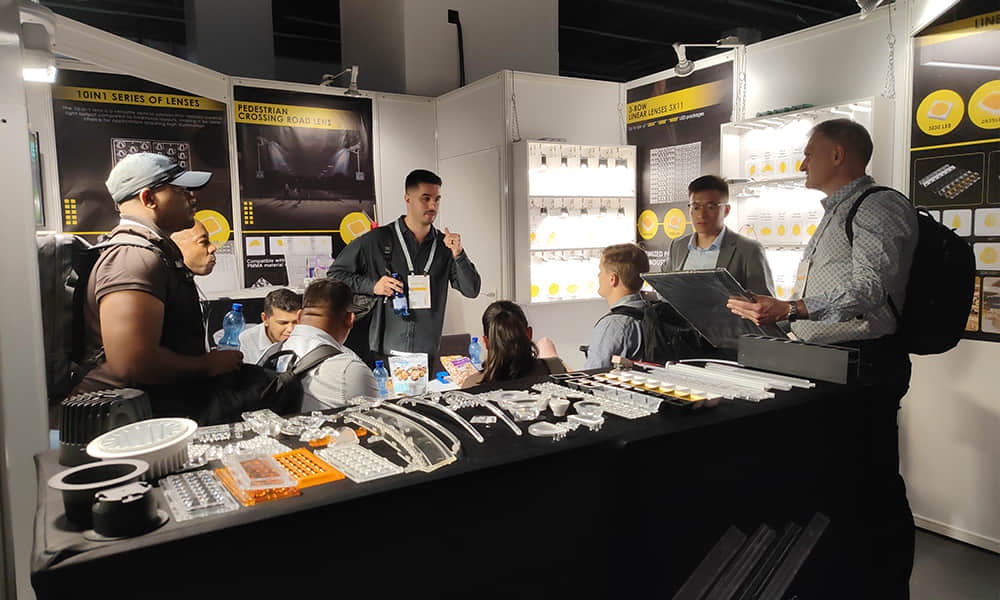
In a highly globalized manufacturing landscape, it is easy to become accustomed to the digital barriers that separate us. For years, particularly following the disruptions of the early 2020s, our primary modes of interaction with global partners have been confined to the dimensions of a computer screen—video conferences, endless email threads, digital CAD file exchanges, and photometric simulation reports. While these digital tools are indispensable for maintaining the speed of modern engineering, they fundamentally lack the human element that builds enduring business partnerships.
This is precisely why our time at Light + Building 2026 was so deeply rewarding. A major highlight of this exhibition for the Asahi Optics team was the invaluable opportunity to finally meet some of our long-time, international clients in person.
After communicating exclusively online for such an extended period, the transition back to face-to-face interaction felt nothing short of wonderful. There was an immediate, palpable sense of familiarity and warmth that washed over the booth every time a recognizable face walked in. It felt less like a formal B2B vendor-buyer meeting and much more like catching up with old friends after a long time apart. We shared stories, laughed about past project hurdles we had overcome together, and discussed the future trajectories of our respective companies.
More importantly, physical proximity changes the nature of optical engineering discussions. You cannot fully appreciate the seamless finish of a customized linear lens or the microscopic precision of a freeform street light optic through a webcam. Sitting across a table, passing physical PC and PMMA prototypes back and forth, holding them up to the light, and tracing the extruded profiles with our own hands allowed for a level of collaborative brainstorming that simply cannot be replicated online. These moments of shared physical validation reinforce trust. They remind our clients that behind every shipping container of optical lenses is a dedicated team of Asahi Optics engineers who genuinely care about the success of their lighting fixtures.
European Design Excellence: Because New is Created
When we weren't hosting partners at our booth, our team took the opportunity to explore the vast exhibition halls, absorbing the latest trends and architectural philosophies. What struck us most profoundly was the breathtaking creativity exhibited by European indoor lighting companies.
The aesthetic beauty and artistry embedded in their product designs are truly unparalleled. In the realm of European indoor commercial and architectural lighting, a luminaire is no longer just a functional device meant to banish darkness; it is a structural masterpiece, a sculptural element that defines the spatial psychology of a room. The exhibition booths themselves were highly innovative, reflecting an obsessive level of thought, care, and dedication to the craft of illumination.
As we navigated through these awe-inspiring displays, we observed a prevailing philosophy—a spirit that was elegantly captured in the marketing materials of one particularly inspiring Austrian design house. It posed a fundamental question to the industry: Where does the new come from?
The answer we absorbed from the exhibition floor resonated deeply with our own engineering ethos. The new does not emerge from complacency. It comes from relentless thinking and rethinking. It comes from pushing the absolute boundaries of your own mind and leaving the ordinary far behind. It demands breaking outdated rules and having the courage to write your own. Innovation requires questioning everything, even your own past successes, and staying hyper-focused on a yet-unknown, ambitious goal.
Because the new doesn't just happen by accident. New is created.
I cannot help but once again praise these European lighting companies for their unwavering dedication to aesthetic beauty and innovation. However, this philosophical realization also highlighted the critical role that Asahi Optics plays in the global supply chain.
A visionary European designer can sketch a breathtaking, continuously curving, ultra-slim linear luminaire that defies conventional geometry. But how does that artistic vision transition from a concept rendering into a physical, mass-produced reality without losing its soul? That is where the new must be created on the manufacturing floor.
To bring these boundary-pushing designs to life, lighting brands require a manufacturing partner capable of matching their design innovation with manufacturing innovation. At Asahi Optics, we internalize this philosophy of creating the new. When an architect demands a linear light with absolutely zero dark spots, we push the boundaries of our extrusion technology to deliver seamless continuity. When a designer requires extreme glare control (UGR) for a high-end office space, we rethink our die-tooling and micro-structure optical designs. We exist to ensure that the spectacular artistry we witnessed in Frankfurt is never compromised by manufacturing limitations. We are the bridge between a designer's imagination and the physical world of precision optics.
Our Core Focus at Frankfurt: Driving Outdoor and Indoor Optical Innovations
While we deeply appreciate the grand architectural concepts presented throughout the exhibition, our primary objective at Light + Building 2026 was highly focused. We came to Frankfurt to present concrete, cutting-edge optical solutions that empower luminaire manufacturers to realize their most ambitious designs. Based on our extensive market research and ongoing dialogue with Tier-1 lighting brands, our exhibition booth this year was strategically anchored around two core areas of optical engineering:
1. Outdoor Customized Streetlight Lenses
The global push for smart city infrastructure and stringent energy conservation has placed unprecedented demands on outdoor street lighting. A modern street luminaire is no longer just a high-wattage bulb; it is a precision optical instrument. At our booth, we showcased our latest advancements in multi-module, freeform streetlight lenses.
Our engineering team engaged in deep technical discussions with municipal lighting contractors and fixture manufacturers regarding complex light distributions (such as Type II, Type III, and Type V patterns). We demonstrated how our meticulously CNC-machined injection molds create street lighting optics that maximize pole spacing, completely eliminate back-light trespass into residential windows, and project incredibly uniform, glare-free illumination onto the asphalt. By combining high-transmission optical-grade materials with ultra-precise surface topographies, our customized outdoor lenses ensure that every single photon generated by the LED is directed exactly where it is needed.
2. Indoor Linear Lighting Lenses
Conversely, the indoor lighting sector is undergoing a massive aesthetic and ergonomic revolution. The sterile, flickering fluorescent troffers of the past have been entirely replaced by sleek, architectural linear lighting systems. Our second major focus was addressing this booming sector.
Throughout the exhibition, we presented our comprehensive portfolio of indoor linear lighting lenses to European and global buyers. We focused heavily on how our optical designs integrate seamlessly with LED light boards and aluminum heat-sink profiles, forming a modular, all-in-one solution that enhances assembly efficiency. However, while our traditional injection-molded linear lenses garnered significant attention, it was our latest technological leap in continuous manufacturing that truly stole the show and became the central talking point for our North American partners.
The Star of the Show: Extrusion Lenses Revolutionizing the US Market
Without a doubt, the absolute highlight of our product showcase this year was our newly launched, and highly sought-after, Extruded Lens (Extrusion Linear Lens) portfolio. While European designers admired the sleek profiles, it was our clients from the United States who immediately recognized the massive disruptive potential of these products for the North American commercial lighting market.
The US market for office spaces, large-scale supermarkets, and expansive retail environments has a voracious appetite for continuous, uninterrupted linear lighting. Traditional injection molding, while incredibly precise, is limited by mold length constraints. Extrusion technology breaks this barrier entirely. By utilizing a highly efficient continuous production process—where optical-grade polymer melt is pushed through a precisely shaped die and cured in a multi-stage vacuum calibration cooling tank—we are able to produce continuous, slender optical components of virtually infinite length.
Among our extensive lineup, the AO 20 Series and the CMB Series emerged as the undisputed stars, perfectly aligning with the aggressive demands of US architectural lighting designers. Here is exactly why these specific extrusion lenses captivated the attention of industry leaders at Light + Building:
1. Seamless Continuity: The Eradication of Dark Zones
The most prominent strength of our extruded linear lenses is their flawless optical continuity. When illuminating a massive open-plan corporate office or a long supermarket aisle in the US, designers want a single, clean line of light. Traditional solutions that rely on assembling multiple short injection-molded lenses end-to-end inevitably create tiny light leaks, visible joints, or subtle dark zones where the lenses meet.
The AO 20 and CMB series seamlessly blend discrete LED point sources into a continuous, perfectly soft band of illumination. Because the lens is extruded as a single, uninterrupted profile, it offers a visually pristine aesthetic that is free of any granular appearance. This continuous extrusion can run along entire ceilings and even navigate custom-curved corners without breaking the visual tension of the light line.
2. Excellent Glare Control (UGR) for Visual Comfort
As commercial spaces become more human-centric, strict regulations regarding the Unified Glare Rating (UGR) are becoming the norm, especially in the US commercial real estate market. An ultra-bright LED array running the length of an office can cause severe eye strain if not properly controlled.
Our engineering team has meticulously designed the cross-sectional optical surfaces of the AO 20 and CMB extrusion dies to combat this exact issue. Through advanced micro-structure engineering embedded directly into the extrusion profile, these lenses significantly reduce the direct brightness of the LED while simultaneously expanding the effective light-emitting area. The result is a dramatic lowering of the UGR, achieving the exceptional visual comfort required for modern workplaces, hospitals, and educational institutions, all without sacrificing overall luminaire efficiency.
Conclusion: Moving Forward Together in the Era of Precision Optics
As the doors closed on Light + Building 2026, our team left Frankfurt not just with a collection of business cards and architectural brochures, but with a profound sense of clarity about the future of the global lighting industry. The landscape is undoubtedly shifting. The era of superficial marketing is fading, replaced by a hyper-focus on authentic product performance, visual comfort, and breathtaking design execution.
While the overall number of exhibitors may have decreased this year, the concentration of genuine innovation has never been higher. The remarkable creativity we witnessed from European designers—the philosophy that new is created through relentless boundary-pushing—serves as a constant inspiration. It reminds us why we do what we do.
For the Asahi Optics team, this exhibition reaffirmed our core mission. Whether it is a perfectly engineered freeform streetlight lens that keeps our cities safe, or a continuous, glare-free extruded linear lens (like our highly acclaimed AO 20 and CMB series) that redefines a North American corporate headquarters, the foundation of great lighting is always precision optics.
But delivering precision optics requires more than just high-quality polymer materials; it demands a comprehensive, uncompromising manufacturing ecosystem. As we move forward from Frankfurt 2026, we want to remind our partners worldwide that Asahi Optics is not merely a component supplier; we are your end-to-end optical engineering partner. From the initial optical and structural design phase, through the meticulous CNC machining of custom extrusion dies, to automated assembly, rigorous photometric testing, and global logistics shipping, we are equipped to bring your most complex lighting visions to life.
We want to extend our deepest gratitude to every client, partner, and new friend who took the time to visit our booth, shake our hands, and share their ideas with us in Frankfurt. The face-to-face connections we rekindled this year are the true lifeblood of our industry.
The future of illumination is bright, continuous, and meticulously designed. Let's create the new together.