In linear LED lighting, a clean and continuous light line is often more important than simply increasing brightness. A fixture may have enough lumen output, but if users can see LED dots, dark zones, harsh brightness, or uneven light bands, the final lighting effect will still feel low-quality.
This is where an extrusion lens becomes important. Unlike a simple cover that only protects the LED strip or softens the light, an extruded linear lens can help control how light leaves the fixture. Through its cross-sectional optical profile, it can redistribute light, improve optical uniformity, reduce visible LED points, and support better glare control in linear lighting applications.
For offices, supermarkets, schools, hospitals, retail stores, architectural lighting, and commercial spaces, the quality of linear light directly affects visual comfort and product appearance. A well-designed LED linear lens can help create a smoother, more continuous light band while maintaining useful light output.
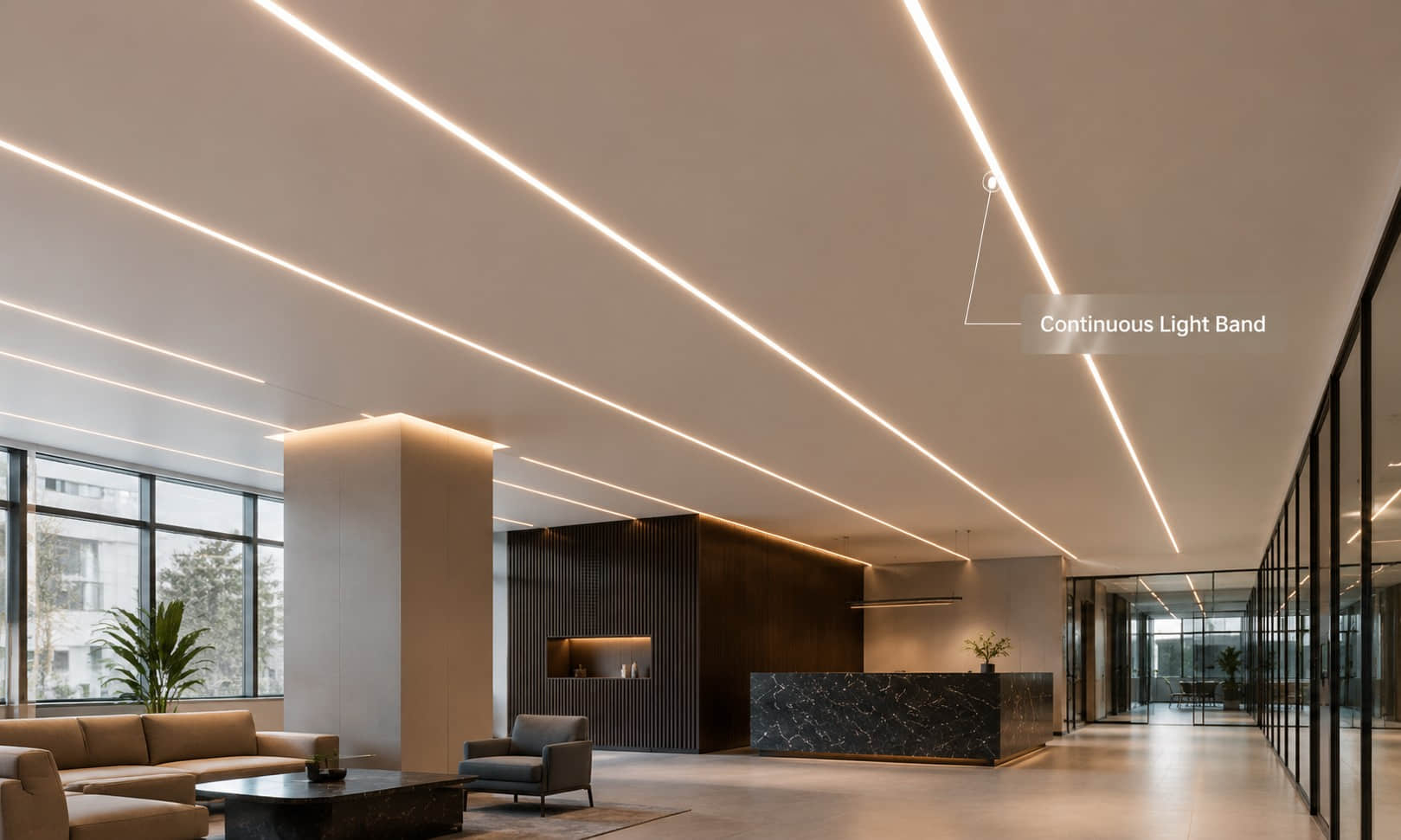
Why Optical Uniformity Matters in Linear LED Lighting
LED Point Sources Can Create Visible Dots
Most linear LED fixtures use rows of small LED packages mounted on a PCB. Although the fixture appears as a long lighting product from the outside, the actual light source is made of many separate points. When the distance between the LED and the cover is not enough, or when the cover does not distribute light properly, these points can become visible.
This is commonly seen as LED dots, bright spots, or a dotted light line. For high-quality linear LED lighting, visible LED points are usually not acceptable. Customers often expect a smooth and continuous line of light, especially in office lighting, retail lighting, architectural lighting, and decorative linear fixtures.
An extrusion lens helps solve this problem by controlling how the light from each LED mixes before leaving the fixture. Instead of letting each LED point shine directly through the cover, the lens profile can spread and blend the light more effectively. This makes the final light output look smoother and more continuous.
Dark Zones Affect the Quality of Linear Light
Visible dots are not the only problem. Dark zones between LEDs can also affect the quality of a linear lighting product. These dark areas usually appear when the LED spacing is too large, the fixture depth is too shallow, or the optical cover does not provide enough light blending.
A properly designed extruded linear lens can improve this by redistributing light across the length and width of the fixture. It can help balance the stronger light directly above the LED and the weaker light between LEDs. This is especially useful when the fixture needs to remain slim while still producing a continuous light appearance.
Uniform Light Improves Visual Comfort and Product Appearance
Uniform light is closely related to visual comfort. When a linear fixture produces a smooth light band, the eye does not need to adjust between bright and dark points. This makes the lighting feel softer, cleaner, and more comfortable.
In office lighting, uniformity helps reduce visual fatigue. In retail lighting, it helps products appear more naturally. In schools and healthcare environments, it supports a more pleasant lighting experience for long periods of use. In architectural applications, a continuous light band can become part of the design language of the space.
For these reasons, optical uniformity is one of the most important goals in LED linear lens design. It is not only about hiding LEDs. It is about creating a controlled lighting effect that looks stable, professional, and suitable for the environment.
What an Extrusion Lens Does Differently from a Simple Diffuser
Diffusers Mainly Scatter Light
A diffuser is commonly used in LED linear lighting to soften light and reduce direct visibility of LED points. It usually works by scattering light in many directions. This can make the output appear softer and help reduce harsh bright spots.
However, scattering light is not the same as controlling light. A simple diffuser may reduce the visibility of LED dots, but it does not always deliver a precise beam shape or efficient light distribution. In some cases, the diffuser hides the LED points by making the material more milky or opaque, which may also reduce light transmission.
For basic decorative lighting, a diffuser may be enough. But for professional linear LED lighting, especially where efficiency, beam control, glare reduction, and uniform light output are important, a diffuser may have limitations.
Extrusion Lenses Control and Redistribute Light
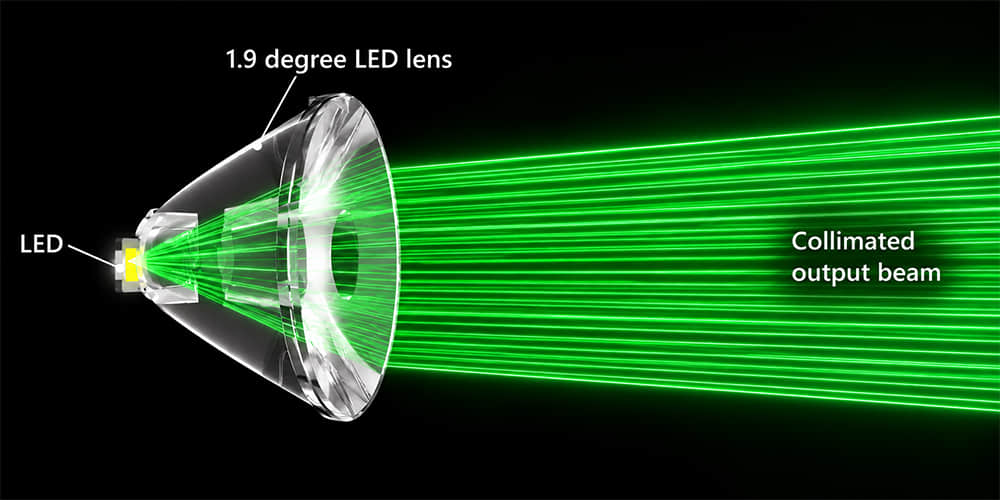
An extrusion lens is designed not only to scatter light, but also to guide and redistribute it. The optical profile of the lens can influence beam angle, light spread, brightness distribution, and the final visual appearance of the linear fixture.
The key difference is the cross-sectional lens design. Because extrusion produces a continuous profile along the length of the product, the lens shape can be designed to control light across the width of the fixture. This makes it suitable for long, continuous lighting applications such as linear lights, cabinet lights, office lights, wall washers, architectural lines, and commercial lighting systems.
Compared with a simple diffuser, an extruded linear lens can provide a more controlled optical result. It can help create a continuous light band, improve beam consistency, reduce dark zones, and support better visual comfort.
Why Lens Profile Design Matters
The most important part of an extrusion lens is its profile design. In extrusion manufacturing, the material passes through a die to form a continuous cross-sectional shape. This cross-section determines how the lens interacts with the LED light.
A small change in the lens profile can change the final light distribution. The height, curvature, surface texture, inner structure, and thickness of the lens can all affect uniformity, transmission, beam angle, and glare. This is why extruded lens optical design needs to be connected with the actual LED source and fixture structure.
A standard profile may work for common applications, but it may not be suitable for every fixture. The same lens may perform differently depending on LED spacing, PCB width, fixture depth, aluminum profile, installation method, and target beam angle.
How Extrusion Lenses Improve Optical Uniformity
Blending Discrete LEDs into a Continuous Light Band
One of the main goals of an extrusion lens is to turn separate LED points into a more continuous light band. In a linear fixture, each LED emits light from a small area. If the optical system does not mix this light properly, the viewer may see individual bright points instead of a smooth line.
An extruded linear lens improves this by reshaping how light exits the fixture. The lens profile can spread the light from each LED sideways and forward, allowing the beams from neighboring LEDs to overlap more smoothly. When this overlap is well controlled, the visible light band becomes more uniform.
This is especially important for slim linear fixtures. Many modern LED linear lights are designed with narrow housings and shallow optical cavities. This creates a challenge: there is less distance between the LED and the lens, so the light has less room to mix naturally. In this situation, the lens profile becomes even more important.
Balancing Light Between LED Spacing
LED spacing has a direct effect on uniformity. When LEDs are placed close together, it is easier to create a smooth light line. When the spacing becomes larger, the risk of visible dots and dark zones increases. However, reducing LED spacing is not always the best or most cost-effective solution.
An extrusion lens can improve this balance by redirecting light from stronger zones to weaker zones. The lens profile can be designed so that light does not simply pass straight through from each LED. Instead, part of the light is spread across the space between LEDs, helping reduce contrast along the length of the fixture.
This does not mean any extrusion lens can remove LED dots in every structure. The final result still depends on LED spacing, lens distance, material transmission, surface finish, and fixture depth. But compared with a basic cover, an optical extrusion lens gives designers more control.
Matching Lens Depth, PCB Width, and Aluminum Profile
Optical uniformity is not decided by the lens alone. The full fixture structure also matters. Lens depth, PCB width, LED position, and aluminum profile shape all influence the final light output.
If the lens is too close to the LEDs, dots may still be visible. If the optical cavity is too shallow, light may not have enough space to mix. If the PCB is too wide or the LEDs are placed too close to the lens edges, the beam may become uneven across the width of the fixture.
A suitable extrusion linear lens should match the fixture structure. The LED type, LED spacing, PCB width, aluminum profile drawing, target beam angle, and uniformity requirement all help define the lens design.
How Extrusion Lenses Help Control Glare and UGR
Why Glare Happens in Linear LED Fixtures
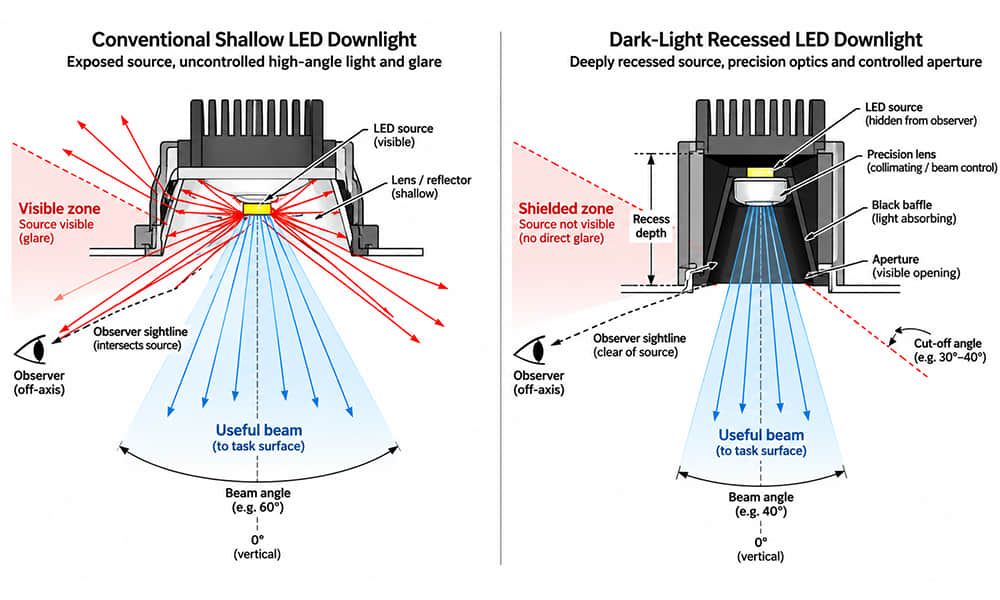
Glare happens when the eye receives too much brightness from a specific direction or small visible area. In linear LED fixtures, glare often comes from visible LED points, high luminance on the lens surface, or a beam that spreads too strongly into uncomfortable viewing angles.
This problem is common in offices, classrooms, healthcare spaces, supermarkets, and commercial interiors. A fixture with moderate lumen output can still feel uncomfortable if the light is concentrated in small bright areas. This is why visible LED dots are not only an appearance problem; they can also increase glare.
An extrusion lens can help by controlling both the shape and direction of the light. Instead of allowing light to spread randomly, the lens profile can guide light toward useful areas while reducing excessive brightness in less comfortable directions.
Optical Surfaces Reduce Direct Brightness
A key part of glare control is managing direct brightness. In linear lighting, the optical surface can help enlarge the apparent light-emitting area, reduce the intensity of individual LED points, and distribute brightness more evenly across the lens.
An extruded linear lens can use curvature, diffusion, microstructure, or a combination of optical features to soften direct light. When the lens spreads LED output more evenly, the viewer sees a smoother luminous surface instead of sharp bright points.
This does not mean the lens should simply block light. A good optical design should reduce harsh brightness while keeping useful output. The better solution is to redistribute light more intelligently. For lighting quality and visual comfort references, the CIE and the Illuminating Engineering Society are widely recognized lighting organizations.
UGR Control in Offices, Schools, and Healthcare Lighting
UGR, or Unified Glare Rating, is often used to evaluate discomfort glare in indoor lighting environments. For offices, schools, hospitals, and other spaces where people stay for long periods, glare control can be a key design requirement.
An extrusion lens can help support UGR control by reducing visible LED points, spreading brightness more evenly, and controlling the beam angle. However, the lens alone does not determine the final UGR value. UGR depends on the entire luminaire, installation layout, room size, surface reflectance, viewing position, and lighting arrangement.
For this reason, it is not accurate to claim that one lens automatically guarantees a specific UGR rating in every fixture. A lens can support lower glare, but the final result should be confirmed through luminaire testing or lighting simulation.
Key Design Factors for an Extruded Linear Lens
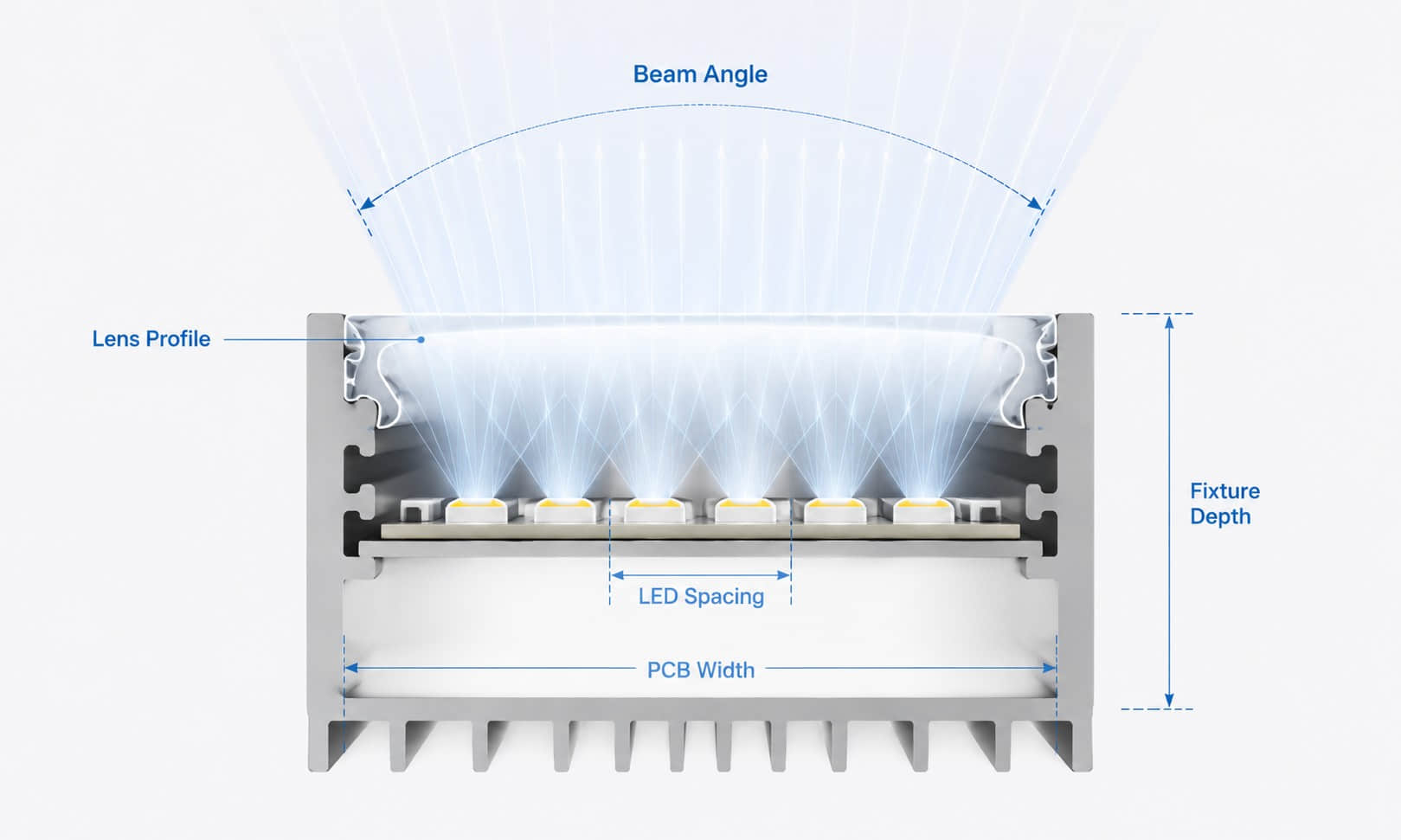
Lens Cross-Sectional Profile
The cross-sectional profile is the core of an extruded linear lens. In extrusion production, the lens is formed as a continuous profile, so the cross-section determines how the light is shaped along the full length of the product.
A small change in the profile can affect beam angle, light transmission, uniformity, glare, and visible appearance. A higher lens profile may provide more space for light mixing. A wider profile may support broader light distribution. A micro-structured or frosted surface may help soften direct brightness. A clear optical surface may provide higher transmission and more precise light control.
LED Type and PCB Layout
The LED package and PCB layout directly influence lens performance. LED type, LED spacing, single-row or multi-row layout, PCB width, and LED position all affect how light enters the lens.
If the LED spacing is large, the lens needs better light mixing ability. If the PCB is wide, the lens may need to control light across a broader area. If the LED is not aligned with the optical center, the beam may become uneven or shifted.
Luminaire Structure and Installation Method
The aluminum profile, fixture depth, cover opening, installation method, and viewing angle also affect the final optical result. Suspended linear lights, recessed linear lights, surface-mounted profiles, cabinet lights, and architectural light lines may all require different lens structures.
For example, a recessed fixture may need stronger glare control from side views, while a suspended fixture may need a broader and more comfortable distribution. A shallow profile may require a lens with stronger mixing ability, while a deeper profile may allow smoother light blending.
Before production, customers can also review related material specifications and certifications to confirm whether the selected lens material and documents meet project requirements.
Common Applications That Need Uniform and Low-Glare Linear Light
Office and Conference Room Lighting
Office and conference room lighting often require visual comfort for long working hours. A smooth light band, reduced LED dots, and controlled glare can make the space feel more comfortable and professional.
For many indoor lighting applications, extrusion lenses can help linear fixtures achieve cleaner light output and better visual comfort.
Retail and Supermarket Lighting
Retail and supermarket lighting need clean visual presentation. Uneven light bands or visible LED dots can make fixtures look less professional and may affect the appearance of displayed products.
School and Healthcare Lighting
Schools and healthcare spaces need lighting that supports comfort and long-term use. Harsh glare or uneven light can affect the user experience, especially in classrooms, corridors, clinics, and patient areas.
Architectural and Curved Linear Lighting
Architectural lighting often focuses on clean lines, continuous illumination, and visual integration with the space. In some projects, the lens may also need to match curved profiles or special installation structures.
When Should You Choose a Custom Extrusion Lens?
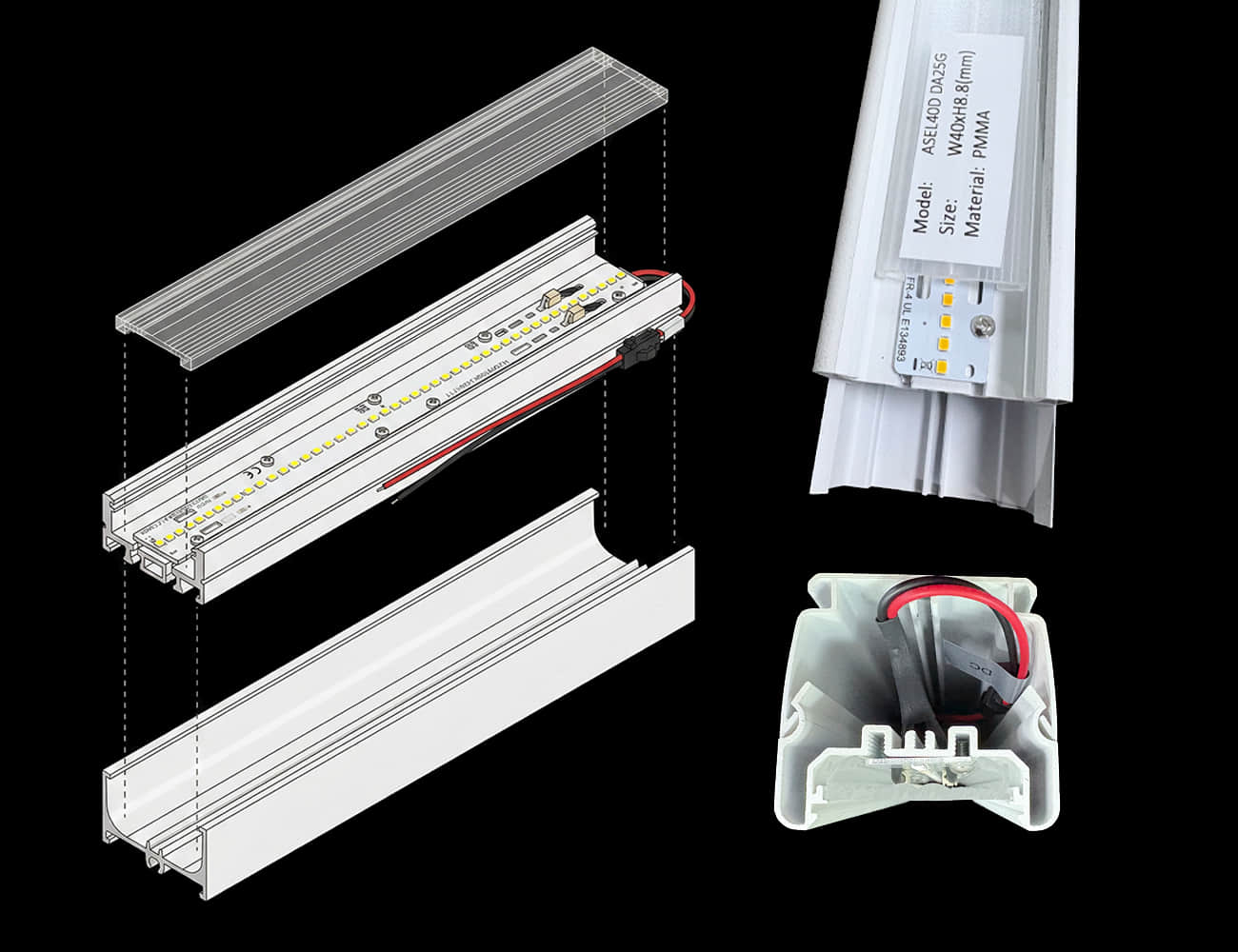
Standard Lens Profiles Cannot Fit Every Fixture
Standard extrusion lens profiles are useful for many common LED linear lights, but they cannot fit every product. Fixture depth, LED spacing, PCB width, housing shape, installation method, and target beam angle can vary from project to project.
If a standard profile creates visible dots, dark zones, high glare, poor fit, or unsuitable beam distribution, it may be time to consider a custom extrusion lens.
Custom Optical Design Improves Light Distribution
A customized lens profile can be designed around the actual fixture and target lighting effect. This can help improve optical uniformity, reduce glare, control beam angle, and create a more suitable continuous light band.
Custom design is especially useful when the project has special requirements for UGR control, high transmission, curved lighting, shallow profiles, or unique aluminum housings. If a standard profile is not enough, Asahi Optics can support custom optical lens development based on your fixture structure and lighting target.
From Prototype to Mass Production
For a new custom LED linear lens, prototype testing is important. Samples can help confirm fit, appearance, light distribution, uniformity, and glare performance before mass production.
Once the profile is confirmed, stable extrusion production helps ensure consistent length, shape, surface quality, and optical performance. This makes the lens more reliable for repeated production and commercial lighting projects.
Conclusion
An extrusion lens is more than a long plastic cover for LED linear lighting. It is an optical component that can help solve important problems such as visible LED dots, dark zones, uneven light bands, glare, and poor beam control.
For modern linear LED lighting, users expect a smooth, continuous, and comfortable light effect. This is especially important in offices, schools, healthcare spaces, retail stores, supermarkets, architectural lighting, and commercial interiors. A well-designed extruded linear lens can help improve optical uniformity while supporting better glare control and visual comfort.
The final performance depends on more than the lens material alone. Lens profile, LED spacing, PCB layout, fixture depth, aluminum housing, installation method, and target beam angle all need to work together. This is why custom extrusion lens design can be valuable when standard covers or standard profiles cannot meet project requirements.
If your linear lighting project needs better uniformity, lower glare, a more continuous light band, or a profile designed around your fixture structure, Asahi Optics can support custom LED linear lens development for extrusion lens applications.
FAQ About Extrusion Lens Uniformity and Glare Control
Q: What is the main purpose of an extrusion lens?
A: An extrusion lens controls and redistributes LED light to improve uniformity, beam shape, and visual comfort in linear lighting.
Q: Is an extrusion lens better than a diffuser?
A: If the fixture needs precise light control, better uniformity, or a specific beam pattern, an extrusion lens is usually more suitable than a simple diffuser.
Q: Can extrusion lenses reduce LED dots?
A: Yes, a well-designed extruded linear lens can help reduce visible LED dots by blending light from separate LED sources.
Q: Can extrusion lenses help with UGR control?
A: Yes, extrusion lenses can support glare reduction, but the final UGR result depends on the complete luminaire and installation environment.