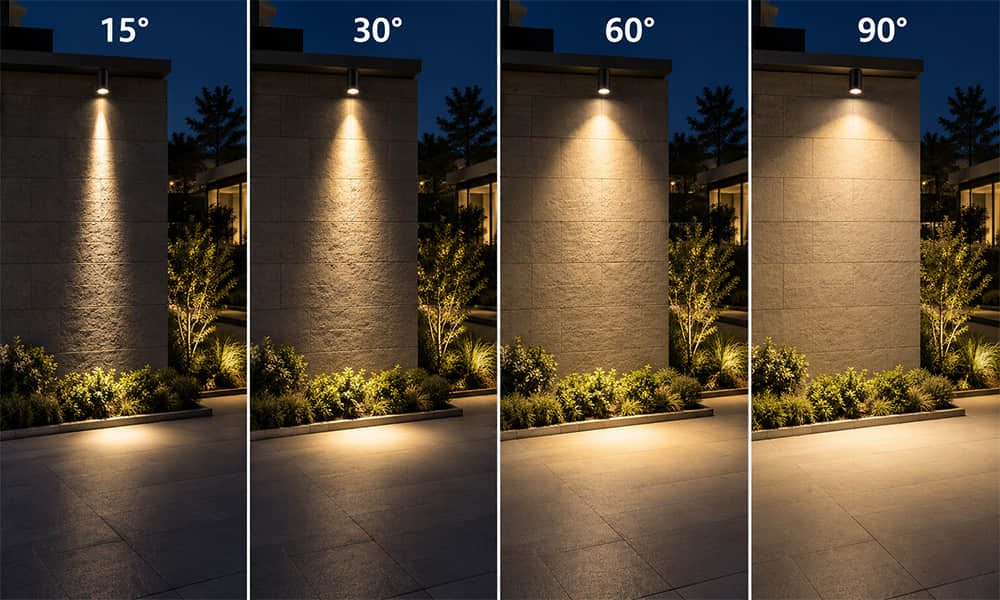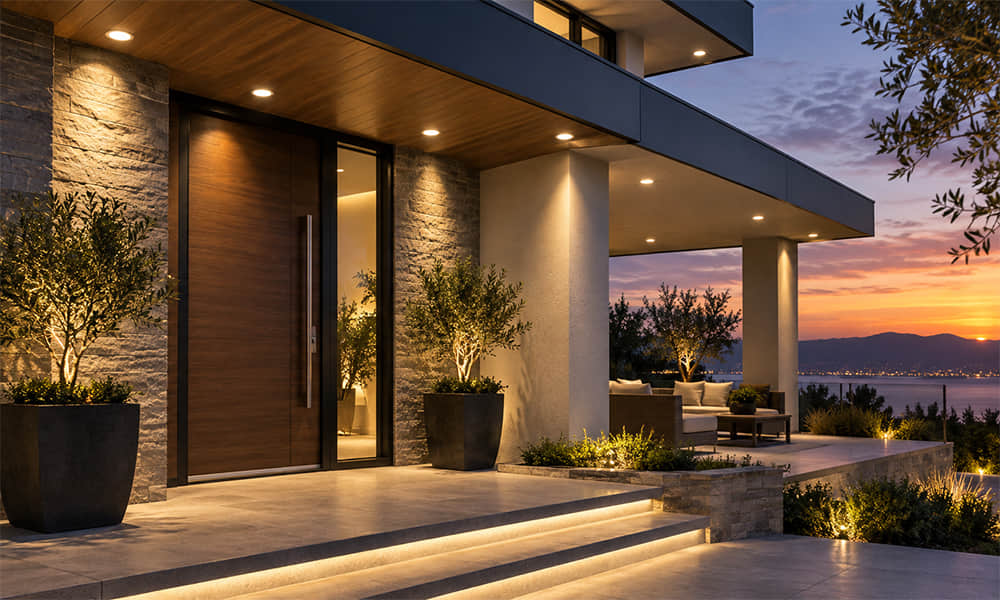
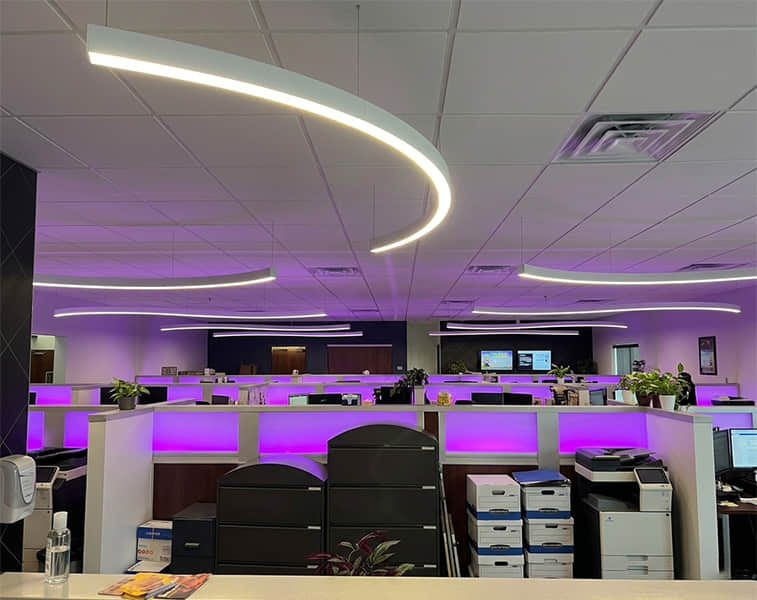
When designing indoor lighting fixtures for the North American market—specifically the United States and Canada—manufacturers must navigate a unique set of regional preferences and strict industry standards. Unlike markets where the primary goal might simply be achieving the highest raw lumen output per dollar, North American buyers prioritize visual comfort, stringent glare control, and rigorous safety certifications.
In commercial offices, educational facilities, and healthcare environments across North America, harsh, glaring light or visible LED hotspots are unacceptable. Building certifications like the WELL Building Standard and LEED place a heavy emphasis on human-centric lighting and occupant well-being. Furthermore, strict regional safety protocols, such as UL certifications, dictate exactly what materials can be safely installed in ceiling plenums and public spaces.
Because of these demanding requirements, the diffuser has become the most critical component of indoor linear lights, troffers, and architectural lighting systems.
In this market, a diffuser is no longer just a basic piece of translucent white plastic used to hide internal wiring. Today, the specific material formulations (like fire-rated Polycarbonate) and the highly engineered textures or micro-structures applied to the surface determine a fixture's success. These surface textures are responsible for shaping the light, completely hiding the LED diodes, and ensuring the luminaire meets strict UGR (Unified Glare Rating) limits.
Understanding the different materials, textures, and optical profiles is essential for any manufacturer looking to penetrate or expand within the North American indoor lighting sector.
The Core Functions of Diffuser Textures and Micro-structures
While the choice of raw material ensures safety and durability, the physical texture applied to the surface of a diffuser—whether extruded, embossed, or injection-molded—is what dictates the luminaire's optical performance. In professional indoor lighting, these surface textures are highly engineered to perform three critical functions.
Eliminating LED Hotspots
As modern LED chips become increasingly powerful, the intensity of individual diodes presents a challenge. If these bare diodes are visible through the fixture cover, they create harsh, distracting points of light commonly referred to as hotspots or pixelation. A well-designed frosted or textured diffuser scatters the light rays as they pass through the material. This blends the individual beams together, transforming intense point sources into a completely uniform, seamless luminous surface. For architectural linear lighting and flat panel troffers, this visual uniformity is a non-negotiable baseline requirement.
Glare Control and UGR Reduction
In North American commercial spaces, controlling glare is arguably the most important optical metric. High-angle light that enters the human eye directly causes severe visual fatigue and discomfort, negatively impacting productivity in offices and classrooms. Specialized surface textures, particularly micro-prisms, act as thousands of microscopic lenses. They are designed to suppress high-angle light (typically above 65 degrees) and refract those rays downward toward the actual work plane. This sophisticated light management is exactly how manufacturers achieve low Unified Glare Ratings (UGR < 19 or even < 16), ensuring compliance with modern workplace ergonomics.
Light Redirection and Optical Efficiency
Modern diffusers are not just passive covers designed to soften light; they are active optical components. By altering the surface geometry or combining textures with specific extrusion profiles, these lenses can physically redirect the light distribution. Instead of a standard Lambertian (wide and symmetrical) spread, engineered textures can steer the light precisely where it is needed. They can push light toward a wall, split the beam down two sides of a retail aisle, or direct it upward to bounce off the ceiling. This improves the overall Light Output Ratio (LOR) of the fixture, meaning less energy is wasted illuminating unwanted areas.
Decoding the Optics and Textures for Indoor Luminaires
To effectively serve the North American market, manufacturers must understand that different applications require entirely different optical strategies. We can categorize these essential diffusers, lenses, and accessories into four distinct groups based on their primary function: foundation materials, glare control, light distribution, and physical shielding.
Foundation Materials and Basic Diffusion
-
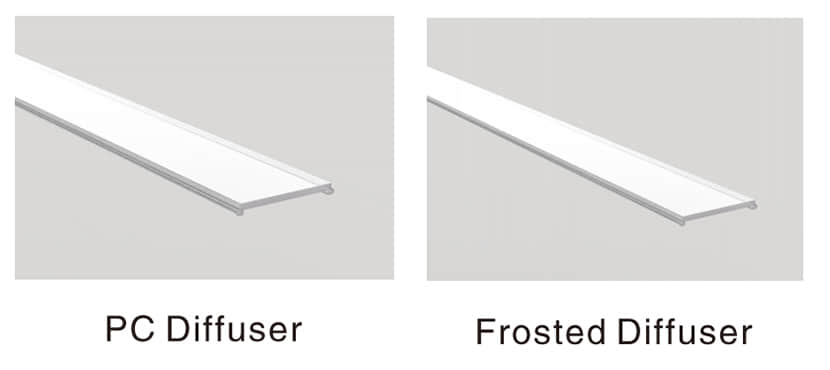
Frosted Diffuser (PMMA) : This is the industry standard for general ambient lighting. A frosted surface treatment provides a dense, cloudy texture that perfectly obscures the LED board, delivering a smooth, uniform Lambertian (wide and even) light distribution. It is the go-to choice for standard linear pendants, recessed troffers, and utility lighting where extreme glare control is not strictly required.
-
PC Diffuser (Polycarbonate) : In the US and Canada, the material itself is just as important as the light it produces. Polycarbonate is widely preferred over Acrylic (PMMA) or Polystyrene (PS) for indoor commercial fixtures because it easily meets the rigorous UL94 V-0 flame retardance standards required by building codes. Furthermore, its superior impact resistance ensures it will not crack or shatter during shipping or installation. The price is also cheaper.
Premium Glare Control (The North American Standard)
-
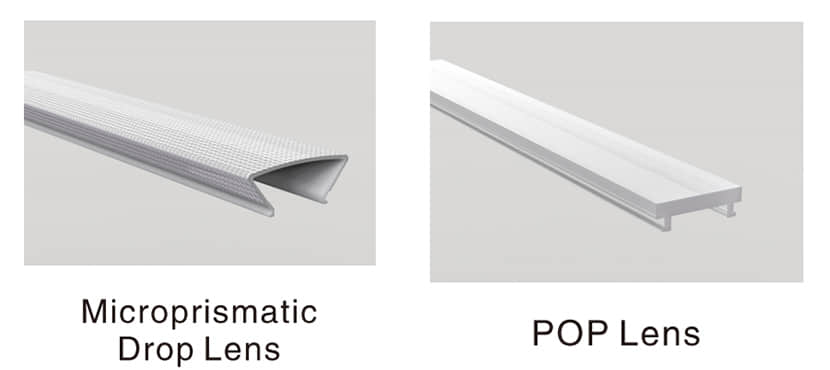
Microprismatic Lens: For high-end office, healthcare, and educational lighting in North America, microprismatic diffusers are practically mandatory. The surface of this lens is engineered with thousands of microscopic geometric structures (often pyramids or hexagons). These micro-structures act as precise optical prisms, bending useful light downward to the desk while aggressively cutting off the high-angle light that causes glare. This is the primary technology manufacturers use to achieve a Unified Glare Rating (UGR) of less than 19.
Precision Light Distribution
When a fixture needs to perform a specific task rather than just illuminating a general area, standard diffusers are replaced by extruded lenses designed to shape the beam.
-
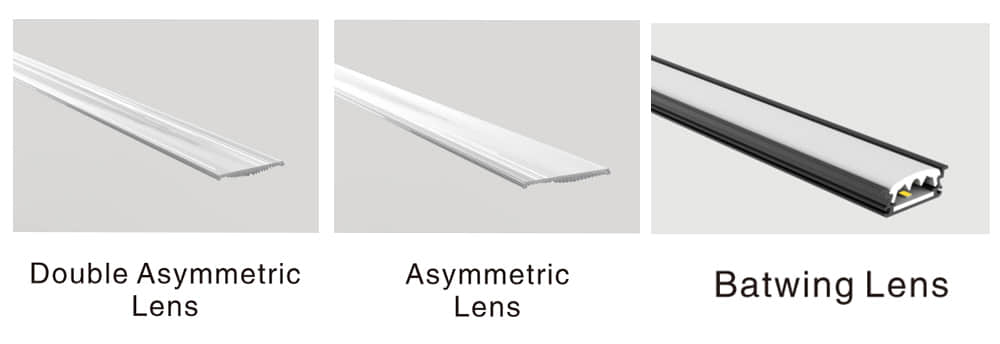
Asymmetric Lens: This lens design pushes the light distribution heavily to one side. It is essential for wall washing, illuminating blackboards in classrooms, or perimeter lighting where fixtures are installed close to the edge of a room and need to throw light toward the center.
-
Double Asymmetric Lens: Often referred to as an aisle or retail lens, this optic splits the light beam into two opposite directions, creating a distinct V shape. In North American supermarkets and warehouses, this is used to efficiently illuminate vertical shelving on both sides of an aisle without wasting energy lighting the floor.
-
Optics-Indirect Lighting (Batwing Lens) : Suspended linear fixtures often utilize uplighting to bounce light off the ceiling, creating a soft, shadow-free environment. A batwing lens is placed on the top of the fixture to spread the light outward at wide angles, preventing a bright hotspot directly above the fixture and ensuring even ceiling illumination.
Volumetric Aesthetics
Modern architectural designs often seek to move away from completely flat, recessed lighting in favor of fixtures that add a sense of volume to the space.
-
Drop Lens & POP Lens: Instead of sitting flush with the aluminum housing, these diffusers physically protrude downward. A Drop Lens typically hangs slightly below the fixture, while a POP lens might feature a more distinct, boxy, or rounded geometric extrusion. These designs allow light to exit from the sides as well as the bottom, offering a wider distribution (up to 270 degrees) and creating a pleasant, three-dimensional luminous glow that illuminates the upper walls and adjacent ceilings.
Physical Glare Shields
-
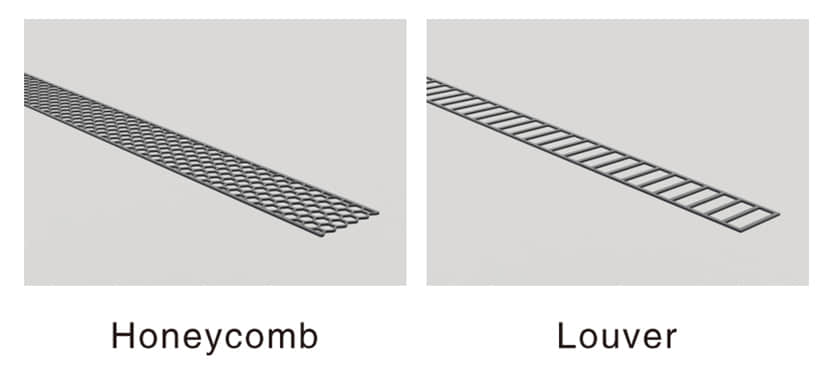
Honeycomb & Louver: In specific applications—such as high-end retail, galleries, or spaces utilizing a dark ceiling design—even a microprismatic lens might emit too much surface brightness. In these cases, manufacturers integrate physical barriers. A honeycomb mesh or a baffled louver is installed directly below the optic. These structures physically block a person's line of sight to the light source unless they are standing directly underneath it, resulting in an exceptionally quiet, glare-free ceiling.
Target Markets and Applications for Engineered Optics
Understanding the technical specifications of these diffusers and lenses is only half the equation. For lighting manufacturers, the real value lies in knowing exactly which optical combination to pitch for specific commercial projects in North America. By aligning the right surface texture and light distribution with the end user's needs, you can significantly increase the success rate of your product lines.
Commercial Offices and Workplaces
In modern open-plan offices, employees spend hours looking at backlit computer screens. The primary concern for lighting designers here is eliminating screen glare and reducing visual fatigue.
-
The Solution: This market relies heavily on Microprismatic diffusers. By integrating a microprismatic lens into linear pendants, manufacturers can guarantee a UGR of less than 19, meeting the strict requirements of ergonomic workplace standards.
Education and Healthcare Facilities
Schools and hospitals require environments that are bright, alert, and safe, but without the harshness that can induce stress. Safety and cleanliness are also paramount.
-
The Solution: PC Diffusers are essential here to meet strict fire and impact safety codes. For classrooms, a combination of Frosted Diffusers for general ambient light and Asymmetric Lenses directed at whiteboards provides a balanced learning environment. In healthcare corridors and patient rooms, indirect lighting using top-mounted Batwing Lenses bounces light off the ceiling, providing a soft, shadowless glow that is comfortable for patients lying on their backs.
Retail and Supermarket Lighting
In the retail sector, lighting is a sales tool. The goal is to draw the shopper's eye to the merchandise, not to illuminate the empty floor space in the center of the aisle.
-
The Solution: Extruded Double Asymmetric Lenses are the standard for grocery aisles and warehouse racks, pushing the lumens directly onto the vertical shelving. For perimeter displays or wall-mounted signage, a single Asymmetric Lens ensures the light is thrown exactly where the products are displayed, maximizing energy efficiency and visual impact.
Conclusion
Entering or expanding within the North American indoor lighting market requires more than just assembling standard components; it demands a deep understanding of optical engineering, material compliance, and regional lighting standards. The diffuser is the face of your fixture—it dictates the visual comfort, the light distribution, and ultimately, the perceived quality of your product.
Whether your next project requires the strict glare control of a Microprismatic lens, the targeted distribution of an Asymmetric extrusion, or the UL-compliant safety of a standard PC Diffuser, choosing the right optical partner is critical. By outfitting your luminaires with tailored textures and precise micro-structures, you can confidently deliver lighting solutions that meet the highest standards of the North American market.