
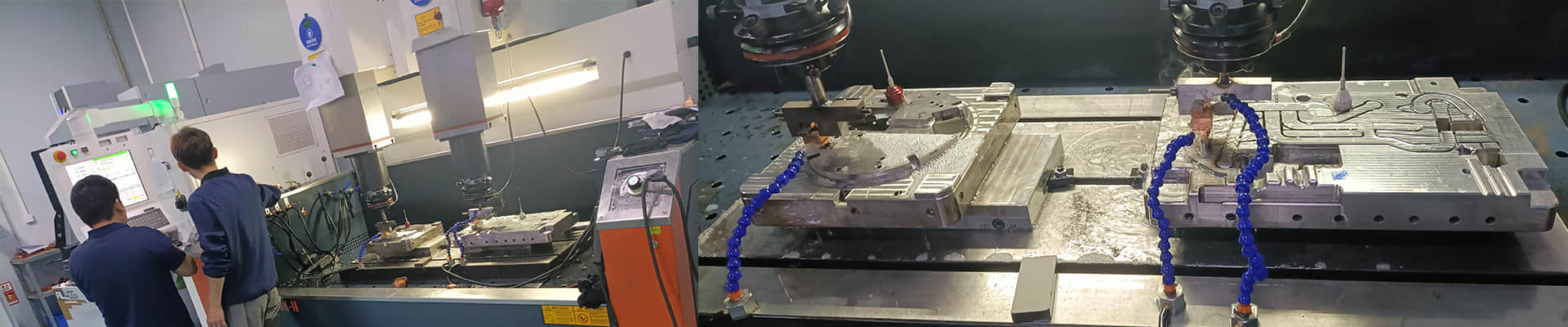
Initially uses wire EDM to complete the mold's basic contours and through-hole processing, laying the foundation for subsequent precision machining.
Performs 3D precision machining based on the wire EDM foundation, achieving precise forming of complex optical surfaces.
Wire EDM enables rapid prototyping while EDM machining delivers precision processing, fully leveraging their respective advantages.
Combines foundational accuracy with fine precision to achieve ultra-precision machining.
Seamless integration of both technologies ensures continuity throughout the machining process.
Fabricate electrodes with shapes precisely complementary to the mold cavity, typically made of pure copper or graphite to ensure conductivity and machining accuracy.
The electrode and workpiece are immersed in a dielectric fluid, with a servo system accurately maintaining a discharge gap ranging from a few micrometers to tens of micrometers.
Instantaneous high temperatures (10,000°C+) melt and vaporize the workpiece surface material, repeating this process thousands of times per second.
The electrode shape is precisely replicated layer by layer onto the workpiece, forming complex three-dimensional cavity structures.
Excels at processing deep grooves, narrow slots, and complex surfaces difficult for CNC to achieve, meeting the most demanding optical design requirements.
No macro cutting forces enable machining of hardened mold steel above HRC 50, extending mold service life.
Precise control of discharge energy creates uniform optical diffraction textures, enhancing lens optical performance.
Electrode shapes are accurately replicated onto workpieces, ensuring product consistency and optical performance stability in mass production.
Asahi Optics welcomes your questions, inquires and feedback. Please use the form below or contact us at any of the addresses below. Our sales team will get back to you shortly.